Have you ever wondered whether to write “schooner or later” or “sooner or later”? These expressions look and sound similar, but they do not have the same meaning. The confusion often happens because people hear the phrase in conversation before seeing it in writing.
The correct expression for saying that something will happen eventually is “sooner or later.” The word “schooner” is also correct English, but it refers to something different. Understanding these words will help you use the right expression in everyday conversations, school assignments, emails, and professional writing.
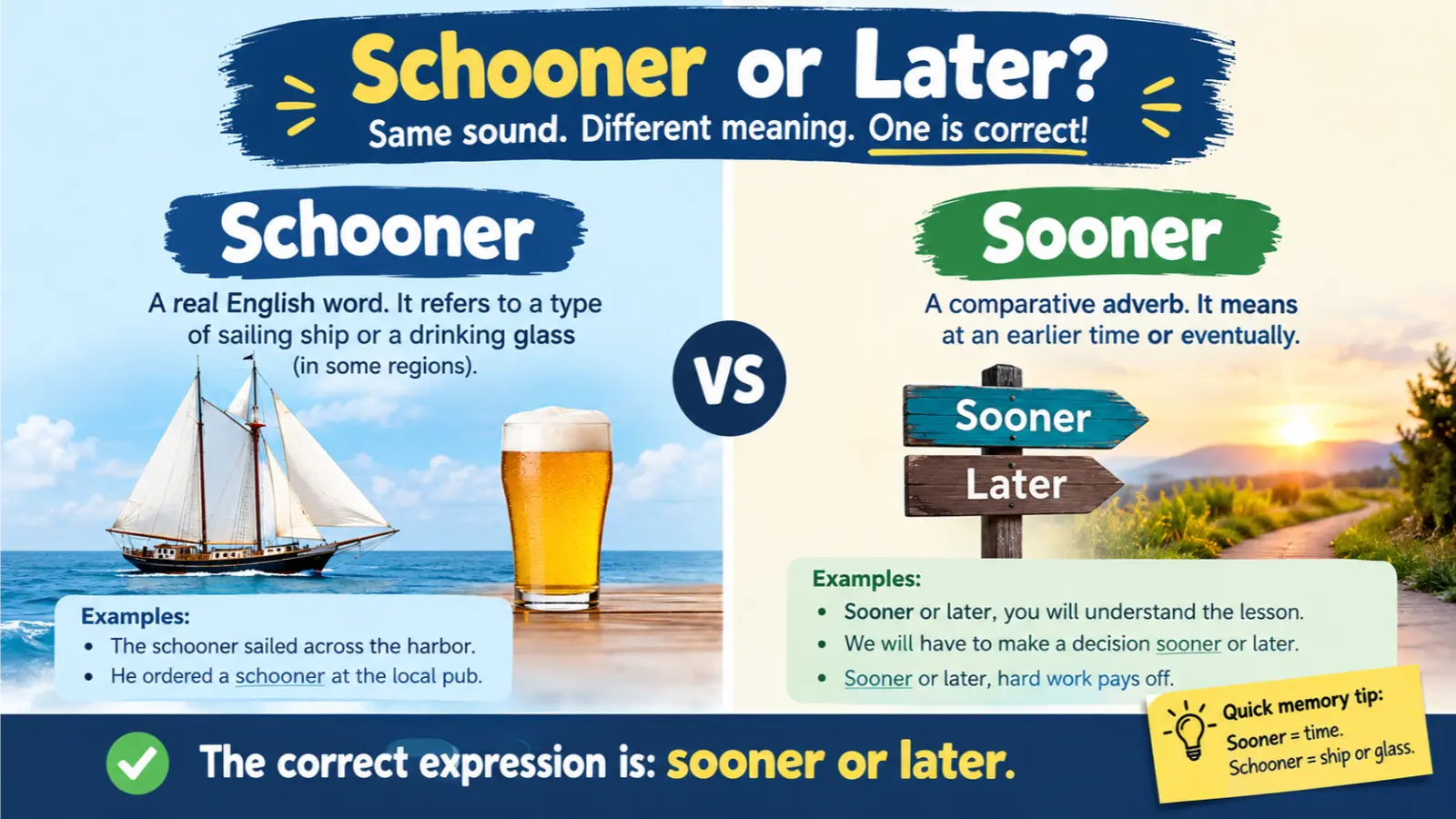
Quick Answer: Schooner or Later?
“Sooner or later” is the correct standard English expression. It means that something will happen at an unspecified time in the future, even if nobody knows exactly when.
“Schooner or later” is not the standard form of this idiom. However, writers can use it intentionally as a joke or a pun, especially when discussing sailing ships or drinking glasses.
Examples:
- Correct: Sooner or later, you will understand the lesson.
- Incorrect in standard usage: Schooner or later, you will understand the lesson.
- Playful wordplay: Schooner or later, we will sail into the sunset.
The final example deliberately uses “schooner” to create a nautical joke.
What Does “Sooner or Later” Mean?
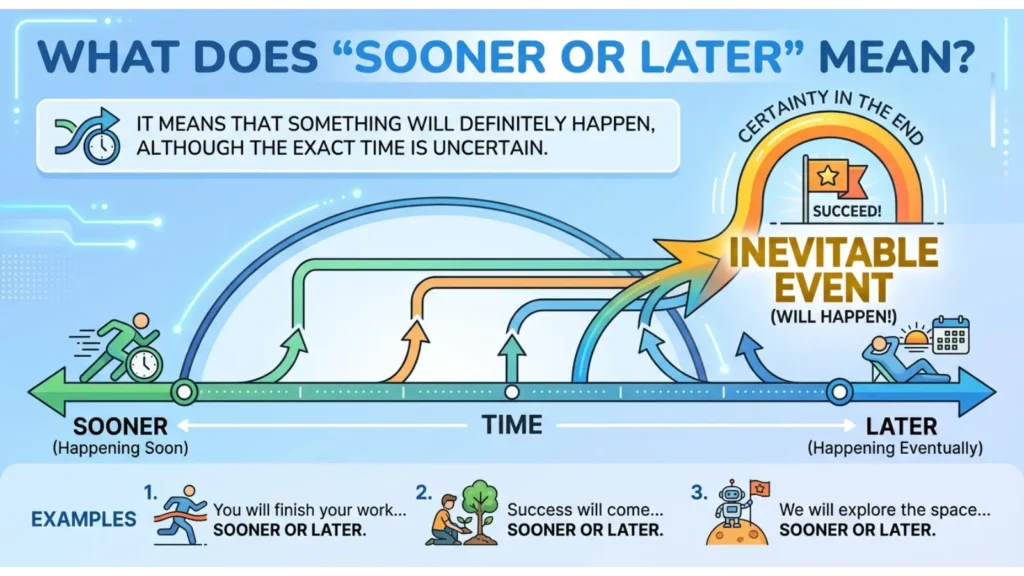
“Sooner or later” is an established English idiom that means eventually or at some point in the future. It suggests that an event is expected to happen, although its exact timing remains uncertain.
The expression works in casual conversations, academic writing, and professional communication.
Examples:
- Sooner or later, hard work can lead to better opportunities.
- You will need to replace your old computer sooner or later.
- Sooner or later, the team must make a final decision.
- Every student faces a difficult question sooner or later.
In each example, the expression points to an expected future event rather than a specific date.
What Does “Schooner” Mean?
“Schooner” is a legitimate English noun, but it does not mean eventually.
It has two common meanings:
- A type of sailing vessel, traditionally featuring two or more masts.
- A drinking glass used for certain beverages in some regions, including Australia.
Examples:
- The schooner sailed across the harbor.
- He ordered a schooner at the local pub.
Because “schooner” resembles “sooner” in sound and spelling, people sometimes confuse the two words. Nevertheless, their meanings are different.
Schooner vs. Sooner: Comparison Table
| Feature | Schooner | Sooner |
|---|---|---|
| Part of speech | Noun | Comparative adverb |
| Main meaning | A sailing vessel or a type of drinking glass | At an earlier time |
| Used in the idiom | Not in the standard expression | Yes |
| Example | The schooner crossed the bay. | We arrived sooner than expected. |
| Common phrase | A schooner sailed away. | Sooner or later |
| Professional usage | Appropriate when referring to the object | Appropriate in the established idiom |
The key distinction is simple: “schooner” names an object, while “sooner” refers to timing.
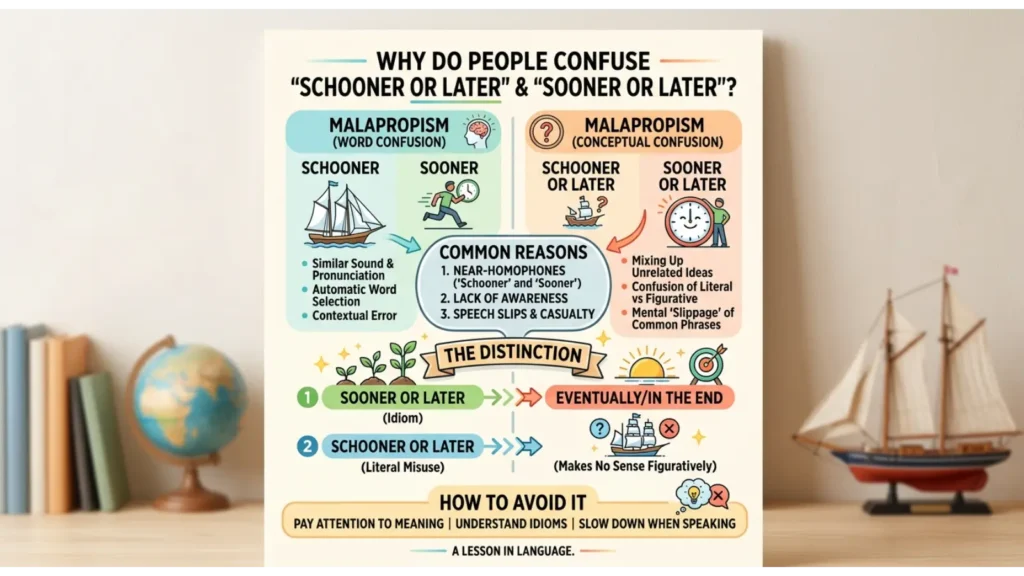
Why Do People Confuse “Schooner or Later” and “Sooner or Later”?
Several factors can cause this mistake.
Similar pronunciation
In rapid conversation, listeners may not clearly distinguish the two words. Someone unfamiliar with the spelling might write “schooner” after hearing “sooner.”
Unfamiliar vocabulary
Some English learners know the expression by sound but have not encountered it in written form. They may select a familiar-looking word without checking its meaning.
Autocorrect and typing errors
Typing mistakes and incorrect suggestions can introduce the wrong word into messages, articles, and social media posts.
Humor and wordplay
Writers sometimes replace “sooner” with “schooner” to make a sailing-related joke. This creative usage is different from an accidental spelling error.
Origin of “Sooner or Later”
The expression “sooner or later” has a long history in English. Dictionary.com records the idiom as dating back to 1577.
The phrase combines “sooner,” the comparative form of “soon,” with “later,” which refers to a subsequent time. Together, these words express the idea that something will happen at an uncertain point in the future.
For example, the sentence “Sooner or later, we must address the problem” means that dealing with the problem cannot be postponed indefinitely.
The word “schooner,” by contrast, has its own history associated with sailing vessels and other objects. Its resemblance to “sooner” does not make it an alternative spelling of the idiom.
Dictionary Recommendations and Modern Usage
Established English dictionaries recognize “sooner or later” as an idiom meaning eventually.
Cambridge Dictionary explains that the expression describes an event whose exact timing is unknown but whose occurrence is expected. Dictionary.com gives a similar definition and records the expression’s historical use.
Sources for further reading:
There is no British-versus-American spelling difference here. Both varieties use “sooner or later” for the standard expression.
For professional writing, use the established idiom unless you deliberately intend a pun or are referring to a schooner itself.
Real-Life Examples of “Sooner or Later”
The following sentences demonstrate how to use the expression naturally.
Everyday conversation
- Sooner or later, you will need to tell the truth.
- We will have to clean the garage sooner or later.
- Sooner or later, everyone makes a mistake.
School and education
- Sooner or later, students must apply what they have learned.
- You will understand this grammar rule sooner or later.
Business and professional writing
- Sooner or later, the company must update its outdated software.
- The department will need to review the policy sooner or later.
- Sooner or later, the project team must resolve the issue.
Creative writing and humor
- Sooner or later, the mystery will be solved.
- Schooner or later, the sailor knew he would return to the sea.
The second sentence is intentional wordplay rather than the standard idiom.
Common Mistakes to Avoid
Mistake 1: Writing “schooner” when you mean “sooner”
Incorrect: Schooner or later, the truth will come out.
Correct: Sooner or later, the truth will come out.
Mistake 2: Treating both expressions as interchangeable
“Schooner” and “sooner” have different meanings. Use the correct word for the intended message.
Mistake 3: Assuming “schooner or later” is always meaningless
Although it is not the standard idiom, it can work as deliberate humor in a suitable context. The important point is to distinguish creative wordplay from standard English usage.
Mistake 4: Using the wrong phrase in formal writing
In reports, academic assignments, business emails, and other professional documents, write “sooner or later” when you mean eventually.
A Simple Memory Trick
Remember this rule:
Sooner = time. Schooner = ship or glass.
If you are talking about something that will happen in the future, choose “sooner or later.”
If you are describing a sailing vessel or a drinking glass, “schooner” may be the correct word.
For example:
- Sooner or later, you will learn the difference.
- The schooner moved slowly across the water.
This simple association can help you avoid the mistake.
Frequently Asked Questions
1. Is “schooner or later” correct?
Not as the standard English idiom. The accepted expression is “sooner or later.” The alternative can be used intentionally as a pun.
2. What does “sooner or later” mean?
It means eventually or at some point in the future, without specifying exactly when something will happen.
3. Is “schooner” a real word?
Yes. A schooner can be a type of sailing vessel or a drinking glass in certain regional contexts.
4. Why do people write “schooner or later”?
They may confuse the similar-sounding words, make a typing error, or deliberately create a joke involving sailing or drinking.
5. Is “sooner or later” the same in British and American English?
Yes. The standard expression and its meaning are the same in both varieties of English.
6. Can I use “schooner or later” in a joke?
Yes. It can work as wordplay when the surrounding context makes the reference to a schooner clear. Avoid using it accidentally in formal writing.
Conclusion
The difference between “schooner or later” and “sooner or later” comes down to meaning and context. “Sooner or later” is the correct standard idiom for expressing that something will eventually happen. “Schooner” is a real word for a type of sailing vessel or, in some regions, a drinking glass.
Remember the simple rule: use “sooner or later” when discussing the future, and reserve “schooner” for its actual meaning or intentional wordplay. This distinction will help you write more accurately and confidently.