Have you ever wondered whether to write dessert or desert when talking about something sweet or a dry landscape? These two words look almost identical, but their meanings are completely different. The confusion usually comes from their similar spelling and pronunciation. However, remembering one simple spelling rule can help you choose the correct word every time.
Both spellings are correct English words. Nevertheless, dessert refers to sweet food served after a meal, while desert usually describes a dry area of land with very little rainfall. Additionally, desert can work as a verb meaning to abandon someone or something. Let’s explore their meanings, origins, pronunciation, and everyday usage.
Quick Answer: Dessert or Desert?
Both dessert and desert are correct spellings, but you cannot use them interchangeably.
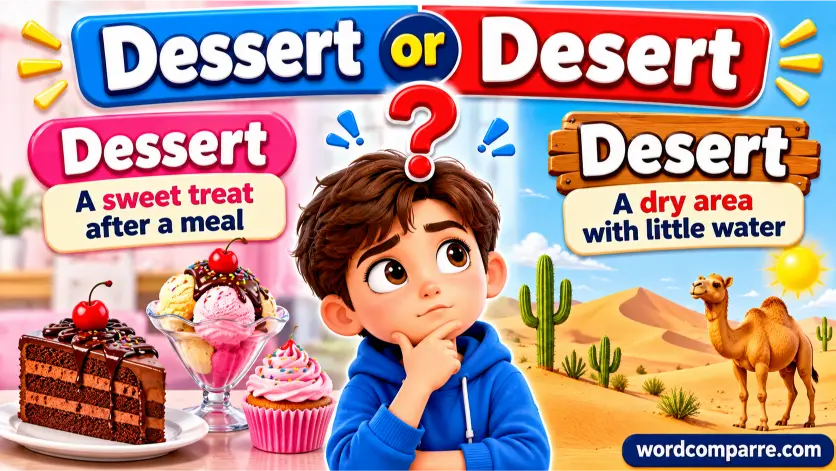
- Dessert (two S’s): A sweet dish eaten after a meal, such as cake, ice cream, or pudding.
- Desert (one S): A dry geographical area with little rainfall and limited vegetation.
- Desert (verb): To leave someone or something, especially when support or responsibility is needed.
Easy rule: Remember that dessert has two S’s because you may want two servings of something sweet!

What Does Dessert Mean?
The word dessert is a noun that describes sweet food usually served at the end of a meal. It can include cakes, pies, ice cream, cookies, puddings, and other treats.
People commonly enjoy dessert after lunch or dinner. Restaurants also use this word when offering customers something sweet after their main course.
Examples of dessert:
- Chocolate cake
- Vanilla ice cream
- Strawberry cheesecake
- Apple pie
- Chocolate pudding
- Fruit salad
- Brownies
Dessert in sentences:
- We ordered chocolate cake for dessert.
- My favorite dessert is strawberry cheesecake.
- Would you like some ice cream for dessert?
- She prepared a delicious dessert for her guests.
- The restaurant offers several desserts after dinner.
Remember to use two S’s whenever you refer to sweet food.
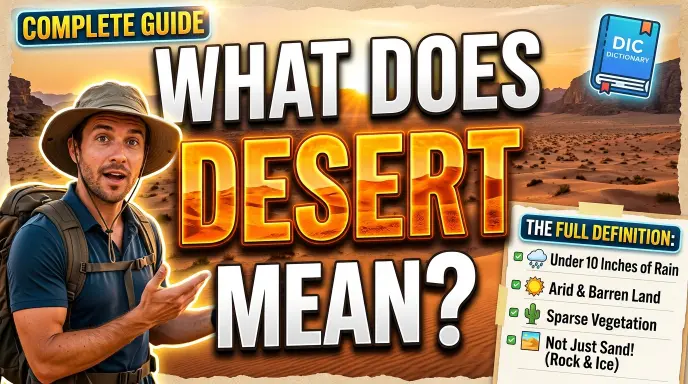
What Does Desert Mean?
The word desert has several meanings depending on how you use it in a sentence.
1. Desert as a Noun
As a noun, desert refers to a large area of land that receives very little rainfall. These environments often have limited vegetation, although some deserts support many specially adapted plants and animals.
The Sahara Desert in Africa is one of the world’s best-known examples.
Examples of desert in sentences:
- Camels can survive in harsh desert environments.
- The Sahara is a famous desert in Africa.
- Many desert animals remain active at night.
- We traveled across the desert during our vacation.
- Few plants can survive in extremely dry desert conditions.
2. Desert as a Verb
Desert can also function as a verb meaning to abandon or leave someone or something.
It often describes leaving a person, responsibility, place, or position without providing the expected support.
Examples of desert as a verb:
- He refused to desert his family.
- The soldiers were ordered not to desert their posts.
- She felt that her friends had deserted her.
- Some animals desert their habitats when conditions become difficult.
- He would never desert his responsibilities.
Notice that the spelling remains desert with one S, even when it describes the action of leaving.
Dessert vs. Desert: Main Differences
Although these words share similar letters, their meanings, pronunciation, and grammatical uses differ.
| Feature | Dessert | Desert |
|---|---|---|
| Spelling | Two S’s | One S |
| Main meaning | Sweet food | Dry region |
| Part of speech | Noun | Noun and verb |
| Pronunciation | dih-ZURT | DEZ-ert (noun) |
| Example | Chocolate dessert | Sahara Desert |
| Common use | Food and restaurants | Geography and everyday writing |
The most important distinction is the extra S in dessert. It helps you remember which word describes something sweet.
Origin and History of Dessert and Desert
Understanding the origins of these words makes their differences easier to remember.
Origin of Dessert
The word dessert entered English through French during the 16th century. It comes from the French word desservir, meaning to clear the table.
Historically, dessert referred to the course served after the main meal, when the table had been cleared. Over time, it became associated with sweet dishes such as cakes, pastries, and puddings.
This French connection explains why dessert has two S’s.
Origin of Desert
The geographical noun desert comes through French from Latin desertum, referring to an abandoned or deserted place.
The verb desert also has Latin roots and developed the meaning of abandoning or leaving someone or something.
Interestingly, another noun appears in the expression just deserts, meaning the reward or punishment someone deserves. It comes from a different historical root related to the word deserve.
Why Do People Confuse Dessert and Desert?
Many English learners and native speakers confuse these words because they look almost identical.
Here are the main reasons:
1. Similar spelling: Both words contain nearly the same letters. The only spelling difference is the additional S in dessert.
2. Similar pronunciation: Dessert and desert as a verb sound alike. However, desert as a geographical noun has a different pronunciation.
3. Different meanings: One word describes food, while the other describes a geographical environment or the action of abandoning someone.
4. Fast writing: People sometimes type quickly without checking which meaning they intend.
5. The just deserts expression: This unusual phrase creates additional confusion because deserts is pronounced like desserts but has only one S.
How Do You Pronounce Dessert and Desert?
Pronunciation is another useful way to distinguish these words.
- Dessert: dih-ZURT, with stress on the second syllable.
- Desert (noun): DEZ-ert, with stress on the first syllable.
- Desert (verb): dih-ZURT, with stress on the second syllable.
For example:
- We ate dessert after dinner.
- The desert receives very little rainfall.
- Never desert your friends when they need you.
An important detail is that dessert and the verb desert have the same pronunciation, even though their meanings and spellings differ.
What Do Major Dictionaries Say?
Major English dictionaries recognize both dessert and desert as correct words with separate meanings.
- Oxford Learner’s Dictionaries: Defines dessert as sweet food eaten at the end of a meal and distinguishes its pronunciation from the geographical noun desert.
- Cambridge Dictionary: Recognizes desert as both a noun for a dry region and a verb meaning to abandon someone or something.
- Collins Dictionary: Explains the differences between the geographical noun, the verb, and the sweet food noun.
These dictionary descriptions confirm that neither spelling is incorrect. The right choice depends on the meaning you want to communicate.

Real-Life Examples of Dessert and Desert
The following examples show how both words work in everyday English.
Examples Using Dessert
- My mother makes the best chocolate dessert.
- We had ice cream for dessert last night.
- The children wanted another serving of dessert.
- This bakery sells delicious desserts.
- She ordered a special dessert for her birthday.
- Would you like cake or pudding for dessert?
Instances Using Desert
- The desert becomes extremely hot during the day.
- Many unique plants grow in the desert.
- The Sahara Desert attracts tourists from around the world.
- The explorers crossed a dangerous desert.
- He promised never to desert his family.
- The soldiers must not desert their positions.
Examples Using Both Words
- We explored the desert and enjoyed dessert at a nearby restaurant.
- After crossing the desert, the travelers celebrated with a delicious dessert.
- The restaurant served dessert before our journey into the desert.
These sentences demonstrate why choosing the correct spelling matters.
Common Mistakes When Using Dessert and Desert
Even experienced writers sometimes confuse these words. Here are some mistakes to avoid.
Mistake 1: Using desert for sweet food
Incorrect: We ordered chocolate desert.
Correct: We ordered chocolate dessert.
Mistake 2: Using dessert for a dry region
Incorrect: Camels live in the dessert.
Correct: Camels live in the desert.
Mistake 3: Adding two S’s to the geographical noun
Incorrect: The Sahara Dessert is very large.
Correct: The Sahara Desert is very large.
Mistake 4: Confusing desert with the verb meaning abandon
Incorrect: He would never dessert his friends.
Correct: He would never desert his friends.
Mistake 5: Misspelling just deserts
Incorrect: He finally got his just desserts.
Correct: He finally got his just deserts.
The expression just deserts means receiving what someone deserves. Despite its pronunciation, it uses only one S in the middle.
Easy Memory Tricks to Remember Dessert or Desert
You do not need to memorize complicated grammar rules to remember these spellings. Try these simple tricks.
Trick 1: Two S’s for Sweet Stuff
Dessert has two S’s. Think of two servings of your favorite sweet food.
Trick 2: One S for Sand
Desert has one S. Associate it with sand, sunshine, and dry landscapes.
Trick 3: Remember the Extra Serving
When you enjoy dessert, you may want a second serving. Therefore, dessert gets an extra S.
Trick 4: Remember the Pronunciation
- DEZ-ert = Dry land.
- dih-ZURT = Sweet food or the action of abandoning someone.
These simple associations can help you avoid spelling mistakes in everyday writing.
Professional Writing: When Should You Use Dessert or Desert?
Choosing the correct spelling is important in professional communication because these words describe entirely different things.
Use Dessert When:
- Writing restaurant menus.
- Describing food recipes.
- Creating food blogs.
- Writing cooking instructions.
- Discussing meals and dining experiences.
For example: Our restaurant offers a variety of homemade desserts.
Use Desert When:
- Writing geography articles.
- Discussing climate and environments.
- Describing wildlife habitats.
- Explaining travel destinations.
- Discussing abandonment or neglected responsibilities.
For example: The research team studied wildlife in the desert.
Professional recommendation: Always check the meaning of the sentence before selecting either spelling. Use dessert for sweet food and desert for dry regions or the act of abandoning someone.
Frequently Asked Questions (FAQs)
1. Is it dessert or desert after dinner?
The correct spelling is dessert. It refers to sweet food served at the end of a meal, such as cake, ice cream, or pudding.
2. Why does dessert have two S’s?
Dessert has two S’s because of its French origin, from desservir. A useful memory trick is to associate the two S’s with two servings of something sweet.
3. Is desert ever used as a verb?
Yes. Desert can be a verb meaning to abandon or leave someone or something. For example, He refused to desert his family.
4. Are dessert and desert homophones?
Dessert and desert as a verb are homophones because they have the same pronunciation but different spellings and meanings. However, desert as a geographical noun has a different pronunciation.
5. What is the difference between dessert and dessert?
Dessert and dessert are the same word with the same spelling and meaning. If you mean the dry geographical region, the correct word is desert.
6. Is it just deserts or just desserts?
The traditional and standard expression is just deserts. It means receiving what someone deserves, whether a reward or punishment. Although it sounds like desserts, it has only one S in the middle.
7. What is the plural of dessert?
The plural of dessert is desserts. For example: The restaurant offers five different desserts.
8. What is the plural of desert?
The plural of desert is deserts. For example: Africa contains several major desert regions.
Conclusion
Choosing between dessert or desert becomes simple once you understand their meanings. Both spellings are correct, but they serve different purposes. Dessert refers to sweet food enjoyed after a meal, while desert describes a dry geographical region or means to abandon someone or something.
Remember the easiest spelling trick: Dessert has two S’s for two servings of sweets, while desert has one S for sand. With this simple rule and the examples in this guide, you can confidently use both words in everyday conversations, professional writing, and educational content.