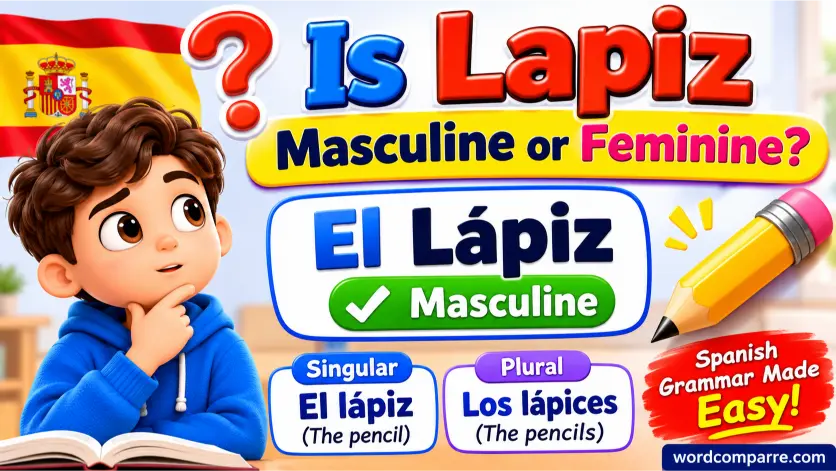
Spanish learners often wonder whether lápiz is masculine or feminine. Although English nouns do not usually have grammatical gender, Spanish assigns every noun a gender. Understanding this rule helps you choose the correct articles, adjectives, and sentence structures.
The correct answer is el lápiz because lápiz is a masculine Spanish noun. You should use masculine words such as un and el when referring to one pencil. Learning this simple rule will help you avoid common Spanish grammar mistakes and speak more naturally.
What Does Lápiz Mean in Spanish?
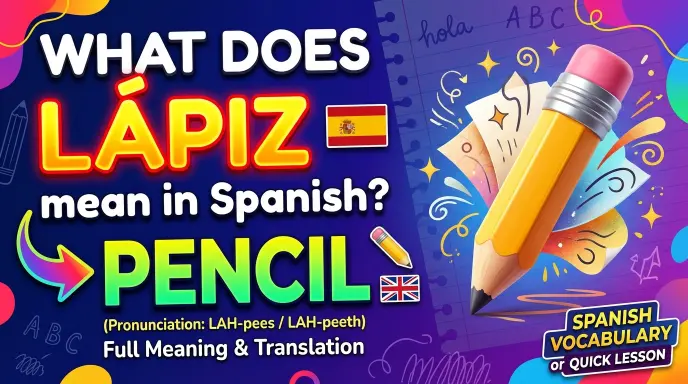
The Spanish word lápiz means pencil in English. It refers to a writing or drawing tool that usually contains graphite inside a wooden or mechanical body.
For example:
- El lápiz: The pencil.
- Un lápiz: A pencil.
- Mi lápiz: My pencil.
- Este lápiz: This pencil.
Spanish speakers use this word in schools, offices, homes, and everyday conversations.
Is Lápiz Masculine or Feminine?
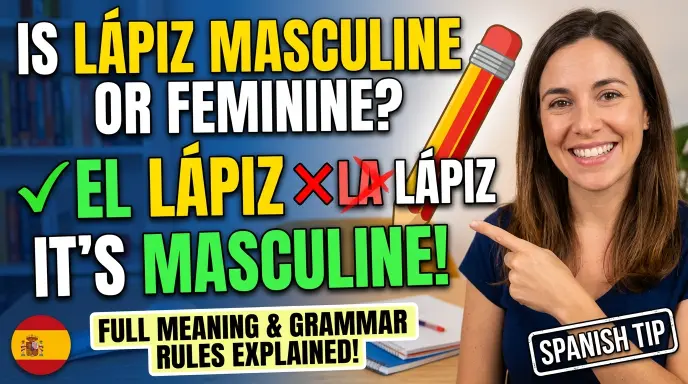
The word lápiz is masculine in Spanish. Therefore, you should use masculine articles and matching adjectives with it.
Here are the correct combinations:
| Spanish | English |
|---|---|
| El lápiz | The pencil |
| Un lápiz | A pencil |
| Mi lápiz | My pencil |
| Este lápiz | This pencil |
| El lápiz nuevo | The new pencil |
| El lápiz rojo | The red pencil |
Notice that the article el appears before lápiz. This indicates its masculine grammatical gender.
You should not use la lápiz in standard Spanish because it is grammatically incorrect.
Why Is Lápiz a Masculine Noun?
Spanish nouns have grammatical genders, which means they are classified as masculine or feminine.
Many masculine Spanish nouns end in the letter -o, while many feminine nouns end in -a. However, these are general patterns, not rules without exceptions.
The word lápiz does not follow the common masculine ending pattern because it ends in -z. Nevertheless, it is still masculine.
The important point is that you cannot determine the gender of every Spanish noun simply by looking at its last letter.
For this reason, it is helpful to learn new Spanish nouns together with their articles.
Instead of memorizing only lápiz, remember el lápiz.
How to Use El Lápiz in Spanish Sentences
Since lápiz is masculine, it takes masculine articles and adjectives. Here are some simple examples that show how to use it correctly.
- El lápiz está sobre la mesa.
The pencil is on the table. - Necesito un lápiz nuevo.
I need a new pencil. - Mi lápiz es azul.
My pencil is blue. - El lápiz es muy pequeño.
The pencil is very small. - Tengo dos lápices.
I have two pencils.
These examples demonstrate how the masculine noun works in everyday Spanish.

What Is the Difference Between Lápiz and Lápices?
The difference between lápiz and lápices is number, not gender.
- Lápiz: Singular form, meaning one pencil.
- Lápices: Plural form, meaning two or more pencils.
Spanish has a spelling rule for certain nouns ending in -z. When making these nouns plural, the letter z changes to c, followed by es.
For example:
| Singular | Plural |
|---|---|
| Lápiz | Lápices |
| Luz | Luces |
| Voz | Voces |
| Pez | Peces |
Both lápiz and lápices are masculine.
For example:
- El lápiz es bonito. (The pencil is beautiful.)
- Los lápices son bonitos. (The pencils are beautiful.)
Common Mistakes When Using Lápiz
Spanish beginners sometimes make mistakes when choosing articles or changing singular nouns into plural forms.
Here are the mistakes you should avoid:
1. Using La Instead of El
Incorrect: La lápiz es bonito.
Correct: El lápiz es bonito.
Explanation: Lápiz is masculine, so it requires the masculine article el.
2. Using Un Instead of Una Correctly
Incorrect: Una lápiz.
Correct: Un lápiz.
Explanation: The masculine indefinite article un must accompany this noun.
3. Creating the Wrong Plural
Incorrect: Lápizes.
Correct: Lápices.
Explanation: The final z changes to c before adding es.
4. Forgetting Adjective Agreement
Incorrect: El lápiz roja.
Correct: El lápiz rojo.
Explanation: The adjective must agree with the masculine noun.

Is Lápiz Used Differently in Formal and Informal Spanish?
The grammatical gender of lápiz never changes between formal and informal Spanish.
However, the surrounding vocabulary can change depending on the situation.
Formal Spanish:
¿Podría prestarme un lápiz, por favor?
Could you lend me a pencil, please?
Informal Spanish:
¿Me prestas un lápiz?
Can you lend me a pencil?
Both sentences use lápiz as a masculine noun. The difference is the level of politeness and sentence structure.
Easy Tricks to Remember That Lápiz Is Masculine
Remembering Spanish noun genders can feel challenging, especially when a noun does not follow common spelling patterns.
Try these simple memory tricks:
- Memorize el lápiz instead of learning the word alone.
- Associate lápiz with the masculine article el.
- Remember that its plural is los lápices.
- Practice using masculine adjectives such as rojo, nuevo, and pequeño.
A useful trick is to repeat this phrase: El lápiz, un lápiz, los lápices.
This small practice can make the correct gender easier to remember.

Real-Life Spanish Conversations Using Lápiz
Here are two short conversations that show how Spanish speakers use this word naturally.
Conversation 1: At School
Student: ¿Tienes un lápiz?
Do you have a pencil?
Friend: Sí, aquí tienes un lápiz.
Yes, here is a pencil.
Student: ¡Gracias!
Thank you!
Conversation 2: In an Office
Employee: ¿Dónde está mi lápiz?
Where is my pencil?
Colleague: Está sobre la mesa.
It is on the table.
Employee: Perfecto, gracias.
Perfect, thank you.
These conversations demonstrate how lápiz appears in everyday situations.
Frequently Asked Questions
1. Is lápiz masculine or feminine in Spanish?
Lápiz is masculine. The correct article is el, so you should say el lápiz rather than la lápiz.
2. Do you say el lápiz or la lápiz?
You say el lápiz. It is a masculine noun, so the masculine definite article is required.
3. What is the plural of lápiz?
The plural is lápices. Spanish changes the final z to c and adds es.
4. Is un lápiz grammatically correct?
Yes. Un lápiz means a pencil and uses the correct masculine indefinite article.
5. Why does lápiz end in z if it is masculine?
Spanish noun gender does not depend entirely on the final letter. Although many masculine nouns end in -o, lápiz is an exception to that common pattern.
6. Is lápices masculine or feminine?
Lápices is masculine. It is simply the plural form of the masculine noun lápiz.
7. Does the gender of lápiz change in formal Spanish?
No. Its grammatical gender remains masculine in both formal and informal Spanish.
Conclusion
So, is lápiz masculine or feminine? The answer is simple: lápiz is masculine in Spanish. You should always use el lápiz for the singular form and los lápices for the plural form.
Although the word ends in -z rather than the common masculine ending -o, its grammatical gender remains masculine. Remembering the phrase el lápiz will help you use the correct articles, adjectives, and sentence structures in everyday Spanish.