Have you ever wondered whether to write pickup or pick up? Both forms are correct in English, but they have different meanings and grammatical roles. “Pickup” is generally used as a noun or adjective, while “pick up” is a phrasal verb that describes an action.
Understanding the difference between pickup and pick up can help you avoid common writing mistakes and communicate more clearly. Whether you are writing an email, completing a school assignment, or sending a text message, knowing when to use each form makes your English more accurate. You can also use the copy button on our website to copy your favorite examples and save them for future reference.
What Is the Main Difference Between Pickup and Pick Up?
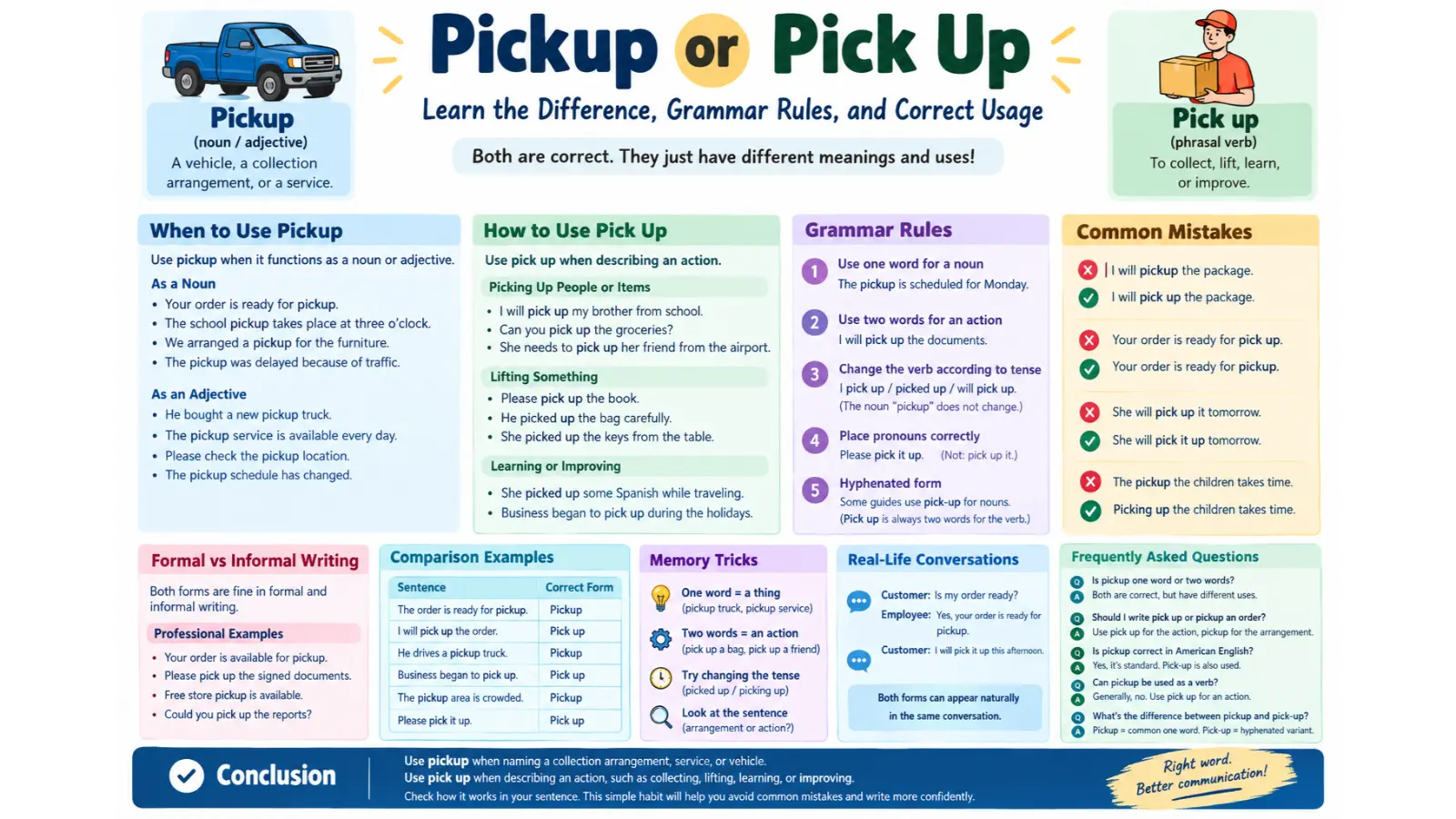
The main difference between pickup and pick up is their function in a sentence. Although they sound the same, they are not interchangeable in standard English writing.
Pickup is usually a noun that refers to collecting someone or something, a collection arrangement, or a type of vehicle. It can also work as an adjective before another noun.
Pick up is a phrasal verb that describes an action. It can mean collecting someone, lifting something, learning a skill, or improving in speed or activity.
Here are some examples.
- My order is ready for pickup.
- I will pick up my order after work.
- He drives a pickup truck.
- Business usually begins to pick up during the holidays.
In the first and third examples, “pickup” functions as a noun or adjective. In the second and fourth examples, “pick up” expresses an action or change.
When Should You Use Pickup as One Word?
Use “pickup” as one word when it functions as a noun or adjective. It commonly appears in conversations about shopping, transportation, deliveries, and collection services.
Pickup as a Noun
A noun names a person, place, thing, or idea. “Pickup” can refer to the process or arrangement of collecting something.
Examples include:
- Your order is ready for pickup.
- The school pickup takes place at three o’clock.
- We arranged a pickup for the old furniture.
- The package pickup was delayed because of traffic.
- The store offers free pickup.
In each sentence, “pickup” names an activity, arrangement, or service rather than describing an action performed by a subject.
Pickup as an Adjective
An adjective describes a noun. “Pickup” can appear before another noun to identify its purpose or type.
Examples include:
- He bought a new pickup truck.
- The pickup service is available every day.
- Please check the pickup location.
- The pickup schedule has changed.
- We received a pickup confirmation.
Expert insight: When “pickup” identifies a service, arrangement, or type of vehicle, the one word form is generally appropriate. Check the noun that follows it to see whether “pickup” describes that noun.
How Do You Use Pick Up as a Phrasal Verb?
Use “pick up” when describing an action. This phrasal verb has several meanings, so its exact meaning depends on the context.
Picking Up People or Items
The most common meaning is to collect a person or item from a particular place.
Examples include:
- I will pick up my brother from school.
- Can you pick up the groceries?
- She needs to pick up her friend from the airport.
- Please pick up your package tomorrow.
- We picked up our guests after lunch.
Lifting Something
“Pick up” can also mean lifting something from a surface or the ground.
Examples include:
- Please pick up the book.
- He picked up the bag carefully.
- She picked up the keys from the table.
- The child tried to pick up the toy.
- Pick up your clothes before leaving the room.
Learning Something New
This expression can describe learning a skill, language, or habit through practice or experience.
Examples include:
- She picked up some Spanish while traveling.
- I picked up a few useful computer skills.
- He picked up the rules very quickly.
- They picked up new techniques at work.
Improving or Becoming Stronger
“Pick up” can describe an increase in activity, speed, business, or intensity.
Examples include:
- Business began to pick up in December.
- The wind started to pick up in the evening.
- Sales usually pick up before the holidays.
- The pace of the game began to pick up.
Expert insight: A phrasal verb usually describes what someone or something does. If you can replace the expression with an action such as collect, lift, learn, or improve, “pick up” may be the correct choice.
What Grammar Rules Help You Choose the Correct Form?
You can select the correct form by checking how the word functions in the sentence. These simple grammar rules make the distinction easier to remember.
Rule One: Use Pickup for a Noun
When you are naming a collection arrangement or service, use “pickup.”
Correct: The pickup is scheduled for Monday.
Incorrect: The pick up is scheduled for Monday.
In the correct sentence, “pickup” names an arrangement.
Rule Two: Use Pick Up for an Action
When someone performs the action of collecting or lifting something, use “pick up.”
Correct: I will pick up the documents on Monday.
Incorrect: I will pickup the documents on Monday.
The sentence describes an action, so the two word phrasal verb is needed.
Rule Three: Change the Verb According to Tense
The phrasal verb changes according to the tense of the sentence.
- Present tense: I pick up my mail every morning.
- Past tense: I picked up my mail yesterday.
- Future tense: I will pick up my mail tomorrow.
- Present continuous: I am picking up my mail now.
By comparison, the noun “pickup” does not change in the same way.
- The pickup is scheduled for today.
- The pickup was delayed yesterday.
- The pickup will take place tomorrow.
Rule Four: Place Pronouns Correctly
When a phrasal verb has a pronoun as its object, the pronoun normally goes between “pick” and “up.”
Correct: Please pick it up.
Incorrect: Please pick up it.
The same rule applies to other pronouns.
- I will pick them up after school.
- She picked him up from the station.
- Can you pick her up at six?
Rule Five: Recognize the Hyphenated Form
Some dictionaries, publishers, and style guides use “pick-up” as a noun or adjective. However, “pickup” is widely used as the standard one word spelling for these roles, particularly in American English.
For the phrasal verb, write “pick up” as two separate words.
Is Pickup or Pick Up Better in Formal Writing?
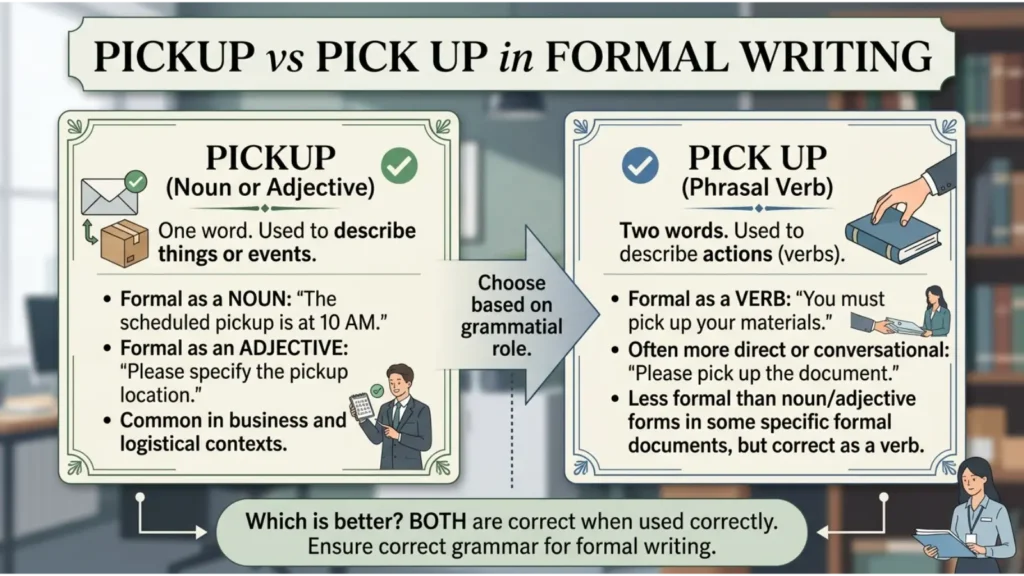
Both forms are suitable for formal and informal writing when used correctly. The choice depends on grammatical function rather than the level of formality.
In professional emails, business documents, and customer service messages, use “pickup” for a collection arrangement and “pick up” for an action.
Examples in Professional Communication
Business email
Your order is ready for pickup at our warehouse.
Work instruction
Please pick up the signed documents before the meeting.
Customer service message
Free store pickup is available for eligible orders.
Office conversation
Could you pick up the printed reports from reception?
Delivery notice
The package pickup has been rescheduled for Friday.
These examples demonstrate how both forms can appear in professional communication without sounding awkward or incorrect.
What Common Mistakes Should You Avoid?
Writers often confuse pickup and pick up because the expressions sound identical when spoken. The following mistakes are easy to correct once you understand their grammatical roles.
Mistake One: Using Pickup as a Verb
Incorrect: I will pickup the package after work.
Correct: I will pick up the package after work.
The sentence describes collecting a package, so the phrasal verb is necessary.
Mistake Two: Using Pick Up as a Noun
Less standard in American English: Your order is ready for pick up.
Preferred: Your order is ready for pickup.
The one word form is commonly used as a noun in American English. Follow your publication’s style guide if it prefers “pick-up.”
Mistake Three: Placing a Pronoun Incorrectly
Incorrect: She will pick up it tomorrow.
Correct: She will pick it up tomorrow.
When the object is a pronoun, place it between the verb and particle.
Mistake Four: Confusing a Noun With an Action
Incorrect: The pickup the children takes too long.
Correct: Picking up the children takes too long.
The corrected sentence uses “picking up” as a gerund phrase functioning as the subject.
Mistake Five: Assuming Both Forms Mean Exactly the Same Thing
Incorrect: The driver will pickup the customer at noon.
Correct: The driver will pick up the customer at noon.
The verb phrase describes the driver’s action. The noun “pickup” cannot normally replace it in this sentence.
Expert insight: Read the complete sentence instead of judging the spelling in isolation. Ask whether the expression names an arrangement or describes an action. This quick check prevents most pickup and pick up mistakes.
Pickup vs Pick Up: Comparison Examples
The following examples show how each form works in everyday English.
| Example sentence | Correct form | Explanation |
|---|---|---|
| The order is ready for pickup. | Pickup | Names a collection arrangement. |
| I will pick up the order. | Pick up | Describes an action. |
| He drives a pickup truck. | Pickup | Identifies a type of vehicle. |
| Business began to pick up. | Pick up | Describes an improvement. |
| The pickup area is crowded. | Pickup | Modifies the noun “area.” |
| Please pick it up. | Pick up | Uses a phrasal verb with a pronoun. |
| We arranged a furniture pickup. | Pickup | Names a collection service. |
| She picked up a new skill. | Pick up | Describes learning something. |
| The pickup was delayed. | Pickup | Names an arrangement. |
| Can you pick up my brother? | Pick up | Describes collecting someone. |
What Memory Tricks Make the Difference Easier?
Remembering a few simple patterns can help you choose the correct spelling without consulting a dictionary every time.
- One word means a thing: Think of a pickup truck or a scheduled pickup.
- Two words describe an action: Think of picking up a bag or picking up a friend.
- Try changing the tense: If you can write “picked up” or “picking up,” you are using the verb phrase.
- Look at the sentence structure: Ask whether the expression names an arrangement or describes what someone does.
- Practice with familiar situations: Use examples from shopping, school transportation, deliveries, and everyday conversations.
For example, “The pickup is late” names an arrangement. “The driver will pick up the order” describes an action.

How Do People Use Pickup and Pick Up in Real Conversations?
Everyday conversations make the difference between these forms easier to understand. Notice how both can appear naturally in the same discussion.
Conversation One: Collecting an Order
Customer: Is my order ready?
Employee: Yes, your order is ready for pickup.
Customer: Great. I will pick it up this afternoon.
The employee uses “pickup” as a noun. The customer uses “pick it up” as a phrasal verb.
Conversation Two: School Transportation
Parent: Who will pick up the children today?
Partner: I will pick them up after work.
Parent: Thanks. The school pickup area gets crowded around three o’clock.
The first two sentences describe an action. The final sentence uses “pickup” to describe an area associated with collection.
Conversation Three: Workplace Communication
Manager: Can you pick up the documents from reception?
Employee: Sure. Is the pickup scheduled for this morning?
Manager: Yes, please collect them before the meeting.
This conversation shows the two forms serving different grammatical purposes in the same discussion.
Conversation Four: Shopping and Delivery
Customer: Do you offer pickup for online orders?
Store employee: Yes, you can pick up your order after receiving the confirmation email.
Customer: Perfect. I will come by this evening.
Here, “pickup” refers to the service, while “pick up” describes the customer’s action.
Frequently Asked Questions About Pickup or Pick Up
Is Pickup One Word or Two Words?
Both forms are correct, but they serve different grammatical purposes. “Pickup” is usually a noun or adjective, while “pick up” is a phrasal verb that describes an action.
Should I Write Pick Up or Pickup an Order?
Write “pick up” when describing the action of collecting an order. For example, “I will pick up my order today.” Use “pickup” when referring to the collection arrangement, as in “My order is ready for pickup.”
Is Pickup Correct in American English?
Yes. “Pickup” is standard American English when used as a noun or adjective. “Pick up” is the correct spelling of the phrasal verb. Some publications also use the hyphenated noun form “pick-up.”
Can Pickup Be Used as a Verb?
In standard English, “pickup” is generally not written as a single word verb. Use “pick up” when describing an action, such as collecting a package, lifting an object, or learning a new skill.
What Is the Difference Between Pickup and Pick-Up?
“Pickup” is the common one word spelling for the noun or adjective. “Pick-up” is a hyphenated variant used by some dictionaries and style guides. “Pick up” is the standard spelling of the phrasal verb.
Conclusion
The difference between pickup and pick up becomes simple once you understand their grammatical roles. Use “pickup” when naming a collection arrangement, service, or vehicle. Use “pick up” when describing an action, such as collecting a package, lifting an object, learning a skill, or improving.
Before choosing a form, check how it works in your sentence. This small habit will help you avoid common spelling mistakes and write more confidently in everyday conversations, academic assignments, and professional communication.