Have you ever wondered whether to write theater or theatre? Both spellings are correct, but the preferred choice depends on the type of English you are using.
This difference often confuses students, writers, and people learning English as a second language.
The good news is that you do not need to memorize two different meanings. In most situations, both words refer to a place where people watch performances or to the art of performing plays.
Understanding regional spelling conventions will help you choose the right form for your audience.
Quick Answer:
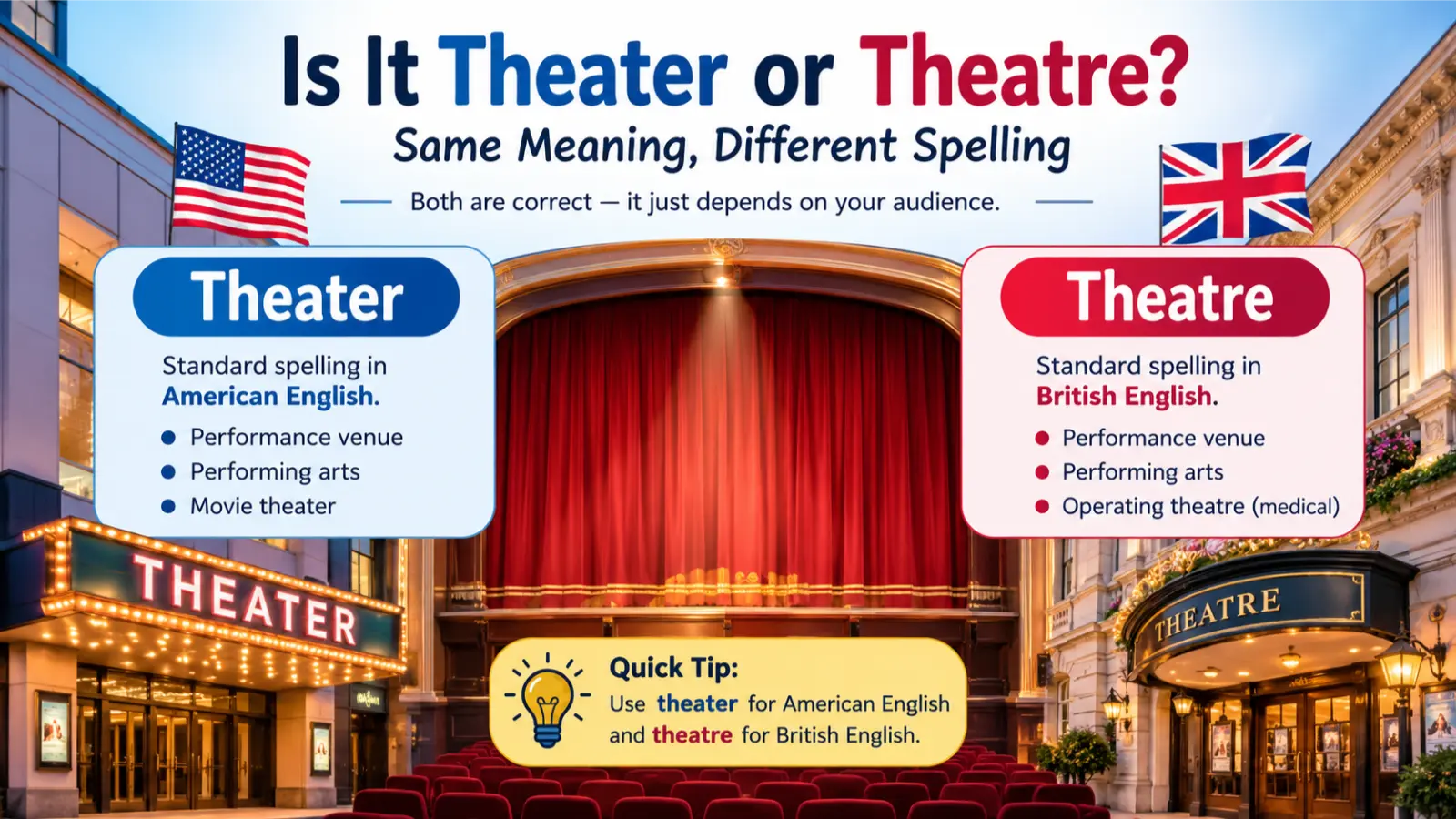
Theater is the standard spelling in American English, while theatre is the standard spelling in British English. Both words are correct, and neither is universally wrong.
- Use theater when writing for a primarily American audience.
- Use theatre when following British English conventions.
- Follow the official spelling when referring to a theater, theater company, or institution by name.
For example, an American writer would usually write, “We went to the movie theater.” A British writer would generally write, “We went to the theatre.”
What Does Theater Mean?
The word theater is a noun that describes a building or venue where people watch plays, musicals, and other performances. In American English, it also commonly refers to a cinema where people watch films.
The word can also describe the performing arts, including acting, directing, and producing stage performances.
Examples of theater in American English:
- We visited the theater to watch a new musical.
- My sister studies theater at college.
- The movie theater opens at noon.
- He has worked in community theater for five years.
In each sentence, theater follows standard American spelling conventions.
What Does Theatre Mean?
Theatre has the same core meanings as theater. It is the preferred spelling in British English and is also widely used in other English-speaking countries, including Australia and New Zealand.
The word can refer to a performance venue, the art of presenting plays, or theatrical activity more broadly. In British medical English, an operating theatre is also a room where surgical procedures take place.
Examples of theatre in British English:
- We booked tickets for the theatre.
- She wants to study theatre at university.
- The theatre is presenting a new production.
- The patient was taken to the operating theatre.
These examples demonstrate how the spelling fits British English usage.
Theater vs. Theatre: Comparison Table
| Feature | Theater | Theatre |
|---|---|---|
| Standard spelling | American English | British English |
| Main meaning | Venue or performing arts | Venue or performing arts |
| Movie venue | Movie theater | Theatre or, more commonly, cinema |
| Academic subject | Theater studies | Theatre studies |
| Common adjective | Theatrical | Theatrical |
| Plural form | Theaters | Theatres |
| Correctness | Correct | Correct |
The key difference is regional spelling, not a fundamental difference in meaning. However, the words may appear in official names according to the institution’s chosen spelling.
What Is the Origin of Theater and Theatre?
Both spellings have a long history. The word traces back to the Ancient Greek theatron, meaning a place for viewing. It passed through Latin theatrum and French before becoming established in English.
Historically, English writers used variations of the spelling. Over time, the ending -er became standard in American English, while -re remained the preferred form in British English.
This pattern appears in several other English words, including center and centre, as well as meter and metre. These regional differences developed through changes in spelling preferences and the standardization of dictionaries and educational materials.
Why Do People Confuse Theater and Theatre?
Several reasons explain why writers often hesitate between these spellings.
Different English varieties
American and British English use different spelling conventions. A person who reads American books but studies British English may encounter both forms regularly.
Online content reaches international readers
Websites, social media posts, and online courses often combine American and British spellings. Readers may see theater in one article and theatre in another.
Both spellings are correct
Unlike a simple spelling mistake, this comparison involves two accepted forms. Neither word should automatically be marked incorrect without considering the intended variety of English.
Institutional names use individual preferences
Some American venues and performing arts organizations use Theatre in their official names. Their spelling may reflect tradition, branding, or organizational preference rather than a general spelling rule.
What Do Dictionaries Recommend?
Major dictionaries recognize both forms while identifying their regional preferences.
- Cambridge Dictionary: Identifies theater as the US spelling of theatre and documents the meanings of both forms.
- American English dictionaries: Generally prefer theater while recognizing theatre as a variant in some contexts.
- British English dictionaries: Generally use theatre as the standard British spelling.
The practical lesson is simple: choose the spelling that matches your audience and follow it consistently. A dictionary’s regional label helps explain which form is preferred; it does not mean the alternative is always incorrect.
Theater or Theatre in Real-Life Examples
The following examples show how to use each spelling naturally.
Examples using theater
- The theater is showing a popular new film.
- He hopes to become a theater director.
- Our school has a theater club.
- The city plans to build a larger movie theater.
- She enjoys studying American theater history.
Examples using theatre
- We watched a comedy at the theatre.
- The theatre company announced its next production.
- My cousin enjoys studying British theatre.
- The new theatre will open next spring.
- The hospital has a modern operating theatre.
Comparing both spellings
American English: The theater is hosting a musical this weekend.
British English: The theatre is hosting a musical this weekend.
Both sentences are grammatically correct. The spelling changes to match the preferred regional convention, while the main meaning remains the same.
Common Mistakes to Avoid
Even though both spellings are correct, writers can still make mistakes when choosing between them.
Treating theatre as universally incorrect in American English
Theatre appears in American English, particularly in proper names and some performing arts contexts. Do not automatically change it when it belongs to an official name.
Assuming the words always have different meanings
Some writers claim that theater means a building and theatre means the art form. This is not a reliable general rule. Both spellings can describe a venue or the performing arts.
Mixing regional spellings unnecessarily
Using theater in one paragraph and theatre in another can make an article look inconsistent when no special reason exists for the change.
Changing official names
If a venue is officially called the Royal Theatre, retain that spelling even if the rest of an American article uses theater.
Forgetting the plural forms
The plural of theater is theaters. The plural of theatre is theatres. Match the plural ending to the spelling you have chosen.
How to Remember Theater vs. Theatre
A simple memory trick can help you choose the correct spelling.
American English = theater. Remember the ending -er, as in the American spelling center.
British English = theatre. Remember the ending -re, as in the British spelling centre.
You can also remember this sentence: “Americans visit the theater, while British audiences often visit the theatre.”
This is a general guide rather than an absolute rule for every organization or country.
Which Spelling Should You Use in Professional Writing?
The best spelling depends on your readers, publication standards, and the purpose of your writing.
For American audiences: Use theater in articles, academic assignments, business documents, and general website content unless an official name requires another spelling.
About British audiences: Use theatre when writing essays, reports, website articles, and other professional material that follows British English.
For international websites: Choose one primary English variety and apply it consistently. If your website targets American readers, use American spelling throughout. If it targets British readers, follow British conventions.
For names and quotations: Preserve the spelling used by the organization or original source. Do not change a proper name merely to make it match your preferred style.
Consistency improves readability and helps establish a clear editorial style.
Frequently Asked Questions
Is theater or theatre correct?
Both are correct. Theater is the standard American spelling, while theatre is the standard British spelling.
Is theatre British or American English?
Theatre is the standard British English spelling. It also appears in American English, particularly in the official names of certain venues and arts organizations.
Do theater and theatre have different meanings?
Generally, no. Both words can refer to a performance venue or the performing arts. In British English, operating theatre also refers to a room used for surgery.
How do you spell theater in the USA?
In the United States, the usual spelling is theater. The plural form is theaters.
How do you spell theatre in the UK?
In the United Kingdom, the standard spelling is theatre. Its plural form is theatres.
Which spelling should I use for SEO content?
Choose the spelling that matches your target audience and the search phrase you are addressing. For American readers, theater is generally the better choice. For British readers, use theatre. Keep the spelling consistent throughout your article.
Conclusion
The choice between theater and theatre comes down mainly to regional spelling conventions. Both forms are correct and usually share the same meaning. American English generally favors theater, while British English favors theatre.
When writing an article, school assignment, or professional document, consider your audience and follow the appropriate style consistently. Remember the simple distinction: theater for American English and theatre for British English. With this rule in mind, you can use either spelling confidently and avoid unnecessary spelling mistakes.

Alex Wordsmith is a comparison research writer and content specialist at WordComparre.com. He focuses on analyzing word meanings, spelling variations, grammar distinctions, and language usage to help readers make informed writing choices. Through clear explanations and practical examples, Alex simplifies complex language topics for students, writers, and professionals. His goal is to make English learning easier, more accurate, and accessible for everyone.