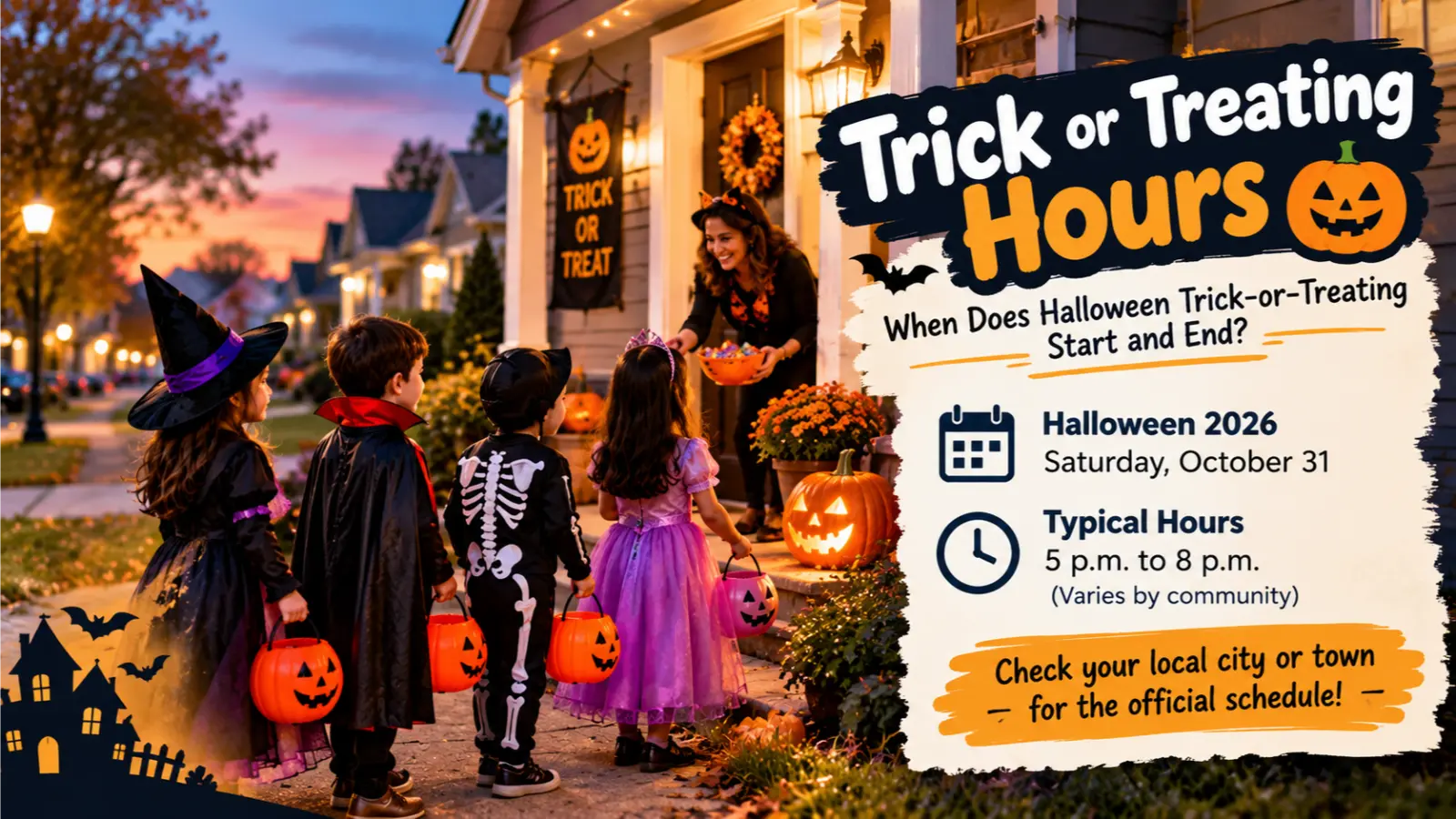
Trick or treating hours help families plan a fun and safe Halloween evening. Parents often want to know when children should start collecting candy, how late they can visit homes, and whether their community has an official schedule. In the United States, trick-or-treating commonly takes place during the early evening, but the exact times depend on local traditions and community announcements.
In 2026, Halloween falls on Saturday, October 31. Some communities have already announced their schedules, while others may publish their hours closer to the holiday. The best way to find the correct trick or treating hours is to check your city’s official announcement before leaving home.
Quick Answer:
Many American communities schedule trick-or-treating between 5 p.m. and 8 p.m., although some begin earlier or finish later. A common schedule is 6 p.m. to 8 p.m., but this is not a nationwide rule.
For Halloween 2026, the Town of Normal, Illinois, has announced hours from 5 p.m. to 8 p.m. Urbana, Illinois, and nearby Champaign County communities have announced hours from 5 p.m. to 7 p.m. on Saturday, October 31. These examples show why families should check their own local schedules.
What Time Does Trick-or-Treating Start?
Trick-or-treating often begins in the late afternoon or early evening. Many families wait until around sunset, when neighborhood decorations and illuminated porches create a festive Halloween atmosphere.
The official starting time can vary according to local customs, daylight, community events, and the ages of participating children. Families with younger children may prefer to begin as soon as the announced hours open.
Before planning your route, check your city or town website, local police department announcements, or neighborhood community pages.
What Time Does Trick-or-Treating End?
In many communities, trick-or-treating ends between 7 p.m. and 9 p.m. Some towns finish earlier, while others allow a longer evening.
The published end time is the most useful guide. Children should respect residents’ preferences and avoid knocking on doors late at night, especially when the household is not displaying signs that it welcomes trick-or-treaters.
If your town has no official schedule, ask neighbors about local customs and plan to finish at a reasonable hour.
Trick-or-Treating Hours for Halloween 2026
Halloween takes place every year on October 31, but the permitted or recommended trick-or-treating window can change from one community to another.
Here are two confirmed examples for 2026:
| Community | Date | Announced hours |
|---|---|---|
| Normal, Illinois | Saturday, October 31, 2026 | 5 p.m. to 8 p.m. |
| Urbana, Illinois, and Champaign County | Saturday, October 31, 2026 | 5 p.m. to 7 p.m. |
These schedules are specific to the communities listed above. They do not apply to every city in Illinois or the United States.
To find your area’s hours, visit the official website of your city or township. You can also check announcements from local law enforcement or community organizations.
How to Find Trick-or-Treating Hours Near You
Finding your local schedule is straightforward when you know where to look.
- Visit your city website. Search for Halloween announcements or official trick-or-treating hours.
- Check local police updates. Police departments sometimes share recommended hours and pedestrian safety reminders.
- Search your neighborhood group. Homeowners associations and community groups may announce local activities.
- Look for official event listings. Libraries, recreation departments, schools, and community centers may publish Halloween events.
- Confirm the date and time. Some communities hold special celebrations on a date other than October 31.
Avoid relying only on a schedule from another city. A nearby town may follow a different timetable, even when both communities celebrate Halloween on the same evening.
Does Every City Have Official Trick-or-Treating Hours?
No. Some local governments publish recommended hours, while others leave the schedule to residents and neighborhood traditions.
An announced time may serve as guidance rather than a legally enforced restriction. However, some communities have specific local rules, so it is important to check the requirements where you live.
If your city does not publish official hours, ask local residents or check established neighborhood announcements. When no schedule is available, early evening is often a practical starting point, provided residents are welcoming visitors.
What Is the Best Time for Young Children to Go Trick-or-Treating?
For toddlers and younger children, the beginning of the local trick-or-treating window is often the most convenient choice. Starting early can provide more daylight, reduce the length of the outing, and make it easier to return home before bedtime.
Parents can choose a short route with familiar neighbors rather than trying to visit every house. A comfortable costume, suitable footwear, and a lightweight candy bag can also make the experience easier for little ones.
Older children may prefer a longer route, but parents should agree on boundaries, supervision, and a return time before the outing begins.
Trick-or-Treating Safety Tips for Families
Halloween can bring extra foot traffic to residential streets. A little preparation helps children enjoy the evening while reducing common risks.
- Stay visible. Use reflective details on costumes and bags, or carry a flashlight or glow stick.
- Use sidewalks and crosswalks. Look both ways and watch for turning vehicles.
- Go with a trusted group. Young children should remain with a responsible adult.
- Visit welcoming homes. Look for a lit porch or another clear sign that residents are participating.
- Never enter an unfamiliar home. Collect treats from the doorway unless you are visiting someone you know and trust.
- Inspect candy at home. Have an adult check treats before children eat them.
- Follow local instructions. Pay attention to community guidance and any applicable rules.
The National Highway Traffic Safety Administration also advises drivers to slow down and watch carefully for children during Halloween festivities.
Why Are Trick-or-Treating Hours Different From One Place to Another?
Several factors influence local schedules. Communities may consider sunset, traffic patterns, school-night routines, neighborhood traditions, and planned Halloween events.
A town may choose an earlier schedule to accommodate younger children, while another may offer a longer window because Halloween falls on a weekend. Local officials may also coordinate their announcements with nearby communities to help families plan.
These differences explain why there is no single time that applies to every American neighborhood.
What Does “Trick-or-Treating Hours” Mean?
The phrase “trick-or-treating hours” refers to the period when children and families are expected or encouraged to visit participating homes for Halloween candy.
The phrase is commonly used in community announcements, local news stories, and online searches. It can refer to officially announced municipal hours, recommended visiting times, or the customary period when residents hand out candy.
“Trick-or-treating” describes the activity, while “hours” identifies the time period. The expression is correct and natural in everyday American English.
Common Mistakes When Checking Halloween Hours
Families can avoid confusion by watching for a few common errors.
- Assuming every city follows the same schedule. Local times vary, so verify the announcement for your own area.
- Using an outdated listing. An old schedule may not apply to the current year.
- Confusing a community event with neighborhood hours. A trunk-or-treat event may have different opening and closing times.
- Ignoring a date change. Some communities hold Halloween activities before October 31.
- Waiting until the last minute. Checking early gives families more time to prepare costumes and routes.
Always confirm the year, date, location, and published time before making plans.
Frequently Asked Questions
1. What time does trick-or-treating usually start?
Trick-or-treating often starts between 5 p.m. and 6 p.m., but the exact time depends on the local community. Check your city’s announcement for the correct starting time.
2. What time does trick-or-treating usually end?
Many communities finish between 7 p.m. and 9 p.m. However, some have earlier closing times or longer schedules. Follow your local guidance.
3. What day is trick-or-treating in 2026?
Halloween falls on Saturday, October 31, 2026. Some communities may schedule separate Halloween events on other dates, so confirm your local calendar.
4. Are trick-or-treating hours the same in every state?
No. There is no single nationwide schedule. Hours can differ between cities, towns, and neighborhoods within the same state.
5. How can I find trick-or-treating hours near me?
Check your local government’s website, police department announcements, neighborhood association, or community event calendar. Search for the current year’s schedule rather than relying on an older listing.
6. Can children go trick-or-treating before sunset?
That depends on local hours and community customs. If early trick-or-treating is permitted, children should still wear visible clothing and follow basic pedestrian safety practices.
Conclusion
Trick or treating hours vary by location, so families should not assume that every community follows the same Halloween schedule. Many areas hold their activities in the early evening, but the correct start and end times come from local announcements.
For Halloween 2026, plan ahead, confirm your community’s schedule, and choose a route that suits your children’s ages. With the right timing and sensible safety precautions, your family can enjoy a memorable Halloween evening.

Alex Wordsmith is a comparison research writer and content specialist at WordComparre.com. He focuses on analyzing word meanings, spelling variations, grammar distinctions, and language usage to help readers make informed writing choices. Through clear explanations and practical examples, Alex simplifies complex language topics for students, writers, and professionals. His goal is to make English learning easier, more accurate, and accessible for everyone.