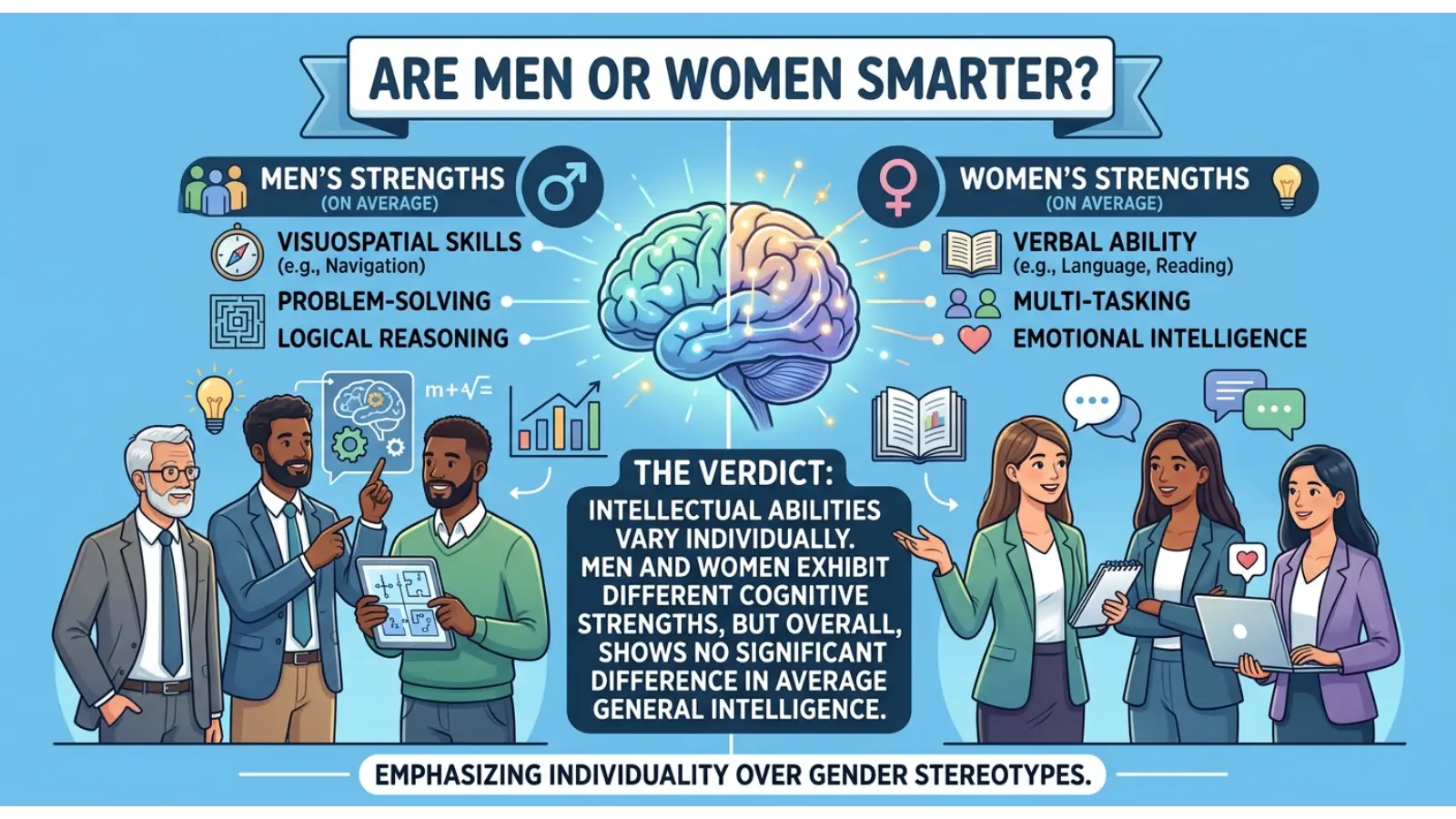
Are men or women smarter? This question has sparked debates for generations, but the scientific answer is more complex than a simple comparison. Research suggests that men and women have broadly similar general intelligence on average, although some studies identify differences in particular cognitive abilities. These findings do not mean that one gender is naturally superior in every area of thinking.
Intelligence includes reasoning, memory, language, learning, creativity, and problem solving. Every individual has a unique combination of strengths and weaknesses. Rather than judging intelligence by gender, it is more accurate to consider individual abilities, experience, education, and the specific skills being measured.
What Does Intelligence Mean?
Intelligence refers to the ability to learn, understand information, solve problems, recognize patterns, and adapt to new situations. Psychologists study intelligence through different assessments because human thinking involves several related abilities.
General intelligence is commonly assessed through standardized cognitive tests. These tests may measure reasoning, verbal comprehension, working memory, visual-spatial skills, and processing speed.
However, intelligence is broader than a single test score. A person may excel at mathematics but struggle with writing, while another may have excellent language skills and strong practical judgment. These differences do not automatically make one person more intelligent in every respect.
Understanding intelligence requires looking at multiple abilities rather than relying on stereotypes or assumptions about men and women.
Are Men or Women Smarter According to Science?
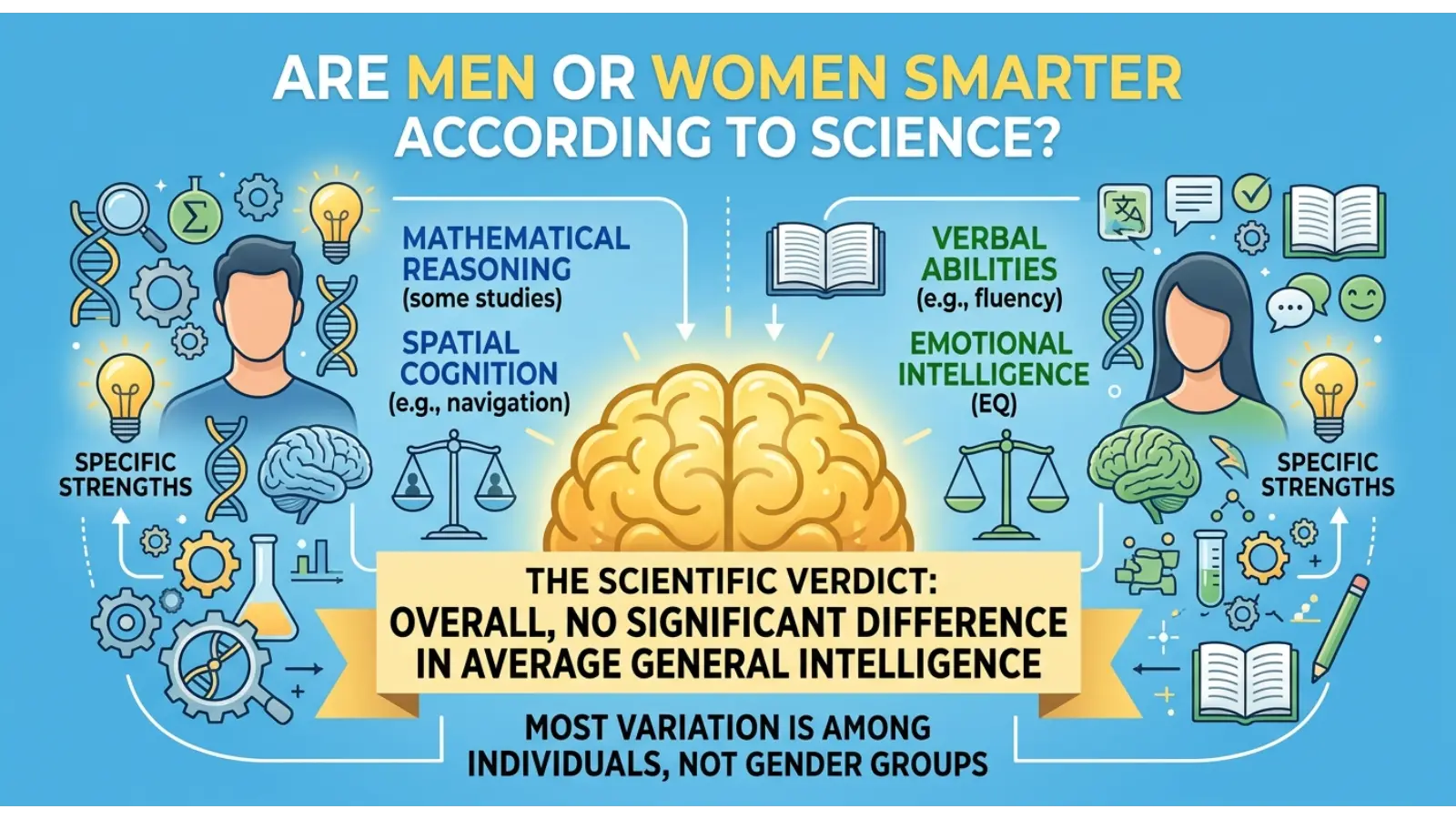
Scientific research does not establish that men or women are universally smarter. Studies examining general intelligence generally find little or no meaningful average difference between the sexes, although results can vary depending on the test, sample, and statistical method.
A 2022 article by Matthew R. Reynolds, Daniel B. Hajovsky, and Jacqueline M. Caemmerer examined sex differences in general intelligence and specific cognitive abilities. The researchers distinguished overall intelligence from particular skills in which average differences have been reported.
For example, some research identifies average differences in certain visual-spatial tasks, writing measures, and processing-speed assessments. However, a difference in one skill does not establish overall intellectual superiority.
There is also considerable variation within each group. Many women perform better than many men on particular cognitive tasks, and many men perform better than many women on others.
The most accurate conclusion is that gender alone cannot determine who is smarter. Individual abilities and the specific task being evaluated matter much more than broad assumptions.
Do Men and Women Have Different Cognitive Strengths?
Research has identified average differences in some cognitive tasks, but these findings should be interpreted carefully. They describe patterns across groups rather than fixed characteristics of every individual.
Verbal Abilities
Some studies report average female advantages in certain verbal tasks, particularly writing. Verbal abilities include understanding language, interpreting written information, explaining ideas, and communicating clearly.
These skills are valuable in education, business, research, and everyday life. However, verbal ability varies considerably among individuals, and people of every gender can develop strong communication skills.
Spatial Reasoning
Men and boys have performed better on average in some visual-spatial tasks, especially certain mental rotation tests. These assessments measure the ability to imagine how an object would look after being rotated.
Spatial reasoning is useful in fields such as architecture, engineering, design, and navigation. However, performance depends on the specific task and can be influenced by practice and experience.
An average difference in one spatial task does not mean that all men have stronger spatial skills than all women.
Processing Speed
Some research has identified average female advantages in certain processing-speed measures. These tasks may involve quickly identifying information, comparing symbols, or responding accurately under time constraints.
Processing speed is only one component of cognitive performance. Working carefully, reasoning deeply, and solving complex problems may require abilities that are not captured by simple speed tests.
Consequently, processing speed alone cannot determine overall intelligence.
Mathematical Reasoning
Mathematical performance depends on several abilities, including numerical reasoning, logical thinking, problem solving, and knowledge of mathematical concepts.
Research findings vary across different mathematical tasks, age groups, and educational settings. Neither men nor women should be assumed to have a universal advantage in mathematics.
Education, practice, teaching quality, confidence, and opportunities to learn all contribute to the development of mathematical skills.
Does IQ Determine Whether Men or Women Are Smarter?
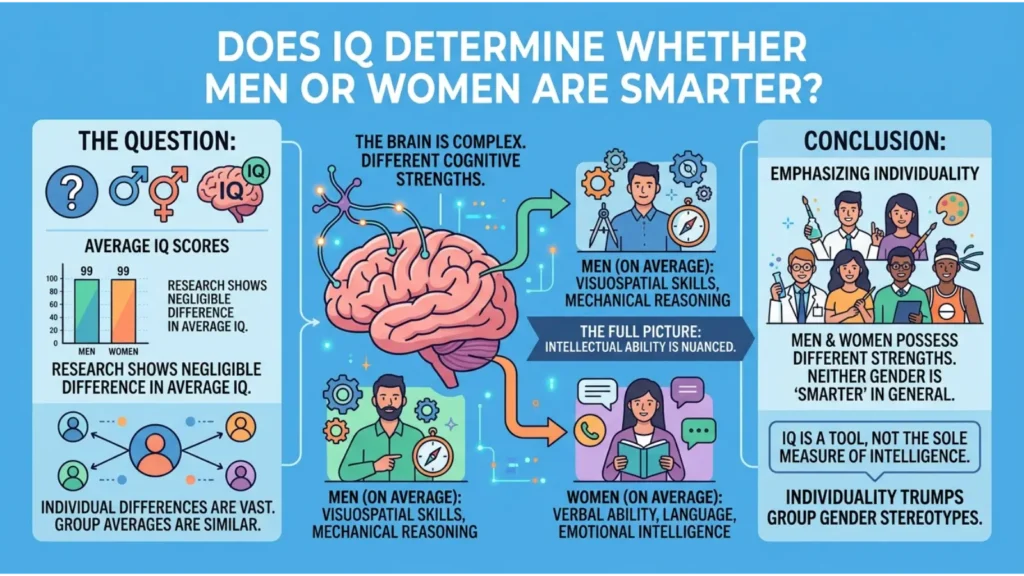
IQ stands for intelligence quotient. It is a standardized score used to assess selected cognitive abilities in relation to an appropriate comparison group.
Depending on the test, IQ assessments may measure verbal comprehension, logical reasoning, working memory, visual-spatial processing, and processing speed.
IQ tests can provide useful information, but they do not measure every aspect of human intelligence. Creativity, emotional understanding, practical judgment, interpersonal skills, and specialized expertise cannot be fully represented by one number.
It is also important to distinguish between an individual’s IQ and a group average. Even when a study identifies an average difference, the results do not predict the abilities of every person in either group.
A person’s score should therefore be interpreted in context. It should not be used as the sole measure of potential, professional ability, or future success.
Does Brain Structure Affect Intelligence?
Researchers continue to investigate how brain development, biology, experience, and the environment influence cognitive abilities. Studies have identified average differences in some measures of brain anatomy and function, but these findings do not automatically establish differences in general intelligence.
The brain is a complex system. Different cognitive tasks involve multiple brain regions working together, and performance can be influenced by learning, experience, attention, and other factors.
It is also important to distinguish correlation from causation. Observing a difference in brain structure does not prove that the difference causes a particular intellectual outcome.
For this reason, simplified claims about male and female brains should not be used to declare one gender smarter than the other.
What Factors Influence Intelligence?
Intelligence develops through a complex interaction of biological, environmental, educational, and personal factors. Gender alone cannot explain the wide range of abilities found among individuals.
Genetics and Development
Genetic factors contribute to differences in cognitive abilities, but intelligence is influenced by many genes and their interactions with the environment. No single gene determines a person’s overall intelligence.
Education and Learning Opportunities
Access to quality education, effective teaching, books, technology, and supportive learning environments can help people develop their abilities.
Practice and Experience
Regular reading, problem solving, mathematical practice, and learning new skills can improve performance in relevant areas. Experience also helps people develop specialized knowledge.
Health and Sleep
Sleep, general health, stress, and nutrition can affect concentration, memory, and attention. These factors may influence how well someone performs on cognitive assessments.
Social and Cultural Environment
Social expectations and cultural attitudes can influence which activities people pursue and the opportunities available to them. These experiences may affect the skills people develop over time.
Together, these factors help explain why individuals differ in their abilities. No single factor provides a complete explanation for every person.
Common Myths About Male and Female Intelligence
Misconceptions about intelligence often arise when people turn limited research findings into universal statements. Understanding the evidence helps readers avoid these mistakes.
Myth One: Men Are Naturally Smarter Than Women
Research does not establish a universal male advantage in general intelligence. Average advantages in certain tasks cannot be used to conclude that men are smarter in every area.
Myth Two: Women Are Naturally Smarter Than Men
This statement is equally misleading. Average advantages in some verbal or processing-speed tasks do not establish that women are universally more intelligent.
Myth Three: A High IQ Guarantees Success
IQ provides information about selected cognitive abilities, but success also depends on knowledge, persistence, experience, opportunities, and other personal and environmental factors.
Myth Four: Boys Are Always Better at Mathematics
Mathematical ability varies widely among individuals. Educational opportunities, practice, motivation, and the type of mathematical task all influence performance.
Myth Five: One Test Measures Every Type of Intelligence
Standardized tests assess specific abilities under particular conditions. They cannot capture every aspect of creativity, practical judgment, emotional understanding, or specialized expertise.
Frequently Asked Questions
Are men or women smarter on average?
Research generally finds little or no meaningful average difference in general intelligence. Some specific cognitive abilities show average differences, but these findings do not establish that either sex is universally smarter.
Do women have higher IQs than men?
There is no reliable basis for claiming that women universally have higher IQs than men. Findings depend on the assessment, population, and method used to analyze the results.
Do men have higher IQs than women?
Research does not establish a consistent, universal male advantage in general intelligence. Particular studies may report differences, but those results should not be generalized without considering the evidence and study design.
Are women better at language than men?
Some research identifies average female advantages in certain verbal skills, particularly writing. However, individual abilities vary widely, and people of every gender can develop excellent language and communication skills.
Are men better at spatial reasoning?
Men have performed better on average in some spatial tasks, particularly certain mental rotation assessments. The size of the difference varies, and spatial reasoning does not represent intelligence as a whole.
Can a woman be smarter than a man?
Yes. Individuals vary considerably in their cognitive abilities. A woman may outperform a man in one or several areas, just as a man may outperform a woman in others. Gender alone does not determine an individual’s intellectual ability.
Can intelligence improve over time?
People can develop knowledge and strengthen many cognitive skills through education, practice, feedback, and experience. The amount of improvement depends on the skill, the individual, and the circumstances.
Is emotional intelligence the same as IQ?
No. IQ assessments measure selected cognitive abilities, while emotional intelligence concerns skills related to recognizing, understanding, and managing emotions. These concepts are different, and neither fully represents every human capability.
Conclusion
Are men or women smarter? The most scientifically responsible answer is that neither men nor women can be considered universally smarter based on gender alone. Research generally finds similar general intelligence on average, while some specific cognitive tasks show average differences.
Intelligence includes many abilities, such as reasoning, memory, verbal comprehension, spatial thinking, and problem solving. Individual differences are substantial, and educational opportunities, practice, experience, and other factors contribute to how people develop their skills.