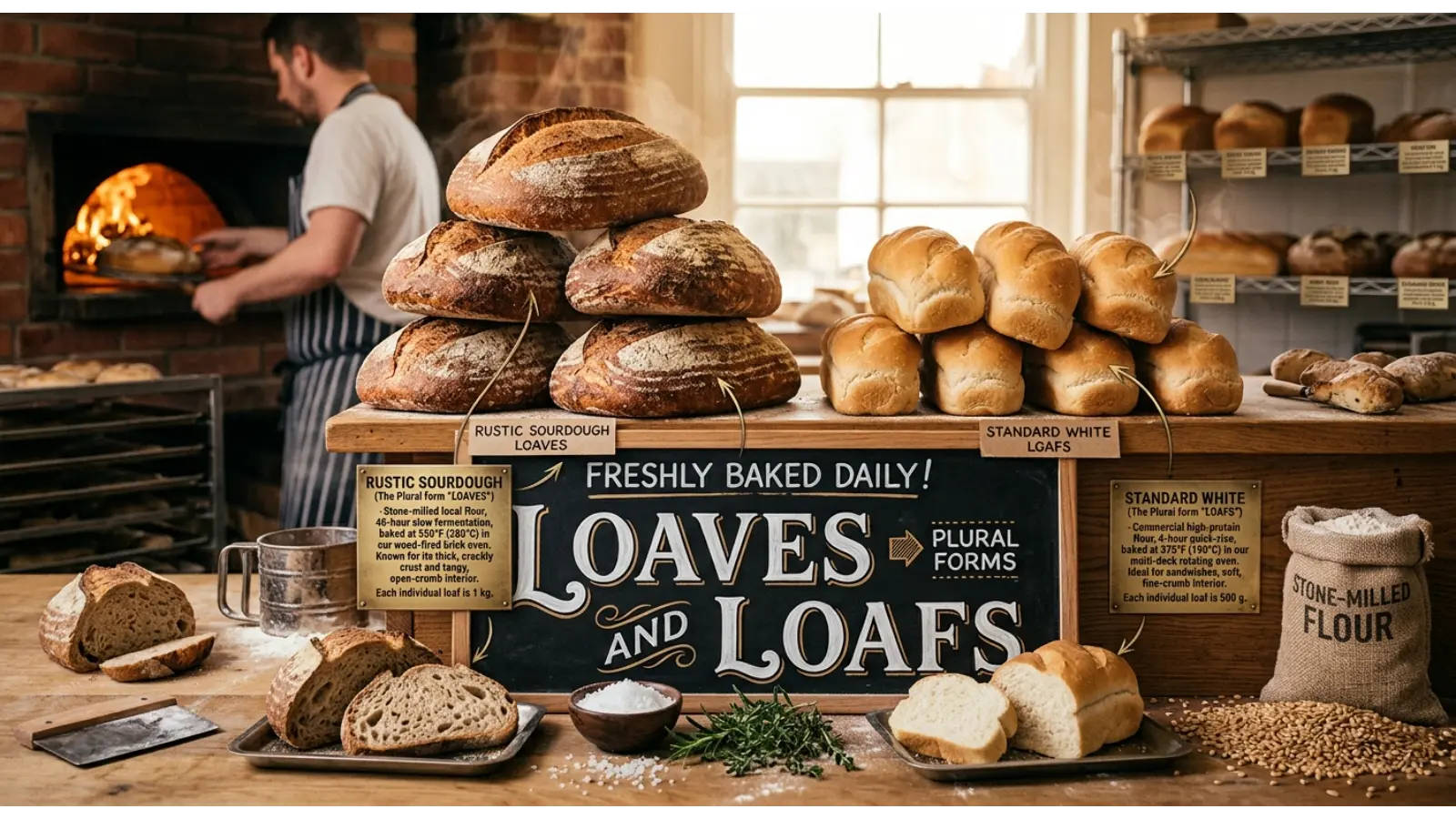
Choosing between loafs or loaves can be confusing because both spellings are correct in English, but they serve different grammatical purposes. The correct choice depends on whether you are talking about multiple pieces of bread or describing someone who spends time doing very little.
The word loaves is the standard plural form of the noun loaf, while loafs is the third-person singular present-tense form of the verb loaf. Understanding this distinction will help you avoid spelling mistakes in everyday conversations, school assignments, professional documents, and online writing.
Quick Answer
The difference between loafs and loaves is based on their grammatical function rather than British or American spelling preferences.
- Loaves is the plural noun used when referring to two or more loaves of bread or similar baked items.
- Loafs is a verb form used with subjects such as he, she, or it to describe spending time idly or avoiding work.
For example, you might write, “The bakery sells fresh loaves every morning,” or “He loafs around the house on weekends.”
Both examples are grammatically correct because each word has a different purpose in the sentence.
What Does Loaves Mean?
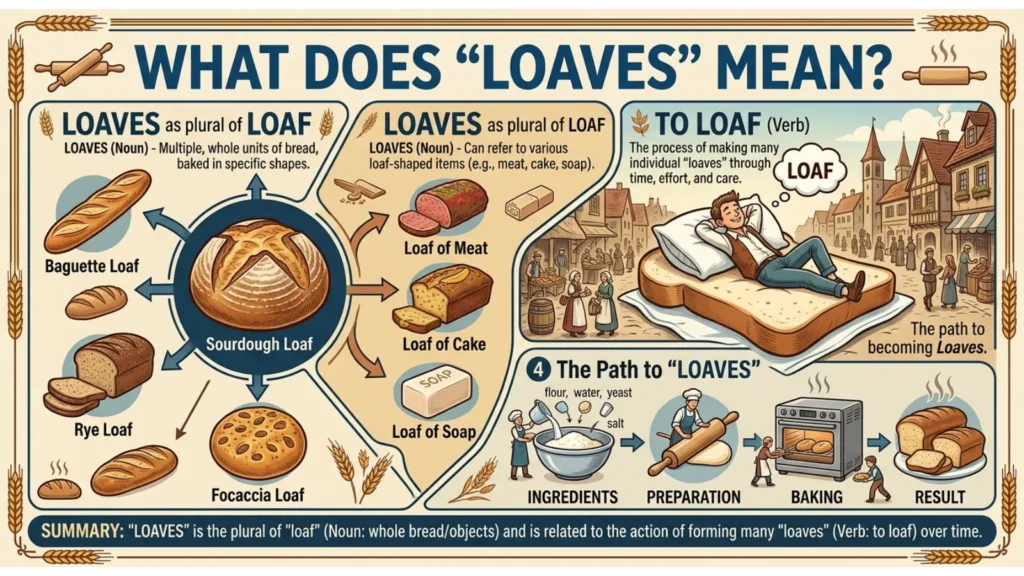
Loaves is the plural form of loaf. A loaf is a shaped quantity of bread or another food prepared in one solid piece. When you refer to more than one, the correct spelling is loaves.
This spelling follows an irregular plural pattern in English. Instead of simply adding an s to the end of loaf, the final f changes to v before adding es.
Examples of Loaves in Sentences
- The baker prepared six fresh loaves for the morning customers.
- We bought two loaves of whole wheat bread.
- The supermarket displays different types of loaves every day.
- My grandmother baked three loaves for the family gathering.
- These loaves are perfect for making sandwiches.
- The bakery donated several loaves to a local shelter.
In each sentence, loaves refers to multiple items. Using loafs in these examples would be incorrect because the word is functioning as a plural noun.
What Does Loafs Mean?
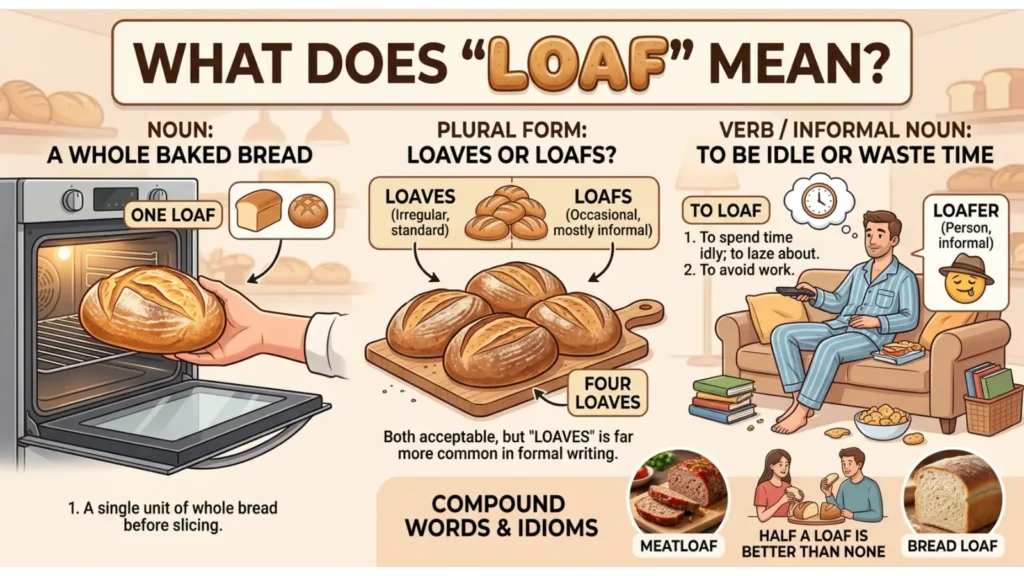
Loafs is the third-person singular present-tense form of the verb loaf. The verb means to spend time doing very little, particularly when someone should be working or completing a task.
English verbs generally take an s or es ending with third-person singular subjects in the simple present tense. Therefore, the correct forms are I loaf, you loaf, we loaf, they loaf, and he loafs.
Examples of Loafs in Sentences
- He loafs around the house instead of cleaning his room.
- My brother loafs on the sofa whenever he has free time.
- She loafs around after finishing her morning coffee.
- The employee loafs during working hours instead of completing assignments.
- He often loafs with his friends during the holidays.
- The student loafs around when there is no homework to complete.
In these examples, loafs describes an action rather than naming multiple objects.
Why Does Loaf Become Loaves?
The noun loaf follows an established English plural spelling pattern. Some nouns ending in f or fe change that ending to ves when they become plural.
This pattern appears in several familiar words.
| Singular | Plural |
|---|---|
| Loaf | Loaves |
| Leaf | Leaves |
| Knife | Knives |
| Wife | Wives |
| Wolf | Wolves |
| Life | Lives |
However, not every noun ending in f follows this pattern. For example, roof commonly becomes roofs, and chief becomes chiefs.
For that reason, it is helpful to learn the plural form of each word instead of assuming that every noun follows the same rule.
Is Loafs or Loaves Correct in British and American English?
Both British and American English use loaves as the plural noun and loafs as the third-person singular verb.
The difference does not depend on geography. It depends on how the word is used in a sentence.
British English Examples
- The bakery sells freshly baked loaves every morning.
- He loafs around the garden during his days off.
American English Examples
- We bought two loaves of bread for the picnic.
- He loafs around the house when he has nothing to do.
These examples follow the same spelling and grammatical rules in both varieties of English. Writers should choose the form that matches the intended meaning, regardless of their preferred English variety.
Common Mistakes When Using Loafs and Loaves
Writers sometimes confuse these words because they look similar and share the same base word. The easiest way to avoid mistakes is to identify whether the sentence requires a noun or a verb.
Mistake One: Using Loafs as a Plural Noun
Incorrect: I bought three loafs of bread.
Correct: I bought three loaves of bread.
Explanation: The sentence refers to multiple pieces of bread, so the irregular plural noun loaves is required.
Mistake Two: Using Loaves as a Verb
Incorrect: He loaves around all afternoon.
Correct: He loafs around all afternoon.
Explanation: The subject he requires the third-person singular present-tense form of the verb loaf.
Mistake Three: Applying the Wrong Rule
Incorrect: The baker prepared five loafs for the customers.
Correct: The baker prepared five loaves for the customers.
Explanation: Adding s alone does not produce the standard plural of the noun loaf.
Mistake Four: Confusing the Noun and Verb Forms
Incorrect: She loafs of bread are on the table.
Correct: Her loaves of bread are on the table.
Explanation: The sentence refers to bread, so it needs the plural noun loaves. The possessive determiner her also makes the sentence grammatically appropriate.
How to Remember the Difference Between Loafs and Loaves
A simple memory trick can help you select the correct word quickly.
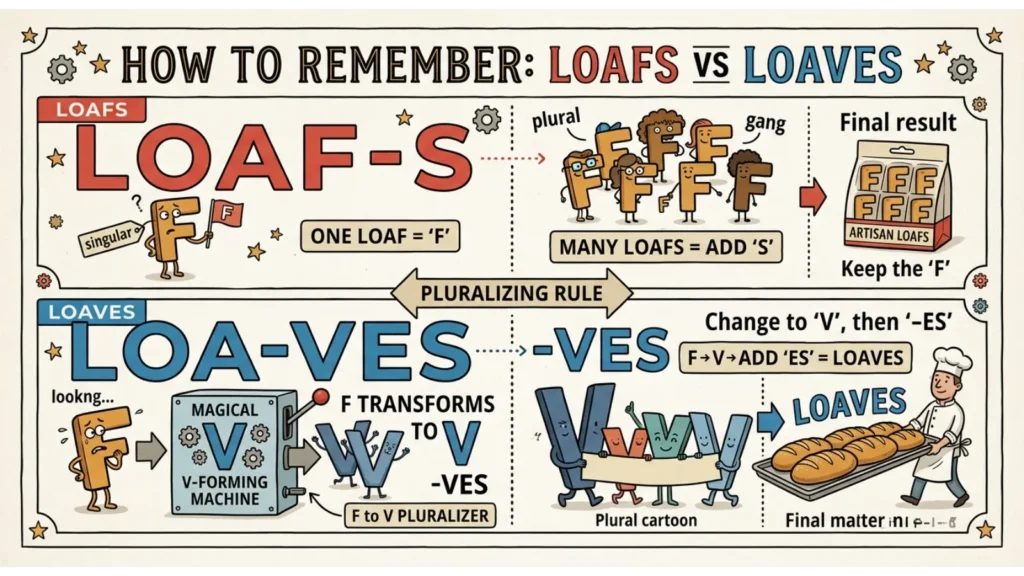
Remember this rule: Loaves are things you can count, while loafs describes what someone does.
- If you can count several pieces of bread, use loaves.
- If someone is spending time idly, use loafs when the subject is he, she, or it.
For example, “The baker makes ten loaves” refers to ten items, while “The baker loafs around” describes an action.
You can also remember the related spelling pattern in leaf/leaves and knife/knives. These examples help reinforce the irregular plural pattern.
Frequently Asked Questions
Is Loafs Ever Correct?
Yes. Loafs is correct as the third-person singular present-tense form of the verb loaf. For example, “He loafs around after lunch.” It is not the standard plural noun for multiple pieces of bread.
Is Loaves the Correct Plural of Loaf?
Yes. Loaves is the standard plural of the noun loaf. For example, “The baker prepared four loaves of bread.”
Why Is the Plural of Loaf Not Loafs?
The noun loaf follows an irregular plural pattern in which the final f changes to v before adding es. The resulting plural is loaves.
Do British and American English Use Different Spellings?
No. Both British and American English use loaves as the plural noun and loafs as the third-person singular verb. There is no standard regional spelling difference between these forms.
What Is the Difference Between Loaf, Loaves, and Loafs?
Loaf is the singular noun or base form of the verb. Loaves is the plural noun. Loafs is the third-person singular present-tense verb form. The correct choice depends on the meaning and grammatical structure of the sentence.
Conclusion
The difference between loafs and loaves becomes clear when you understand their grammatical roles. Use loaves when referring to more than one loaf of bread, and use loafs when describing someone who spends time idly.
Both forms are correct in their appropriate contexts, and neither is exclusive to British or American English. By learning the distinction and reviewing the examples in this guide, you can choose the correct spelling confidently in everyday, academic, and professional writing.