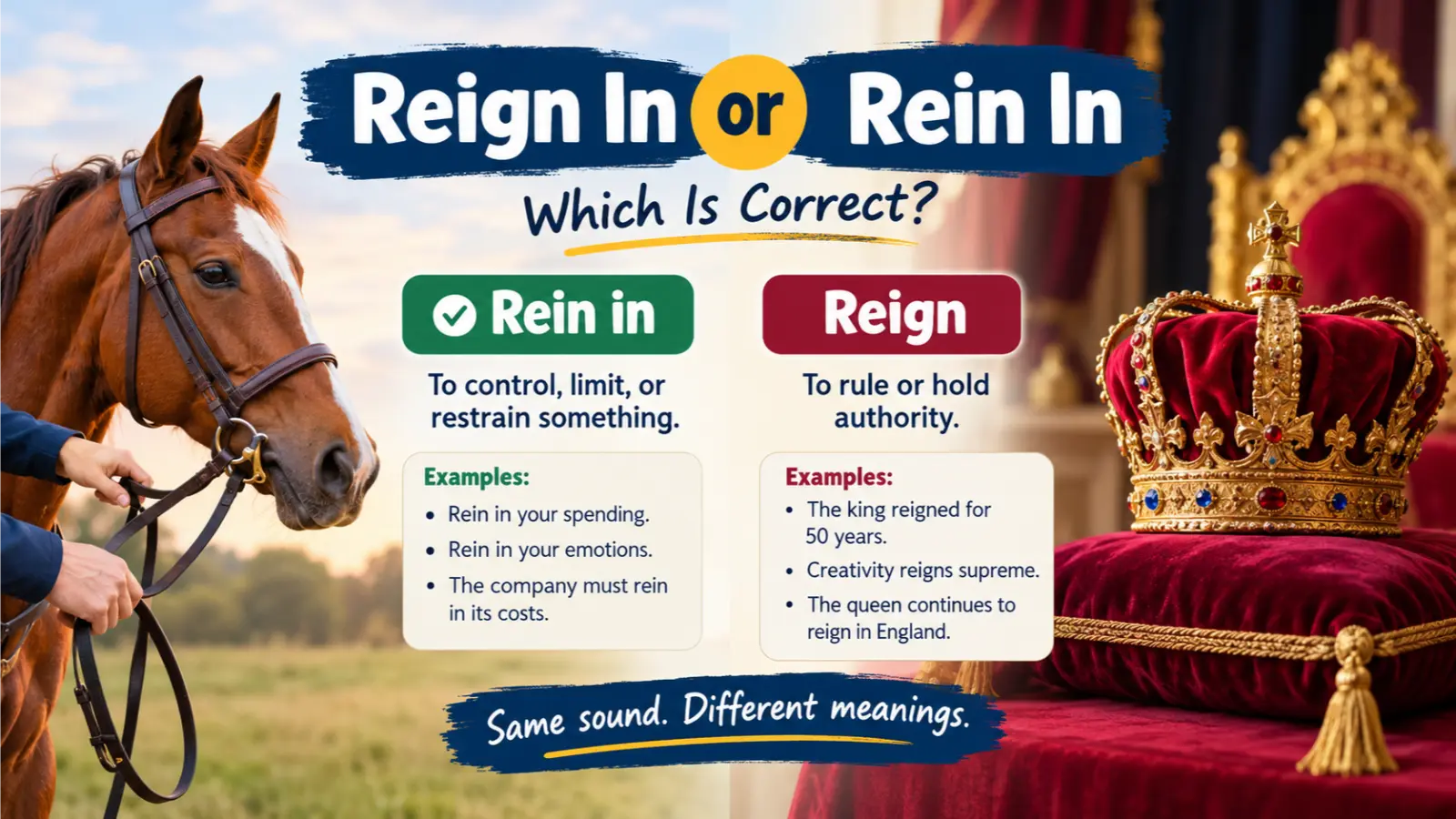
Have you ever wondered whether to write reign in or rein in? These expressions sound the same, so it is easy to confuse them. However, rein in is the correct expression when you want to describe controlling, limiting, or restraining something.
The difference comes from the meanings of the words rein and reign. A rein is used to guide or control a horse, while a reign refers to a period of rule or the exercise of authority. Understanding this distinction will help you use the correct expression in everyday conversations, academic assignments, and professional writing.
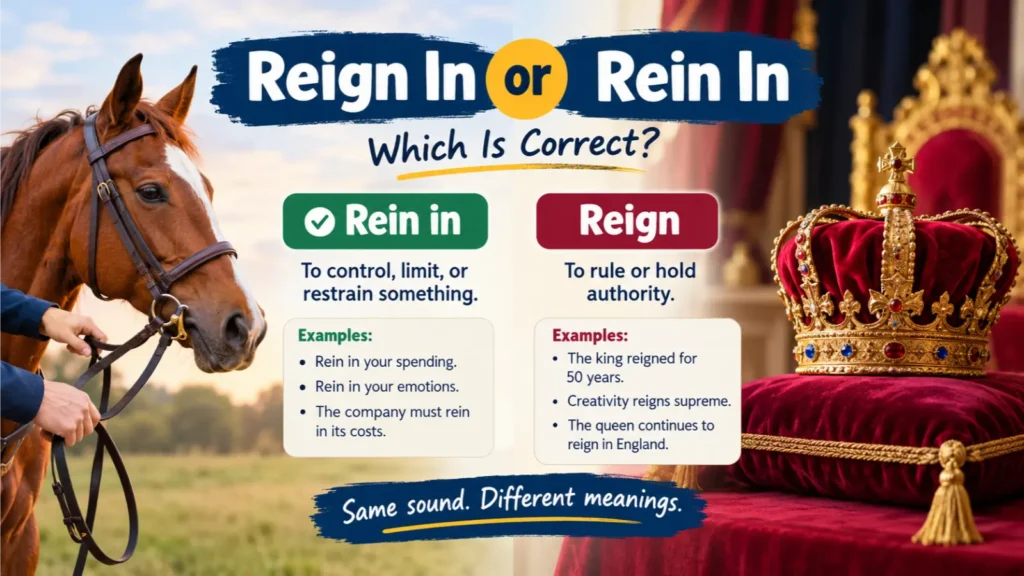
Reign In or Rein In: What Is the Difference?
Rein in is the standard expression meaning to control, limit, or restrain someone or something. Reign in is generally a spelling error when used with this meaning.
| Expression | Meaning | Example |
|---|---|---|
| Rein in | To control or limit something | We need to rein in unnecessary spending. |
| Reign | To rule or exercise authority | The monarch continued to reign. |
| Reign in | Incorrect for the intended meaning of restraint | We need to reign in our expenses. |
Although both rein and reign are correct English words, they have different meanings. Choosing the right word depends on what you want to communicate.
What Does Rein In Mean?
The phrase rein in means to control, restrain, reduce, or limit something that has become excessive or difficult to manage. It originally relates to controlling a horse with reins, but today it is frequently used figuratively.
For example, a person might rein in their emotions, a business might rein in its expenses, or a government might introduce policies to rein in inflation.
Here are some examples of how to use the phrase correctly.
- The company must rein in its operating costs.
- She tried to rein in her anger during the meeting.
- The government introduced measures to rein in inflation.
- Parents sometimes need to rein in their children’s screen time.
- The manager asked the team to rein in unnecessary spending.
- He struggled to rein in his excitement before the announcement.
In each example, rein in communicates the idea of bringing something under control.
What Does Reign Mean?
The word reign refers to ruling as a king, queen, or other sovereign. It can also describe a period of leadership or the dominance of a particular person, idea, or quality.
Unlike rein in, the word reign does not mean to restrain something. Its central meaning relates to ruling, authority, or dominance.
Consider these examples.
- Queen Victoria reigned from 1837 to 1901.
- The king’s reign lasted for several decades.
- Creativity reigns supreme in the design studio.
- Confusion reigned throughout the crowded hall.
- The champion hopes to continue his reign over the sport.
These examples demonstrate how reign is used when discussing authority, leadership, or a period of rule.
Why Do People Confuse Reign and Rein?
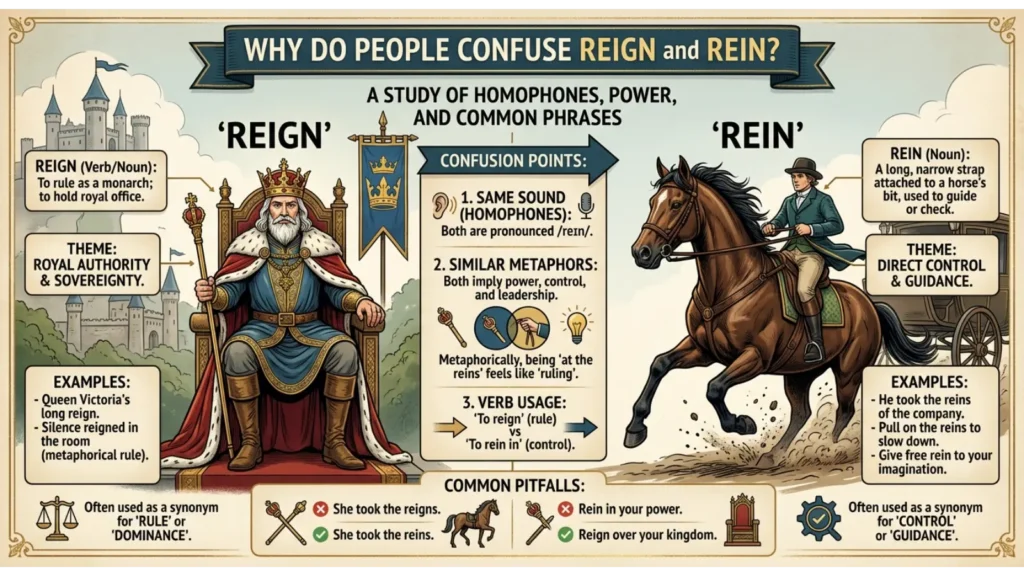
The main reason people confuse these words is that reign and rein are homophones. They have the same pronunciation but different spellings and meanings. The word rain also shares this pronunciation.
Here is a simple explanation of the three words.
- Rein: A strap used to guide a horse, or a word associated with control and restraint.
- Reign: To rule or the period during which someone rules.
- Rain: Water that falls from clouds.
Because reins help a rider control a horse, the expression rein in developed a figurative meaning involving restraint. Remembering this connection makes the correct spelling easier to identify.
Is Reign In Ever Correct?
When you mean to control, restrain, or limit something, rein in is the standard expression. Writing reign in with that meaning is generally considered incorrect.
However, the words reign and in can appear next to each other in a grammatically correct sentence when they serve separate purposes.
For example:
- Incorrect: The manager needs to reign in unnecessary costs.
- Correct: The manager needs to rein in unnecessary costs.
- Correct: The queen continued to reign in Britain.
In the last example, reign means to rule, while in Britain identifies the place. The words do not form the expression rein in.
Always consider the intended meaning before selecting the spelling.
Reign In or Rein In in British and American English
There is no British-versus-American spelling difference between these expressions. Both varieties of English use rein in to mean control, restrain, or limit something.
The distinction remains the same in everyday conversations, academic papers, business documents, and international communication.
| Writing context | Correct usage |
|---|---|
| British English | Rein in spending |
| American English | Rein in spending |
| Academic writing | Rein in unnecessary costs |
| Business writing | Rein in operating expenses |
| International communication | Rein in excessive spending |
Writers should follow their publication’s style guide for general spelling and formatting conventions. However, those conventions do not change the standard spelling of this expression.
The History and Origin of Rein In and Reign
The words rein and reign have different historical origins, which help explain their meanings today.
The word rein entered English through Old French and is associated with the Latin word retinere, meaning to hold back or restrain. Its original use related to the straps used to guide horses. Over time, the word developed figurative meanings involving the control of emotions, spending, behavior, and other activities.
The word reign developed through Old French and Latin, with roots connected to ruling and royal authority. It has been used in English since the medieval period to describe the exercise of sovereign power and the period during which a ruler holds authority.
Although both words can relate to ideas of control, they developed different meanings and remain distinct in modern English.
How to Remember the Correct Expression
A simple memory trick can help you avoid confusing reign in with rein in.
Think about a horse and its reins. A rider uses reins to guide, slow, or control a horse. Therefore, when you want to describe controlling something, remember rein in.
When discussing a king, queen, or period of authority, use reign.
You can also remember these related expressions.
- Rein in: Control or restrain something.
- Free rein: Freedom to act or make decisions.
- Take the reins: Take control or responsibility.
- Reign supreme: Hold the highest position or dominate.
These expressions reinforce the difference between the language of restraint and the language of ruling.
Common Mistakes to Avoid
Confusing rein and reign can lead to several common spelling mistakes. Learning the correct forms will improve your writing.
| Incorrect expression | Correct expression |
|---|---|
| Reign in expenses | Rein in expenses |
| Free reign | Free rein |
| Take the reigns | Take the reins |
| Reign in your emotions | Rein in your emotions |
The expression free rein means giving someone freedom to act or make decisions without unnecessary restrictions. The expression take the reins means taking control or responsibility.
Both expressions originate from the literal use of reins in horseback riding.
Before publishing an article, email, or report, check whether the sentence refers to ruling or controlling something. This quick check can prevent many common errors.
Frequently Asked Questions
Is reign in or rein in correct?
Rein in is correct when you mean to control, restrain, or limit something. Reign in is generally incorrect when used with that intended meaning.
Is rein in British or American English?
The expression rein in is standard in both British and American English. Neither variety uses a different spelling for this meaning.
What does rein in mean in simple words?
It means to control something or prevent it from becoming excessive. For example, “I need to rein in my spending” means that I need to control my expenses.
Why is it called rein in?
The expression comes from horseback riding. A rider uses reins to guide and control a horse. The phrase later developed a figurative meaning involving the control of behavior, emotions, spending, and other activities.
Can reign in ever be grammatically correct?
The words can appear next to each other when reign means to rule and in belongs to a separate phrase, as in “The monarch continued to reign in England.” However, when you mean to restrain or control something, use rein in.
Conclusion
The difference between reign in and rein in becomes easy to understand once you know their meanings. Rein in is the correct expression for controlling spending, managing emotions, limiting behavior, or restraining an activity. Reign refers to ruling, authority, or a period of leadership.
Both British and American English follow the same distinction, so there is no regional spelling choice to make. Remember the connection between reins and controlling a horse, and you will be able to use the expression correctly in everyday conversations, academic writing, and professional communication.
SEO Meta Description: Learn whether reign in or rein in is correct, explore their meanings, discover common mistakes, and understand proper usage in English.