Have you ever wondered whether to write on board or onboard? Both forms are correct, but they serve different purposes in English. Understanding their meanings will help you choose the right form in emails, conversations, professional documents, and everyday writing.
The key difference is simple. On board usually means being aboard a vehicle or being part of a group, while onboard often describes equipment, services, or the process of welcoming someone into an organization. Use the copy button on this page to save useful examples and remember the difference whenever you write.
What Does On Board Mean?
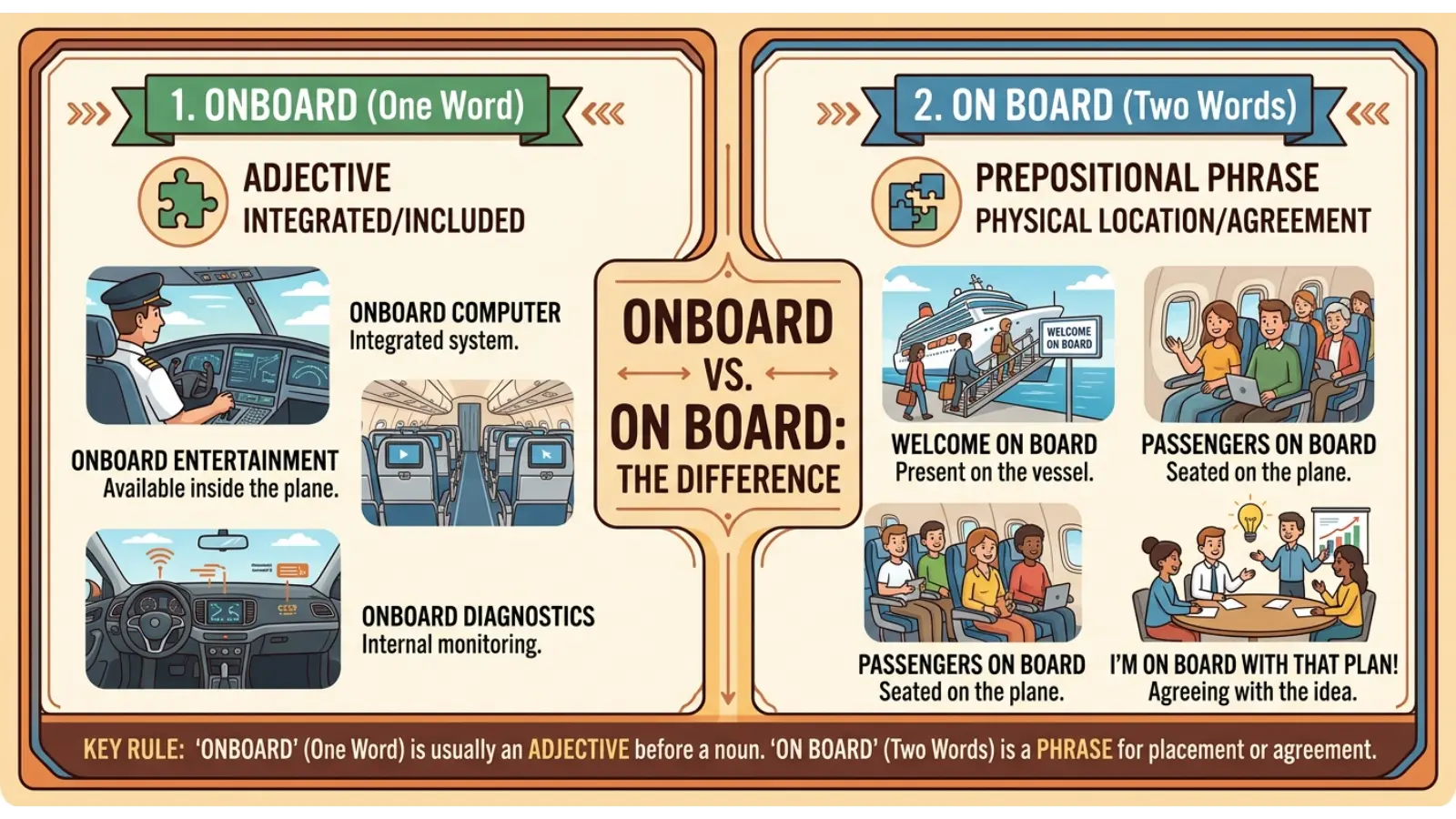
The phrase on board consists of two separate words. It commonly means being inside or aboard a vehicle, such as a plane, train, ship, or bus. It can also describe someone who agrees with a plan or joins a team.
Examples include:
- All passengers are on board the aircraft.
- The new employee is now on board with our project.
- Everyone on board the ship followed the safety instructions.
- Are you on board with our proposal?
In the first three examples, the phrase describes being aboard a vehicle or being part of a group. In the final example, it means agreeing with a proposal.
What Does Onboard Mean?
Onboard is generally written as one word when it functions as an adjective. It can describe something built into a device, included in a system, or connected with an organization.
Examples include:
- The laptop has an onboard graphics processor.
- Our company provides onboard training for new employees.
- The vehicle comes with an onboard navigation system.
- The website offers an onboard payment feature.
Onboard can also function as a verb, particularly in business and technology. It means to introduce or integrate a new employee, customer, or user into a company, service, or system.
Examples:
- The HR team will onboard three new employees.
- We need to onboard our customers before the launch.
- The company plans to onboard new users this month.
Remember that the correct form depends on the sentence, not simply on how the word sounds.
On Board vs Onboard: Key Differences
Although these forms look similar, their grammatical roles and meanings are not always interchangeable.
| Feature | On board | Onboard |
|---|---|---|
| Spelling | Two words | One word |
| Common role | Phrase or expression | Adjective or verb |
| Main meaning | Aboard or in agreement | Built in, included, or integrated |
| Example | We are on board the train. | The train has onboard Wi-Fi. |
| Business example | She is on board with the plan. | We will onboard the new employee. |
The easiest way to remember the difference is to focus on what you want to say. Use on board for being aboard something or supporting an idea. Use onboard for describing an integrated feature or the process of bringing someone into a system.
Grammar Rules for On Board and Onboard
English grammar provides useful clues for choosing the correct form.
Rule 1: Use On Board for Being Aboard
When someone is physically aboard a vehicle, vessel, or aircraft, write on board as two words.
Examples:
- The captain is on board the ship.
- All passengers are on board the bus.
- The crew welcomed us on board the aircraft.
This construction is especially common in travel announcements and transportation writing.
Rule 2: Use Onboard Before a Noun as an Adjective
Use onboard as one word when it describes a feature or system that is built into or provided with something.
Examples:
- The car includes an onboard computer.
- The aircraft has an onboard entertainment system.
- We installed an onboard monitoring device.
In each example, onboard describes the noun that follows it.
Rule 3: Use Onboard as a Verb for Integration
In workplace and technology contexts, onboard can describe the process of introducing someone to a role, organization, or service.
Examples:
- The manager will onboard the new staff members.
- Our team must onboard every client before the project begins.
- The platform helps businesses onboard users efficiently.
This usage is common in human resources, customer service, and software companies.
Rule 4: Use On Board for Agreement
The phrase on board can also mean willing to participate in or support a decision.
Examples:
- I am on board with your suggestion.
- The entire team is on board with the new strategy.
- Are the investors on board with the proposal?
Do not replace this expression with onboard in standard writing when you mean agreement.
Sentence Structure: How to Use Each Form
Understanding sentence structure makes the distinction easier to apply.
On board in a sentence
Common patterns include:
- Subject + be + on board.
- Subject + be + on board + a vehicle.
- Subject + be + on board with + an idea.
Examples:
- The passengers are on board.
- The crew is on board the ship.
- Our director is on board with the plan.
Onboard in a sentence
Common patterns include:
- Onboard + noun.
- Subject + onboard + object.
Examples:
- The device has an onboard camera.
- The company will onboard new employees.
- We use onboard software to manage the equipment.
These patterns are practical guidelines rather than absolute rules. Always consider the intended meaning and the role the word plays in the sentence.
Common Mistakes When Using On Board or Onboard
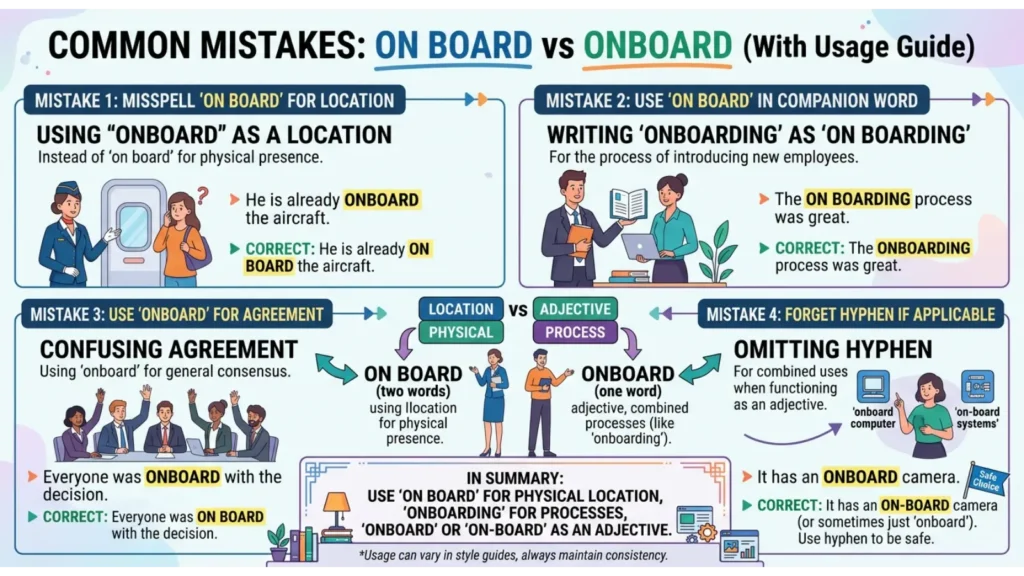
Writers sometimes confuse these forms because they sound alike. The following examples show how to correct common errors.
Mistake 1: Using onboard for physical presence
Incorrect: All passengers are onboard the plane.
Better for standard edited writing: All passengers are on board the plane.
Onboard may appear in informal or industry-specific writing, but the two-word form is the safer choice for this meaning.
Mistake 2: Separating onboard when describing a feature
Less suitable: The laptop has on board graphics.
Better: The laptop has onboard graphics.
The one-word adjective clearly describes the graphics built into the device.
Mistake 3: Using onboard to express agreement
Incorrect: I am onboard with your idea.
Preferred: I am on board with your idea.
The two-word expression is the established choice when expressing support or agreement.
Mistake 4: Using on board as a verb
Incorrect: The company will on board new customers.
Correct: The company will onboard new customers.
The verb is written as one word.
Mistake 5: Assuming one form is always correct
Neither form is universally correct in every context. Choosing between them requires understanding whether the sentence refers to presence, agreement, an integrated feature, or an integration process.
Professional Usage in Business, Travel, and Technology
Both forms appear in professional English, but they suit different situations.
In Business Communication
Use on board when discussing agreement or participation.
Example: Our department is on board with the proposed changes.
Use onboard when describing the process of introducing employees or customers.
Example: The HR department will onboard the new hires next Monday.
In Travel and Transportation
Use on board when referring to people or things aboard a vehicle.
Example: Please ensure all passengers are on board before departure.
In Technology
Use onboard to describe components integrated into a device.
Example: The tablet features an onboard security system.
In Customer Service
Use onboard as a verb when explaining how users begin using a service.
Example: Our support team will onboard new customers and guide them through the setup process.
Choosing the appropriate form helps professional writing remain clear, consistent, and easy to understand.
On Board or Onboard in Formal and Informal Writing
Both forms are acceptable in modern English when used according to their meanings.
In formal writing, use on board for physical presence and agreement. Use onboard for integrated features and the process of introducing people into an organization or service.
Examples for formal writing:
- The passengers were on board before the scheduled departure.
- The committee is on board with the recommended changes.
- The vehicle contains an onboard diagnostic system.
- The company will onboard new employees during the next quarter.
In informal conversations, people may use variations such as “I’m onboard” to express agreement. However, “I’m on board” is the more established choice in standard edited English.
For business reports, academic work, and professional emails, consistency and clarity matter more than choosing the longer or shorter form.
Easy Memory Tricks to Remember the Difference
Use these simple techniques to avoid confusion.
- Two words, two common ideas: Think of being on a ship or being on board with a plan.
- One word, built-in feature: Think of onboard Wi-Fi, onboard cameras, or onboard software.
- One word, action: Think of a company onboarding a new employee.
- Check the meaning: Ask whether you mean aboard, in agreement, integrated, or introduced.
Try this quick practice:
- The passengers are ___ the plane.
- The laptop has an ___ microphone.
- We will ___ ten new employees.
- I am ___ with your suggestion.
Answers: on board, onboard, onboard, on board.
Practice with real sentences instead of memorizing spelling alone. This approach helps you recognize the correct form naturally.
Real-Life Conversations Using On Board and Onboard
Here are some short conversations showing how these expressions work in everyday English.
Conversation 1: At an Airport
Passenger: Are all the travelers on board?
Staff member: Yes, everyone is on board, and the plane is ready to depart.
Conversation 2: At Work
Manager: Is the team on board with the new marketing plan?
Employee: Yes, everyone supports the proposal.
Conversation 3: In a Technology Store
Customer: Does this laptop have an onboard graphics processor?
Salesperson: Yes, it includes integrated graphics.
Conversation 4: During Employee Training
HR manager: When will we onboard the new employees?
Team leader: We will onboard them on Monday and introduce them to the company systems.
These conversations demonstrate that the correct form depends on the situation and intended meaning.
Frequently Asked Questions
Is On Board or Onboard Correct?
Both forms are correct. Use on board for being aboard a vehicle or supporting an idea. Use onboard as an adjective for integrated features or as a verb meaning to introduce someone into a system.
Is On Board One Word or Two Words?
On board is two words. It is commonly used for physical presence aboard a vehicle and for expressing agreement with an idea or plan.
Is Onboard One Word?
Yes. Onboard is one word when used as an adjective or verb, as in “onboard equipment” and “onboard new employees.”
Should I Write Onboard or On Board a Plane?
For standard edited English, write “on board a plane.” This phrase describes passengers or crew members who are aboard the aircraft.
Is It Onboard With or On Board With?
Use on board with when expressing agreement or support. For example, “I am on board with your proposal” is the preferred standard form.
What Does Onboarding Mean?
Onboarding is the noun or gerund form associated with the verb onboard. It describes the process of introducing a new employee, customer, or user to an organization, product, or service.
Can Onboard Be Used as a Verb?
Yes. In business and technology, onboard means to bring someone into an organization or help them begin using a system or service. For example, “We will onboard new customers this week.”
Conclusion
Choosing between on board or onboard becomes simple when you understand the meaning of each form. Use on board when referring to people aboard a vehicle or expressing agreement with an idea. Choose onboard when describing integrated equipment or the process of introducing employees and customers into a system.
Remember the practical rule: on board means aboard or in agreement, while onboard commonly means integrated or to integrate someone into a system. Applying this distinction will help you write clearer sentences and communicate confidently in everyday, academic, and professional settings.