Introduction
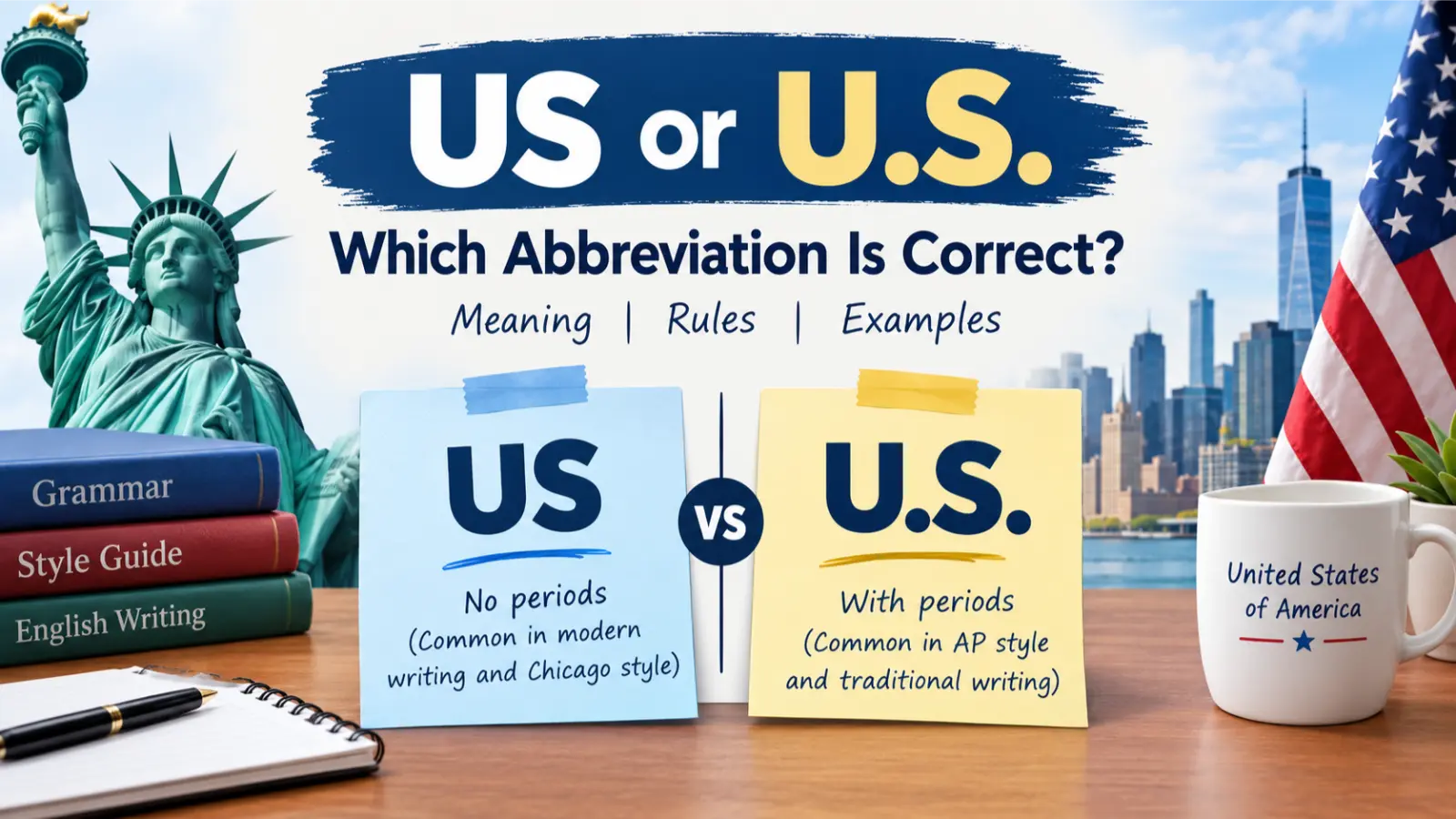
US or U.S. is a common writing question for students, bloggers, journalists, and professional writers. Both forms refer to the United States, but they follow different punctuation preferences. Understanding these differences helps you choose the right form for your audience and writing style.
The good news is that neither spelling is universally incorrect. US omits periods, while U.S. includes them. The best option depends on the style guide you follow and the context in which you use the abbreviation.
Quick Answer: US or U.S.?
Both US and U.S. are accepted abbreviations for the United States of America. The Chicago Manual of Style prefers US without periods, while Associated Press style traditionally uses U.S. in regular text and US in headlines. Always follow your publication’s preferred style.
What Does US Mean?
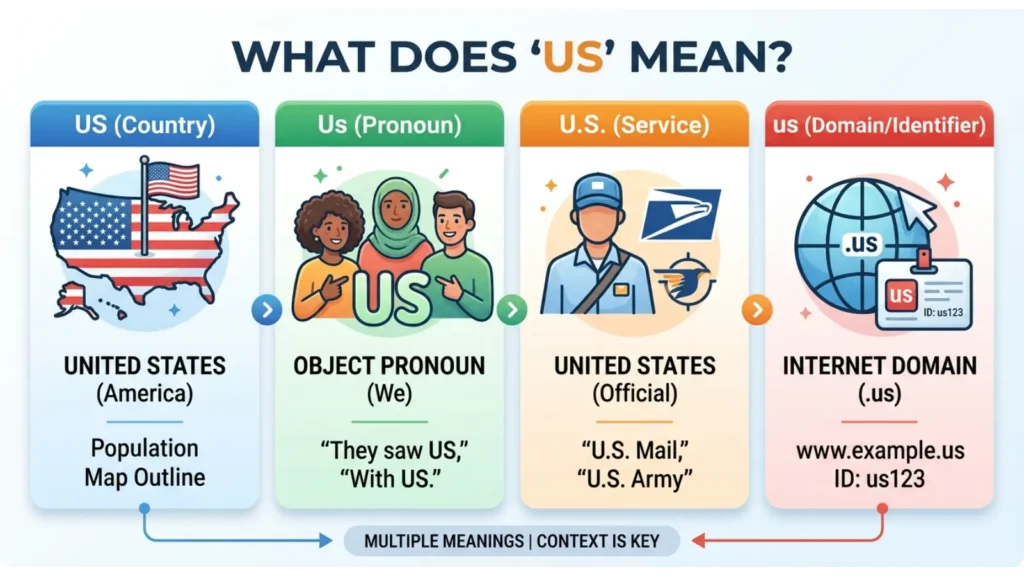
US stands for United States. Writers use it as a shortened form of the country’s name, particularly when discussing American society, government, geography, or the economy.
Examples:
- The US has a diverse population.
- She moved to the US last year.
- The US economy affects global markets.
The version without periods is especially useful in modern publications that prefer simplified punctuation.
What Does U.S. Mean?
U.S. also stands for United States. The periods show the traditional abbreviation of the two initial letters. This form remains common in American newspapers, government documents, educational materials, and other publications that follow traditional punctuation rules.
Examples:
- The U.S. government announced a new policy.
- He applied for a U.S. passport.
- The U.S. economy continues to influence international trade.
Both forms communicate the same basic meaning.
US vs. U.S.: Comparison Table
| Feature | US | U.S. |
|---|---|---|
| Full form | United States | United States |
| Periods | No | Yes |
| General meaning | Same | Same |
| Chicago style | Preferred | Not preferred |
| AP style | Used in headlines | Used in regular text |
| Modern appearance | Streamlined | Traditional |
| Correctness | Correct | Correct |
These differences concern editorial style rather than a difference in the country’s identity.
Origin of the Abbreviations
Both forms developed from the initials of United States. The abbreviation became widely used as the country’s name appeared frequently in official documents, newspapers, books, and everyday communication.
Traditional American writing often placed periods after abbreviated initials. Over time, many publishers began removing periods from capitalized abbreviations to make text cleaner and more consistent. This explains why US and U.S. continue to appear in modern English.
Why Do People Confuse US and U.S.?
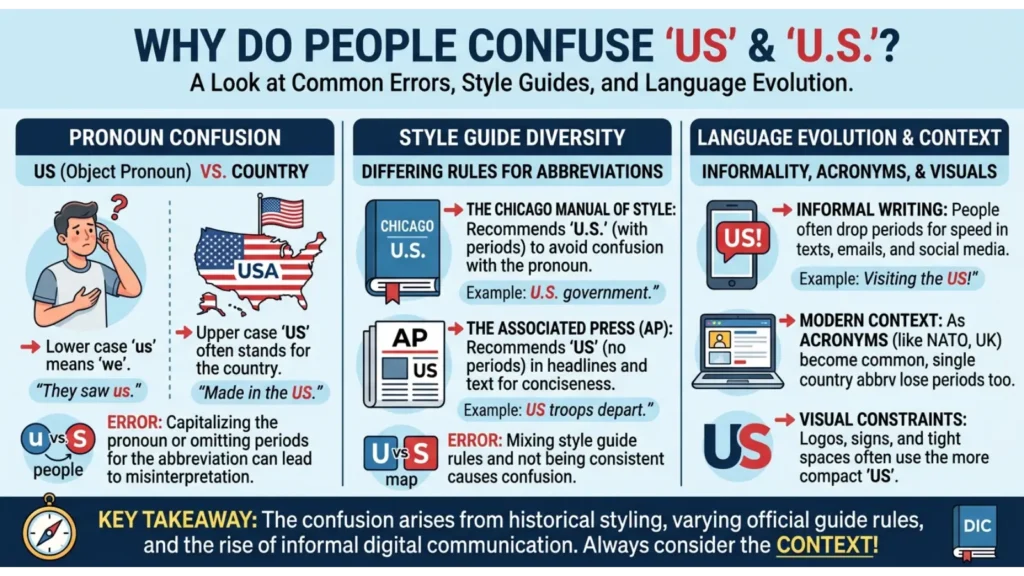
The confusion exists because different style guides recommend different punctuation practices. Readers may see U.S. in a government report and US in a newspaper or online article.
Another reason is that writers sometimes assume every abbreviation must contain periods. In reality, English punctuation conventions vary according to the publication, organization, and type of abbreviation.
For example, NASA is written without periods, and many publishers use US in the same way. Other organizations retain traditional punctuation for U.S.
Dictionary and Style Guide Recommendations
There is no single punctuation rule that every English publication follows.
The Chicago Manual of Style prefers US without periods and allows it as a noun when the meaning is clear. The Associated Press follows a different convention, using U.S. in regular text and US in headlines. Government publications may follow their own official guidelines.
The key lesson is to follow one style consistently instead of switching between forms without a reason.
Real-Life Examples of US and U.S.
Examples Using US
- The US is home to many national parks.
- Our company plans to expand into the US market.
- She studies American history at a US university.
- The US president delivered a public address.
Examples Using U.S.
- The U.S. government released an official statement.
- He is applying for a U.S. visa.
- The U.S. military operates in several regions.
- The U.S. Department of State published new information.
These examples demonstrate how both forms work in ordinary sentences. Your chosen style guide determines which version you should publish.
Common Mistakes to Avoid
Switching Between Forms
Using US in one paragraph and U.S. in the next can make an article look inconsistent. Select one form according to your style guide.
Assuming U.S. Is Always More Formal
The presence of periods does not automatically make a sentence more professional. Many respected publications use US without periods.
Assuming US Is Incorrect
US is an accepted form in several major editorial styles. Removing periods is a style choice, not necessarily a spelling error.
Confusing US With USA
US and USA both refer to the United States, although USA explicitly includes the word America. Follow your publication’s conventions when choosing between them.
Forgetting Context
Some formal documents prefer the full name, United States, when referring to the country as a noun. Check the rules that apply to your document.
Memory Trick: How to Remember US or U.S.
Use this simple reminder:
- US: Understand it as the streamlined version without periods.
- U.S.: Remember the traditional version with periods after both initials.
Both forms refer to the same country. The important thing is to use the version required by your publication or organization.
Which Form Should You Use in Professional Writing?
For professional writing, choose the form recommended by your organization’s style guide.
Use US if your publication follows the Chicago Manual of Style or another guide that prefers abbreviations without periods. Use U.S. if you follow Associated Press conventions in regular text or a government style guide that requires periods.
If no style guide is available, either form can work. Choose one and apply it consistently throughout your article, report, website, or academic assignment.
For particularly formal writing, consider spelling out United States when it improves clarity or matches the required style.
Frequently Asked Questions
Is US or U.S. correct?
Both are correct abbreviations for United States. The difference is punctuation and editorial preference.
Is US more modern than U.S.?
US often has a more streamlined appearance and is preferred by many modern style guides. However, U.S. remains widely used and accepted.
Should I write US or U.S. in an essay?
Check your instructor’s or institution’s style requirements. If none are provided, choose one form and use it consistently.
Does AP style use US or U.S.?
Associated Press style traditionally uses U.S. in regular text and US in headlines.
Is USA different from US?
Both refer to the United States, but USA stands for United States of America. US stands for United States. Their use depends on context and publication style.
Conclusion
Choosing between US and U.S. is mainly a matter of punctuation and style. Both forms refer to the United States, and neither is universally wrong. Chicago style prefers US without periods, while AP style traditionally uses U.S. in regular text. Follow your required style guide, maintain consistency, and spell out United States whenever the full name makes your writing clearer.