Choosing the right players for your fantasy football lineup can make a big difference in your weekly results. A Start or Sit Calculator helps fantasy football managers compare players, review projected points, and decide who belongs in the starting lineup and who should remain on the bench.
Instead of relying only on personal opinions, you can use player statistics, matchups, injury updates, and scoring rules to make better decisions. The goal is to build a competitive lineup while understanding that no calculator can guarantee a win.
What Is a Start or Sit Calculator?
A Start or Sit Calculator is a fantasy football tool that helps managers decide which players to start and which players to bench for an upcoming game week.
The tool compares available players using information such as projected fantasy points, recent performances, opponent strength, playing time, and injury status. Some calculators also consider league scoring settings and player rankings.
For example, if you have two wide receivers competing for one lineup spot, the calculator can help you compare their expected production and identify the stronger option.
How Does a Fantasy Football Start or Sit Calculator Work?
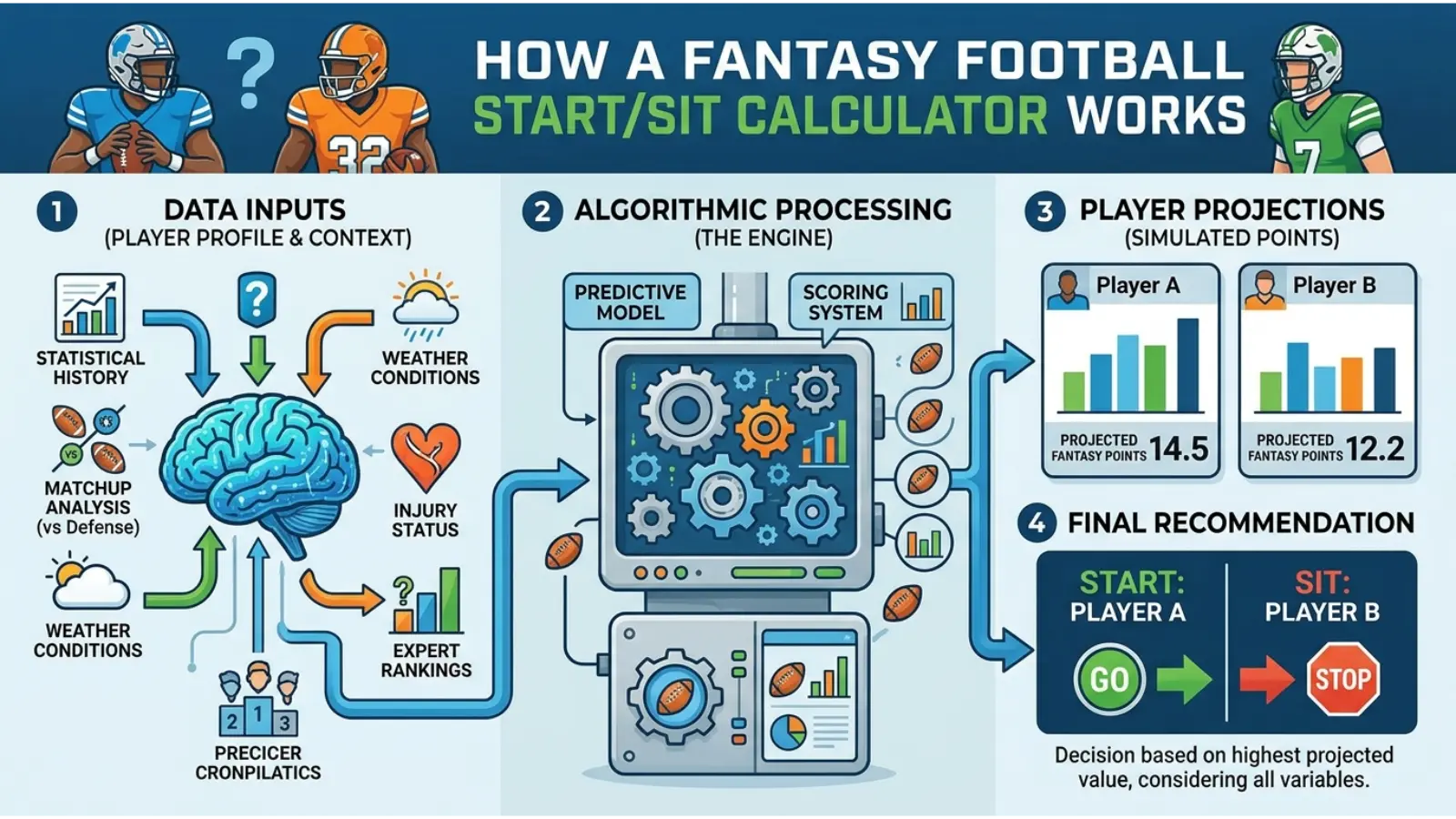
Most start or sit tools follow a simple process. They collect player information, compare relevant statistics, and present an estimate of each player’s expected performance.
Player Projections
Player projections estimate how many fantasy points a player might score during an upcoming game. These estimates often consider past performances, expected workload, touchdowns, receptions, and other relevant statistics.
A player with a higher projection may be the better choice, but the difference between two projections should not be treated as a guaranteed outcome.
Matchup Analysis
A player’s opponent can influence his fantasy potential. For example, a running back facing a defense that struggles to stop the run may have a favorable opportunity.
However, matchup rankings do not tell the whole story. Team strategy, offensive line performance, and expected playing time also matter.
Injury Reports and Playing Time
Injuries can change a player’s expected workload or prevent him from playing. A calculator may include injury designations, but managers should verify the latest official reports before kickoff.
Also consider whether a player has recently gained or lost playing time. A backup who receives more opportunities may become a useful fantasy option.
League Scoring Settings
Different fantasy leagues award points differently. In a points per reception league, commonly called PPR, players receive additional points for catches. Standard scoring leagues generally do not award points for receptions.
Always select the correct scoring format when using a calculator. Otherwise, the comparison may not reflect your league’s actual rules.
How to Use a Start or Sit Calculator Step by Step
Follow these steps to compare players and make a more informed lineup decision.
- Choose your fantasy football league. Check your roster, scoring format, and starting lineup requirements.
- Select the players. Enter the names of the players you are considering for the same position or a flexible lineup spot.
- Review projected points. Compare their expected fantasy production for the upcoming week.
- Check their matchups. Review opponent strength, expected workload, and recent performances.
- Verify injury information. Look for official updates that could affect availability or playing time.
- Compare the results. Consider projections, player roles, scoring rules, and potential risks.
- Make your final decision. Choose the player who best fits your lineup and weekly strategy.
Recheck important information before the games begin because late injury announcements and lineup changes can affect your decision.
Which Players Should You Start or Sit?
The right decision depends on the player, position, scoring format, and available alternatives. A player who deserves a starting spot in one league may be a bench option in another.
Quarterbacks
When comparing quarterbacks, review passing yards, touchdown potential, rushing ability, turnovers, and the opposing defense.
A quarterback who produces consistent fantasy points may be a safer option than one who depends on occasional long passes. However, a high-upside quarterback can be attractive when you need a larger score to compete.
Running Backs
Running backs benefit from carries, receptions, goal-line opportunities, and a consistent role in the offense.
Before starting a running back, check whether he shares work with another player. A favorable matchup can help, but limited opportunities may reduce his fantasy value.
Wide Receivers
Wide receivers depend on targets, receptions, receiving yards, and touchdowns. PPR leagues often increase the value of receivers who regularly catch passes.
Review target volume, recent usage, quarterback performance, and the opposing pass defense before choosing between two receivers.
Tight Ends
Tight ends can be difficult to evaluate because their opportunities vary considerably. Look at targets, routes, red-zone involvement, and expected playing time.
A tight end who regularly receives passes may provide a more dependable option than one who needs a touchdown to produce a strong fantasy score.
Flex Players
A flex position usually allows eligible players from multiple positions, depending on league rules. Compare the available running backs, wide receivers, and eligible tight ends using the same scoring settings.
Do not automatically choose a running back over a receiver or the other way around. Focus on projected points, workload, consistency, and the needs of your lineup.
Important Factors to Check Before Making Your Decision
A calculator is most useful when you understand the information behind its recommendation.
- Recent performance: Review recent fantasy scores, but avoid assuming that one excellent game guarantees another.
- Expected workload: Carries, targets, routes, and playing time help explain a player’s opportunities.
- Matchup quality: Consider how the opposing defense performs against the player’s position.
- Injury status: Confirm whether the player is healthy enough to participate and whether his workload may be limited.
- Team situation: Changes in offensive strategy, teammate injuries, and expected game conditions may affect production.
- Scoring format: Use the exact rules of your fantasy league.
- Consistency and upside: Decide whether you prefer a more predictable performance or a player with greater potential for a high score.
These factors work together. No single statistic should automatically determine your entire lineup.
Common Mistakes to Avoid When Using a Start or Sit Calculator
Even helpful tools can lead to poor decisions when managers interpret their results incorrectly.
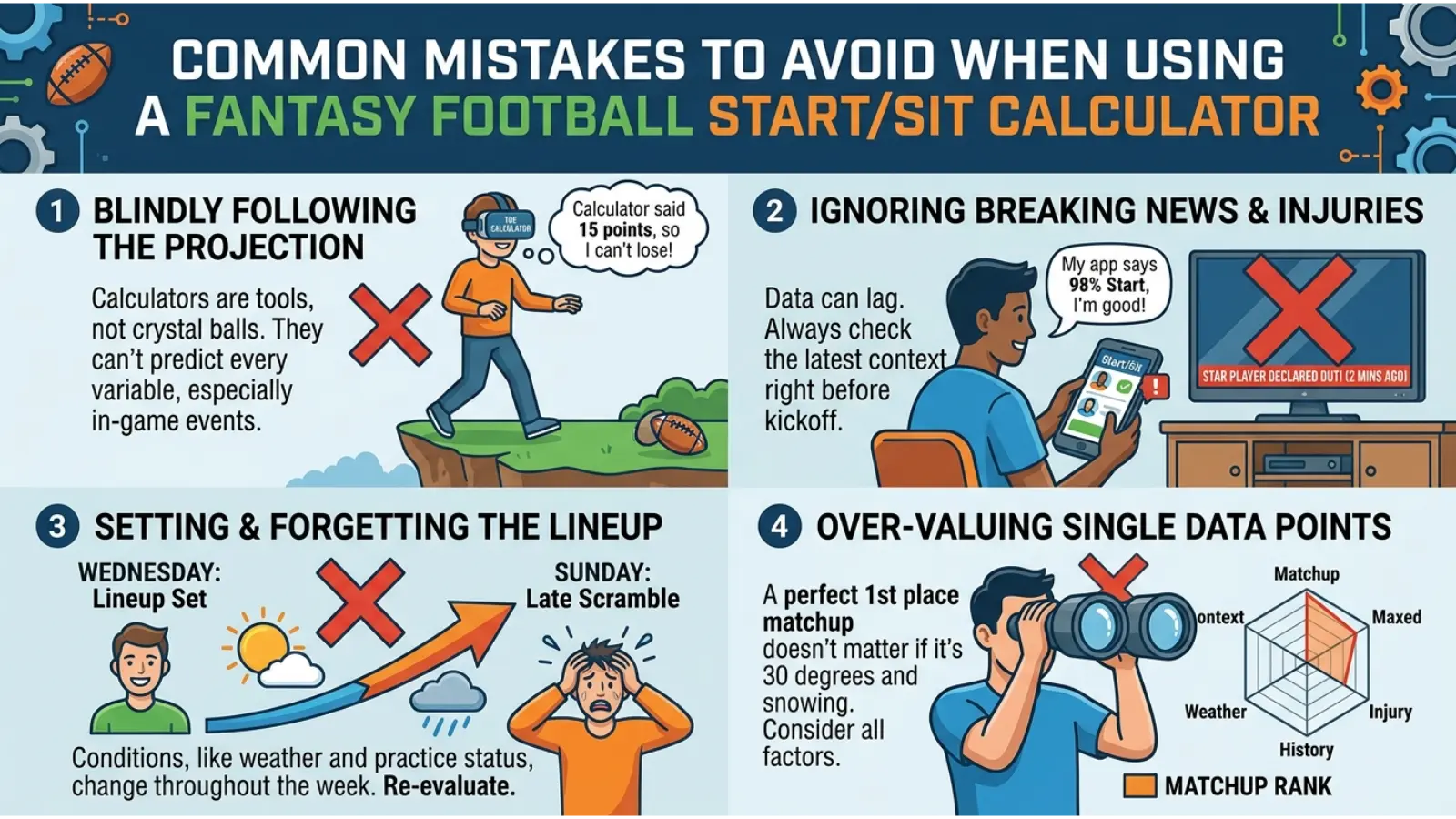
Following Projections Without Checking News
Projections may become outdated when new injury information or lineup changes emerge. Always check important updates before the relevant game begins.
Choosing Players Based Only on Their Last Game
One strong performance can create unrealistic expectations. Look at the player’s overall role, opportunities, and longer-term performance rather than relying on one result.
Ignoring Your League’s Scoring Rules
A receiver who catches many passes may have greater value in PPR scoring than in a standard league. Selecting the wrong format can distort the comparison.
Overreacting to Small Projection Differences
A projected difference of one or two points does not guarantee that one player will outperform another. Consider the uncertainty surrounding both players before making your decision.
Forgetting About Bye Weeks
An NFL team on a bye does not play a regular-season game that week. Check the schedule and make sure every player in your starting lineup is eligible to score points.
Best Tips for Getting More Value From a Start or Sit Calculator
Use the calculator as part of a broader decision-making process instead of treating its recommendation as a final answer.
First, compare players who could realistically fill the same position. Next, confirm the scoring format and review current player news. Then consider whether you need a dependable score or a higher-risk option with greater upside.
It also helps to understand the difference between a player’s expected points and his possible range of outcomes. A player may have a strong projection but still deliver a low score because of limited opportunities, injuries, turnovers, or unexpected game conditions.
Finally, review your decision before kickoff. A well-informed choice depends on current information, not simply on the first result shown by a tool.
Start or Sit Calculator Example
Imagine that you must choose between two fictional wide receivers for one starting lineup spot.
| Factor | Receiver A | Receiver B |
|---|---|---|
| Projected fantasy points | 14 | 12 |
| Recent performance | Consistent | Inconsistent |
| Expected role | Regular targets | Fewer expected targets |
| Injury status | Healthy | Questionable |
| Initial assessment | Stronger option | More uncertainty |
In this example, Receiver A appears to be the stronger choice because he has a higher projection, a more consistent recent record, and fewer availability concerns.
However, these figures are illustrative rather than live player projections. Actual decisions should use current statistics, confirmed injury information, and your league’s scoring rules.
The example demonstrates how a calculator can organize relevant information without eliminating uncertainty.
Frequently Asked Questions
What Is the Best Start or Sit Calculator?
The best calculator is one that provides relevant player projections, current injury information, matchup details, and support for your league’s scoring format. Compare the information each tool offers before relying on its recommendation.
Is a Start or Sit Calculator Free?
Some fantasy football start or sit calculators are available for free, while others offer premium features or require a subscription. Check the individual tool’s current terms before using it.
Should I Always Start the Player With the Highest Projection?
Not necessarily. A higher projection is a useful starting point, but injuries, changes in workload, scoring settings, and your team’s situation can affect the final decision.
Can a Start or Sit Calculator Guarantee a Win?
No. Fantasy football involves uncertainty, and even well-projected players can perform below expectations. A calculator helps you make informed choices but cannot guarantee a particular result.
When Should I Use a Start or Sit Calculator?
Use it when setting your weekly lineup, especially when two or more players offer similar value. Check it again before kickoff if injury reports, player availability, or other important information changes.
Conclusion
A Start or Sit Calculator can simplify fantasy football lineup decisions by comparing player projections, matchups, expected workloads, and injury information. It helps managers evaluate their options instead of relying entirely on guesswork.
For the best results, choose the correct scoring format, review current player news, and consider both consistency and upside. Use the calculator as a guide, apply your own judgment, and make your final lineup decisions using the most reliable information available.