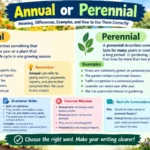
Understanding annual or perennial can help you choose the right plants, improve your vocabulary, and use these words correctly in everyday English. Although both words relate to time, they have different meanings and uses.
Annual usually describes something that happens once a year or a plant that completes its life cycle in one growing season. Perennial describes something that lasts for many years or continues over a long period. This guide explains their meanings, grammar rules, examples, and common mistakes in simple English.
What Is the Difference Between Annual and Perennial?
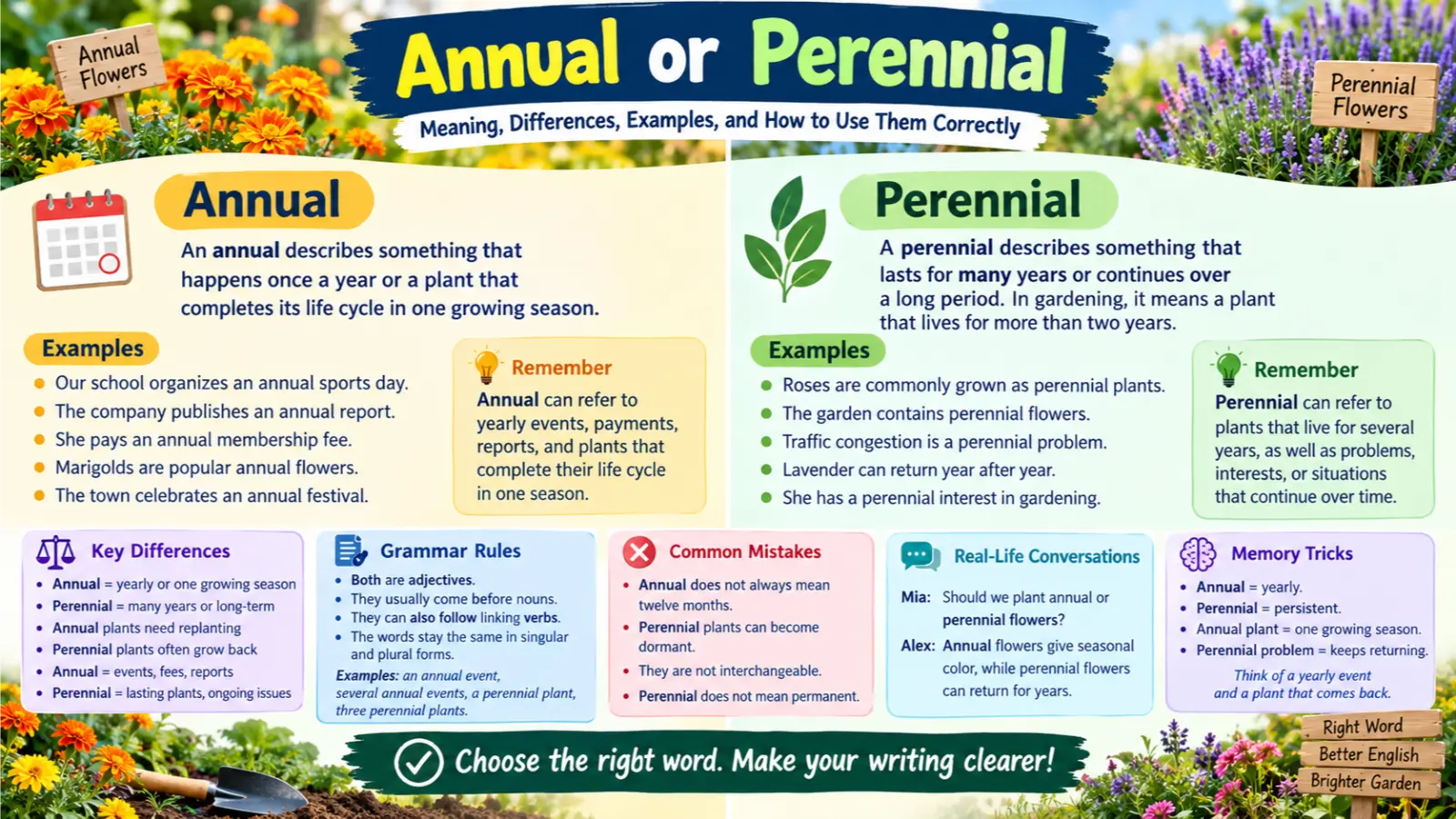
The main difference between annual and perennial is how long something lasts or how often it happens. Annual often refers to yearly events, payments, and reports. In gardening, it describes plants that complete their life cycle in one growing season.
Perennial usually refers to plants that live for more than two years. It can also describe problems, interests, or situations that continue for a long time.
For example, a school may organize an annual sports competition, while a perennial plant may grow again after winter. Understanding this difference helps you select the right word for your sentence.
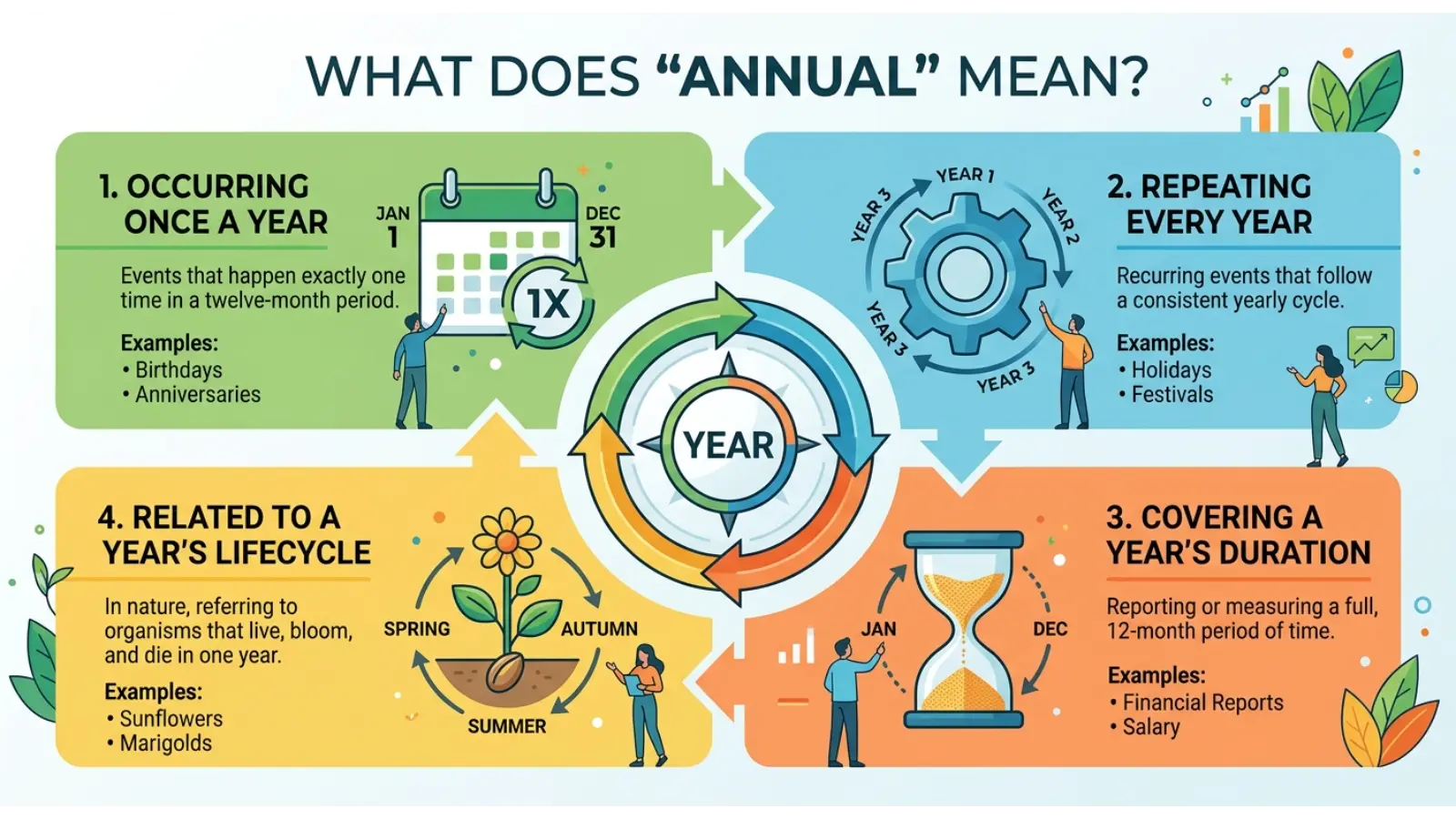
What Does Annual Mean?
Annual is an adjective that describes something that happens once a year or relates to a year. In gardening, an annual plant grows, flowers, produces seeds, and completes its life cycle within one growing season.
People commonly use annual when discussing events, financial reports, subscriptions, celebrations, and plants.
Examples of annual in sentences.
- Our school organizes an annual sports day.
- The company publishes an annual financial report.
- She pays an annual membership fee.
- Marigolds are commonly grown as annual flowers.
- The town celebrates an annual cultural festival.
Expert insight: Annual does not always mean that something lasts for exactly twelve months. An annual event may happen once a year, while an annual plant typically completes its life cycle within one growing season.
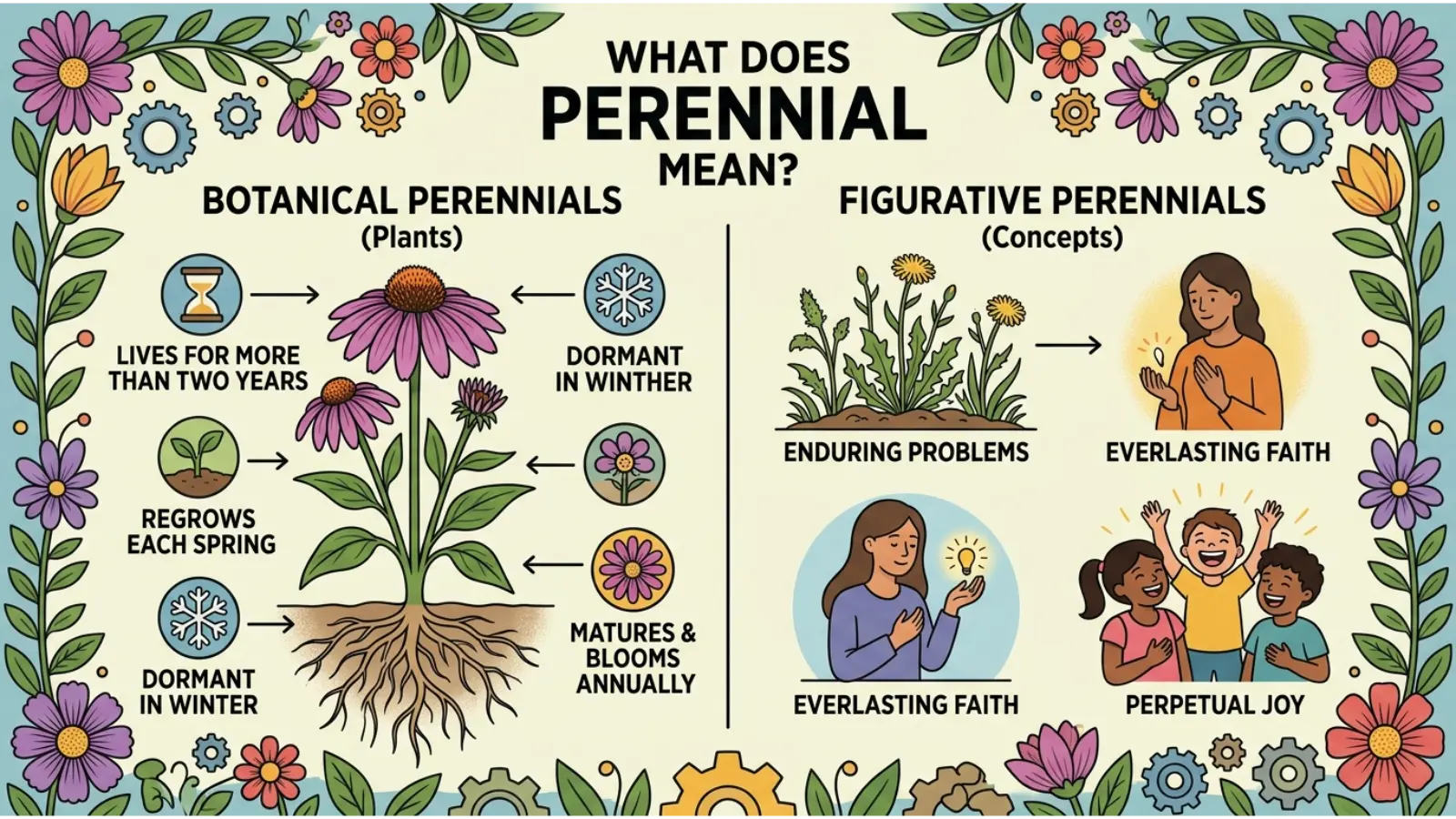
What Does Perennial Mean?
Perennial is an adjective that describes something that lasts for many years or continues over a long period. In gardening, a perennial plant lives for more than two years and can grow again during later growing seasons.
Perennial plants may become dormant during winter or another unfavorable season. Their leaves and flowers may disappear temporarily, but the plant can survive and regrow when conditions improve.
Examples of perennial in sentences.
- Lavender is a perennial plant in suitable climates.
- Roses are commonly grown as perennial plants.
- Traffic congestion is a perennial problem in the city.
- The organization continues to face a perennial challenge.
- She has a perennial interest in gardening.
Expert insight: Perennial does not mean that something lasts forever. It means that something can continue for years or repeatedly return. Plant survival depends on the species, climate, and growing conditions.
Annual vs Perennial Plants
Annual and perennial are especially important terms in gardening because they describe different plant life cycles. Knowing the difference helps gardeners plan flower beds, manage maintenance, and choose plants for different seasons.
Annual plants usually provide seasonal color and need to be replanted if you want them again the following growing season. Perennial plants can survive for several years and may return without being replanted.
Examples of commonly grown annual plants include marigolds, zinnias, and many sunflowers. Common perennial plants include lavender, hostas, and many varieties of roses.
Gardeners should check the specific plant variety before purchasing it because some plants behave differently depending on the climate. A plant that grows as a perennial in a warm region may be grown as an annual in a colder region.
Expert insight: Choose annuals when you want flexible seasonal displays. Choose perennials when you want a garden that can develop over several years. Combining both types can create attractive flower beds with changing colors and long-lasting structure.
Annual or Perennial: Key Differences
Understanding the main differences makes it easier to use these words correctly in writing and conversation.
| Feature | Annual | Perennial |
|---|---|---|
| General meaning | Yearly or related to one year | Lasting for many years |
| Plant life cycle | Completes its life cycle in one growing season | Lives for more than two years |
| Replanting | Usually needed for another display | Often unnecessary if the plant survives |
| Common plant examples | Marigolds and zinnias | Lavender and hostas |
| Business usage | Annual report or annual fee | Perennial business challenge |
| Time pattern | Happens yearly or lasts one growing season | Continues for years or repeatedly returns |
Expert insight: Do not compare the words only by their connection to time. Their exact meanings depend on context. Annual can describe frequency, while perennial often describes long-term duration or persistence.
Grammar Rules for Annual and Perennial
Annual and perennial are adjectives. They describe nouns and usually appear before the nouns they modify.
Examples include annual meeting, annual report, perennial flower, and perennial problem.
Both adjectives can also appear after linking verbs such as is, are, was, and were.
Examples.
- The meeting is annual.
- These flowers are perennial.
- The review was annual.
- Those plants are perennial.
The adjectives do not change when the noun becomes plural. You can write one annual event or several annual events. Similarly, you can write one perennial plant or several perennial plants.
Expert insight: Remember that the noun changes to show singular or plural, but the adjectives annual and perennial stay the same. This rule makes it easy to use both words in grammatically correct sentences.
Sentence Structure and Usage Examples
You can use annual and perennial in several common sentence structures. Learning these patterns will help you apply both words naturally.
Adjective before a noun.
- We attended an annual conference.
- They planted perennial flowers.
Adjective after a linking verb.
- The celebration is annual.
- These plants are perennial.
Using annual to describe frequency.
- The organization reviews its policies annually.
- We visit our relatives every year.
Using perennial to describe an ongoing situation.
- Budget planning remains a perennial concern.
- Water shortages are a perennial challenge in some regions.
Notice that annually is the adverb form of annual. Perennial is commonly used as an adjective, while perennially is its adverb form.
Expert insight: Choose the form that fits your sentence. Use annual before a noun, annually to describe how often an action happens, and perennial to describe something lasting or recurring over a long period.
Common Mistakes When Using Annual and Perennial
Writers sometimes confuse annual and perennial because both words relate to time. However, using one in place of the other can change the meaning of a sentence.
Mistake one: Assuming annual always means twelve months.
An annual event may take place once every year without lasting twelve months.
Incorrect explanation: An annual festival must last an entire year.
Correct explanation: An annual festival happens once a year.
Mistake two: Thinking perennial plants never lose their leaves.
Some perennial plants become dormant during cold or dry seasons. They may lose their leaves and grow again when conditions improve.
Mistake three: Treating annual and perennial as interchangeable.
An annual flower usually completes its life cycle in one growing season, while a perennial flower can survive for multiple years.
Mistake four: Assuming perennial means permanent.
A perennial problem may continue for years, but it can still be solved. A perennial plant can also die if growing conditions become unsuitable.
Expert insight: Always consider the meaning of the entire sentence before choosing a word. Context helps you determine whether you are describing frequency, a plant life cycle, or a situation that continues over time.
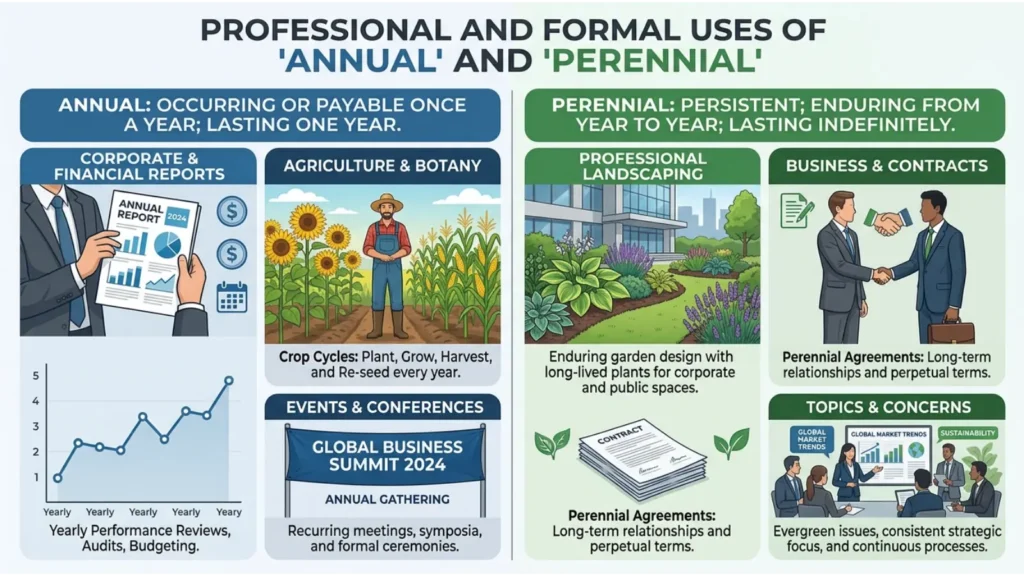
Professional and Formal Uses of Annual and Perennial
Annual and perennial are both appropriate in professional, academic, business, and educational writing. The correct choice depends on what you want to communicate.
In business, annual commonly appears in financial reports, budgets, performance reviews, and membership fees. It tells readers that something relates to a year or happens once each year.
In gardening and environmental writing, perennial often describes plants that survive for multiple growing seasons. In general writing, it can describe continuing concerns, repeated challenges, or long-lasting interests.
Examples of professional usage.
- The company released its annual financial report.
- Employees receive an annual performance review.
- The garden contains perennial flowers and shrubs.
- Water management remains a perennial concern.
- The research team conducts an annual assessment.
Expert insight: Professional writing requires precision. Use annual when the yearly schedule matters and perennial when continued existence or repeated recurrence matters. Avoid choosing a word merely because it sounds formal.
Real-Life Conversations Using Annual and Perennial
Everyday conversations provide an easy way to understand how these words work.
Conversation one: Gardening
Mia: Should we plant annual or perennial flowers?
Alex: Annual flowers give us seasonal color, while perennial flowers can return for several years.
Mia: Then we can combine both types in the garden.
Conversation two: Office work
Sara: Do we need to prepare another report?
James: Yes, our annual report is due next month.
Sara: I will organize the financial information this week.
Conversation three: Everyday problems
Ali: Why do people call traffic congestion a perennial problem?
Ahmed: Because it continues for a long time and keeps returning.
Expert insight: Real-life examples help you connect vocabulary with situations you already understand. Annual often relates to schedules and yearly activities, while perennial often describes long-lasting patterns or concerns.
Easy Memory Tricks for Annual and Perennial
Simple memory tricks can help you remember the difference without memorizing complicated definitions.
Annual means yearly. Think of an annual birthday celebration, school event, or financial report. These activities happen once a year.
Perennial means lasting for years. Think of a perennial plant that survives one growing season and returns in another.
Annual plants complete one growing season. Picture a flower growing from a seed, producing more seeds, and completing its life cycle.
Perennial problems keep returning. Picture a concern that people continue to face over many years.
You can also ask yourself two questions before choosing a word.
- Does the sentence describe something that happens once a year or a plant that completes its life cycle in one growing season? Use annual.
- Does the sentence describe something that lasts for several years or continues over time? Use perennial.
Expert insight: Associate annual with a yearly schedule and perennial with persistence. These simple connections make both words easier to remember and use correctly.
Frequently Asked Questions About Annual or Perennial
What is the main difference between annual and perennial?
Annual means yearly or describes a plant that completes its life cycle in one growing season. Perennial describes something that lasts for many years or continues over time.
Are annual and perennial synonyms?
No, they are not interchangeable synonyms. Both relate to time, but annual often emphasizes yearly frequency, while perennial emphasizes long-term survival or persistence.
Which flowers are annual?
Marigolds, zinnias, and many sunflowers are commonly grown as annuals. Their classification can depend on the species and local climate.
Which flowers are perennial?
Lavender, hostas, and many roses are examples of perennial plants. They can survive for several years under suitable growing conditions.
Can perennial describe a problem?
Yes. A perennial problem is an issue that continues for a long time or repeatedly returns. For example, traffic congestion can be a perennial problem in a busy city.
Does annual mean every twelve months?
Not necessarily. Annual usually means once a year or related to a year. An annual event can last only a few hours or days.
Do perennial plants grow throughout the year?
Not always. Many perennial plants grow during favorable seasons and become dormant when temperatures or other conditions are unsuitable.
Which word should I use in formal writing?
Use annual when discussing yearly events, reports, payments, or activities. Use perennial when describing long-lasting plants, persistent challenges, or recurring concerns.
Conclusion
Understanding annual or perennial becomes much easier when you focus on the context. Annual describes something that happens once a year or a plant that completes its life cycle in one season. Learn the difference between annual or perennial with simple meanings, plant examples, grammar rules, common mistakes, and easy memory tricks. season. Perennial describes something that survives for multiple years or continues over a long period.
Both words are useful in gardening, business, education, and everyday communication. Remember that annual relates to yearly schedules, while perennial relates to persistence and long-term survival. With the examples, grammar rules, and memory tricks in this guide, you can choose the correct word confidently and avoid common mistakes.