Choosing between received or recieved can be confusing because both forms look similar and sound identical. However, only one spelling is accepted in standard English. Whether you are writing an email, completing a school assignment, or preparing a professional document, using the correct form helps make your writing clear and accurate.
The confusion often comes from the familiar spelling rule about the letters i and e. Although this rule can be helpful, it has several exceptions, and the word receive follows a different pattern than many people expect.
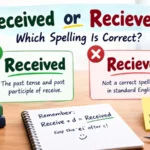
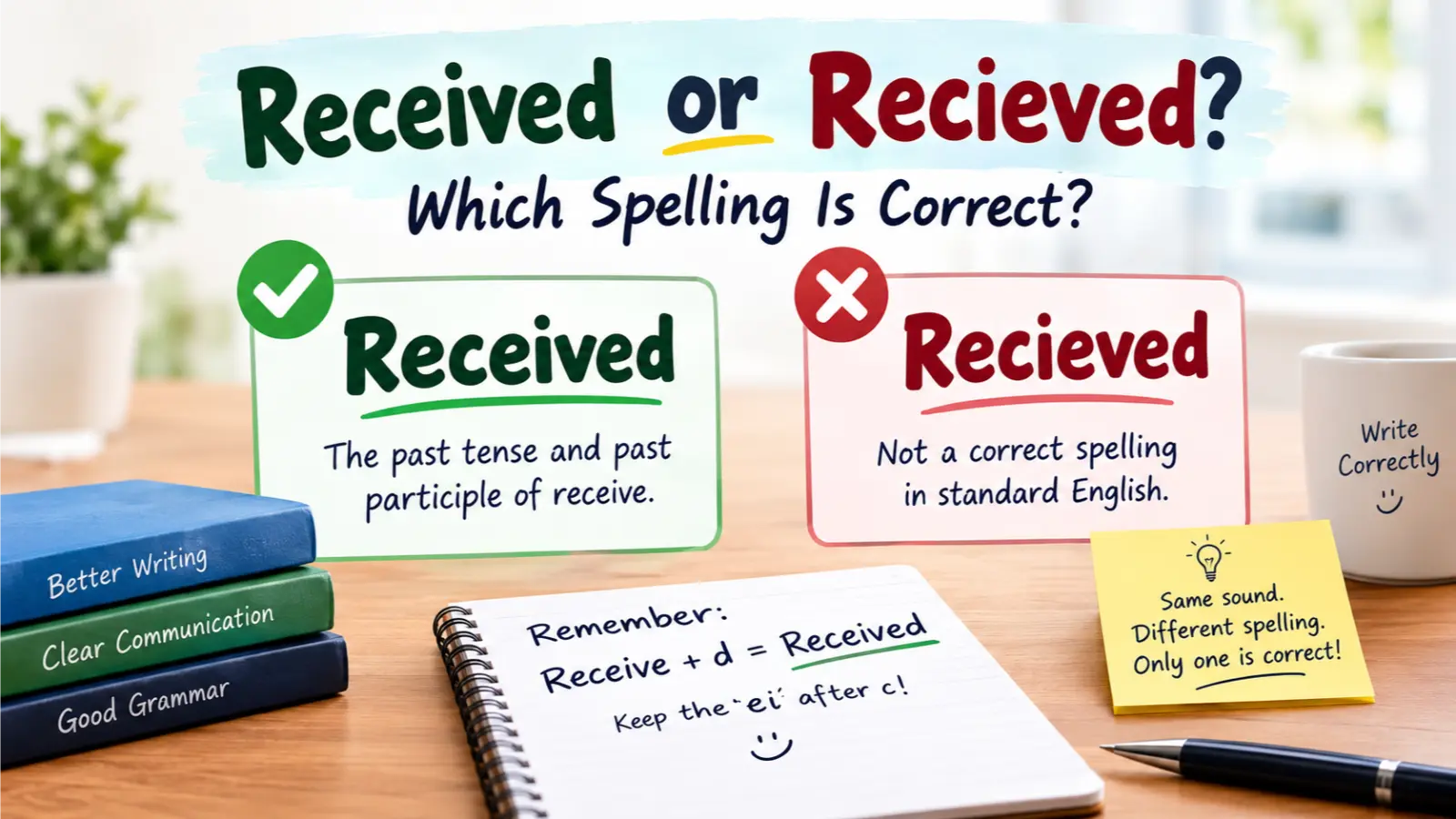
The key point is simple: received is correct, and recieved is a misspelling.
Quick Answer: Received or Recieved?
Received is the correct spelling. It is the past tense and past participle of the verb receive, meaning to get, accept, or be given something.
Recieved is incorrect in standard English and should not be used in formal or informal writing.
Examples.
- Correct: I received your email yesterday.
- Incorrect: I recieved your email yesterday.
Remember to spell the word as r-e-c-e-i-v-e-d.
What Does Received Mean?
The word received describes getting, accepting, or being given something. It can refer to physical objects, messages, information, payments, invitations, or other things.
It is the past tense of receive and also serves as its past participle.
Examples.
- She received a birthday gift from her friend.
- We received your application this morning.
- The company received the payment on Monday.
- He has received several invitations to the event.
In each sentence, the word explains that someone got or accepted something.
Received as a Past Tense Verb
Use received when describing an action that happened in the past.
Examples.
- I received the package last week.
- They received the results yesterday.
- My teacher received my assignment before the deadline.
Received as a Past Participle
Use received with helping verbs such as has, have, or had to form perfect tenses.
Examples.
- She has received the documents.
- We have received your confirmation.
- He had received the message before the meeting began.
These examples show why the correct spelling matters in different sentence structures.
What Does Recieved Mean?
Recieved is a misspelling of received. It does not have a separate meaning in standard English and is not an accepted alternative spelling.
People may type this form because they remember the common phrase “i before e” and apply it incorrectly. Others may simply make a typing mistake or confuse the spelling with similar words.
Incorrect examples.
- I recieved your letter.
- She has recieved the invitation.
- They recieved the payment yesterday.
Correct versions.
- I received your letter.
- She has received the invitation.
- They received the payment yesterday.
When writing for school, work, or publication, always replace recieved with received.
Received vs Recieved: Comparison Table
| Feature | Received | Recieved |
|---|---|---|
| Spelling status | Correct | Incorrect |
| Standard dictionary usage | Accepted | Not an accepted standard spelling |
| Meaning | Got or accepted something | No separate standard meaning |
| Part of speech | Verb form | Misspelling of a verb form |
| Past tense of receive | Yes | No |
| Suitable for professional writing | Yes | No |
| Example | I received the report. | I recieved the report. |
The distinction is straightforward. Use received whenever you mean that someone got, accepted, or was given something.
Why Do People Confuse Received and Recieved?
Several factors make this spelling mistake common.
The I Before E Rule
Many English learners learn the rule “i before e, except after c.” According to this familiar guideline, the letters i and e appear in a particular order in many words.
However, receive follows the “except after c” part of the rule. After the letter c, the spelling is ei, producing receive and received.
Examples of the same pattern include:
- Receive.
- Receipt.
- Deceive.
- Conceive.
- Perceive.
Learning these related words makes it easier to recognize the correct spelling.
Similar Pronunciation
In ordinary speech, received and recieved would generally be pronounced the same because they contain the same intended sounds. Since pronunciation does not reveal the letter order, writers must rely on spelling knowledge.
Typing Too Quickly
People sometimes write recieved while typing quickly, especially when composing emails, messages, or notes. Spell-checking tools can catch many such errors, but proofreading remains important.
Origin of the Word Received
The word received comes from the verb receive, which entered English through Anglo-French and Old French forms derived from Latin recipere, meaning to take back, take in, or accept.
The spelling reflects the history of the word rather than the simplified spelling patterns that learners sometimes memorize.
Understanding its connection to receive also makes the correct spelling easier to remember. The base verb keeps the same letter order when you add the past-tense ending -ed.
- Receive → Received.
- Deceive → Deceived.
- Conceive → Conceived.
- Perceive → Perceived.
Notice that the spelling does not change from ei to ie when the ending is added.
What Do Dictionaries Recommend?
Standard English dictionaries recognize receive as the correct base verb and received as its past tense and past participle.
The misspelling recieved is not a standard alternative.
When checking a spelling question, consult a reliable dictionary such as Merriam-Webster, Oxford, or Cambridge Dictionary. Look for the main entry receive and review its verb forms.
For professional writing, follow these recommendations.
- Use received in emails, reports, essays, and business documents.
- Use received in academic work and formal applications.
- Do not treat recieved as a regional spelling variant.
- Check the dictionary entry when you are uncertain about a word’s spelling or grammatical form.
British and American English both use received. There is no standard British-versus-American spelling difference for this word.
Real-Life Examples of Received
The following examples show how to use received in everyday communication.
Everyday Conversations
- I received your text a few minutes ago.
- Have you received my message?
- She received a beautiful gift for her birthday.
- We received an invitation to the wedding.
School and Education
- The student received a high grade on the exam.
- I received feedback from my English teacher.
- The school received new books for its library.
Business and Professional Writing
- We received your order and will process it shortly.
- The manager received the report before the meeting.
- Your payment has been received successfully.
- The applicant received confirmation by email.
Technology and Online Communication
- I received a notification on my phone.
- The server received the request from the application.
- We received your support ticket.
- She received the verification code by text.
These examples demonstrate that received works naturally across many situations.
Common Mistakes to Avoid
Understanding common errors helps you improve your spelling and write more confidently.
Writing Recieved Instead of Received
Incorrect: I recieved your application yesterday.
Correct: I received your application yesterday.
The letters after c should appear as ei, not ie.
Changing the Spelling in Perfect Tenses
Incorrect: She has recieved the package.
Correct: She has received the package.
The past participle remains received when used with has, have, or had.
Assuming Both Spellings Are Acceptable
Unlike some English words that have recognized regional spelling variants, received does not have a standard alternative spelling of recieved.
Trusting Pronunciation Alone
The two forms may look similar and represent the same intended pronunciation, but pronunciation cannot determine their correct written form. Check the spelling whenever you are unsure.
Forgetting to Proofread
A quick review can catch spelling errors before you submit an assignment or send a professional email. Use a spell-checking tool and read your text carefully.
Easy Memory Trick for Received
The easiest way to remember received is to connect it with the base word receive.
Think of this simple pattern:
Receive + d = received.
The spelling keeps the letters e-i after c. You do not change them to i-e when adding the past-tense ending.
You can also remember this sentence:
“I received what I came to receive.”
Both forms of the verb contain the same ei letter sequence.
For additional practice, memorize these related words.
- Receive and received.
- Deceive and deceived.
- Conceive and conceived.
- Perceive and perceived.
Writing these pairs a few times can help you recognize the pattern automatically.
Professional Writing Recommendation
In professional communication, accuracy helps your message look polished and credible. Always use received when referring to something that someone got, accepted, or was given.
Before sending an email or submitting a report, review words that are commonly misspelled. Pay particular attention to words whose pronunciation does not make their spelling obvious.
For example, write:
“Thank you for your email. I received the documents and will review them today.”
Avoid writing:
“Thank you for your email. I recieved the documents and will review them today.”
The first version follows standard English spelling and is appropriate for workplace communication.
If you use a grammar checker or word processor, enable spelling suggestions. These tools are helpful, but they should support your proofreading rather than replace it.
Frequently Asked Questions
Is received or recieved correct?
Received is correct. Recieved is a common misspelling and is not accepted as a standard alternative in English.
Why is received spelled with ei instead of ie?
The word receive follows the familiar “i before e, except after c” pattern. Because the letters follow c, the correct sequence is ei. The past-tense form keeps this spelling.
Is received correct in British and American English?
Yes. Both British and American English use received. Neither variety uses recieved as a standard spelling.
What is the past tense of receive?
The past tense of receive is received. For example, “I received your message yesterday.”
Is received a past tense or a past participle?
It can be both. Use received as a simple past-tense verb, as in “She received the letter,” or as a past participle, as in “She has received the letter.”
How can I remember the spelling of received?
Remember the base verb receive and add -d to form received. Keep the letters ei in the same order.
Conclusion
When choosing between received or recieved, always use received. It is the correct spelling in standard English, whether you are writing a casual message, a school assignment, or a professional document.
The mistake usually happens because writers misapply the “i before e” rule or type too quickly. Remember that receive contains ei after c, and the same spelling carries over to received.
With this simple rule and a little practice, you can avoid this common spelling mistake and communicate more confidently in English.