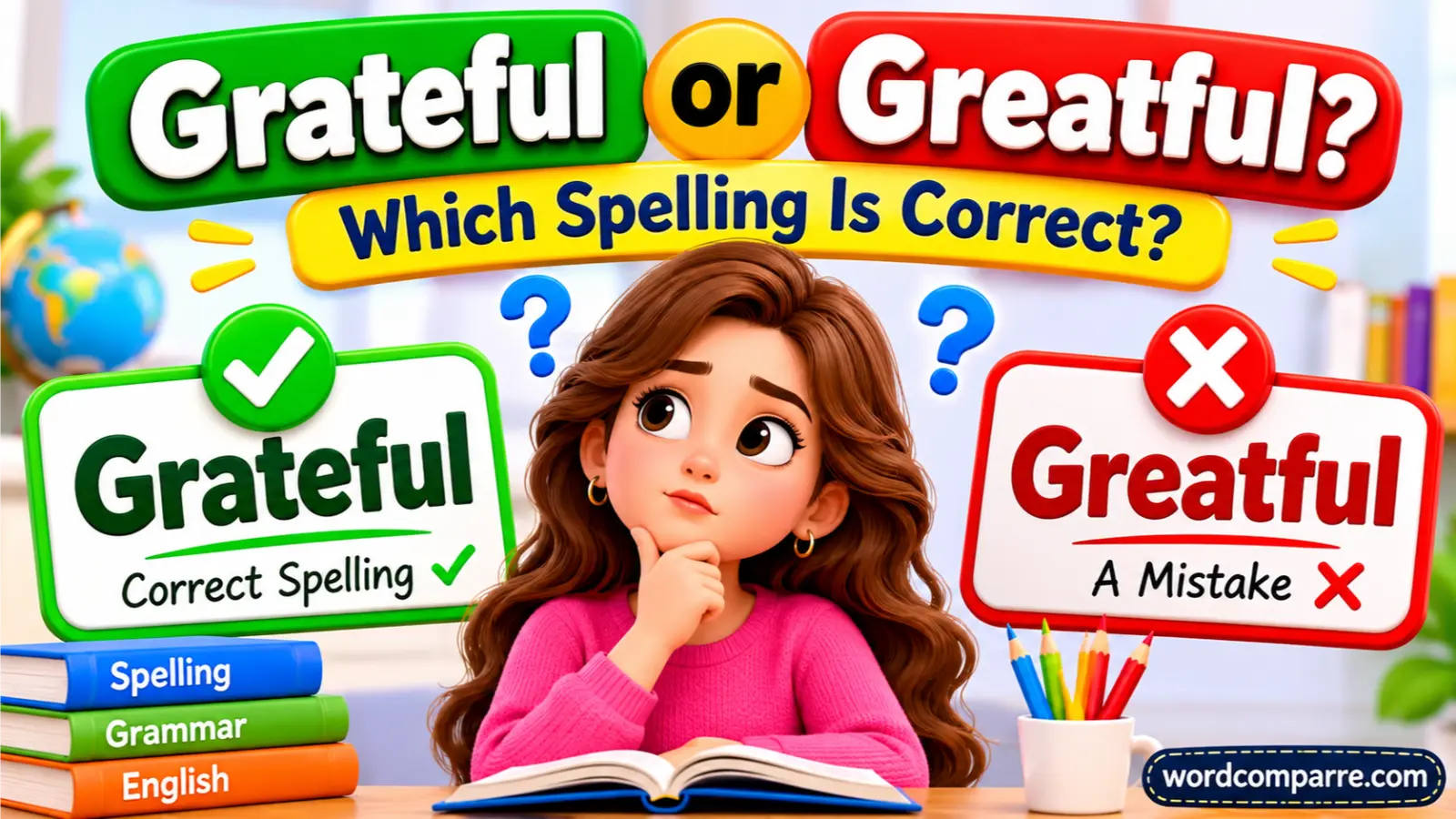
Have you ever wondered whether to write grateful or greatful? These two spellings look similar, so it is easy to mix them up. However, only one is correct in standard English. The correct spelling is grateful, which means feeling thankful or showing appreciation for something. On the other hand, greatful is a common spelling mistake that appears in informal writing, messages, and online searches.
Understanding the difference between grateful and greatful can help you improve your spelling and communicate more confidently. Whether you are writing a thank-you message, a professional email, a social media post, or an academic assignment, choosing the correct spelling matters.
Quick Answer: Grateful or Greatful?
Grateful is the correct spelling in standard English. It describes someone who feels thankful or appreciates something they have received.
Greatful is an incorrect spelling and is not recognized as a standard English word.
For example:
- Correct: I am grateful for your kindness.
- Incorrect: I am greatful for your kindness.
Always use grateful when you want to express appreciation or thankfulness.

Meaning of Grateful and Greatful
Although grateful and greatful look almost identical, they do not have the same status in English.
What Does Grateful Mean?
Grateful is an adjective that describes a feeling of thankfulness, appreciation, or recognition for someone’s kindness, support, or help.
People commonly use this word when someone does something thoughtful or provides something valuable.
Examples:
- I am grateful for your friendship.
- She felt grateful for the support of her family.
- We are grateful for your generous donation.
- He was grateful for the opportunity to work with the team.
The word can describe appreciation for people, experiences, opportunities, gifts, and everyday blessings.
What Does Greatful Mean?
Greatful is a misspelling of grateful. It is not an accepted standard English word and has no independent meaning in standard dictionaries.
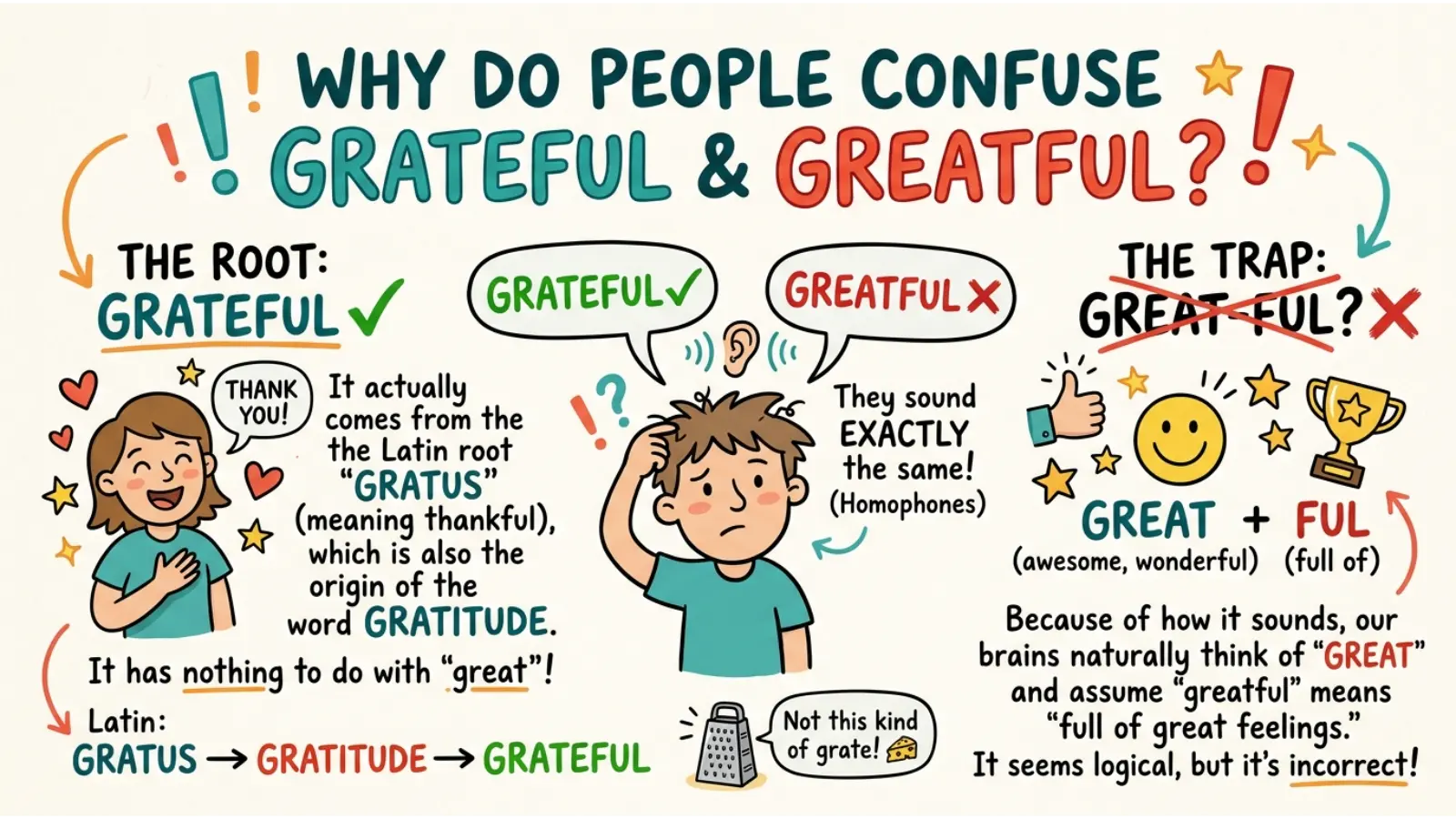
People sometimes write greatful because they associate it with the word great. However, the correct spelling comes from a different historical root.
Examples of incorrect usage:
- I am greatful for your help.
- She is greatful to her parents.
- We feel greatful for this opportunity.
In each sentence, grateful is the correct choice.
Grateful vs. Greatful: Comparison Table
| Feature | Grateful | Greatful |
|---|---|---|
| Spelling status | Correct | Incorrect |
| Part of speech | Adjective | Not a standard word |
| Meaning | Thankful or appreciative | No accepted standard meaning |
| Dictionary recognition | Recognized | Not recognized as standard |
| Professional writing | Recommended | Avoid |
| Everyday usage | Correct | Common misspelling |
| Example | I am grateful. | I am greatful. |
The main difference is simple: grateful is the correct English spelling, while greatful is a spelling error.
Origin of the Word Grateful
The word grateful has an interesting linguistic history. It comes from the Latin word gratus, which means pleasing, welcome, or thankful.
It entered English through French and developed into the adjective grateful.
Its spelling is also connected to the English word gratitude, which describes the feeling of being thankful.
This historical connection explains why grateful contains the letters G-R-A-T rather than G-R-E-A-T.
Although great and grateful look similar, they have different origins and meanings.
Why Do People Confuse Grateful and Greatful?
Many English learners and even native speakers make this spelling mistake. There are several reasons behind the confusion.
1. Similar Appearance
Both words contain almost the same letters. The main difference is the placement of the vowels.
Because of this similarity, people may type greatful without noticing their mistake.
2. Influence of the Word Great
The English word great means excellent, wonderful, or impressive.
Since gratitude is often associated with positive feelings, people naturally connect grateful with great. However, this connection does not determine the correct spelling.
3. Pronunciation Similarity
In everyday English, grateful and the imagined spelling greatful may seem similar when spoken quickly.
As a result, people sometimes rely on pronunciation rather than remembering the correct spelling.
4. Typing Habits
People frequently use informal messages and social media platforms where spelling mistakes can go unnoticed.
If someone repeatedly types greatful, the incorrect version may become familiar.
What Do Major Dictionaries Say?
Major English dictionaries recognize grateful as the correct spelling.
Established dictionary references support this usage:
- Merriam-Webster: Defines grateful as feeling or showing thanks or appreciation.
- Oxford English Dictionary: Records grateful as an established English adjective with a historical connection to gratitude.
- Cambridge Dictionary: Defines grateful as feeling or showing appreciation for something.
These dictionary references support the same conclusion: use grateful in standard English writing.
Real-Life Examples of Grateful in Sentences
The best way to remember a spelling is to see how people use it in everyday situations.
Personal Conversations
- I am truly grateful for everything you have done.
- She was grateful to her mother for the advice.
- We feel grateful to have such wonderful friends.
- I am grateful that you took the time to help me.
Workplace and Professional Writing
- I am grateful for your time and consideration.
- Our company is grateful for your continued support.
- We are grateful for the opportunity to collaborate with your organization.
- The manager was grateful for the team’s hard work.
Academic and Formal Writing
- Students should be grateful for educational opportunities.
- The researcher was grateful for the participants’ cooperation.
- I am grateful to my teachers for their guidance.
- The author expressed gratitude to everyone who contributed to the project.
Social Media and Thank-You Messages
- Feeling grateful for all the beautiful moments in life.
- I am grateful to everyone who supported me.
- Always be grateful for the little things.
- So grateful for the love and kindness surrounding me.
Notice that grateful works naturally in personal, professional, and academic situations.
Common Spelling Mistakes to Avoid
When writing grateful, people sometimes make other related spelling mistakes.
| Incorrect Spelling | Correct Spelling |
|---|---|
| Greatful | Grateful |
| Gratefull | Grateful |
| Greatfull | Grateful |
| Gratful | Grateful |
| Gratefulnesss | Gratefulness |
The correct spelling is grateful. Its related noun, gratitude, is also commonly used to express appreciation.
One important point: gratefulness is also a correctly spelled word, although gratitude is often the more natural choice.
Easy Memory Trick: How to Remember Grateful
Here is a simple way to remember the correct spelling.
Think of GRATITUDE, not GREAT.
Both grateful and gratitude begin with the letters GRAT.
Remember these three points:
- Grateful starts with GRAT, not GREAT.
- Grateful means thankful or appreciative.
- Greatful is a spelling mistake in standard English.
You can also remember this sentence:
“I am grateful because I have gratitude.”
This connection makes it easier to recall the correct spelling whenever you write.
Professional Writing Recommendation
In professional communication, spelling accuracy helps create a positive impression. Therefore, always use grateful instead of greatful.
Use grateful in:
- Business emails and formal letters.
- Academic assignments and research papers.
- Professional thank-you messages.
- Customer service responses.
- Blog posts and website content.
- Social media captions.
For example:
Professional: We are grateful for your continued trust and support.
Informal: So grateful for all the love and kindness!
Both examples use the correct spelling. The tone changes, but the spelling remains the same.
If you are unsure, check a trusted dictionary or use a spelling checker before publishing your work.
Frequently Asked Questions
1. Is it grateful or greatful?
Grateful is the correct spelling. Greatful is a common spelling mistake and should not be used in standard English.
2. Why is grateful not spelled greatful?
Grateful comes from the Latin word gratus and is related to gratitude. It does not come from the English word great.
3. Is greatful ever correct?
No. Greatful is not accepted as a standard English spelling. Use grateful when expressing thankfulness or appreciation.
4. What is the meaning of grateful?
Grateful means feeling thankful or appreciative for someone’s kindness, help, support, or a positive experience.
5. Is grateful a noun or an adjective?
Grateful is an adjective. It describes a person who feels thankful. Gratitude is the related noun.
6. What is the difference between grateful and gratitude?
Grateful is an adjective describing a feeling of thankfulness, while gratitude is a noun referring to the feeling itself.
Example: I am grateful for your help and express my gratitude for your kindness.
7. How do you spell grateful correctly?
The correct spelling is G-R-A-T-E-F-U-L. Remember that it begins with GRAT, not GREAT.
Conclusion
When choosing between grateful or greatful, always use grateful. It is the correct spelling in standard English and describes a feeling of thankfulness or appreciation. Greatful is simply a common spelling mistake caused by its visual similarity to the word great.
Remember the connection between grateful and gratitude to avoid this error in the future. Whether you are writing a personal message, professional email, school assignment, or website article, using grateful will keep your writing accurate and clear.