The words Blanky or Blankie may look like two different spellings, but both are used as informal terms for a favorite comfort blanket. Many children use a special soft blanket to feel safe, comfortable, and relaxed, especially during bedtime or stressful moments. However, you may wonder whether blanky or blankie is the better spelling and which form you should use in everyday writing.
In this article, we will explore the meaning of blanky and blankie, explain their spelling differences, and provide simple examples to help you understand when to use each word. Whether you are writing casually, talking about a child’s favorite blanket, or choosing the correct spelling, this guide will make the difference easy to understand.
Quick Answer
Both spellings are acceptable, but “blankie” is the safer and more common choice. It is the form most dictionaries list first, and “blanky” is usually recorded as a variant. In a book, article, product listing, or school document, use blankie. In a casual text or a personal note, “blanky” is perfectly fine.
What Each Spelling Means
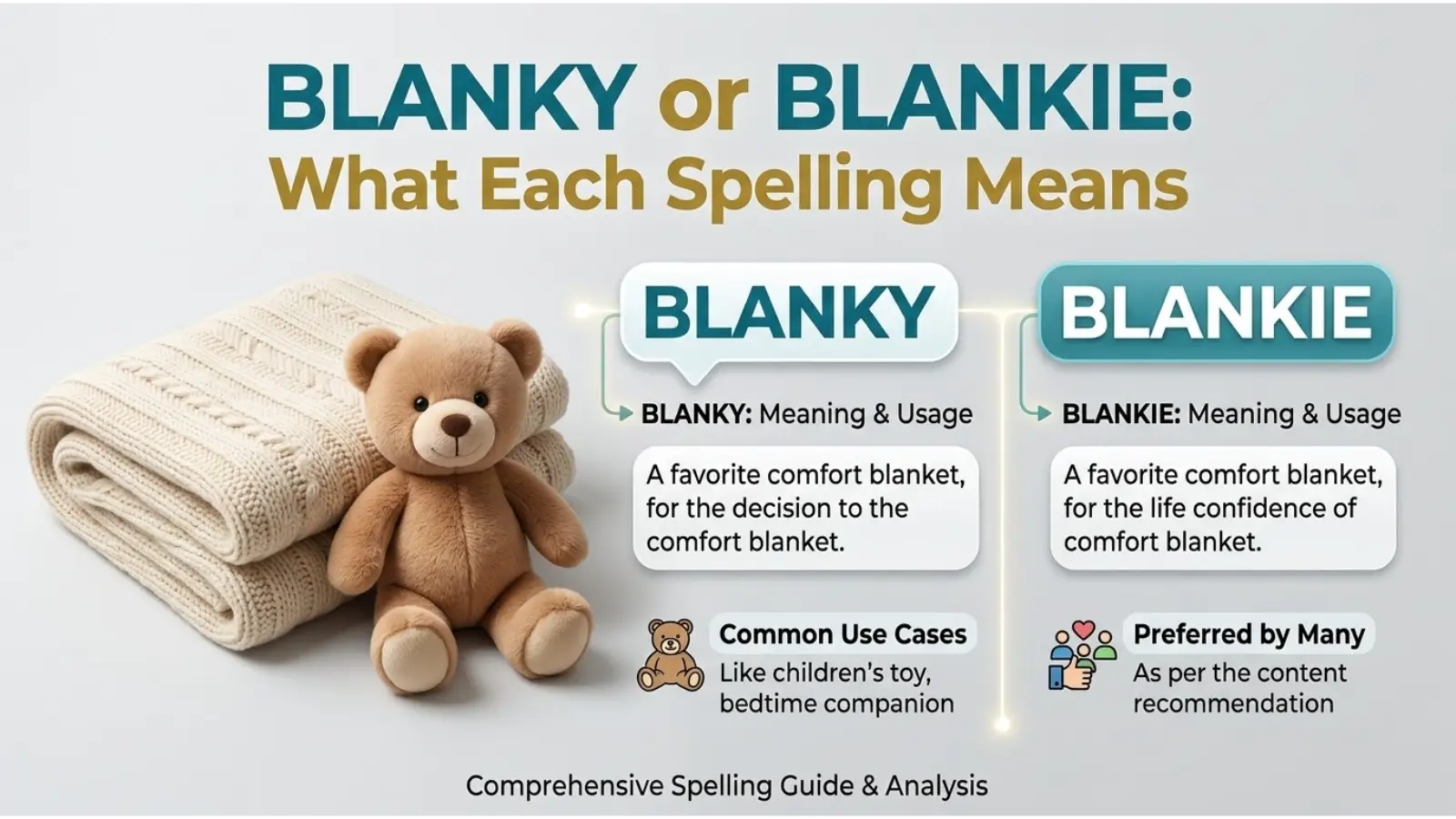
Both words mean the same thing: a small, soft blanket that a child carries around for comfort, often called a security blanket. The word can also be used affectionately for any blanket, especially a cozy one.
- Blankie: the standard informal spelling, listed first in most dictionaries.
- Blanky: a recognized variant with the identical meaning.
Neither word is a different word or a mistake for the other. They are two ways of writing the same sound.
Comparison Table
| Feature | Blankie | Blanky |
|---|---|---|
| Meaning | A child’s comfort blanket | Same |
| Dictionary status | Main entry | Variant spelling |
| Plural | blankies | blankies |
| Tone | Informal, widely accepted | Informal, more casual |
| Best for | Articles, product pages, books | Texts, captions, personal notes |
| Capitalized use | A character or product name | Rare |
Where the Word Comes From
Both spellings come from blanket, with the ending shortened and a pet-name ending added. English does this all the time with words for things children love: doggy, kitty, bunny, nightie, hanky. The two endings, -ie and -y, do the same job. They make a word sound smaller and warmer.
The idea of a “security blanket” became widely known in the 1950s and 1960s, partly through the cartoon character Linus in Peanuts. As the habit of calling it a pet name spread through families, both spellings grew side by side.
Why the Confusion Exists
The confusion comes from a pattern in English, not from a lack of knowledge:
- The sounds are identical. Spoken aloud, “blanky” and “blankie” cannot be told apart, so people spell what feels natural.
- English has two common pet-name endings. Some words settle on -y (hanky) and others on -ie (movie, cookie), and there is no rule for which one a new nickname will take.
- The word is mostly spoken. It lives in nurseries and living rooms rather than in edited text, so no style guide fixed it early.
- A third form also appears. You may see “blankey” too, which is less common and best avoided.
What Dictionaries Recommend
Major English dictionaries that include the word generally treat blankie as the main spelling and blanky as an accepted alternative. If you want to confirm this for a specific style guide or publisher, look the word up in the dictionary your publication follows, since smaller dictionaries may list only one form.
When you must pick one for consistency, pick blankie. It is the form a reader or editor is least likely to question.
Real-Life Examples
Blankie
- “She won’t fall asleep without her blankie.”
- “We packed the blankie in the carry-on so it wouldn’t get lost.”
- “The store sells a washable blankie with a built-in toy.”
Blanky
- “Where did you leave your blanky, sweetie?”
- “He drags his blanky to the park every day.”
- “Grandma knitted a new blanky for the baby.”
Plural
- “Both of my kids have blankies, and they are always in the wash.”
Note that the plural of both spellings is blankies. Writing “blankys” is a common mistake.
Common Mistakes
- Writing “blankys” as the plural. Words ending in a consonant plus y change to -ies, so the correct plural is blankies.
- Mixing both spellings in one document. Choose one and stay with it.
- Using the word in formal writing. In a medical report or a legal document, write “comfort blanket,” “security blanket,” or “blanket.”
- Treating “blanky” as a typo. It is a real variant, so you do not need to “correct” it in someone else’s casual writing.
- Confusing it with “lovey.” A lovey is a small comfort object, usually a soft toy attached to a piece of cloth. A blankie is specifically a blanket.
A Simple Memory Trick
Think of other child-friendly words that end in -ie: cookie, birdie, sweetie. A blankie belongs in that group of small, loved things. If you remember that pattern, “blankie” comes to mind first.
Professional Writing Recommendation
- Blogs, magazines, and books: use blankie.
- Product listings and SEO: use blankie as your main term, and mention “security blanket” or “comfort blanket” once so readers searching those phrases can find you.
- Formal documents: avoid both and use a plain term like “comfort blanket.”
- Dialogue in fiction: use whichever spelling suits the character, and keep it consistent.
- Editing others’ work: respect an author’s choice of “blanky” unless a style guide requires one form.
FAQ
Is “blanky” a real word?
Yes. It is an informal variant of “blankie” and means the same thing.
Which is more correct, blanky or blankie?
Neither is wrong, but “blankie” is the preferred and more widely listed spelling.
What is the plural of blankie?
Blankies. The plural of “blanky” is also blankies.
Is “blankey” correct?
It appears in some writing, but it is less common. Stick to “blankie” or “blanky.”
Should I capitalize blankie?
Only at the start of a sentence, or when it is a character’s name or a brand name.
Can I use “blankie” in an essay?
Only in informal or personal writing. In academic or professional work, use “security blanket” or “comfort blanket.”
What is the difference between a blankie and a lovey?
A blankie is a blanket. A lovey is a small plush toy, often with a blanket attached.
Conclusion
“Blankie” and “blanky” are two spellings of the same affectionate nickname for a blanket, and neither is a mistake. Choose blankie when you want the standard, dictionary-preferred form, and save blanky for casual, personal writing. Whichever one you use, keep it consistent and remember the plural: blankies.