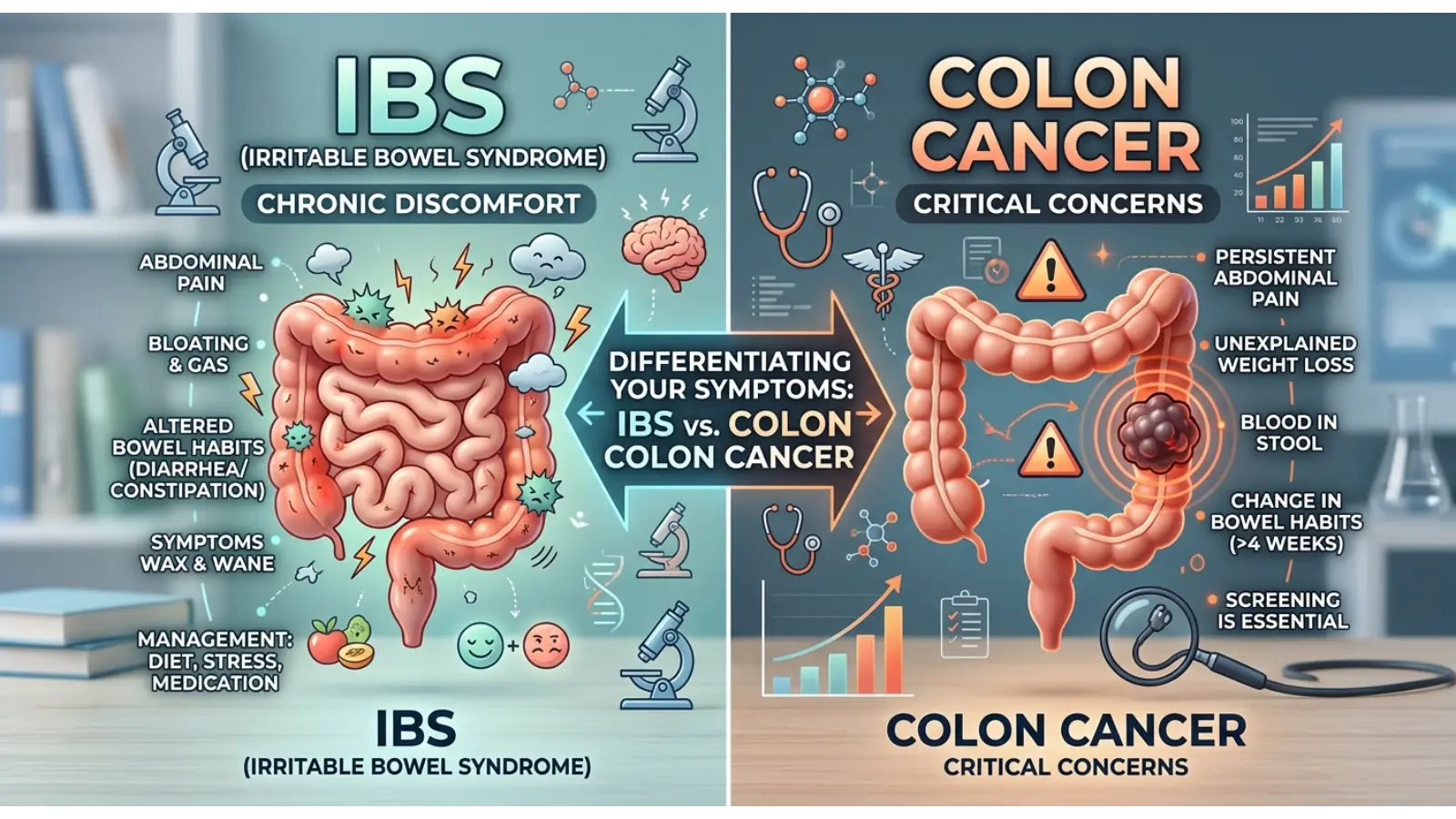
Stomach pain can be scary, especially when it lasts for weeks. Many people feel bloated, tired, and worried at the same time. Because the symptoms overlap, it is easy to fear the worst. As a result, they often search for “IBS or colon cancer” late at night, hoping for a clear answer. That worry is completely understandable.
However, these two terms describe very different things. IBS is a common gut condition that affects how the bowel works. Colon cancer, on the other hand, is a serious disease that grows inside the large intestine. Although some symptoms look alike, the causes, risks, and treatments are not the same.
In this guide, you will learn what each term means and how doctors tell them apart. You will also see the warning signs that need quick medical attention. Besides that, the article explains how to write both terms correctly in English, because small mistakes can confuse readers. For example, many writers mix up bowel and bowl, or colon and colin.
First, here is a short answer. After that, we will go through the details step by step, so you can understand the topic without stress. Please remember that this article is for learning only, and it does not replace a doctor’s advice.
Quick Answer:
Quick answer: IBS and colon cancer are not the same. IBS is a common bowel condition that does not damage the gut, so it does not turn into cancer. Colon cancer, however, is a serious disease that needs early treatment. Therefore, blood in the stool, weight loss, or new bowel changes should always be checked by a doctor.
What Is IBS?
IBS stands for irritable bowel syndrome. People say the letters one by one: I, B, S.
It is a long-term condition, but it does not harm the bowel. Instead, the gut is simply sensitive and works in an uneven way. Doctors cannot see damage in tests, so they study the pattern of symptoms. Common symptoms include cramps, gas, bloating, diarrhea, and constipation. Stress and certain foods can also make the problem worse.
What Is Colon Cancer?
Colon cancer starts when abnormal cells grow in the lining of the large intestine. In many cases, it begins as a small growth called a polyp. Over time, some polyps can turn into cancer. Colon cancer and rectal cancer are often grouped as colorectal cancer. Fortunately, doctors can often treat it well when they find it early. For this reason, screening tests are so important.
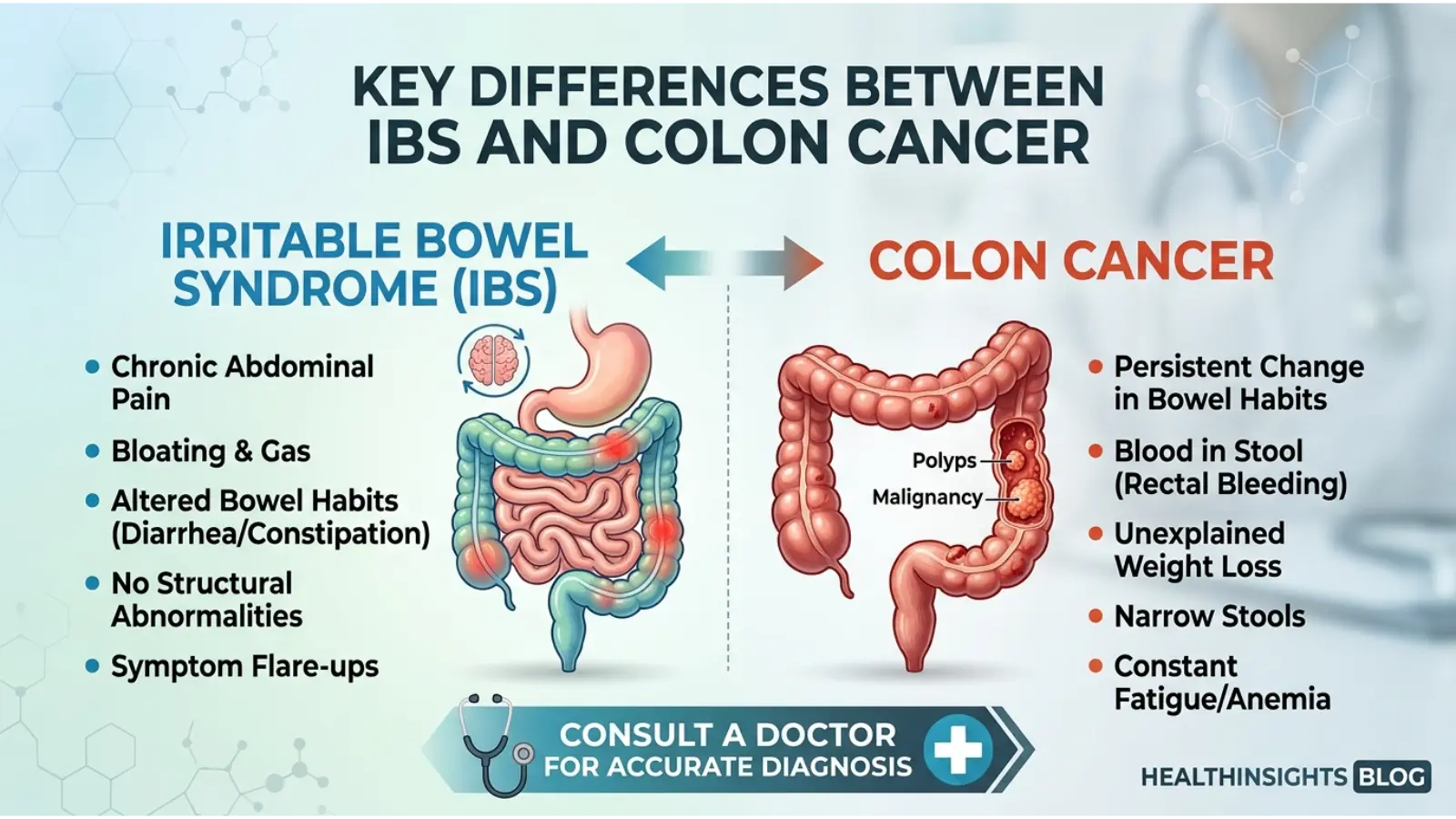
Main Differences Between IBS and Colon Cancer
First, the two terms describe different kinds of problems. IBS affects how the bowel works, while colon cancer is a disease that grows in the colon. Second, IBS does not damage the bowel. Colon cancer, in contrast, harms the tissue where it grows. Third, blood in the stool is not a usual sign of IBS. However, it can be a warning sign of colon cancer. Finally, doctors find the two problems in different ways. They diagnose IBS from symptom patterns, but they confirm colon cancer with tests such as a colonoscopy.
Can IBS Turn Into Colon Cancer?
No, IBS does not turn into colon cancer. It also does not cause cancer. However, IBS does not protect anyone from cancer either. As a result, a person with IBS can still develop colon cancer. Therefore, new symptoms should never be ignored. Instead of assuming that it is only IBS, please ask a doctor to check.
Warning Signs That Need a Doctor
Some signs are reasons to see a doctor soon. They are not a diagnosis, but they deserve attention.
For example, blood in the stool or bleeding from the rectum needs a check. Black stool that looks like tar is also a reason to call a doctor. In addition, weight loss without a clear reason can be serious. Likewise, a bowel change that lasts several weeks should not be ignored. Low iron in a blood test is another warning sign. Besides that, pain or diarrhea that wakes you at night needs attention. Finally, a close family member with colon cancer raises your own risk.
Adults at average risk are usually advised to start screening at age 45. However, your doctor may suggest an earlier start if cancer runs in your family.
How Doctors Tell Them Apart
Doctors begin by asking about your symptoms, your age, and your family history. Then they may order blood tests or stool tests. If needed, they will also suggest a colonoscopy. During this test, the doctor looks inside the colon and can remove polyps. As a result, a colonoscopy helps both to find and to prevent colon cancer.
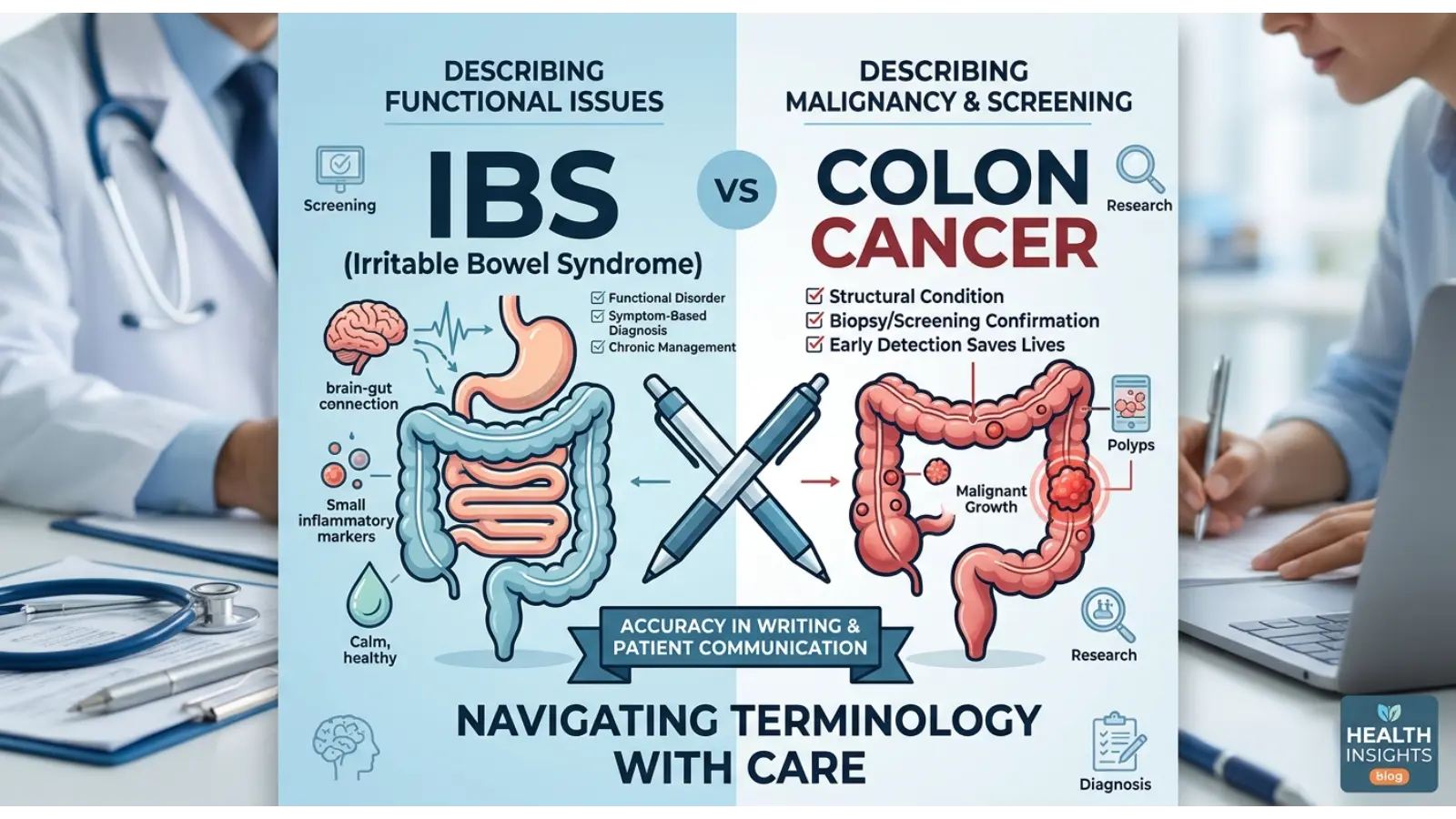
How to Write IBS and Colon Cancer Correctly
This section is about English writing. These rules apply to English text only, so keep the examples unchanged if you translate this article.
Choosing a or an
The choice between a and an depends on sound, not spelling. Because IBS starts with the sound “eye”, we write an IBS diagnosis. In contrast, colon cancer starts with a consonant sound, so we write a colon cancer test.
Using the Right Verb
IBS takes a singular verb. For example, write IBS is common, not IBS are common. To talk about many cases, use IBS cases or people with IBS.
Capital Letters
Write the short form IBS in capital letters. However, write the full name in small letters unless it starts a sentence. For example, write She has irritable bowel syndrome.
Explaining the Short Form
In formal writing, give the full name first. Then add the short form in brackets, and use the short form after that.
Asking a Clear Question
A clear question is Is it IBS or colon cancer? Besides, keep both choices in the same form, so the sentence stays balanced.
Common Spelling Mistakes
First, the correct word is bowel, but many people write bowl. A bowl is only a dish for food. Second, the correct word is colon, not colin, because Colin is a name. Third, IBS and IBD are different. IBD means inflammatory bowel disease, and it causes real inflammation and damage. IBS, in contrast, does not damage the gut. Finally, colon cancer and colorectal cancer are close, but they are not identical. Colorectal cancer includes both the colon and the rectum.
Formal and Everyday Wording
In everyday talk, people say “My stomach is upset again.” They may also say “I am afraid it is cancer.” In formal writing, however, it is better to say “I am having an IBS flare-up.” Similarly, you can write “I would like to rule out colon cancer.” Use formal wording in emails to a doctor or an employer, but use everyday wording with friends and family.
Easy Memory Tricks
For example, bowel has the letter e, so remember that it is inside me. Likewise, colon has the letter o, which can remind you of the word organ. In addition, think of IBS as an irritated gut, but not a damaged gut. Finally, remember this rule: blood, weight loss, or night symptoms mean it is time to call a doctor.
Sample Conversations
Between Two Friends
Sara tells her friend Ali that her stomach has been bad for weeks, so she wonders if it is IBS or something worse. Ali asks whether there is any blood or weight loss. Because Sara has neither, but feels tired, Ali gives simple advice. Instead of guessing, she should see a doctor.
At the Doctor
At the clinic, a patient says “I have had cramps and bloating for months, so I am worried about colon cancer.” The doctor replies that this is a fair question. Then they check the history and plan some tests.
In an Email
Here is a short email example. Dear Doctor Khan, I have had stomach pain and irregular bowel movements for six weeks. Therefore, I would like to rule out serious causes, including colon cancer. I would also like to know if this is IBS. Thank you, Maria.
Frequently Asked Questions
Can IBS turn into colon cancer?
No, it cannot. IBS does not turn into cancer, but new symptoms should still be checked.
Can a person have both?
Yes, because they are separate conditions. For this reason, any new or changing symptom deserves a check.
Does IBS cause blood in the stool?
No, blood is not a usual sign of IBS. Therefore, please have any bleeding checked by a doctor.
Should I write an IBS or a IBS?
Write an IBS, because the first sound is a vowel sound.
Is IBS the same as IBD?
No, they are different. IBD causes inflammation and damage, while IBS does not.
Is colon cancer the same as colorectal cancer?
Not exactly. Colorectal cancer includes both colon cancer and rectal cancer.
At what age should screening start?
For average risk, screening usually starts at age 45. However, your doctor may advise an earlier start if cancer runs in your family.
Conclusion:
In short, IBS and colon cancer are two different things. IBS is a common gut condition that does not damage the bowel, but colon cancer is a serious disease that can be treated well when found early. Also, IBS does not turn into colon cancer. Still, nobody should diagnose themselves. If symptoms are new, changing, or linked with blood or weight loss, please see a doctor soon. Finally, when you write about IBS or colon cancer, remember the simple rules: use an IBS, use a colon cancer test, write bowel not bowl, and write colon not colin.