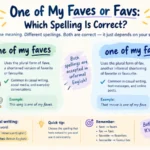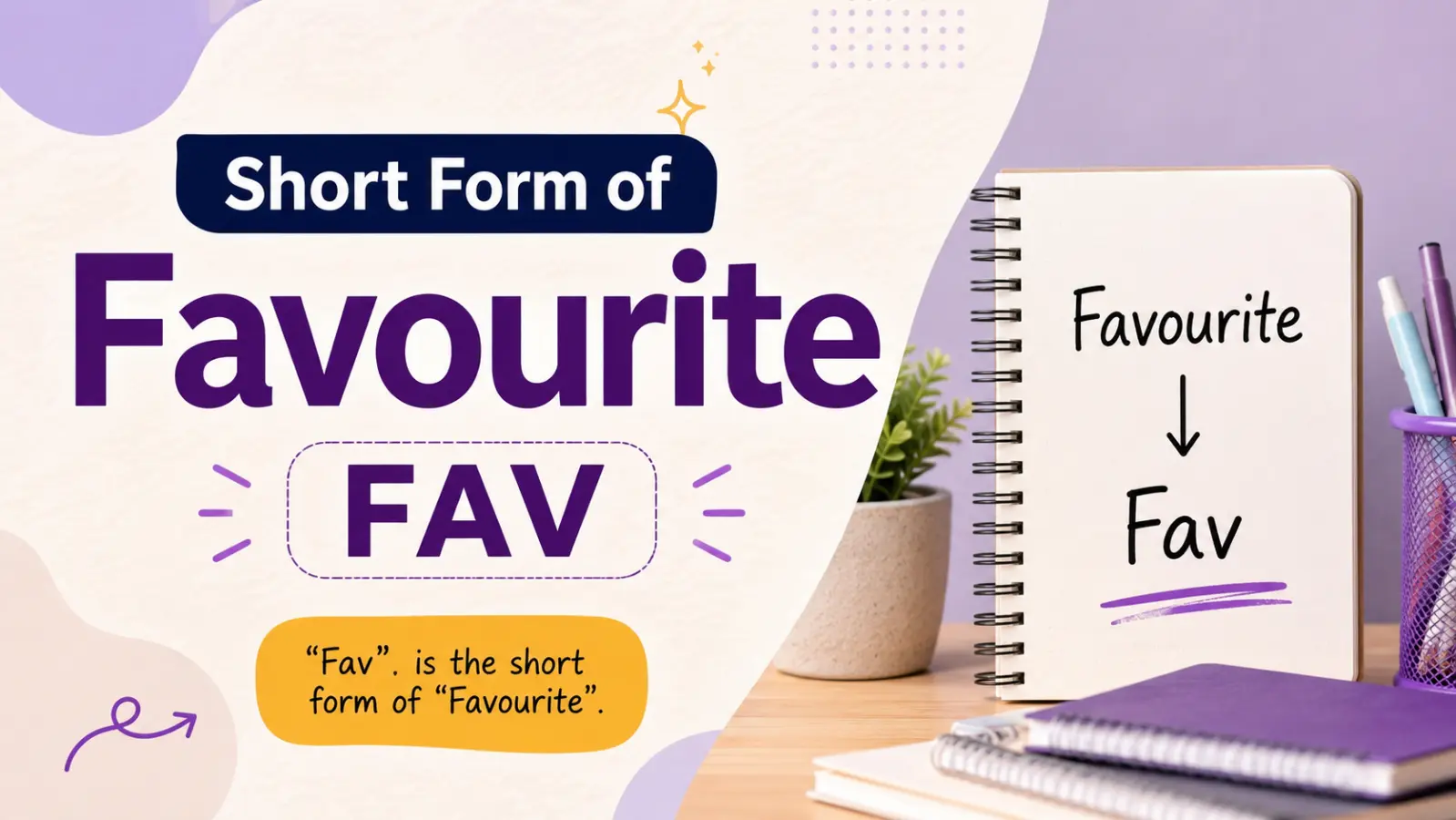
If you are looking for the short form of favourite, you will usually see fav or fave. Both forms are used in informal English, but they are not equally common in every situation.
The full word is favourite in British English and favorite in American English. Cambridge Dictionary lists favourite as the UK spelling and favorite as the US spelling.
When people shorten the word, fav is a common informal abbreviation. Fave is also widely used, especially in casual speech and online writing.
The right choice depends on the situation. Neither fav nor fave should normally replace favourite or favorite in formal writing.
Quick Answer
The most common short forms of favourite are:
- Fav — common informal abbreviation
- Fave — common informal shortened form
- Favourite — standard British English
- Favorite — standard American English
For texting and social media, fav and fave are both understandable.
For formal writing, use the complete word: favourite or favorite.
What Is the Short Form of Favourite?
There is no single official short form that must be used everywhere.
Fav is a shortened form commonly used in informal communication. It is especially common in texts, social media, notes, and online conversations.
Fave is another informal form. It looks and sounds more like a shortened spoken version of favourite.
For example:
What’s your fav movie?
or:
What’s your fave movie?
Both are natural in casual English.
Fav vs. Fave
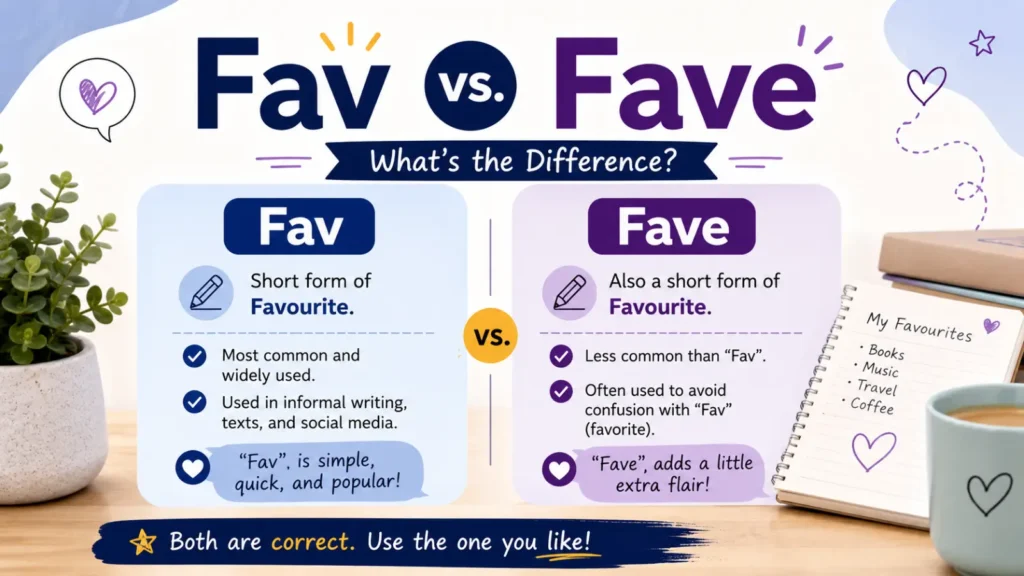
| Form | Meaning | Usage | Best For |
| favourite | Full British English word | Standard | Formal and everyday writing |
| favorite | Full American English word | Standard | Formal and everyday US English |
| fav | Short form | Informal | Texts, social media, quick notes |
| fave | Short form | Informal | Conversation, social media, casual writing |
The important point is that fav and fave are informal forms, rather than different meanings of favourite.
What Does “Fav” Mean?
Fav is a shortened form of favourite/favorite.
It can refer to a person, object, food, place, song, movie, or anything that someone likes most.
Examples:
Pizza is my fav food.
This is my fav song.
Who is your fav actor?
The abbreviation is easy to understand from context.
It is especially useful when space and speed matter, such as in text messages, comments, captions, and social posts.
What Does “Fave” Mean?
Fave also means favourite or favorite.
It is an informal shortened form and is often used as a casual noun or adjective.
Examples:
This is my fave restaurant.
She’s my fave singer.
What’s your fave color?
Unlike fav, the ending of fave gives a stronger visual connection to the sound of favourite.
Why Are There Two Short Forms?
English often creates informal shortened words in more than one way.
Fav is formed by shortening favourite/favorite to its first part.
Fave keeps the basic sound and adds a final e, creating a form that resembles other casual shortened words.
Neither form changes the meaning.
The difference is mainly one of style and personal preference.
Is “Fav” or “Fave” More Correct?
Neither is the formal spelling of favourite.
Both fav and fave are informal forms, so calling one universally “correct” would be misleading.
For example, in a text message, either of these works:
That’s my fav book.
That’s my fave book.
However, in a formal report, write:
That is my favourite book.
If you are using American English:
That is my favorite book.
British vs. American English
The full word has two standard regional spellings:
British English: favourite
American English: favorite
Cambridge Dictionary specifically identifies favorite as the US spelling of favourite.
The informal forms fav and fave can be understood in both varieties of English.
For consistency, however, use the full regional spelling in formal content.
Origin of “Favourite”
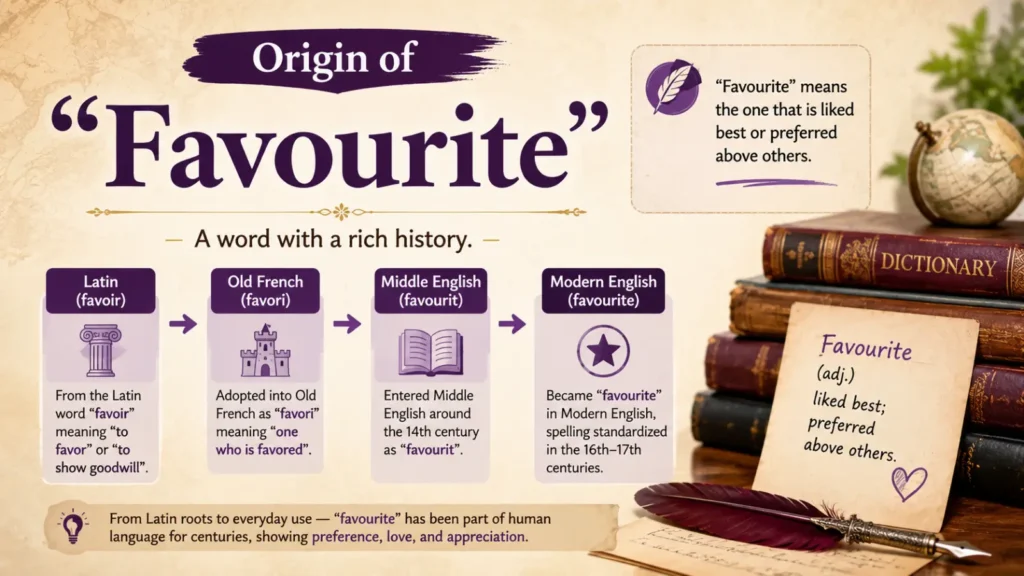
The word favourite is related to favor and ultimately comes through French from Latin roots associated with showing favor or support.
British English retained the -our spelling found in words such as:
- favour
- favourite
- behaviour
- colour
American English commonly uses the shorter -or forms:
- favor
- favorite
- behavior
- color
This explains why the full word can appear as either favourite or favorite.
Dictionary Recommendation
Dictionaries clearly recognize favourite and favorite as standard regional spellings. Cambridge Dictionary lists favourite as UK English and favorite as US English.
The key distinction is between the standard full word and its informal shortened forms.
If you are writing something formal, the safest dictionary-based choice is the complete form appropriate to your variety of English.
Use:
favourite → British English
favorite → American English
Use fav or fave only when an informal tone is suitable.
Real-Life Examples
Text Message
What’s your fav movie?
Social Media Caption
My fave place in the city!
Casual Conversation
That’s definitely my fave song.
Informal Review
This is one of my fav books this year.
School Assignment
This is my favourite book.
American English
This is my favorite book.
The last two examples are better choices when the writing needs to follow standard English conventions.
Common Mistakes
Using “Fav” in Formal Writing
Fav may look too casual in an academic paper, business report, or professional article.
Use favourite or favorite instead.
Assuming “Fave” Is the British Spelling
Fave is not the British equivalent of American favorite.
The standard British spelling is favourite.
Mixing Regional Spellings
Avoid switching between favourite and favorite in the same piece of writing.
Choose one English variety and keep it consistent.
Treating “Fav” as a Universal Formal Abbreviation
Although readers understand fav, it is still informal.
A short form being common does not automatically make it appropriate for formal documents.
A Simple Memory Trick
Think of it this way:
FAV = favourite/favorite, shortened
FAVE = favourite/favorite, shortened casually
And remember:
Formal → Full word
Casual → Fav or Fave
This simple rule works in most everyday situations.
Which Short Form Should You Use?
Choose fav if you want a very short, quick abbreviation.
My fav restaurant.
Choose fave if you want a casual form that feels closer to the spoken word.
My fave restaurant.
Choose favourite or favorite when clarity and formality matter.
There is no major difference in meaning between fav and fave. The choice is mostly about style.
Professional Writing Recommendation
In professional writing, avoid fav and fave unless you are intentionally using a casual voice.
For a website, report, academic assignment, business email, résumé, or formal article, write the complete word.
Use favourite if your content follows British English.
Use favorite if your content follows American English.
For social media posts, informal blogs, messages, and casual conversations, fav or fave can make the language feel more relaxed.
FAQ
What is the short form of favourite?
The common informal short forms are fav and fave.
Is “fav” short for favourite?
Yes. Fav is commonly used as an informal shortened form of favourite or favorite.
Is “fave” short for favourite?
Yes. Fave is an informal shortened form of favourite/favorite.
Is fav or fave more correct?
Neither is the formal standard form. Both are informal shortenings. Choose the one that fits your preferred style.
Is “fav” acceptable in formal writing?
Usually, no. Use favourite or favorite in formal writing.
Is “fave” a real word?
Yes. Fave is an established informal form used to mean a favourite person or thing.
What is the American spelling of favourite?
The American spelling is favorite. Cambridge Dictionary identifies favorite as the US spelling of favourite.
What is the British spelling of favorite?
The British spelling is favourite.
Can I use “fav” on social media?
Yes. Fav is well suited to casual online writing, captions, comments, and messages.
Should I use favourite, favorite, fav, or fave?
Use favourite for British English and favorite for American English in standard writing. Use fav or fave for informal communication.
Conclusion
The short form of favourite is commonly written as fav or fave. Both are informal forms, and neither changes the meaning of the original word.
For standard English, remember the regional difference:
Favourite = British English
Favorite = American English
Fav = informal short form
Fave = informal short form
If you are writing professionally, use the full word. In texts, social media, and casual conversations, fav and fave are both suitable.

Alex Wordsmith is a comparison research writer and content specialist at WordComparre.com. He focuses on analyzing word meanings, spelling variations, grammar distinctions, and language usage to help readers make informed writing choices. Through clear explanations and practical examples, Alex simplifies complex language topics for students, writers, and professionals. His goal is to make English learning easier, more accurate, and accessible for everyone.