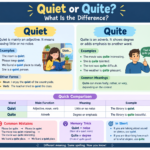
Quiet and quite are two commonly confused English words. They look and sound similar, but they have different meanings and grammatical functions. Quiet is mainly related to silence or a low level of noise, while quite is used to show degree or emphasis.
Understanding this small difference can help you avoid one of the most common spelling and grammar mistakes in everyday English.
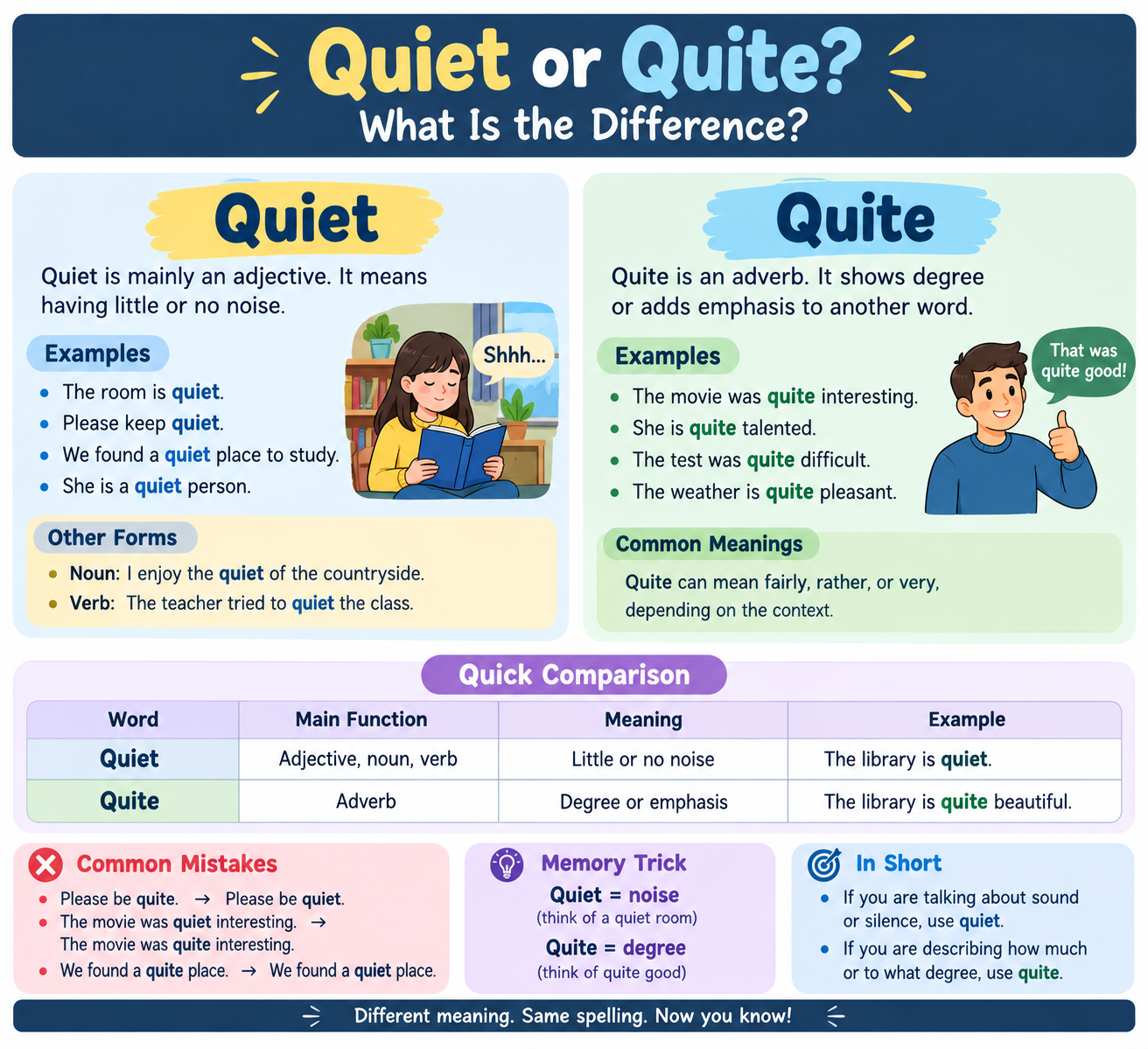
Quiet vs Quite at a Glance
| Word | Main Function | Meaning | Example |
|---|---|---|---|
| Quiet | Adjective | Having little or no noise | The room is quiet. |
| Quite | Adverb | To a certain degree or extent | The room is quite comfortable. |
The easiest way to remember the difference is:
Quiet = silence or little noise.
Quite = degree or emphasis.
What Does Quiet Mean?
Quiet usually describes something that makes little or no noise. It can describe a place, person, situation, or environment.
Examples:
- The classroom is quiets.
- We live in a quiets neighborhood.
- Please keep quiets during the exam.
- The baby became quiets.
- She is a very quiets person.
The word can also describe someone who does not talk much.
James is quiet during meetings.
This sentence means James does not speak very often.
What Does Quite Mean?
Quite is an adverb. It is used to express degree or add emphasis to another word.
Examples:
- The movie was quite interesting.
- The test was quite difficult.
- She is quite talented.
- The restaurant is quite popular.
- He speaks quite clearly.
The exact strength of quite can depend on the sentence and context. It can mean something similar to fairly, rather, or very in different situations.
Why Do People Confuse Quiet and Quite?
The confusion happens because the two words contain almost the same letters.
Quiet → Q-U-I-E-T
Quite → Q-U-I-T-E
The letters E and T change position. Their pronunciation can also be confusing for English learners.
The meanings, however, are very different.
Compare:
Please be quiets.
This is about making less noise.
The movie was quite good.
This is about the degree to which the movie was good.
How to Use Quiet in a Sentence
Quiet is commonly used as an adjective.
A common sentence pattern is:
Subject + be + quiet
Examples:
- The library is quiets.
- My office is quiets.
- The children are quiets.
- The street was quiets.
You can also place quiets before a noun.
Examples:
- a quiets room.
- a quiets street.
- a quiets evening.
- a quiets conversation.
Quiet as a Verb
Quiet can also be used as a verb. In this form, it means to make something less noisy or calmer.
Examples:
- The teacher tried to quiets the class.
- The mother quieted the crying baby.
- The music helped quiets his mind.
How to Use Quite in a Sentence
Quite normally works as an adverb.
It can appear before an adjective.
Examples:
- The book is quite useful.
- The weather is quite pleasant.
- The question is quite simple.
- The building is quite large.
It can also appear before an adverb.
Examples:
- She works quite quickly.
- He answered quite confidently.
- They arrived quite early.
The important point is that quite expresses degree rather than silence.
Quiet and Quite in Sentence Structure
Look at these two patterns.
Quiet
Subject + linking verb + quiets
The house is quiets.
Here, quiets describes the house.
Quite
Quite + adjective
The house is quite beautiful.
Here, quite modifies the adjective beautiful.
This simple structure can help you identify the correct word quickly.
Quiet or Quite in Different Examples
Consider these examples:
The classroom is quiet.
There is little noise in the classroom.
The classroom is quite large.
The word quite tells us something about the size of the classroom.
Another example:
Please remain quiets.
The speaker wants people to make little noise.
The instructions are quite clear.
The speaker is describing the degree of clarity.
One more example:
My brother became quiets.
He stopped talking or became less noisy.
My brother became quite nervous.
He became noticeably nervous.
Common Mistakes With Quiet and Quite
Mistake 1: Using Quite for Silence
Incorrect:
Please be quiets.
Correct:
Please be quiets.
When asking someone to stop making noise, use quiets.
Mistake 2: Using Quiet Before an Adjective
Incorrect:
The movie was quiets interesting.
Correct:
The movie was quite interesting.
Here, the speaker wants to express the degree of interest, so quite is needed.
Mistake 3: Describing a Silent Place
Incorrect: We found a quite place.
Correct:
We found a quiets place.
The place has little noise, so quiets is correct.
Mistake 4: Confusing the Spelling
Remember that the final letters are different:
Quiet: Q-U-I-E-T
Quite: Q-U-I-T-E
Quiet or Quite in Professional Writing
Both words are perfectly acceptable in professional English. The choice depends on what you want to communicate.
Use quiets when discussing noise, peaceful environments, or someone’s communication style.
The meeting room should remain quiets during presentations.
Use quite when expressing degree or making an evaluation.
The proposed solution is quite effective.
Professional writing becomes clearer when these words are used according to their actual meanings.
Formal and Informal Usage
Neither word is specifically informal. Both quiet and quiets are standard English words and can appear in formal and informal communication.
Formal example:
The examination room must remain quiet.
Informal example:
Can you keep quiet for a minute?
Formal example:
The new system is quite effective.
Informal example:
That movie was quite good.
The difference is not about formality. It is about meaning and grammatical function.
Quiet vs Quite in Everyday English
Here are some natural examples you may hear in everyday conversations:
- The house is quiet today.
- Please stay quiet.
- This is a quiet place.
- She is usually quiet in large groups.
- The food was quite good.
- That sounds quite interesting.
- The problem is quite easy.
- He is quite confident.
- The weather is quite pleasant.
These examples show how each word fits into normal English sentences.
A Simple Memory Trick
Use this rule:
Quiet = noise
Think of a quiets library.
Quite = degree
Think of quite good, quite difficult, or quite interesting.
Another useful trick is to ask yourself:
Am I talking about sound?
If yes, quiet is probably the correct choice.
Am I describing how much or to what degree something is true?
If yes, quite may be the correct choice.
Real Life Conversations
Conversation 1
Ali: Why are you whispering?
Sara: Everyone is studying, so we need to stay quiet.
Conversation 2
Ali: How was the restaurant?
Sara: The food was quite good.
Conversation 3
Teacher: Please be quiet while I explain the lesson.
Student: Sorry, teacher.
Conversation 4
Friend: Was the test difficult?
Student: Yes, it was quite challenging.
These conversations show the practical difference between the two words.
Quick Test: Quiet or Quite?
Choose the correct word.
- Please be ___ during the movie.
- The book was ___ interesting.
- We found a ___ place to study.
- The question was ___ difficult.
- The library is very ___.
- She is ___ confident about her answer.
Answers
- quiets
- quite
- quiets
- quite
- quiets
- quite
If the sentence relates to noise or silence, choose quiets. If the word expresses degree, quiets is usually the better choice.
Frequently Asked Questions
Is quietsthe same as quite?
No. Quiet generally relates to silence or low noise, while quiets is an adverb that expresses degree or emphasis.
Is it “be quiets” or “be quite”?
The correct expression is be quietswhen telling someone not to make noise.
Is “quite good” grammatically correct?
Yes. Quite good is a standard English expression used to indicate a degree of goodness.
Is quietsan adjective?
Yes. Quiet is commonly an adjective, although it can also be used as a noun or verb.
Is quite an adjective?
No. Quite is an adverb. It commonly modifies adjectives and adverbs.
How can I remember quiets and quite?
Remember quiets for silence and quite for degree. A quiets room has little noise, while something can be quite interesting.
Conclusion
Quiet and quite may look almost identical, but they have different jobs in English. Quiet is mainly used for silence, low noise, or someone who speaks very little. Quite is an adverb that expresses degree or adds emphasis.
The easiest rule is simple: quiets is connected with noise, while quite is connected with degree. Keep this distinction in mind, and you will find it much easier to choose the correct word in both everyday and professional English.
Meta description: Quiet or quite? Learn the simple difference, meanings, grammar rules, examples, common mistakes, and an easy memory trick.