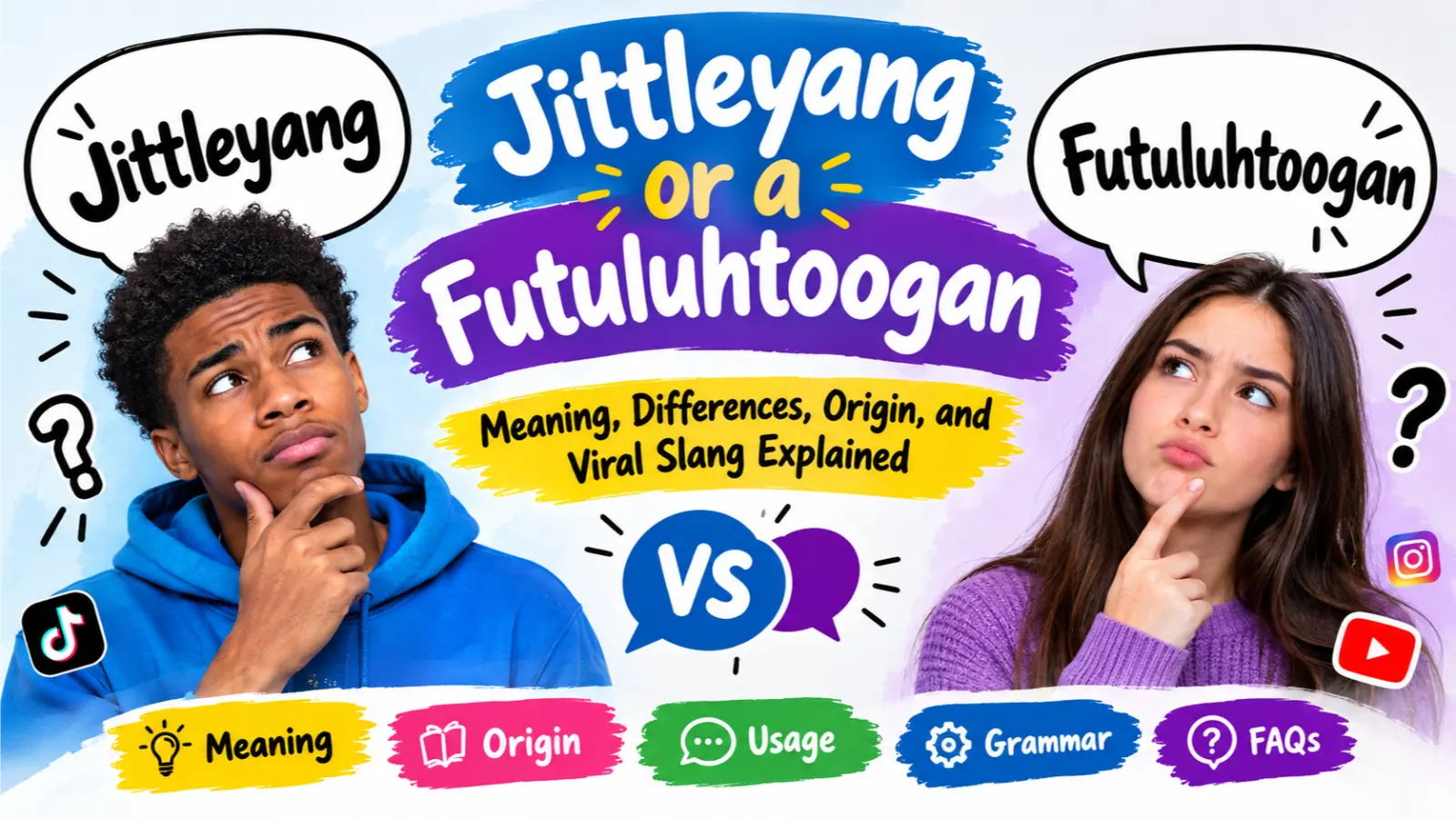
The phrase “Jittleyang or a Futuluhtoogan” became popular through internet memes and social media videos. Many people search for these unusual words because they hear them in viral clips and want to understand their meanings. The phrase is associated with Baltimore slang and online wordplay, particularly the question, “Are you a jittleyang or a fuhuhluhtoogan?”
Although people have suggested different definitions, neither term has one universally accepted meaning. Understanding their background, spelling variations, and online usage can help readers understand the trend without confusing informal slang with standard English.
What Does Jittleyang or a Futuluhtoogan Mean?
“Jittleyang or a Futuluhtoogan” is a humorous phrase used in internet culture. It asks someone to choose between two unusual slang expressions that became recognizable through viral videos and memes.
The spellings vary across websites and social media posts. Jittleyang is also associated with the spelling Jikkuhlang, while Futuluhtoogan is commonly written as Fuhuhluhtoogan or Fuhuhlatoogan.
These terms do not have clear, universally accepted dictionary definitions. Some explanations connect jittleyang with attracting attention, while interpretations of fuhuhluhtoogan are less certain. Therefore, readers should treat proposed meanings as interpretations rather than established facts.
Where Did Jittleyang and Futuluhtoogan Come From?
The phrase is associated with Baltimore, Maryland, and the slang style popularized by rapper and barber Richard Webster, known online as Bippleyipsnipp.
In March 2021, a video featuring his song “City Girls” introduced many viewers to his distinctive wordplay. The song later attracted attention on social media, and the unusual expressions became part of internet meme culture.
During 2023 and 2024, interest in these words grew across platforms such as TikTok and Instagram. A viral video posted in January 2024 showed a young girl repeatedly asking her mother whether she was a jittleyang or a fuhuhluhtoogan. The mother’s confused reactions helped the question spread as a meme.
The trend demonstrates how an unusual phrase can become popular even when many viewers do not understand its original context.
What Does Jittleyang Mean?
Jittleyang is an informal expression associated with Baltimore slang and internet culture. Its exact meaning remains uncertain, although some explanations connect it with the idea of attracting attention.
The related spelling Jikkuhlang appears in material associated with Bippleyipsnipp. His book, Jikkuhlang the Dictionary, includes a related term, jikkal, described as an attention grabber. However, the book does not provide a direct, definitive definition of jittleyang itself.
As a result, it would be inaccurate to claim that every person who uses the word intends the same meaning.
How Is Jittleyang Used Online?
People may use the term in memes, captions, comments, and humorous conversations. Its meaning often depends on the creator’s intended joke.
For example:
- “That video has everyone asking about jittleyang.”
- “I heard the word jittleyang in a viral clip.”
- “My friend keeps repeating the jittleyang meme.”
These examples demonstrate how the word can appear in sentences. They do not establish an official definition.
What Does Futuluhtoogan Mean?
Futuluhtoogan is another unusual expression associated with the same Baltimore slang trend. The spelling Fuhuhluhtoogan is more commonly documented in explanations of the original meme.
Unlike ordinary English words, futuluhtoogan does not have one clearly established meaning that applies across all online communities. Some interpretations connect related expressions in the creator’s slang with adult themes, but that does not establish a precise definition for this particular word.
In many online posts, the expression functions mainly as the second option in the viral question. Its unusual sound and uncertain meaning are part of what makes the meme memorable.
How Is Futuluhtoogan Used Online?
The expression can appear in social media jokes, reaction videos, captions, and conversations about the trend.
For example:
- “Someone asked me if I was a futuluhtoogan.”
- “The video repeated the word futuluhtoogan several times.”
- “I searched for futuluhtoogan after seeing the meme.”
These are illustrative sentences showing possible usage. They should not be interpreted as proof of a fixed slang definition.
Jittleyang vs Futuluhtoogan: What Is the Difference?
The main difference is that the two expressions occupy different positions in the same viral phrase. Some internet users interpret them as contrasting labels, but their meanings are not consistently defined.
| Feature | Jittleyang | Futuluhtoogan |
|---|---|---|
| Type of expression | Informal slang | Informal slang |
| Cultural association | Baltimore slang and internet memes | Baltimore slang and internet memes |
| Common spelling variations | Jikkuhlang | Fuhuhluhtoogan, Fuhuhlatoogan |
| Established dictionary meaning | No universally accepted definition | No universally accepted definition |
| Common online use | Memes, jokes, and playful labels | Memes, jokes, and playful labels |
The safest way to understand the difference is to consider the original video or conversation. Online users may assign their own meanings to either expression.
Is Jittleyang or Futuluhtoogan Correct English?
Neither expression is standard English vocabulary in the usual dictionary sense. Both are associated with informal slang and internet culture.
However, an unfamiliar word is not automatically a grammatical error. People create slang, nicknames, and playful expressions all the time. Such language can be meaningful within a particular community even when it does not belong to formal English.
For example, the sentence “Are you a jittleyang or a futuluhtoogan?” follows a normal English question structure. The unusual part is the vocabulary, not the grammar.
In formal writing, it is better to explain the terms instead of assuming that every reader understands them.
Grammar Rules and Sentence Structure
Although these expressions do not have special grammar rules, they can appear in ordinary English sentence patterns.
Using the Words as Nouns
A speaker can use either expression as a label within a sentence.
Examples:
- “He mentioned jittleyang in his video.”
- “She asked about futuluhtoogan.”
- “The phrase includes both expressions.”
These examples use the terms as nouns or references to words.
Forming a Choice Question
The viral phrase uses a standard question structure:
Are you + option one + or + option two?
For example:
“Are you a jittleyang or a futuluhtoogan?”
The word or connects the two alternatives. The sentence is grammatically understandable even if the reader does not know what either label means.
Using the Terms in Past-Tense Sentences
Examples include:
- “I heard the phrase yesterday.”
- “They discussed the meme after school.”
- “We watched a video about the slang.”
The verbs follow ordinary English tense rules. The unusual vocabulary does not change the basic structure of the sentence.
Common Mistakes to Avoid
Readers and writers can misunderstand this trend in several ways.
Assuming Both Words Have Fixed Definitions
Internet users sometimes present personal interpretations as official meanings. A better approach is to acknowledge that the expressions have uncertain and changing interpretations.
Confusing Different Spellings
Jittleyang and Jikkuhlang are associated with the same slang tradition, while Fuhuhluhtoogan and Fuhuhlatoogan appear as spelling variations of the other expression. The spelling used in a particular source may depend on the creator or community.
Treating the Phrase as Formal Vocabulary
These expressions are primarily associated with casual internet culture. They are not appropriate replacements for ordinary English words in formal academic or professional writing.
Confusing Grammar With Vocabulary
A sentence can follow English grammar rules while containing unfamiliar slang. Understanding the sentence structure is different from knowing the meaning of every word.
Believing Every Online Explanation
Memes often encourage people to invent humorous definitions. Check the original context and distinguish documented background information from jokes and speculation.
Can You Use Jittleyang or Futuluhtoogan in Professional Writing?
These expressions can be discussed in professional writing when the subject is internet culture, slang, social media, or viral memes. However, writers should explain the terms for readers who may not recognize them.
For example, an article about digital trends could say:
“The phrase became popular through social media videos featuring two unusual expressions associated with Baltimore slang.”
This sentence communicates the subject without relying on unexplained slang.
In a casual caption, a writer might use the original question to reference the meme. In a business report or academic essay, an explanation of the trend is generally more suitable.
Why Did the Jittleyang or Futuluhtoogan Meme Become Popular?
Several features helped the phrase attract attention.
Its Unusual Sound
Both expressions sound unfamiliar to many English speakers. Their distinctive pronunciation makes them memorable and easy to repeat in humorous videos.
Its Unclear Meaning
People often search for an unfamiliar phrase when they encounter it online. The uncertainty surrounding these words encouraged discussions, guesses, and joke explanations.
Its Simple Question Format
The question invites people to choose between two options, even when they do not understand the options. This makes it easy to recreate in reaction videos and conversations.
Its Shareable Nature
A short question with a funny or confusing answer can work well in social media clips. People can reproduce the format in different situations, allowing a meme to spread beyond its original audience.
Memory Tricks to Remember the Phrase
Remembering the expressions is easier when you connect them with the trend rather than trying to memorize an uncertain definition.
- Jittleyang: Remember it as the first option in the viral question.
- Futuluhtoogan: Remember it as the second option in the question.
- Spelling: Look at the original source when exact spelling matters.
- Meaning: Keep in mind that neither term has a universally accepted definition.
- Context: Consider the video, caption, or conversation before interpreting either expression.
These simple reminders help you recognize the phrase without treating speculation as fact.
Real-Life Conversation Examples
The following fictional conversations show how people might discuss the meme in everyday situations.
Conversation One: Friends Discussing a Viral Video
Alex: “Have you seen that video asking whether someone is a jittleyang or a futuluhtoogan?”
Sam: “Yes, but I still do not know what the words mean.”
Alex: “That confusion is part of why the meme is funny.”
Conversation Two: A Student Asks About the Phrase
Mia: “I saw these words in a social media comment. Are they proper English?”
Noah: “They are informal slang expressions associated with an internet trend, not standard vocabulary.”
Mia: “So the sentence can still be grammatically correct?”
Noah: “Yes. The grammar and the meaning of the slang are two different things.”
Conversation Three: Writing a Blog Post
Editor: “Can we explain this phrase in our article?”
Writer: “Yes. We should describe its online origin and explain that its meaning is not firmly established.”
Editor: “Good. That will help readers understand the trend without misleading them.”
These conversations are original examples created to demonstrate how people might discuss the expressions.
Frequently Asked Questions
What does Jittleyang or a Futuluhtoogan mean?
It is a viral internet phrase associated with Baltimore slang and social media memes. The two expressions have several proposed interpretations, but neither has one universally accepted definition.
Is Jittleyang a real word?
Jittleyang is used as an informal slang expression online. It is not a standard English word with a clearly established dictionary definition.
What does Futuluhtoogan mean on TikTok?
On TikTok, futuluhtoogan appears in videos, captions, and memes connected with the question asking whether someone is a jittleyang or a futuluhtoogan. Its precise meaning remains uncertain.
Are Jittleyang and Jikkuhlang the same?
Jikkuhlang is a spelling associated with the slang tradition from which the internet spelling jittleyang became widely known. The spellings differ, and their use can depend on the source.
Is Futuluhtoogan spelled correctly?
Futuluhtoogan is a spelling used in online searches, while Fuhuhluhtoogan and Fuhuhlatoogan are also documented variations. Because the expression is informal slang, spelling is not standardized in the same way as ordinary dictionary words.
Who popularized Jittleyang and Futuluhtoogan?
The expressions are associated with Baltimore rapper and barber Richard Webster, known as Bippleyipsnipp, whose song “City Girls” helped introduce the slang to a wider online audience.
Why do people ask, “Are you a Jittleyang or a Futuluhtoogan?”
People repeat the question as a humorous meme. Its unusual wording, uncertain meaning, and the reactions it produces make it suitable for short videos and online jokes.
Can I use these words in a formal essay?
You can discuss them in an essay about slang or internet culture, but you should introduce them as informal expressions and explain their context. Avoid presenting uncertain interpretations as established definitions.
Conclusion
“Jittleyang or a Futuluhtoogan” is a memorable internet phrase associated with Baltimore slang and viral social media content. The expressions gained attention through distinctive wordplay, humorous videos, and a question that encouraged people to repeat the trend.
Although some online explanations assign particular meanings to the terms, neither has one universally accepted definition. Their spelling can also vary across sources. The most accurate approach is to explain their cultural background, distinguish confirmed information from speculation, and recognize that informal slang does not follow the same conventions as standard dictionary vocabulary.
For English learners and curious readers, the phrase offers a useful example of how internet culture creates new expressions and spreads them across communities. Understanding the context is more important than memorizing an unverified definition.