Bad rap and bad rep are both used when talking about a negative reputation, so it is easy to wonder which expression is correct. The confusion comes from the fact that rep is a familiar short form of reputation, while rap has a long-established meaning connected with criticism and blame.
Bad rap or bad rep can confuse English learners because both expressions describe a negative reputation, but they come from different forms of the word. Understanding how people use these phrases can help you choose the right expression in everyday and professional writing.
In this article, you will learn the meaning, usage, and differences between bad rap and bad rep, with simple examples to help you use each phrase correctly. Whether you are writing casually or formally, this guide will make the choice easier.
The traditional expression is bad rap, especially when someone or something receives unfair criticism or an undeservedly negative judgment. Bad rep is also used in modern English as an informal shortening of bad reputation, so it should not automatically be treated as a spelling mistake.
Quick Answer
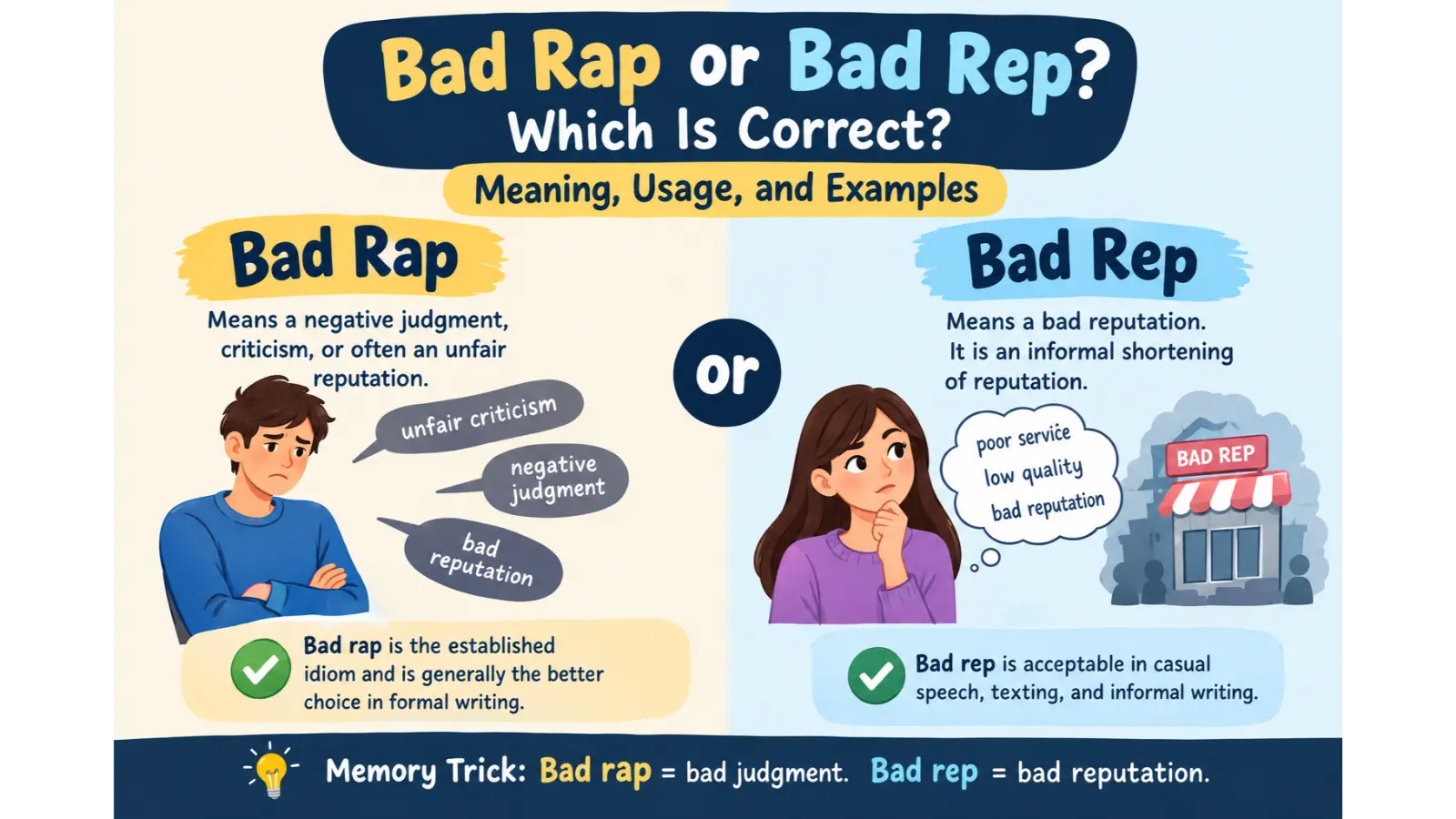
Bad rap is the established idiom and is generally the better choice in polished writing.
Bad rep is an informal shortening of bad reputation. It is understandable and used in modern English, especially in casual speech, texting, and informal writing.
For professional or edited writing, bad rap is usually the safest choice when you mean an established negative judgment or reputation.
Meaning of Bad Rap
Bad rap means a negative judgment, criticism, blame, or reputation, often with the suggestion that the judgment is unfair or undeserved.
Cambridge Dictionary lists rap as a noun meaning a judgment or reaction and gives bad rap as an example of severe criticism. Oxford also defines rap as an informal unfair judgment on someone or something.
Examples
- The restaurant gets a bad rap, but its food is actually excellent.
- Brussels sprouts have received a bad rap for years.
- The new technology has gotten a bad rap from some critics.
- Teenagers sometimes get a bad rap because of unfair stereotypes.
In these examples, bad rap can suggest that the negative opinion is not completely deserved.
Meaning of Bad Rep
Bad rep is an informal shortening of bad reputation.
Here, rep comes directly from reputation. A person, business, product, or place can have a bad rep when people generally have a negative opinion of it.
For example:
- That restaurant has a bad rep for slow service.
- The company has a bad rep among local customers.
- He has a bad rep at school.
- That neighborhood has a bad rep, although it has improved considerably.
The important point is that bad rep does not necessarily mean the reputation is undeserved. It simply describes a negative reputation.
Bad Rap vs Bad Rep Comparison
| Feature | Bad Rap | Bad Rep |
|---|---|---|
| Basic meaning | Negative or often unfair judgment | Negative reputation |
| Status | Established idiom | Informal shortening |
| Source of the key word | Older sense of rap connected with criticism or blame | Short form of reputation |
| Tone | Common and established | Casual and conversational |
| Formal writing | Generally preferred | Usually less suitable |
| Main idea | Often emphasizes criticism or unfair judgment | Mainly describes a poor reputation |
The meanings can overlap considerably, but the expressions have different histories and usage patterns.
Origin of Bad Rap
The rap in bad rap does not come from the modern musical sense of rap.
The word rap has older meanings associated with criticism, accusation, blame, and judgment. Oxford traces the noun to Middle English and notes its informal North American sense of an unfair judgment.
That older meaning explains why someone can get a bad rap. The expression describes receiving an unfavorable judgment or reputation.
Why Do People Confuse Bad Rap and Bad Rep?
The confusion is easy to understand.
First, rap and rep sound similar in ordinary speech. Second, rep is a well-known abbreviation for reputation, so bad rep appears perfectly logical.
For example:
The company has a bad reputation.
It is natural to shorten this informally to:
The company has a bad rep.
However, bad rap is a separate, established expression. It has existed as an idiom rather than simply being a misspelling of rep. Merriam-Webster’s usage discussion recognizes bad rap as the original phrase and notes that bad rep has gained enough usage to merit recognition.
What Do Dictionaries Recommend?
Major dictionaries support bad rap as an established expression.
Cambridge Dictionary defines rap in one sense as a judgment or reaction and specifically gives bad rap as an example. (
Oxford similarly records rap as an informal noun meaning an unfair judgment and gives the example “Wolves get a bad rap.”
Dictionary.com also lists bad rap and identifies it as a variation of bum rap.
The dictionary evidence makes the practical recommendation straightforward: choose bad rap when you want the established idiom, particularly in carefully edited writing.
Real Life Examples
Bad Rap
- The old hotel gets a bad rap, but the rooms are comfortable.
- Fast food often gets a bad rap for its nutritional value.
- The actor received a bad rap after the controversial interview.
- This breed of dog has gotten a bad rap from unfair stereotypes.
- The product received a bad rap even though many customers liked it.
Bad Rep
- That store has a bad rep for poor customer service.
- The brand has a bad rep among younger shoppers.
- He has a bad rep for arriving late.
- The website has a bad rep because of its old design.
- The restaurant has a bad rep in the local community.
These examples show why context matters. Bad rap often focuses on negative judgment, while bad rep works naturally as a casual abbreviation of bad reputation.
Common Mistakes
Using Bad Wrap
Bad wrap is not the standard spelling when you mean a negative reputation or criticism.
The word wrap has its own meanings, such as covering something or referring to certain types of food. It does not form the established idiom bad rap.
So write:
The company gets a bad rap.
Not:
The company gets a bad wrap.
Assuming Bad Rep Is Always Wrong
Calling every use of bad rep a spelling error is too simplistic.
Because rep is a recognized informal shortening of reputation, bad rep can be meaningful and understandable in casual English. The issue is mainly one of conventional usage and register.
Using Bad Rep in Highly Formal Writing
Although readers will generally understand bad rep, it can sound casual.
For formal reports, academic writing, professional documents, or carefully edited articles, consider using bad rap when the established idiom fits or simply write bad reputation.
Memory Trick
A simple way to remember the difference is:
Bad rap = bad judgment or criticism.
Bad rep = bad reputation.
Think of rep as the first part of reputation.
For rap, remember the established phrase get a bad rap, which means receiving an unfavorable judgment or reputation, often unfairly.
Professional Writing Recommendation
For professional and polished writing, bad rap is generally the better choice when you are using the established idiom.
Use bad rep when you intentionally want an informal, conversational tone and mean bad reputation.
If maximum clarity matters, especially in formal documents, you can simply write bad reputation.
Compare:
- Casual: The brand has a bad rep.
- Established idiom: The brand gets a bad rap.
- Formal and direct: The brand has a bad reputation.
The best choice depends on the intended meaning and tone rather than on treating one form as universally wrong.
FAQ
Is bad rap or bad rep correct?
Bad rap is the established idiom. Bad rep is an informal shortening of bad reputation and is also used in modern English.
Does bad rap mean bad reputation?
Yes. Bad rap can refer to a negative reputation or judgment, particularly one that is unfair or undeserved. Cambridge and Oxford both record this sense. (Cambridge Dictionary)
Is bad rep grammatically correct?
Bad rep is acceptable in informal English when rep means reputation. However, it is less conventional than bad rap as the established idiom.
Should I use bad rap in professional writing?
Usually, yes, when you mean the established expression involving negative judgment or criticism. If you want completely neutral formal wording, bad reputation is also an excellent choice.
Is bad wrap correct?
Not when you mean a negative reputation. The established expression is bad rap. Wrap has a different meaning.
Conclusion
Bad rap is the traditional and established expression for an unfavorable judgment, criticism, or often undeserved negative reputation. Bad rep is an informal shortening of bad reputation and has gained enough modern usage to be recognized, but it remains more casual.
For polished or professional writing, choose bad rap when the idiom fits. Choose bad rep when a conversational tone is appropriate, or use bad reputation when you want the clearest formal wording. The key is to understand that bad rap and bad rep are not simply two spellings of the same word; they come from different usage patterns and can carry slightly different emphasis.