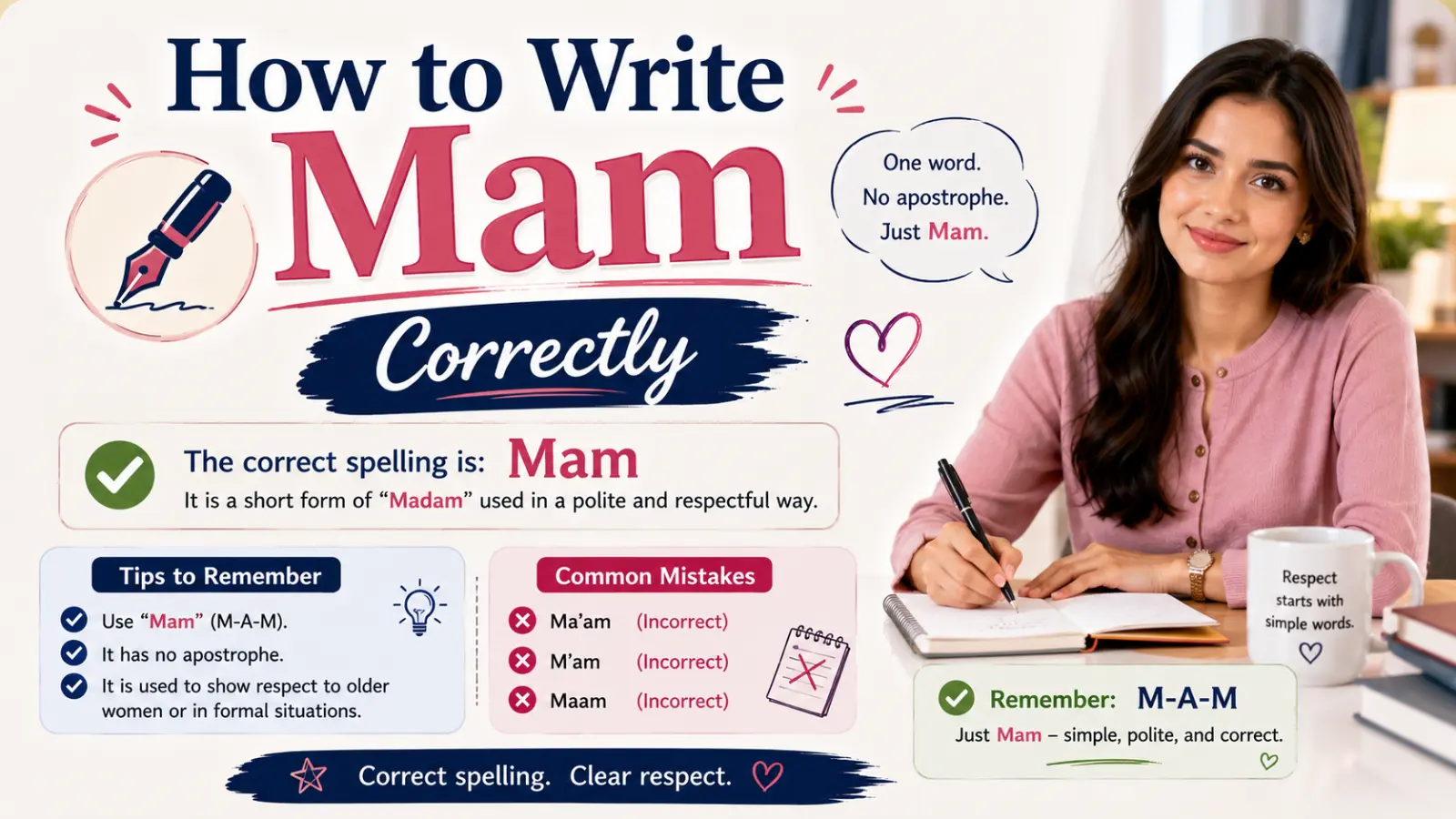
How to write mam correctly is a common question because mam and ma’am sound almost identical. However, they are not always used in the same way. The correct spelling depends on what you mean.
If you want to politely address a woman, ma’am is the standard choice in modern English. It is a contraction of madam and is widely recognized in dictionaries.
The word mam also exists. In British English, it can mean “mother” and is often used in regional or informal speech. Merriam-Webster also lists mam as a variant spelling of ma’am.
So, neither spelling is automatically wrong. The important point is meaning and context.
Quick Answer
If you mean a polite way to address a woman, write ma’am.
- Ma’am = a polite form of address for a woman.
- Mam = commonly means “mother” in some British English dialects.
- Ma’am comes from madam.
- Mam can be correct in regional or informal English.
- For professional writing, ma’am is the safer choice when addressing a woman.
What Does “Ma’am” Mean?
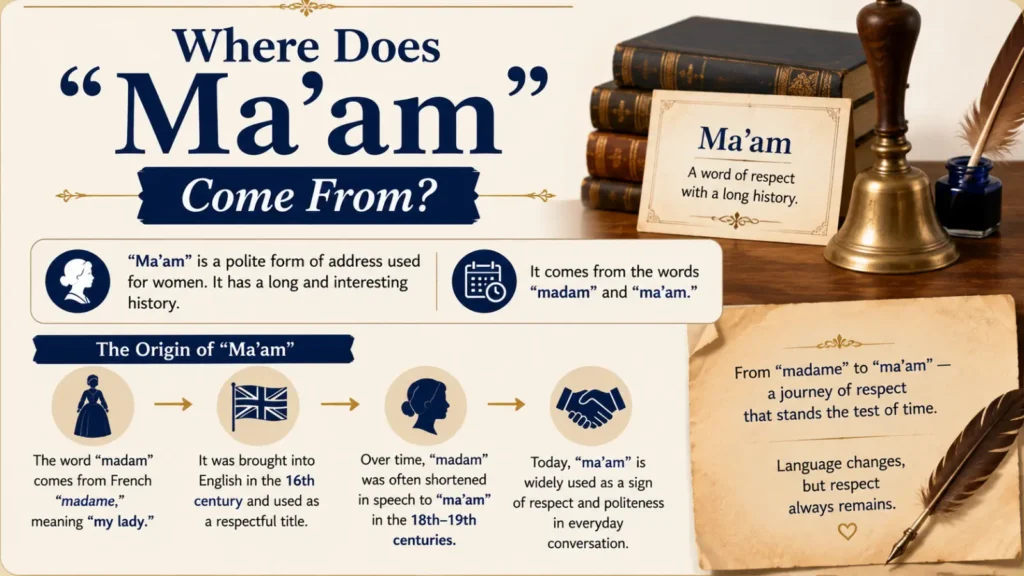
Ma’am is a polite form of address used when speaking directly to a woman.
It is a shortened form of madam. Cambridge Dictionary defines ma’am as a polite way of talking to a woman and also identifies it as a contraction of madam.
Examples
- Excuse me, ma’am.
- Can I help you, ma’am?
- Thank you for your time, ma’am.
- Yes, ma’am, I understand.
The apostrophe is important because it shows that part of the original word madam has been removed.
What Does “Mam” Mean?
Mam has a different common meaning.
In British English, particularly in some regional dialects, mam means mother. Oxford labels this use as British English, dialect, and informal.
Examples
- My mam is making dinner.
- I called my mam after work.
- Her mam lives nearby.
Merriam-Webster also defines mam as “mom” and marks this sense as chiefly British.
Therefore, mam is not simply a misspelling of ma’am in every situation.
Mam vs. Ma’am: Comparison Table
| Word | Meaning | Main Use | Example |
| ma’am | A polite way to address a woman | Formal or polite speech | Excuse me, ma’am. |
| mam | Mother | British regional/informal English | My mam is at home. |
| ma’am | Short form of madam | Direct address | Yes, ma’am. |
| mam | Variant of ma’am in some dictionaries | Less standard usage for this meaning | Thank you, mam. |
Why Does the Confusion Exist?
The confusion mainly comes from pronunciation.
In many varieties of English, ma’am is pronounced similarly to mam. When people hear the word, they may not know whether it contains an apostrophe.
The spelling becomes especially confusing because ma’am is a shortened form of madam. The apostrophe represents letters removed from the original word.
For example:
madam → ma’am
At the same time, mam is an established word in some British dialects. This gives the two spellings overlapping pronunciation but different meanings.
Where Does “Ma’am” Come From?
Ma’am is a contraction of madam.
The full word madam has traditionally been used as a respectful form of address for a woman. Over time, the shortened form ma’am became common in spoken and written English.
Cambridge specifically describes ma’am as a contraction of madam.
Today, ma’am is widely understood as a polite form of address, especially in American English.
Where Does “Mam” Come From?
The history of mam is different.
Oxford lists mam as a British English dialect word meaning mother. It gives the word an origin dating to the late 16th century and suggests that it may imitate a child’s early syllables such as “ma, ma.”
Merriam-Webster similarly identifies mam as chiefly British when it means “mom.”
This explains why mam can be completely correct in sentences about someone’s mother.
What Do Dictionaries Recommend?
Major dictionaries make an important distinction between the two words.
Cambridge Dictionary gives ma’am as a polite form of address for a woman and describes it as a contraction of madam.
Oxford Advanced Learner’s Dictionary lists mam as a British English dialect and informal word meaning “mother.”
Merriam-Webster gives two relevant entries for mam. One defines it as chiefly British “mom,” while another lists mam as a variant spelling of ma’am.
This means it would be inaccurate to say that mam is never a correct word.
However, if your intended meaning is “a polite way to address a woman,” ma’am is the clearest and safest spelling.
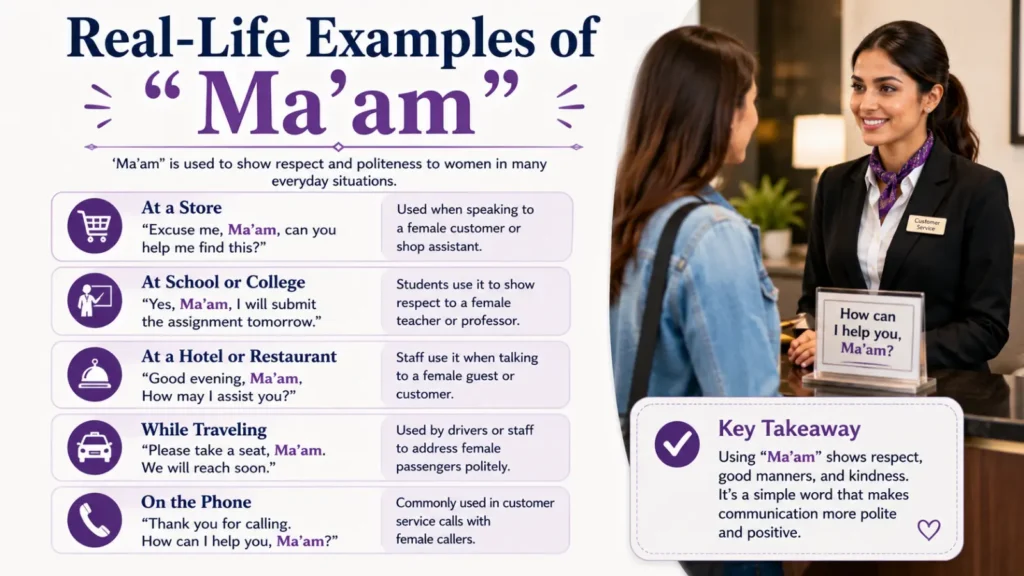
Real-Life Examples of “Ma’am”
Use ma’am when speaking directly to a woman politely.
Example 1
Excuse me, ma’am. You dropped your phone.
Here, ma’am is a polite form of address.
Example 2
Can I help you, ma’am?
The speaker is respectfully addressing a woman.
Example 3
Thank you, ma’am.
The word is used as a polite response.
Example 4
Yes, ma’am. I understand.
This is a common respectful expression.
Real-Life Examples of “Mam”
Use mam when it means mother, especially in regional British English.
Example 1
My mam works at the local school.
Here, mam means mother.
Example 2
I asked my mam to pick me up.
The word refers to the speaker’s mother.
Example 3
Her mam taught her how to cook.
Again, mam means mother.
This usage is informal and regional, so it may sound unusual to speakers from other English-speaking regions.
Common Mistakes
1. Writing “mam” when you mean “ma’am”
Incorrect for standard formal usage:
Excuse me mam, can you help me?
Better:
Excuse me, ma’am. Can you help me?
The apostrophe makes the intended meaning clear.
2. Assuming “mam” is always wrong
This is also a mistake.
Mam is a real English word. In some British dialects, it means mother.
3. Confusing “ma’am” with “madam”
Both can be used as polite forms of address, but ma’am is the contracted form.
- Madam → full form
- Ma’am → contracted form
4. Forgetting punctuation
When using ma’am, remember the apostrophe:
ma’am
Not:
maam
Not:
mam when standard ma’am is intended.
Is “Maam” Correct?
Maam without an apostrophe is generally not the standard spelling when you mean the contraction of madam.
The standard spelling is:
ma’am
The apostrophe indicates the missing letters from madam.
In casual online writing, people sometimes leave out punctuation and write maam or mam. However, informal texting does not make those spellings the best choice for professional writing.
Is “Mam” Correct?
Yes, mam can be correct.
It depends on what you mean.
If mam means mother, it is a recognized regional English word, especially in British English.
If you are using it to address a woman politely, ma’am is normally the better choice in standard professional English.
Professional Writing Recommendation
For emails, applications, customer service messages, school communication, and other professional writing, use ma’am when addressing a woman politely.
For example:
Thank you for your assistance, ma’am.
However, you do not always need to use ma’am in professional communication. In many situations, using the person’s name or an appropriate title is more natural.
For example:
Dear Ms. Ahmed,
may be more suitable than:
Dear Ma’am,
When you do not know someone’s name, a neutral greeting such as Dear Sir or Madam may also be appropriate, depending on the situation.
A Simple Memory Trick
Remember this:
Ma’am = Madam
If you can replace the word with madam, use ma’am.
For example:
Thank you, ma’am.
You could also say:
Thank you, madam.
So ma’am is the right choice.
For mam, think:
Mam = Mom/Mother
If you are talking about someone’s mother, mam may be correct in regional British English.
Which One Should You Use?
Use this simple rule:
Talking politely to a woman? → ma’am
Talking about your mother in a regional British context? → mam
For general international and professional English, ma’am is the safer choice when you mean a respectful form of address.
FAQ
How do you spell mam correctly when talking to a woman?
The standard spelling is ma’am when you are politely addressing a woman. It is a contraction of madam.
Is “mam” a correct spelling?
Yes. Mam is a recognized word, especially in British regional English, where it can mean “mother.” Merriam-Webster also lists mam as a variant of ma’am.
Is “ma’am” the same as “madam”?
Yes. Ma’am is the contracted form of madam.
Should I write “mam” or “ma’am” in an email?
If you are politely addressing a woman, ma’am is the safer standard choice. In many professional emails, however, using the person’s name or title is more natural.
Is “maam” correct?
Maam without an apostrophe is not the standard spelling of the contraction ma’am. Use ma’am in formal and professional writing.
Is “mam” British English?
Yes. Mam is used in British English, especially in regional dialects, to mean “mother.” Oxford labels this use British, dialect, and informal.
Why do people write “mam” instead of “ma’am”?
The two words can sound very similar in speech. People may also omit apostrophes in casual writing. Regional English can add further confusion because mam is independently used to mean “mother.”
Is “ma’am” formal or informal?
Ma’am is generally polite and respectful. Its exact level of formality depends on the situation and variety of English, but it is suitable when respectfully addressing a woman.
Conclusion
The answer to “how to write mam correctly” depends on what you mean.
If you are politely addressing a woman, ma’am is the clearest standard spelling. It is the contracted form of madam.
If you mean mother, mam can be correct in British regional and informal English.
Therefore, mam is not always wrong. The two words have different uses, even though they can sound alike. When writing professionally, choose ma’am when you mean a respectful form of address. When referring to a mother in a regional British context, mam may be the natural choice.

Alex Wordsmith is a comparison research writer and content specialist at WordComparre.com. He focuses on analyzing word meanings, spelling variations, grammar distinctions, and language usage to help readers make informed writing choices. Through clear explanations and practical examples, Alex simplifies complex language topics for students, writers, and professionals. His goal is to make English learning easier, more accurate, and accessible for everyone.