Cubbie or cubby is a common spelling question because both words appear online, in schools, furniture catalogs, and everyday conversations. If you are unsure which one belongs in professional writing, you are not alone. The good news is that both spellings exist, but they are not used equally.
In this guide, you’ll learn which spelling dictionaries prefer, why the two forms are often confused, where each version is commonly used, and which one you should choose in formal and everyday writing.
Quick Answer
Cubby is the standard and widely accepted spelling in modern English. It appears in major dictionaries and is the preferred choice for formal, academic, and professional writing.
Cubbie is an alternative spelling used in some regions and communities. It is less common and often appears as a regional or informal variation rather than the standard form.
What Do Cubby and Cubbie Mean?
Cubby
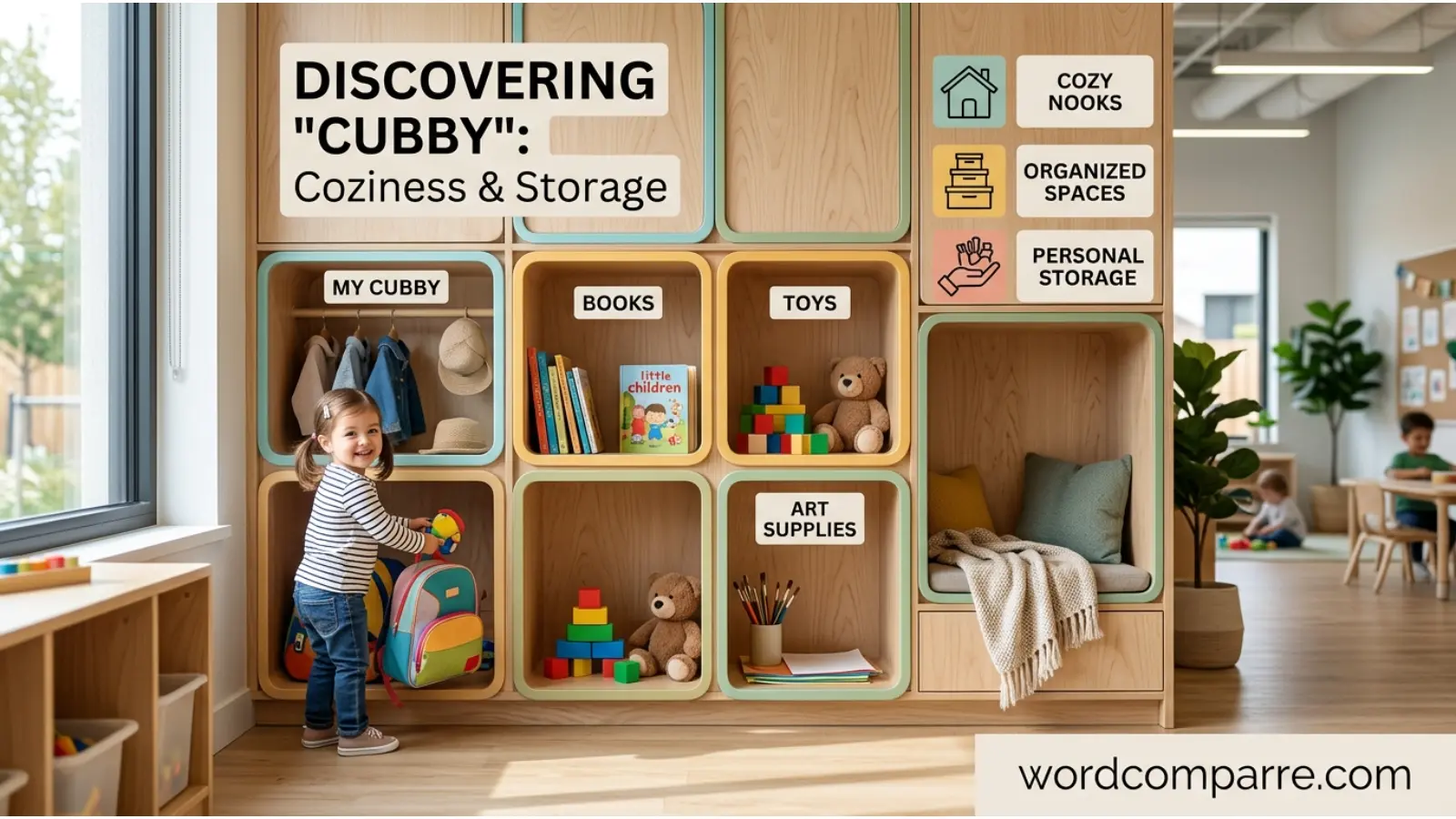
A cubby is a small enclosed storage space or compartment used to organize personal items. It can also describe a small, cozy hiding place.
Examples:
- Please place your backpack in your cubby before class.
- Each employee has a cubby for storing office supplies.
- The cat curled up inside its favorite cubby.
Cubbie
Cubbie usually carries the same meaning as cubby. In many places, especially in informal speech, people use it to describe a child’s storage compartment at school or daycare.
Examples:
- Put your lunchbox in your cubbie.
- Every child has a labeled cubbie for their belongings.
Although the meaning is the same, cubby remains the standard spelling in most published writing.
Cubbie vs Cubby Comparison
| Feature | Cubby | Cubbie |
|---|---|---|
| Standard spelling | Yes | Alternative spelling |
| Dictionary preference | Strongly preferred | Less commonly listed |
| Meaning | Small storage compartment or cozy space | Same meaning |
| Formal writing | Recommended | Usually avoided |
| Everyday use | Very common | Regional and informal |
| School settings | Common | Also common in some areas |
Where Did the Word Come From?
The word cubby comes from the older expression cubbyhole, which has been part of English for centuries. Originally, it described a small enclosed compartment or tiny hiding place.
Over time, people shortened cubbyhole to cubby, especially when talking about classroom storage, office organizers, closets, and compact spaces.
The spelling cubbie developed later as a phonetic variation. Since both words sound exactly alike, some speakers naturally added ie, a common English ending seen in familiar words like doggie or birdie. Despite this variation, the traditional spelling remained cubby.
Why Are People Confused?
Several factors make these spellings easy to mix up.
Both words are pronounced exactly the same.
Parents, teachers, and childcare centers sometimes use cubbie in newsletters, classroom labels, and informal communication.
Many people learn the word by hearing it rather than seeing it written.
Search engines and social media contain examples of both spellings, making it appear that they are equally standard.
What Do Dictionaries Recommend?
Major English dictionaries recognize cubby as the standard spelling.
If your goal is accurate, professional English, cubby is the safest choice because it is the form most dictionaries, publishers, educators, and editors expect.
While cubbie may appear in local usage or informal writing, it is not the preferred spelling in most authoritative references.

Real Life Examples Of Cubby
School:
- Each student keeps their books in a cubby.
Home:
- The shoes fit neatly inside the hallway cubby.
Office:
- She placed the files in her desk cubby.
Informal regional usage:
- The children hung their coats inside their cubbies before class.
Common Mistakes
Using cubbie in formal reports or professional documents when cubby is expected.
Assuming both spellings are equally accepted in dictionaries.
Changing the spelling simply because another school or organization uses cubbie.
Believing cubbie has a different meaning. In most cases, it does not.
Easy Memory Trick
Think of cubbyhole.
Since the original word is cubbyhole, the shortened standard form naturally stays cubby.
If you remember cubbyhole, you’ll almost always choose the correct spelling.
Professional Writing Recommendation
Choose cubby whenever you are writing:
- Articles
- Books
- School assignments
- Business documents
- Websites
- Product descriptions
- Educational materials
Use cubbie only when you are intentionally matching local, regional, or organizational style, or when quoting someone who uses that spelling.
Frequently Asked Questions
Is cubbie a real word?
Yes. Cubbie is a real alternative spelling, but it is less common than cubby.
Which spelling do dictionaries prefer?
Most major dictionaries list cubby as the standard spelling.
Are cubby and cubbie pronounced differently?
No. Both are pronounced exactly the same.
Do they have different meanings?
Generally, no. Both refer to a small storage compartment or cozy enclosed space.
Which spelling should students use?
Students should normally use cubby, unless a teacher or school specifically prefers cubbie.
Which spelling is better for SEO and professional websites?
Cubby is the better choice because it is the standard spelling recognized by dictionaries and most readers.
Conclusion
The comparison between cubbie and cubby is not about one word being completely wrong. Both spellings exist and usually carry the same meaning. However, cubby is the standard, dictionary-supported form and should be your first choice for professional, academic, and published writing.
If you encounter cubbie, remember that it is typically a regional or informal variant rather than the preferred spelling. Choosing cubby ensures your writing matches modern English standards and is immediately recognized by the widest audience.

Alex Wordsmith is a comparison research writer and content specialist at WordComparre.com. He focuses on analyzing word meanings, spelling variations, grammar distinctions, and language usage to help readers make informed writing choices. Through clear explanations and practical examples, Alex simplifies complex language topics for students, writers, and professionals. His goal is to make English learning easier, more accurate, and accessible for everyone.