Gnarly or narly is a common spelling question, especially because both words sound exactly the same when spoken. If you have seen narly on social media or in casual messages, you may wonder if it is an accepted spelling or simply a mistake. The confusion happens because English contains many silent letters, and the silent G in gnarly makes the word easy to misspell.
In this guide, you’ll discover which spelling dictionaries recognize, why people often write narly, how to remember the correct form, and when to use gnarly confidently in everyday writing.
Quick Answer
Gnarly is the correct and standard English spelling.
Narly is generally considered a misspelling of gnarly and is not recognized as the standard form in major English dictionaries.
If you’re writing for school, work, business, or publishing online, always use gnarly.
Meaning of Both Spellings
Gnarly
Gnarly is a real English adjective with several meanings depending on the context.
It can describe:
- Something rough, twisted, or covered with knots, especially wood or tree branches.
- Something difficult, dangerous, or challenging.
- Something extremely impressive, exciting, or intense in informal American English, especially in surfing, skateboarding, snowboarding, and youth culture.
Examples:
- That old oak tree has a gnarly trunk.
- The hikers faced a gnarly mountain trail.
- That skateboard trick was absolutely gnarly!
Narly
Narly does not have a standard dictionary meaning.
Most uses of narly are simply spelling mistakes caused by dropping the silent G from gnarly. Occasionally, someone may intentionally spell it this way online for style, but it is not considered correct English.
Comparison Table
| Feature | Gnarly | Narly |
|---|---|---|
| Standard English | Yes | No |
| Found in dictionaries | Yes | No |
| Correct spelling | Yes | No |
| Professional writing | Recommended | Avoid |
| Informal internet spelling | Rare | Sometimes appears |
| Meaning | Rough, difficult, impressive, extreme | Usually intended to mean gnarly |
Origin of Gnarly
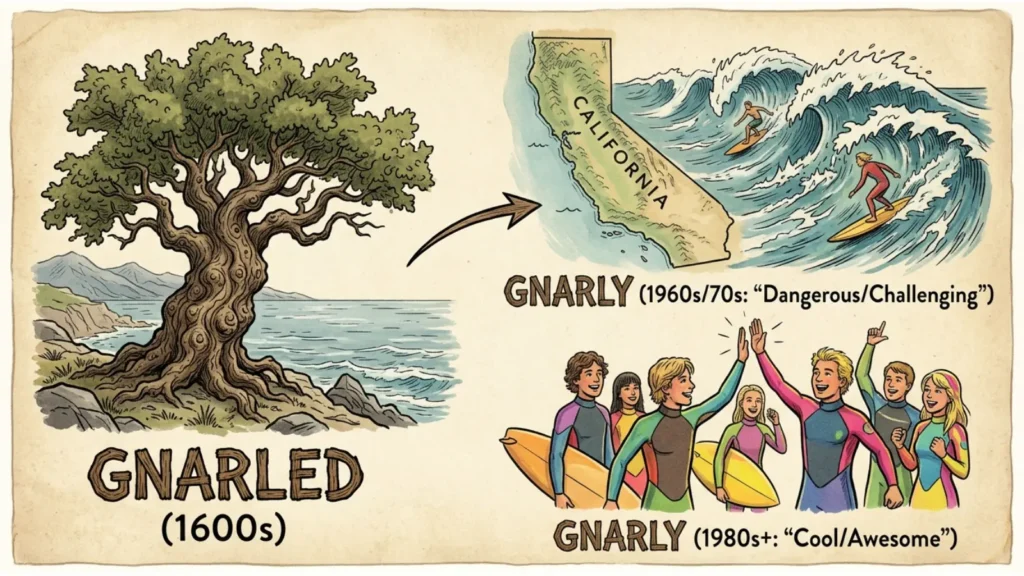
The word gnarly developed from the word gnarled, which describes something full of knots, twists, or rough growth, especially tree branches.
During the late twentieth century, surfers in California gave the word a new meaning. They began using gnarly to describe huge waves, dangerous conditions, and later anything exciting, intense, or impressive. Over time, the slang spread into everyday English and popular culture.
Why the Confusion Exists
There are several reasons people confuse gnarly and narly.
The biggest reason is the silent G. Since it is not pronounced, many people naturally spell the word exactly as they hear it.
The popularity of texting and social media also contributes to the confusion. Users often type quickly without checking spelling, allowing narly to spread online even though it is not the standard form.
People who have only heard the word spoken may never realize it begins with GN.
Dictionary Recommendations
Major English dictionaries recognize gnarly as the correct spelling.
They describe it as a word meaning rough, knotty, difficult, dangerous, or extremely impressive depending on the context.
Narly does not appear as a standard dictionary entry and is generally treated as a misspelling.
For accurate and professional writing, always choose gnarly.
Real Life Examples
Correct examples:
- The tree had a gnarly branch hanging over the road.
- We drove through some gnarly weather.
- That was a gnarly surfing competition.
- His skateboard trick looked gnarly.
- The trail became gnarly after the heavy rain.
Incorrect example:
- That was a narly wave.
Correct version:
- That was a gnarly wave.
Common Mistakes
Many writers accidentally remove the silent G because they spell the word based on pronunciation.
Another mistake is assuming narly has become an accepted alternative because it appears in comments or online posts. While it may be seen on the internet, it is not considered correct English.
Some people also believe gnarly only means “cool.” In reality, the word can describe rough objects, dangerous situations, difficult experiences, or something impressively extreme.
Memory Trick
Think of the word gnarled.
Both gnarled and gnarly begin with GN and relate to rough, twisted, or extreme things.
If you remember gnarled, you’ll naturally remember to spell gnarly with the silent G.
Professional Writing Recommendation
For academic papers, business communication, journalism, marketing, blogs, and professional websites, always write gnarly.
Avoid narly unless you are intentionally reproducing someone’s original spelling in a quotation or discussing the misspelling itself.
Using the correct spelling improves clarity, professionalism, and credibility.
Frequently Asked Questions
Is narly a real word?
No. Narly is generally considered a misspelling of gnarly and is not recognized as a standard English word.
Is gnarly correct?
Yes. Gnarly is the correct spelling and is accepted by major English dictionaries.
Why do people spell gnarly as narly?
Because the G is silent, many people spell the word the way they hear it.
Can I use narly in formal writing?
No. Formal writing should always use gnarly.
Does gnarly always mean cool?
No. Depending on the context, gnarly can mean rough, twisted, difficult, dangerous, or extremely impressive.
Is gnarly American slang?
It became especially popular in American surfing culture, but today it is widely understood in many English-speaking countries.
Conclusion
When comparing gnarly or narly, the correct choice is clear. Gnarly is the accepted English spelling found in dictionaries and used in both literal and slang contexts. It can describe rough objects, difficult situations, or something exciting and impressive.
Narly is simply a common misspelling caused by the silent G. Although it occasionally appears online, it should not be used in professional, academic, or polished writing. Choosing gnarly ensures your writing is accurate, natural, and easy for readers to trust.

Alex Wordsmith is a comparison research writer and content specialist at WordComparre.com. He focuses on analyzing word meanings, spelling variations, grammar distinctions, and language usage to help readers make informed writing choices. Through clear explanations and practical examples, Alex simplifies complex language topics for students, writers, and professionals. His goal is to make English learning easier, more accurate, and accessible for everyone.