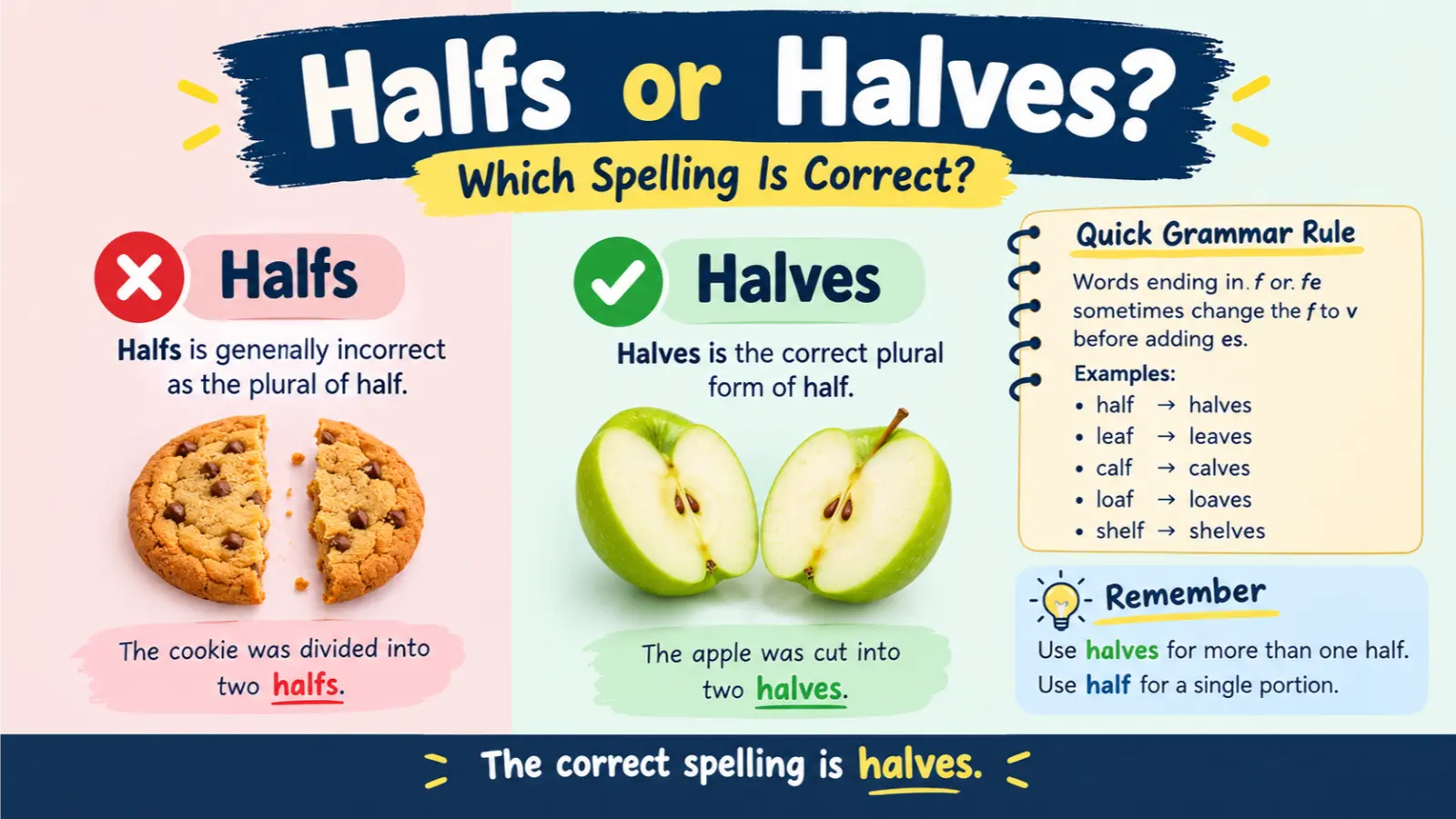
When deciding between halfs or halves, the correct spelling in standard English is halves. It is the plural form of half, which means one of two equal parts of something. Although many English nouns form their plurals by adding s, words ending in f sometimes change to ves.
Understanding this spelling rule can help you avoid common grammar mistakes in everyday writing, school assignments, professional communication, and online content. In this guide, you will learn the difference between halfs and halves, explore the relevant grammar rules, and see practical examples that make the correct spelling easy to remember.

What Is the Difference Between Halfs and Halves?
The main difference is that halves is the standard plural of half, while halfs is generally considered incorrect when referring to more than one half.
- Half: The singular form, referring to one of two equal parts.
- Halves: The plural form, referring to two or more half portions.
- Halfs: A nonstandard spelling that should generally be avoided in ordinary English writing.
Examples:
- I ate half of the sandwich.
- She divided the cake into two halves.
- We bought several halves of different fruits.
These examples show how the correct form changes according to the number of portions being discussed.

Why Is Halves the Correct Plural of Half?
English has several nouns that change their spelling when forming the plural. One common pattern involves nouns ending in f or fe, which may change to ves.
The word half follows this pattern:
- Half becomes halves.
- Calf becomes calves.
- Leaf becomes leaves.
- Loaf becomes loaves.
- Shelf becomes shelves.
However, this is not a universal rule. Some words ending in f simply add s, such as roofs and chiefs. Therefore, it is important to learn the accepted plural form of each word.
What Does Half Mean?
The word half refers to one of two equal parts of a whole. It can function as a noun, an adjective, or part of a phrase.
Examples:
- I drank half of the water.
- She spent half the day studying.
- We shared a half portion of dessert.
The meaning stays the same whether you are discussing food, time, money, distance, or other quantities.
What Does Halves Mean?
Halves is the plural form of half. It describes two or more portions, each representing half of a whole.
Examples:
- Cut the apple into two halves.
- The children divided the pizzas into halves.
- Both halves of the document were missing.
The word is especially common when describing things that have been divided into equal parts.
Grammar Rules for Using Halves
Follow these simple rules to use halves correctly.
Use Halves for More Than One Half
When referring to multiple half portions, use halves.
Incorrect: The orange was divided into two halfs.
Correct: The orange was divided into two halves.
Use Half for One Portion
Use half when referring to a single half of something.
Example: He ate half of the apple.
Remember That the Plural Can Follow Numbers
The word halves commonly appears after numbers or expressions that indicate multiple portions.
Examples:
- Two halves make one whole.
- Three halves of a cup equal one and a half cups.
- The two halves fit together perfectly.
Halfs or Halves in Everyday Writing
The correct spelling remains halves in most everyday contexts.
In academic writing: Use halves when explaining fractions, measurements, or mathematical concepts.
Example: The students divided the circle into two equal halves.
In professional writing: Use halves when describing divided products, quantities, or resources.
Example: The company split the project into two halves.
In casual conversation: Use halves when talking about food, objects, or shared portions.
Example: We cut the cookies into halves and shared them.
The word halfs is not the accepted plural spelling in these contexts.
Common Mistakes When Using Halfs or Halves
Writers often make this mistake because many English plurals are formed by adding s to a singular noun. However, half follows a different spelling pattern.
Here are common errors to avoid:
- Writing halfs instead of halves.
- Assuming every noun ending in f forms its plural in the same way.
- Using halves when only one portion is being discussed.
- Confusing a half portion with a whole object that has been divided.
Memory tip: Remember the pattern half → halves, just as leaf → leaves. Practicing these word pairs can help you remember the correct spelling.
Frequently Asked Questions
Is halfs ever correct?
Halfs is generally incorrect as the ordinary plural of half. Use halves in standard English writing.
Is halves the plural of half?
Yes. Halves is the accepted plural form of half.
Why does half change to halves?
The word follows a traditional English plural pattern in which the final f changes to v before adding es.
Which is correct: two halfs or two halves?
Two halves is correct because halves is the standard plural form of half.
Do all words ending in f change to ves?
No. Some words change f to v before adding es, while others simply add s. For example, leaf becomes leaves, but roof becomes roofs.
Conclusion
When comparing halfs or halves, remember that halves is the correct standard plural of half. The word half describes one of two equal parts, while halves refers to multiple half portions. Although adding s works for many English nouns, some words follow special plural patterns. Learning these forms will help you write more accurately and communicate clearly. Whenever you need the plural of half, choose halves rather than halfs.