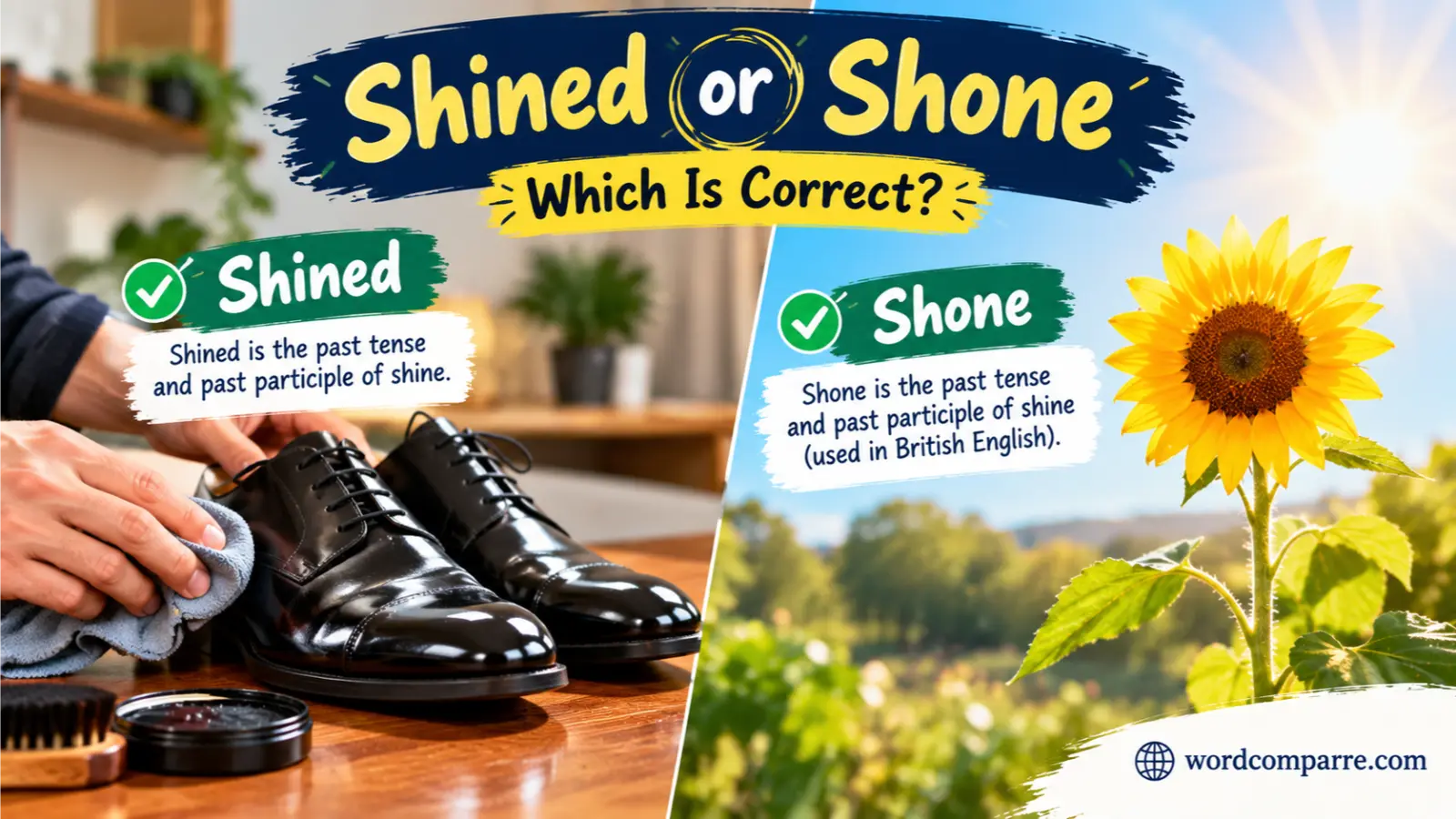
Have you ever wondered whether to write shined or shone when describing light, sunshine, or a polished object? Both words are correct forms of the verb shine, but they are not always used in the same situations. Understanding the difference will help you write clearer sentences and avoid common grammar mistakes.
In this guide, you will learn when to use shined and shone, how they work in different sentences, and which form sounds more natural in everyday conversations and professional writing. You can also use the copy button on this website to save useful examples for later.
What Do Shined and Shone Mean?
The words shined and shone are both past-tense forms of the verb shine. They can describe something that produced light or reflected brightness. They can also describe the act of making an object bright through polishing.
The main difference is their common usage.
- Shone: Often used when a light source produces light or something appears bright.
- Shined: Often used when someone polishes an object or directs light toward something.
Examples:
- The moon shone brightly over the lake.
- He shined his shoes before the interview.
Both sentences use the correct verb form for their intended meaning.
When Should You Use Shone?
Use shone when describing light, brightness, or something that appeared radiant. This form is especially common in traditional storytelling, literature, and descriptions of natural light.
Examples:
- The sun shone through the clouds.
- Her eyes shone with excitement.
- The stars shone above the quiet village.
- A bright light shone through the window.
In these examples, the verb describes light or brightness rather than an action performed to polish something.
Expert insight: Shone is a strong choice when describing natural light or a glowing appearance. It often sounds natural in both everyday writing and formal prose. However, shined can also be correct when describing light, depending on the sentence and the variety of English.
When Should You Use Shined?
Use shined especially when describing the action of polishing or making something shiny. It is common in everyday American English and appears frequently in conversations about shoes, furniture, and other objects.
Examples:
- She shined her shoes before the ceremony.
- The worker shined the brass handles.
- He shined the silverware until it looked new.
- The mechanic shined the metal surface.
In these sentences, someone performs an action to improve an object’s appearance.
Expert insight: Shined is a natural choice when a person actively polishes something. Remember that the meaning of the sentence matters more than simply memorizing a rule about the two forms.
Shined vs. Shone: The Main Grammar Difference
The difference becomes easier to understand when you look at the action being described.
| Feature | Shined | Shone |
|---|---|---|
| Verb form | Past tense of shine | Past tense of shine |
| Past participle | Shined | Shone |
| Common use | Polishing an object | Producing light or appearing bright |
| Example | He shined his shoes. | The sun shone brightly. |
| Correct English | Yes | Yes |
Both forms can function as the simple past tense. They can also appear as past participles, although shined is the form used more commonly in American English when referring to polishing.
Examples:
- Simple past: The sun shone all afternoon.
- Simple past: She shined the table.
- Present perfect: The sun has shone brightly this week.
- Present perfect: He has shined shoes for many years.
The choice depends on meaning, usage, and the sentence structure.
How to Use Shined and Shone in Sentences
Both words can appear in different sentence structures. The following examples show how to use them naturally.
Using shined:
- Subject + shined + object: He shined his shoes.
- Subject + has shined + object: She has shined the silver bowl.
- Subject + had shined + object: They had shined the windows before the guests arrived.
Using shone:
- Subject + shone: The moon shone.
- Subject + shone + adverb: The light shone brightly.
- Subject + has shone: The sun has shone through the window all morning.
Notice that shined often takes an object when it describes polishing. Shone often appears without an object when it describes light being emitted or brightness being visible.
These are common patterns, not absolute rules. The verb shine can be used in other constructions, too.
Common Mistakes to Avoid
Writers sometimes assume that one form is always correct and the other is always wrong. That is not true.
Here are a few mistakes to watch for.
Mistake one: Treating shined as incorrect.
Incorrect assumption: Shined is never correct in the past tense.
Correct understanding: Shined is a standard past-tense form, especially when describing polishing.
Mistake two: Using shone for every polishing action.
Less natural in many contexts: He shone his shoes before work.
More common: He shined his shoes before work.
The first sentence may occur in some varieties of English, but shined is the more usual choice for this meaning in American English.
Mistake three: Confusing past tense with present tense.
Incorrect: The sun shone brightly every day, and today it shine brightly.
Correct: The sun shone brightly yesterday, and today it shines brightly.
Mistake four: Assuming shone is always the past participle.
Both forms can be used as past participles. For example, both has shone and has shined occur in English, with preferences depending on meaning and usage.
Which Form Is Better for Professional Writing?
Both words are acceptable in professional writing. Choose the form that best matches your intended meaning.
For business communication, reports, and everyday professional documents, use shined when describing polishing an object.
Example: The maintenance team shined the brass fixtures before the inspection.
For descriptive writing, reports about lighting, and creative work, shone is often a natural choice when describing emitted light.
Example: A bright beam shone across the entrance.
Consistency is helpful, but you do not need to avoid either word simply because the other appears elsewhere in your document.
Is Shined or Shone More Common in American and British English?
Both forms are used in American and British English, but preferences can differ by meaning and context.
In American English, shined is particularly common for polishing shoes or other objects. Shone is widely used for light and brightness.
British English also commonly uses shone to describe light and brightness. Shined is used for polishing, too, although individual speakers and contexts may differ.
The difference is not a strict rule separating American and British English. It is mainly a matter of usage and meaning.
Examples:
- American English: He shined his shoes for the wedding.
- British English: The sun shone through the clouds.
- Both varieties: The lamp shone brightly in the hallway.
Easy Memory Tricks for Shined and Shone
Remember these simple associations to make the difference easier to recall.
- Shined = polished: Think of someone shining shoes before an important meeting.
- Shone = light: Think of the sun shining across the sky.
- Both are correct: Neither word is automatically a spelling or grammar error.
- Check the meaning: Ask yourself whether the sentence describes polishing something or light appearing.
Try this quick test.
Choose the correct word for each sentence.
- The stars _____ brightly last night.
- He _____ his shoes before the interview.
- The flashlight _____ directly into the cave.
- She _____ the silver tray until it gleamed.
Answers: 1. shone, 2. shined, 3. shone, 4. shined.
These answers reflect common usage rather than an absolute rule for every possible context.
Real-Life Conversations Using Shined and Shone
Short conversations can help you understand how people use these words naturally.
Conversation one: Getting ready for work
Alex: Your shoes look fantastic. Did you buy a new pair?
Sam: No, I shined them this morning.
Alex: They look almost brand new.
Conversation two: Talking about the weather
Mia: Was it sunny yesterday?
Leo: Yes, the sun shone all afternoon.
Mia: That sounds like a perfect day for a walk.
Conversation three: Describing a night sky
Sara: Did you see the stars last night?
Emma: Yes, they shone so brightly that I stayed outside for an hour.
Sara: I wish I had seen them, too.
These conversations show how context helps you choose the appropriate form.
Frequently Asked Questions
Is shined grammatically correct?
Yes. Shined is a correct past-tense form of shine and is especially common when describing polishing shoes or another object.
Is shone grammatically correct?
Yes. Shone is a correct past-tense form of shine and is frequently used to describe light, brightness, or a glowing appearance.
Should I write shined or shone in American English?
Use shined most commonly for polishing objects and shone commonly for light or brightness. Both forms have broader uses, so consider the intended meaning.
Can I say the sun shined?
Yes. The expression occurs in English, particularly in some American usage. However, the sun shone is also very common and is often preferred in traditional descriptive writing.
Is shone the past tense or past participle of shine?
Shone can be both the simple past tense and the past participle. For example, you can write the light shone and the light has shone. Shined can also serve as both forms.
Conclusion
The difference between shined and shone is mainly about usage, not correctness. Both words are legitimate forms of the verb shine. Shined is especially common when someone polishes an object, while shone is frequently used to describe light or brightness.
To choose the right word, consider what your sentence means and how the verb is being used. With a little practice, you can use both forms confidently in conversations, schoolwork, and professional writing.