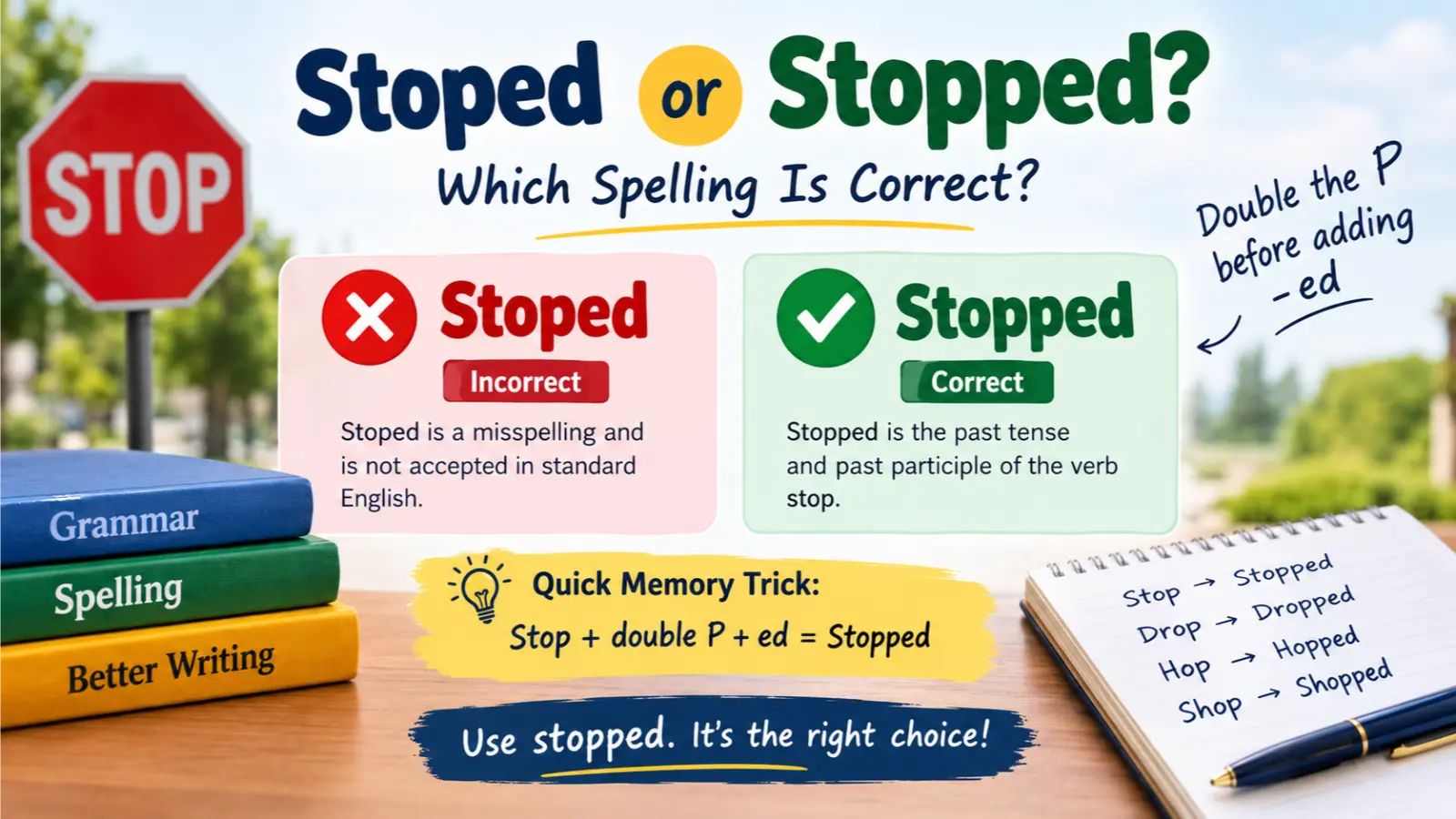
The difference between Stoped or Stopped often confuses English learners because both spellings look similar. However, stopped is the correct spelling, while stoped is incorrect in standard English. The word stopped is the past tense and past participle of the verb stop, which means to cease moving or doing something. Learning the correct spelling helps you write more clearly and avoid common grammar mistakes.
In this guide, you will learn why stopped uses a double p, explore simple sentence examples, and understand the spelling rules for adding -ed to verbs. You can also use our copy button to copy your favorite examples quickly and save them for future reference. By the end, you will know how to use stopped confidently in everyday conversations, school assignments, and professional writing.
Quick Answer: Stoped or Stopped?
Stopped is correct, while stoped is incorrect in standard English.
Use stopped when describing an action that happened in the past or when forming certain verb tenses.
- Correct: The car stopped at the red light.
- Incorrect: The car stoped at the red light.
Remember that the base verb is stop, but its past tense is stopped. The final letter p doubles before adding -ed.
What Does Stopped Mean?
The word stopped means that an action, movement, activity, or process came to an end. It can also mean that someone prevented an action from continuing.
For example:
- The train stopped at the station.
- She stopped talking when the teacher entered.
- The security guard stopped the visitor at the entrance.
- We stopped working because the power went out.
In each sentence, stopped describes an action that occurred in the past.
Is Stoped Ever Correct?
In ordinary modern English, stoped is not the accepted spelling of the past tense of stop. You should use stopped in essays, professional documents, schoolwork, and online content.
If you encounter stoped in a sentence, it is usually a spelling error that needs correction.
Stoped vs. Stopped: Comparison Table
| Feature | Stoped | Stopped |
|---|---|---|
| Standard spelling | Incorrect | Correct |
| Base verb | Intended to be stop | Stop |
| Past tense | Incorrect form | Stopped |
| Past participle | Incorrect form | Stopped |
| Suitable for formal writing | No | Yes |
| Example | He stoped running. | He stopped running. |
The key difference is the doubled p in stopped. This spelling follows a common English rule for forming the past tense of certain verbs.
Why Is Stopped Spelled With Two Ps?
English spelling rules often require a final consonant to be doubled when a verb ends in a single consonant preceded by a single vowel and the final syllable is stressed. For short, one-syllable verbs such as stop, this rule commonly applies before adding -ed.
Follow these steps:
- Start with the base verb: stop.
- Identify the final consonant: p.
- Double the final consonant: stopp.
- Add -ed: stopped.
This process explains why stoped is incorrect.
More Examples of the Same Rule
Several other common verbs follow the same pattern.
- Hop → Hopped.
- Shop → Shopped.
- Drop → Dropped.
- Clap → Clapped.
- Plan → Planned.
These examples show how doubling the final consonant helps preserve the expected pronunciation and follows conventional English spelling.
Origin and Development of the Word Stopped
The verb stop has historical roots in older Germanic languages and developed through earlier forms of English. Over time, English spelling conventions established how the verb changes when referring to past actions.
The spelling stopped reflects the regular pattern of adding -ed to a verb while doubling its final consonant. This is a grammatical spelling change rather than a difference in meaning between stoped and stopped.
Modern dictionaries recognize stopped as the standard past-tense and past-participle form of stop.
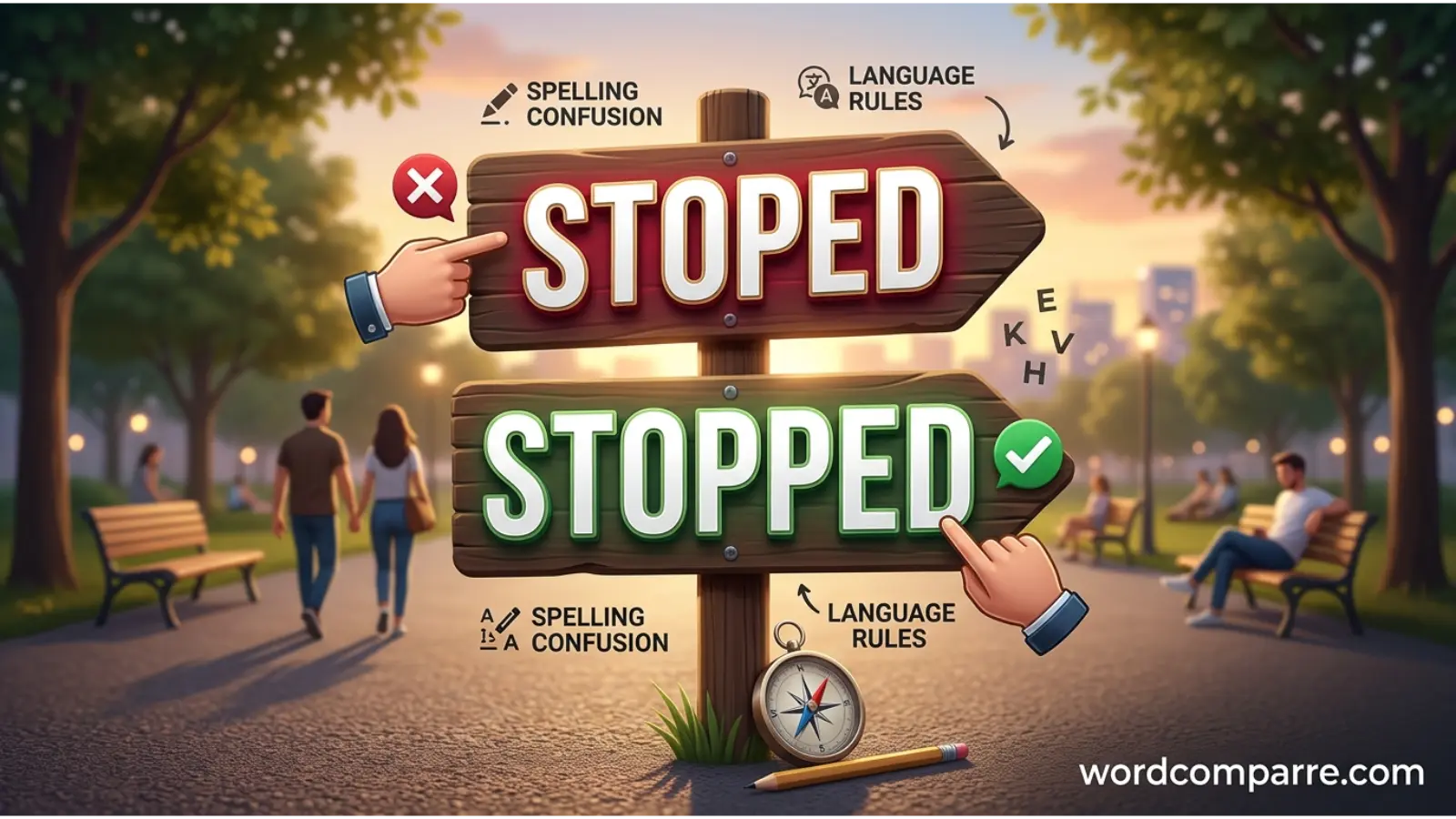
Why Do People Confuse Stoped and Stopped?
There are several reasons why writers sometimes use the wrong spelling.
1. Forgetting to Double the Final Consonant
Some writers assume that adding -ed to a verb always requires changing nothing else. However, English spelling rules sometimes require doubling the final consonant.
Incorrect: The bus stoped outside the school.
Correct: The bus stopped outside the school.
2. Applying a General Rule Too Broadly
Some verbs simply take -ed, such as walked and talked. Others require a spelling change, such as stopped and planned.
Learning common verb patterns helps prevent mistakes.
3. Typing Too Quickly
When writing quickly, it is easy to leave out one letter. Spell-checking tools can catch many errors, but understanding the rule is more useful for avoiding them in the future.
Dictionary Recommendations: Stoped or Stopped?
Standard English dictionaries list stopped as the past tense and past participle of stop. The spelling stoped is not the standard form for this verb.
When checking an unfamiliar spelling, consult reputable dictionaries such as Merriam-Webster, Oxford English Dictionary, or Cambridge Dictionary. Look for the verb’s past-tense and past-participle forms rather than relying only on the base word.
For professional and academic writing, use stopped consistently.
Real-Life Examples of Stopped in Sentences
Seeing the correct spelling in different contexts can make it easier to remember.
Everyday Conversations
- I stopped at the grocery store on my way home.
- He stopped calling after he moved abroad.
- We stopped the game because it started raining.
- My friend stopped laughing when the teacher arrived.
School and Academic Writing
- The experiment stopped when the equipment failed.
- The student stopped writing to review the instructions.
- The teacher stopped the lesson to answer a question.
Workplace and Professional Writing
- The company stopped production temporarily.
- The manager stopped the meeting to discuss an urgent issue.
- The software stopped responding after the update.
- The team stopped the project until the budget was approved.
All these examples use stopped correctly because they describe completed actions or events in the past.
Common Mistakes to Avoid
Avoid these frequent spelling and grammar errors when using stop.
| Incorrect sentence | Correct sentence |
|---|---|
| She stoped the car. | She stopped the car. |
| He has stoped working. | He has stopped working. |
| They stoped the discussion. | They stopped the discussion. |
| The machine suddenly stoped. | The machine suddenly stopped. |
| I had stoped eating. | I had stopped eating. |
Notice that stopped works with different sentence structures. It can appear on its own as a past-tense verb or after helping verbs such as has, have, and had.
Is Stopped the Past Tense or Past Participle?
It can be both.
- Simple past: She stopped the car.
- Present perfect: She has stopped the car.
- Past perfect: She had stopped the car.
The surrounding words determine which grammatical tense is being used, but the spelling remains the same.
Easy Memory Trick: How to Spell Stopped
Here is a simple way to remember the correct spelling:
Stop + double P + ed = Stopped.
Think of the word stop as needing one extra p before it can become a past-tense verb.
You can also remember this short sentence:
“The bus stopped, so the P doubled.”
Practice with a few similar words:
- Stop → Stopped.
- Drop → Dropped.
- Hop → Hopped.
- Shop → Shopped.
Writing these words a few times can help you remember the pattern naturally.
Professional Writing Recommendation
Always use stopped instead of stoped in professional, academic, and casual writing.
If you are editing a document, check whether the word describes a past action or follows a helping verb such as has, have, or had. In these cases, stopped is the correct form.
For website articles, emails, reports, and educational content, correct spelling improves readability and helps readers trust your writing. A quick proofreading check can also catch missing or doubled letters.
Frequently Asked Questions
1. Is stoped or stopped correct?
Stopped is correct. Stoped is a misspelling when intended as the past tense or past participle of stop.
2. Why does stopped have two Ps?
The final consonant is doubled before adding -ed because stop follows a common English spelling rule for short verbs ending in a consonant preceded by a single vowel.
3. What is the past tense of stop?
The past tense of stop is stopped. For example, “The train stopped at the station.”
4. Is stopped also a past participle?
Yes. Stopped serves as both the simple past form and the past participle. For example, “She stopped” and “She has stopped.”
5. How can I remember the correct spelling?
Remember the pattern stop + p + ed = stopped. Doubling the final p before adding -ed will help you avoid the common mistake.
Conclusion
When choosing between stoped or stopped, always use stopped in standard English. It is the correct past tense and past participle of stop, while stoped is a spelling error in this context.
The easiest way to remember the difference is to double the final p before adding -ed. With a little practice and careful proofreading, you can use stopped confidently in everyday conversations, school assignments, professional documents, and website content.