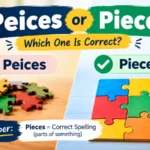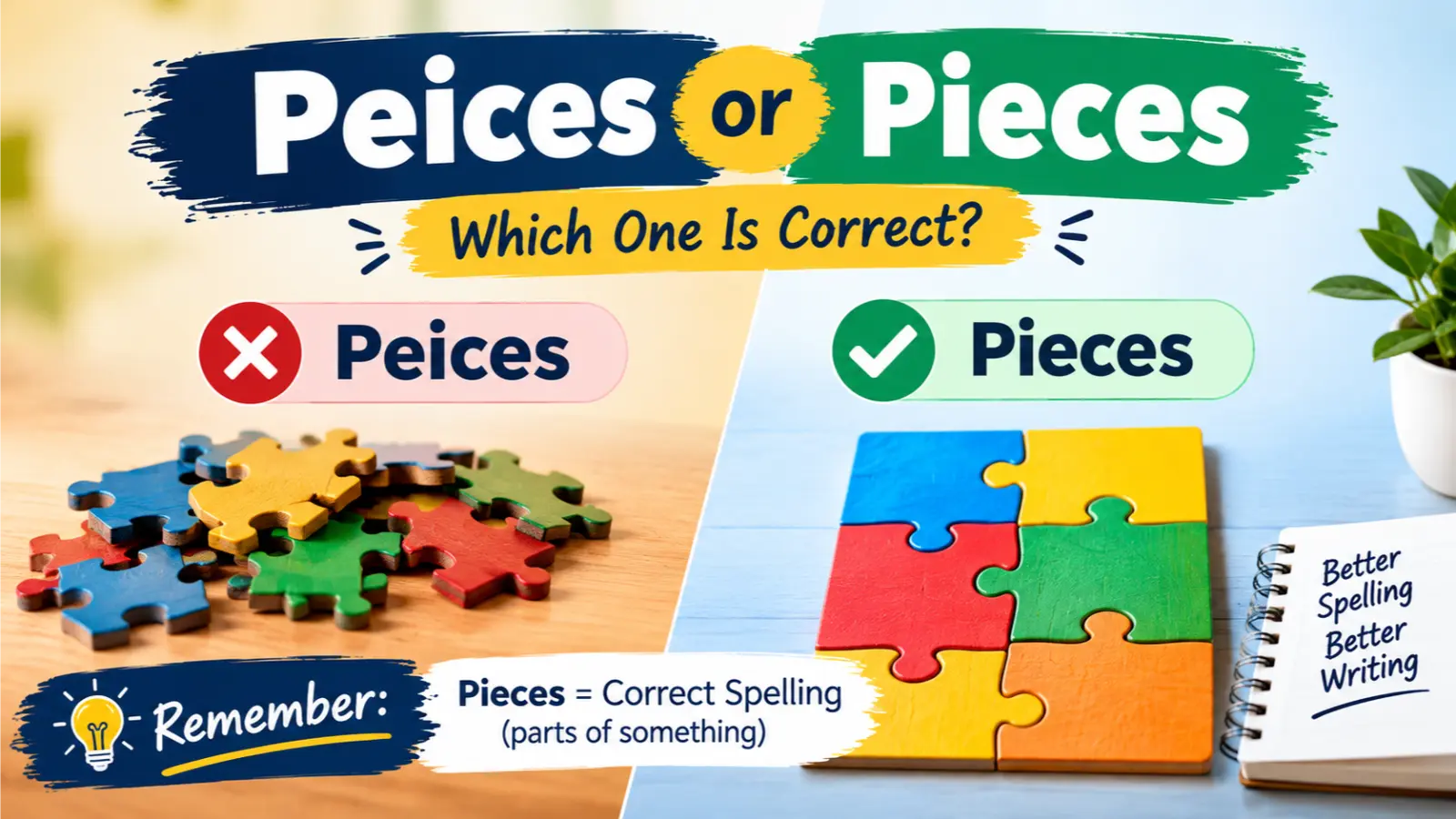
Have you ever wondered whether to write peices or pieces? These spellings look similar, so it is easy to mix up their letters when writing quickly. However, only one is the standard spelling in modern English.
Pieces is the correct spelling. It is the plural form of piece, which means a part or portion of something. The spelling peices is a common spelling mistake that occurs when writers place the letters E and I in the wrong order.
Learning this small spelling rule can help you write more confidently in school assignments, professional emails, articles, and everyday conversations.
Quick Answer:
Pieces is correct, while peices is incorrect in standard English.
Use pieces when referring to more than one part of something.
Examples:
- She cut the cake into six pieces.
- I found several pieces of paper on the floor.
- The puzzle has one hundred pieces.
Avoid peices in formal and informal writing because it is a misspelling of pieces.
What Does Pieces Mean?
The word pieces is the plural form of piece. It refers to separate parts of an object, a quantity of something, or individual items belonging to a larger whole.
The meaning depends on the context.
Parts of an object
- The glass broke into several pieces.
- He arranged the wooden pieces on the table.
Portions of food
- We shared two pieces of pizza.
- She ate three pieces of chocolate.
Individual items or works
- The artist displayed several pieces of artwork.
- I bought a few pieces of furniture for my new apartment.
In each example, pieces describes more than one part, portion, or item.
What Does Peices Mean?
Peices has no recognized standard meaning in modern English. It is generally a misspelling of pieces.
People commonly make this error because they remember the letters but place them in the wrong order. Since the two spellings look similar, the mistake can happen during typing, note-taking, or proofreading.
Incorrect: The box contains several peices of equipment.
Correct: The box contains several pieces of equipment.
For professional writing, always use pieces.
Peices vs Pieces: Key Differences
| Feature | Peices | Pieces |
|---|---|---|
| Spelling status | Incorrect | Correct |
| Standard dictionary form | No | Yes |
| Meaning | No standard meaning intended | Parts or portions of something |
| Grammar | Misspelling | Plural noun |
| Professional writing | Avoid | Recommended |
The main difference is the order of the letters I and E. In pieces, the letters appear in the sequence I before E after the initial P.
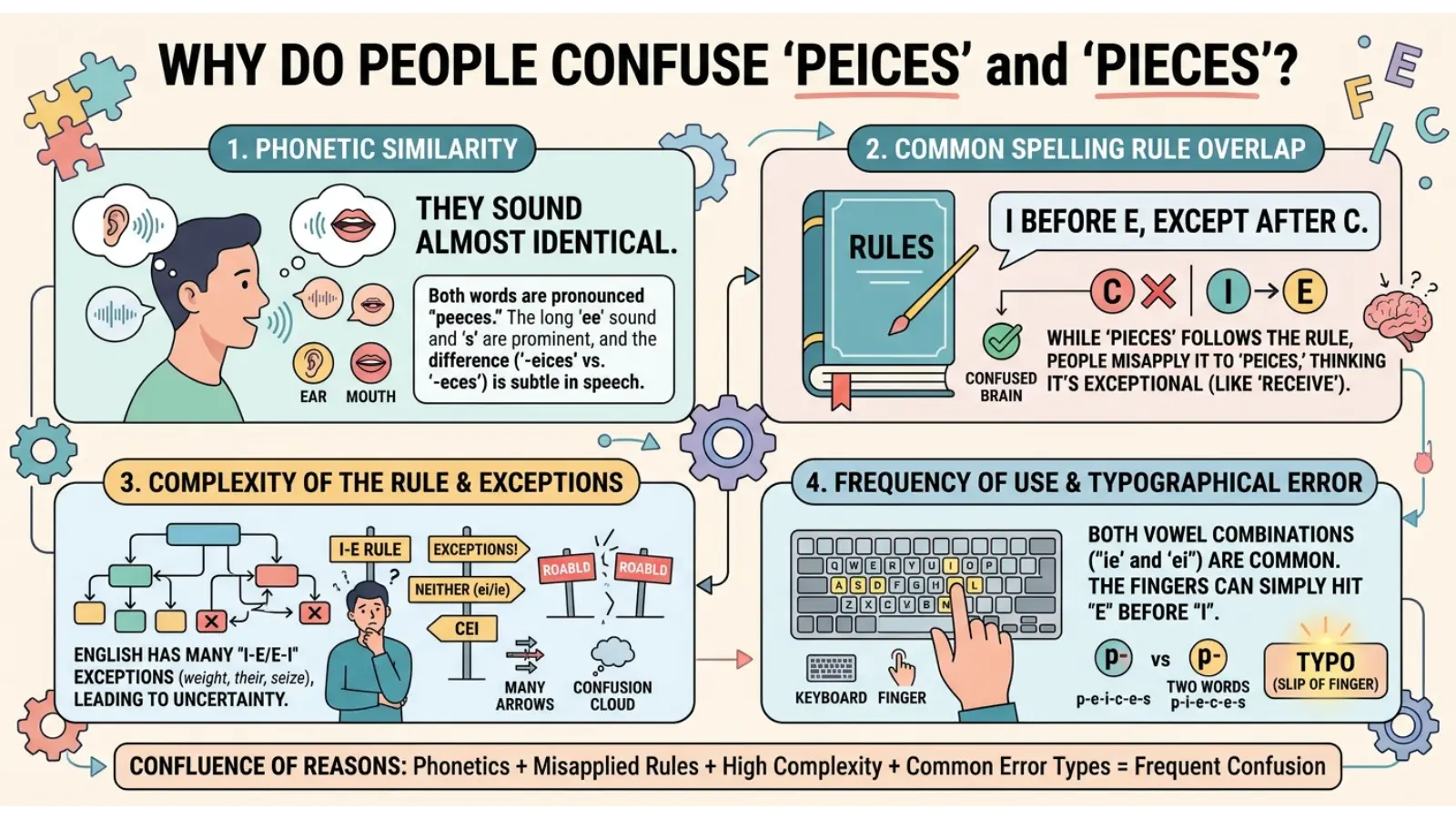
Why Do People Confuse Peices and Pieces?
The confusion usually happens because English spelling does not always follow predictable patterns. Writers may remember how a word sounds but forget the exact order of its letters.
Several factors contribute to this mistake.
Mixing up letter order
Writers sometimes type peices because they accidentally reverse the I and E.
Writing too quickly
When people focus on expressing their ideas, they may overlook small spelling errors.
Relying on pronunciation
The difference between the two spellings is not obvious when speaking because both are usually intended to represent the same word.
Typing without proofreading
A misspelling can remain unnoticed if the writer does not review the sentence carefully.
Understanding these causes makes it easier to recognize and correct the error.
Origin and Spelling of the Word Pieces
The word piece entered English through Anglo-French, from a form related to Old French piece. Its spelling developed through the history of the English language.
The plural form follows a familiar English rule: add s to the singular noun.
- One piece.
- Two pieces.
- Several pieces.
The spelling peices does not follow the standard spelling of the word. Remembering the singular form piece can help you spell its plural correctly.
What Do Dictionaries Recommend?
Standard English dictionaries recognize piece as the correct noun and pieces as its plural form. Peices is not the standard spelling of this word.
When checking an unfamiliar spelling, consult a reputable dictionary such as Merriam-Webster, Cambridge Dictionary, or Oxford Learner’s Dictionaries.
A dictionary can help you confirm a word’s spelling, definition, pronunciation, and grammatical use. For this particular comparison, the recommendation is straightforward: use pieces.
Examples of Pieces in Everyday Sentences
Reading correct examples helps reinforce the spelling and shows how the word works in different situations.
At home
- Please put the broken pieces of the vase in a safe container.
- I need two pieces of paper to finish the project.
- She arranged the puzzle pieces on the floor.
At school or work
- The teacher distributed pieces of colored paper to the students.
- The report contains several important pieces of information.
- We reviewed the different pieces of evidence before making a decision.
While shopping or eating
- He ordered three pieces of fried chicken.
- The shop sells individual pieces of jewelry.
- We divided the cake into equal pieces.
These examples demonstrate that pieces can refer to physical objects, portions, and parts of an idea or collection.
Common Spelling Mistakes to Avoid
The most important mistake to avoid is reversing the I and E in pieces. Other errors may occur when writers are unfamiliar with the singular and plural forms.
Review these examples.
- Incorrect: I bought two peices of bread.
- Correct: I bought two pieces of bread.
- Incorrect: The toy broke into many peices.
- Correct: The toy broke into many pieces.
- Incorrect: She collected small peices of wood.
- Correct: She collected small pieces of wood.
Remember that the singular form is piece, while the plural form is pieces. You do not need to change the internal spelling when adding the plural ending.
An Easy Memory Trick for Pieces
A simple way to remember the correct spelling is to focus on the sequence PIE inside the word.
Think of the familiar word pie. It uses the letters I before E. The word pieces begins with the same letter sequence:
P + IE + CES = PIECES
This memory trick is not a rule for every English word, but it can help you remember this particular spelling.
You can also practice by writing these phrases:
- A piece of cake.
- Two pieces of cake.
- Several pieces of paper.
Repeating the singular and plural forms helps make the correct spelling more familiar.
Professional Writing Recommendation
Always use pieces in professional emails, academic assignments, business documents, blog posts, and published content.
Although readers can often understand peices from context, the error may reduce the credibility of your writing. Correct spelling makes your message clearer and helps readers focus on your ideas rather than mistakes.
Before publishing an article, check commonly misspelled words with a spellchecker and proofread the final draft. Automated tools can help, but a careful review is still useful because not every spelling or context error is detected automatically.
Frequently Asked Questions
Is Peices or Pieces Correct?
Pieces is correct. Peices is a common misspelling and should not be used in standard English writing.
What Is the Meaning of Pieces?
Pieces is the plural form of piece. It refers to multiple parts, portions, or individual items, such as pieces of cake or pieces of furniture.
Why Is Peices Incorrect?
Peices reverses the I and E in the standard spelling pieces. English dictionaries recognize pieces as the correct form.
Is Pieces Singular or Plural?
Pieces is plural. The singular form is piece, which refers to one part or item.
How Can I Remember the Spelling of Pieces?
Remember the letters in the word pie. The sequence I before E appears in pieces, which can help you recall the correct spelling.
Can I Use Peices in Formal Writing?
No. Use pieces in formal writing, professional communication, and published articles. Correcting the spelling helps maintain accuracy and credibility.
Conclusion
When choosing between peices or pieces, always use pieces. It is the correct plural form of piece, while peices is a spelling mistake caused by reversing the letters I and E.
Remember the word pie to help you recall the correct letter order. Whether you are writing about pieces of cake, puzzle pieces, or pieces of information, using the standard spelling will make your writing clearer and more professional.