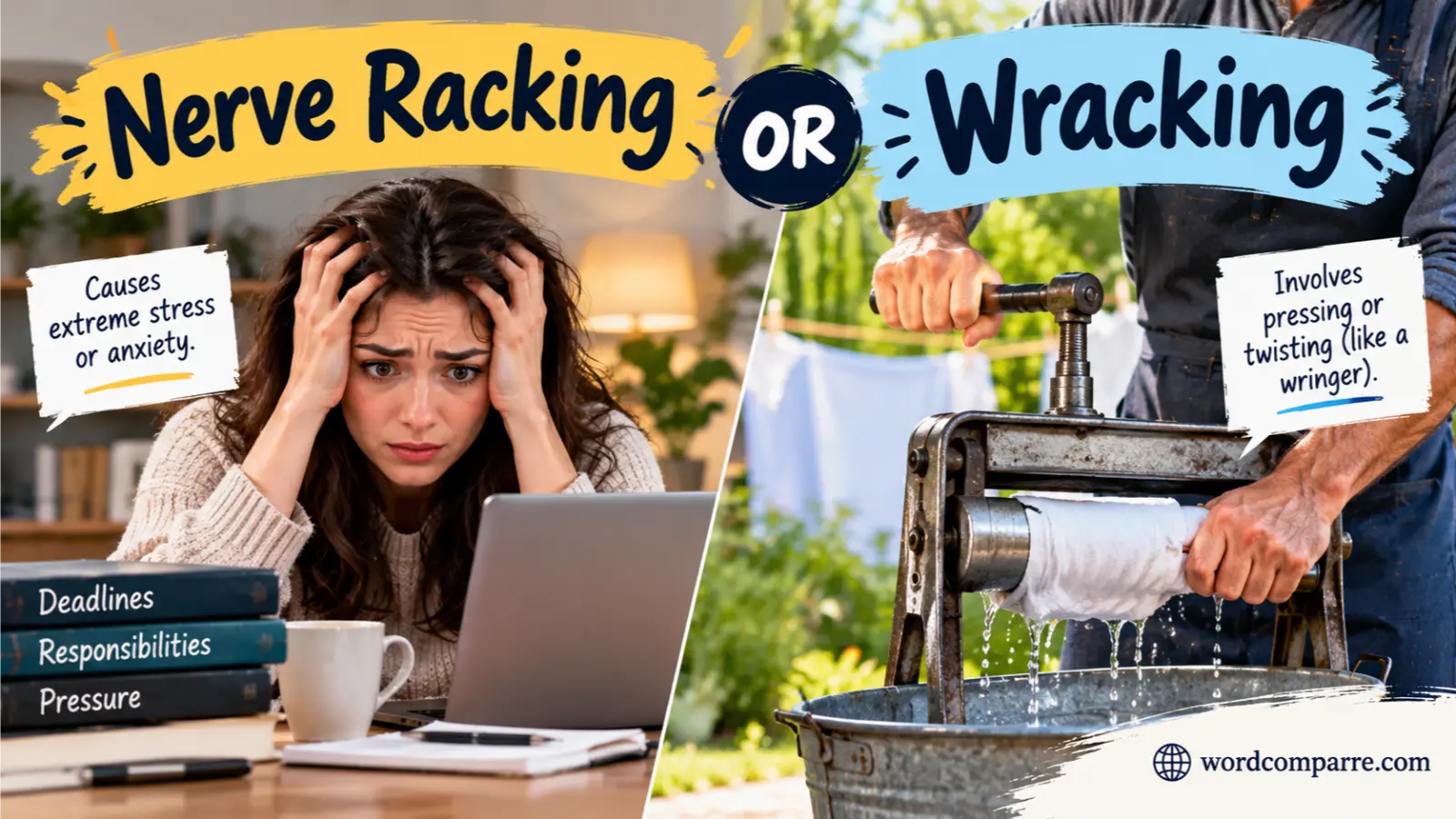
Choosing between nerve-racking and nerve-wracking can be confusing because both expressions describe stressful or worrying experiences. You may see either spelling in books, articles, and everyday conversations.
The good news is that both forms are accepted in standard English. The traditional spelling is nerve-racking, while nerve-wracking is a recognized variant. Understanding their meanings and origins can help you choose the right form for your writing.
Quick Answer: Nerve-Racking or Nerve-Wracking?
Both nerve-racking and nerve-wracking are correct. They describe something that makes a person feel nervous, anxious, or worried.
- Nerve-racking: The traditional spelling and a common dictionary headword.
- Nerve-wracking: An accepted alternative with the same meaning.
For professional writing, choose one spelling and use it consistently throughout your article or document. Cambridge and Oxford both recognize nerve-wracking as a variant of nerve-racking.
What Does Nerve-Racking Mean?
Nerve-racking is an adjective describing an experience that causes considerable anxiety, tension, or worry. It often refers to situations where someone feels nervous because the outcome is uncertain or the pressure is high.
Examples include job interviews, difficult examinations, important presentations, and waiting for medical test results.
Examples in sentences:
- Waiting for the interview results was nerve-racking.
- Driving through the storm was a nerve-racking experience.
- Her first public speech felt nerve-racking, but she performed well.
- The final minutes of the championship were nerve-racking for every supporter.
The expression emphasizes the emotional strain a situation creates.
What Does Nerve-Wracking Mean?
Nerve-wracking is another accepted spelling of the same adjective. It describes an experience that puts your nerves under pressure or makes you feel extremely anxious.
The meaning does not change when you add the letter w. Both spellings communicate the same idea and can be used in similar contexts.
Examples in sentences:
- The long wait for the results was nerve-wracking.
- Preparing for her first interview was nerve-wracking.
- Watching the close game was nerve-wracking for the fans.
- Moving to a new country can be a nerve-wracking experience.
Use this spelling when it matches your preferred style or the spelling used throughout your publication.
Nerve-Racking vs. Nerve-Wracking: Comparison Table
| Feature | Nerve-Racking | Nerve-Wracking |
|---|---|---|
| Correct spelling | Yes | Yes |
| Part of speech | Adjective | Adjective |
| Meaning | Causing anxiety or worry | Causing anxiety or worry |
| Pronunciation | NURV-rak-ing | NURV-rak-ing |
| Dictionary status | Traditional headword | Accepted variant |
| Example | A nerve-racking interview | A nerve-wracking interview |
The main difference is spelling rather than meaning. Neither form is inherently incorrect.
Origin of Nerve-Racking and Nerve-Wracking
The difference becomes easier to understand when you look at the words rack and wrack.
The origin of rack
The word rack has historical associations with a frame used to stretch or torture someone. Over time, the expression rack one’s nerves developed the sense of putting someone under severe mental or emotional strain.
This history explains why nerve-racking is the older and more traditional spelling.
The origin of wrack
Wrack is associated with destruction, ruin, and severe damage. Because emotional stress can feel destructive, some speakers naturally connect the word with the phrase nerve-wracking.
That spelling became established through usage and is now accepted by major dictionaries.
Why Do People Confuse Nerve-Racking and Nerve-Wracking?
Several factors explain why these expressions are frequently confused.
Both words sound the same
The initial w in wracking is silent. As a result, both expressions have the same pronunciation, making the spelling difference difficult to notice during conversation.
Their meanings overlap
The words rack and wrack have overlapping associations with strain and suffering. This makes either spelling seem reasonable to many writers.
Both spellings appear in published English
Readers encounter both forms in online articles, books, and other written material. Seeing each version in use reinforces the impression that both are acceptable.
What Do Dictionaries Recommend?
Major dictionaries recognize both spellings.
- Oxford Learner’s Dictionaries: Lists nerve-racking and identifies nerve-wracking as an alternative.
- Cambridge Dictionary: Defines nerve-racking as something difficult or worrying and recognizes nerve-wracking as a variant.
- Merriam-Webster: Recognizes both forms, treating nerve-wracking as a variant of the traditional nerve-racking spelling.
These references support the conclusion that neither spelling is wrong. However, nerve-racking remains a sound choice when you want to follow the traditional dictionary form.
Real-Life Examples of Both Spellings
The following examples show how either form works in everyday English.
At work
- The upcoming performance review was nerve-racking.
- Delivering the presentation to senior managers was nerve-wracking.
At school
- Taking the final examination was nerve-racking.
- Waiting for university admission results was nerve-wracking.
In daily life
- Driving on an unfamiliar mountain road can be nerve-racking.
- Meeting her future in-laws for the first time was nerve-wracking.
In entertainment
- The final scene of the thriller was nerve-racking.
- Watching the penalty shootout was nerve-wracking.
Each pair expresses the same meaning. You can substitute one spelling for the other without changing the sentence’s message.
Common Mistakes to Avoid
Understanding the accepted variants helps prevent unnecessary spelling corrections.
Mistake 1: Claiming that nerve-wracking is always wrong.
This is incorrect because major dictionaries recognize it as an accepted variant.
Mistake 2: Assuming the two spellings have different meanings.
They are interchangeable when describing anxiety, tension, or worry.
Mistake 3: Writing nerve-wrecking.
Although wrecking is a real word, nerve-wrecking is not the established spelling of this expression. Use nerve-racking or nerve-wracking instead.
Mistake 4: Forgetting the hyphen in a compound adjective.
The standard dictionary forms are usually hyphenated. For example, write “a nerve-racking experience” or “a nerve-wracking situation.” Follow your publication’s style guide if it specifies a different treatment.
Memory Trick: How to Remember the Correct Spelling
Use this simple memory trick to remember both forms.
- Rack: Think of your nerves being stretched to their limit.
- Wrack: Think of the emotional strain feeling destructive.
- Both: Remember that both established expressions describe something stressful.
If you are unsure, choose nerve-racking as the traditional form. You can also use nerve-wracking when it suits your writing style.
Which Spelling Should You Use in Professional Writing?
For academic assignments, business documents, news articles, and website content, either spelling is acceptable. The most important considerations are consistency, clarity, and the style guide you follow.
Choose nerve-racking if you prefer the traditional dictionary headword. Choose nerve-wracking if that is the established form in your publication or preferred editorial style.
For SEO content, both spellings can be relevant search terms. However, avoid repeating both expressions unnaturally just to target additional keywords. Write for readers first and use the expression that fits the sentence.
Frequently Asked Questions
Is nerve-racking one word or two?
It is written as a hyphenated compound adjective: nerve-racking. The accepted alternative is nerve-wracking.
Is nerve-wracking grammatically correct?
Yes. Major dictionaries recognize nerve-wracking as an accepted variant of nerve-racking.
Is nerve-racking more correct than nerve-wracking?
Nerve-racking is the traditional spelling and a common dictionary headword. However, nerve-wracking is also correct, so it is not necessary to label it a spelling error.
Is nerve-wrecking correct?
Nerve-wrecking is not the established spelling of this expression. Use nerve-racking or nerve-wracking to describe something that causes anxiety.
What is a synonym for nerve-racking?
Common synonyms include stressful, anxiety-inducing, worrying, tense, and nerve-wracking. The best choice depends on the context.
Conclusion
Both nerve-racking and nerve-wracking are correct spellings that describe an experience that causes anxiety, nervousness, or worry. The first is the traditional dictionary form, while the second is a recognized variant.
For clear and professional writing, select one form and use it consistently. Remember that nerve-wrecking is not the standard expression, and you can confidently use either accepted spelling when describing a stressful experience.