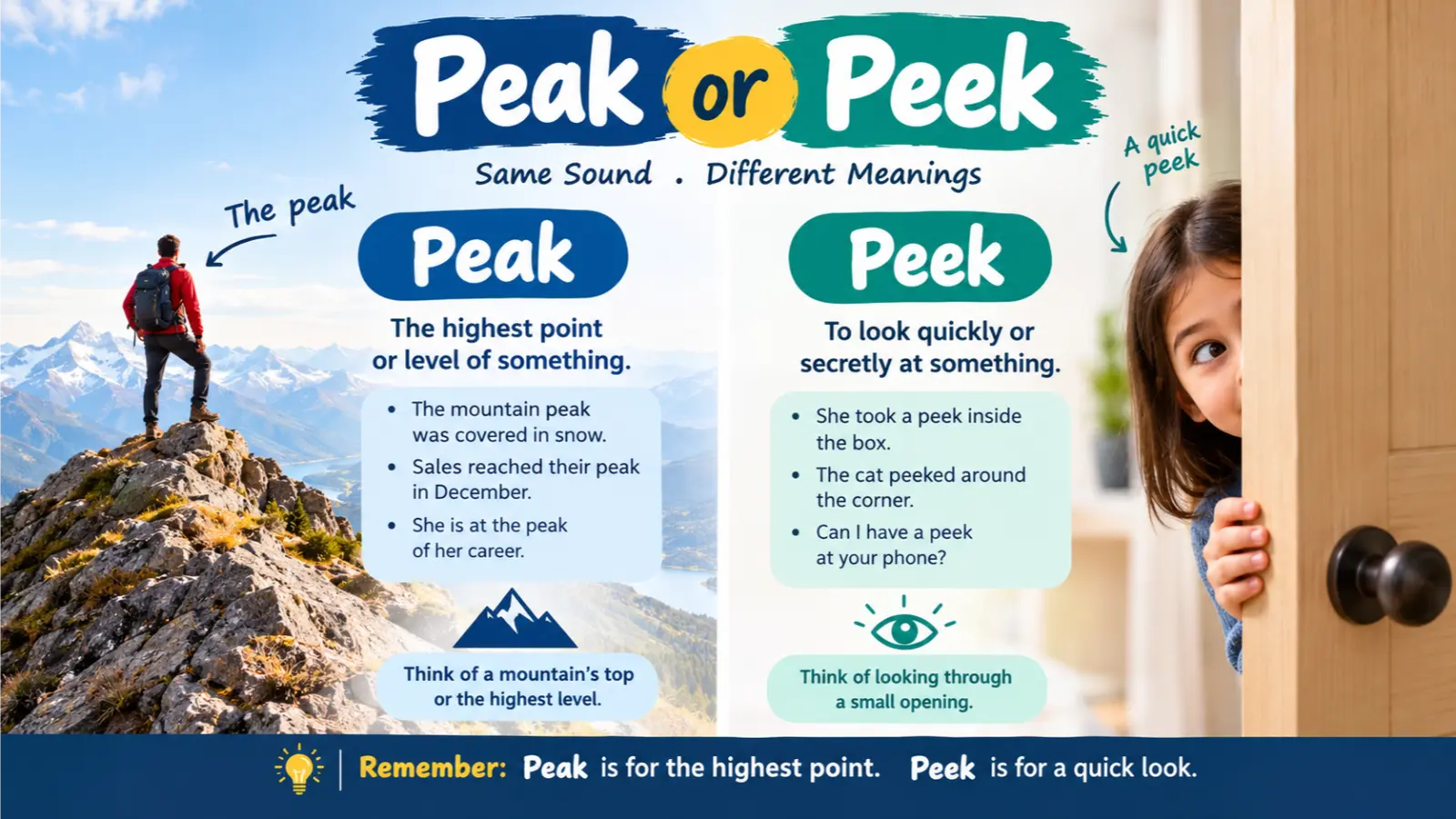
Understanding Peak or Peek can be confusing because these words sound exactly the same but have completely different meanings. Peak refers to the highest point, level, or stage of something, while peek means to take a quick or secret look at something. Knowing the difference helps you avoid spelling mistakes and use both words correctly in everyday writing.
In this guide, you will learn the meanings, grammar rules, and practical examples of peak and peek. You can also use our copy button to quickly copy your favorite examples and save them for later. By the end, you will know when to use each word confidently in conversations, emails, and professional writing.
In this guide, you will learn how to use peak and peek correctly with simple definitions, practical examples, grammar rules, and common mistakes. You can also use the copy button to save useful examples and revisit them whenever you need help choosing the right word.

What Does Peak Mean?
The word peak refers to the highest point, greatest level, or maximum amount of something. It is often used when discussing mountains, business performance, popularity, temperatures, and achievements.
Peak can work as a noun, verb, or adjective depending on the sentence.
Examples of peak in sentences:
- We finally reached the peak of the mountain.
- The company’s sales reached their peak in December.
- Traffic tends to peak during the evening rush hour.
- She is performing at the peak of her career.
- The gym is usually crowded during peak hours.
As a noun, peak identifies the highest point or level. As a verb, it describes reaching that level. As an adjective, it appears in expressions such as peak season and peak performance.
Expert insight: Use peak when describing a maximum, summit, or highest stage. It is especially useful in professional writing, business reports, travel articles, and discussions about performance.

What Does Peek Mean?
The word peek means to look at something quickly, secretly, or carefully without being fully noticed. It often describes a brief look motivated by curiosity.
Peek can function as both a noun and a verb.
Examples of peek in sentences:
- She took a peek inside the gift box.
- The little boy peeked through the window.
- Can I have a peek at your new phone?
- The cat peeked around the corner.
- Please do not peek at the answers before the test.
As a noun, peek means a quick look. As a verb, it describes the action of looking briefly.
Expert insight: Peek is common in everyday conversations, informal messages, and descriptions of curiosity. Expressions such as take a peek and sneak a peek are especially common.
Peak vs. Peek: What Is the Main Difference?
Although peak and peek have identical pronunciations, their meanings are completely different. The easiest way to distinguish them is to consider the action or idea you want to describe.
| Feature | Peak | Peek |
|---|---|---|
| Meaning | The highest point or level | A quick or secret look |
| Part of speech | Noun, verb, adjective | Noun, verb |
| Common expression | Peak performance | Take a peek |
| Example | We reached the peak. | I took a peek inside. |
| Memory clue | A mountain summit | Looking through a small opening |
Remember: If you are talking about a mountain’s top or the highest level of activity, use peak. If you are talking about looking at something briefly, use peek.
Grammar Rules for Using Peak and Peek
Learning the basic grammar rules will help you use both words accurately in different situations.
Rules for Peak
Peak can be used in several grammatical roles.
1. Peak as a noun
Use peak to identify the highest point or maximum level.
- The mountain peak was covered in snow.
- The company reached its peak last year.
- Summer is the peak season for tourism.
2. Peak as a verb
Use peak to describe reaching the highest point or level.
- Temperatures peak in July.
- Demand for electricity peaks during hot weather.
- His popularity peaked after the film’s release.
3. Peak as an adjective
Peak can describe the busiest or most active period.
- We traveled during peak season.
- The train is crowded during peak hours.
- Athletes need proper training to achieve peak performance.
Rules for Peek
Peek is used as a noun or verb when describing a brief look.
1. Peek as a noun
- I took a peek at the invitation.
- She wanted a quick peek inside the room.
- He gave the document a brief peek.
2. Peek as a verb
- The child peeked through the curtains.
- She peeks inside the box every morning.
- They peeked around the corner.
Important grammar tip: The past tense of peek is peeked. The past tense of peak is also peaked. Their spellings remain different because their meanings are different.
Sentence Structure: How to Use Peak and Peek
Understanding sentence patterns makes it easier to use each word naturally.
Common Sentence Patterns With Peak
Pattern 1: Subject + reached + the peak of + noun
Example: The athlete reached the peak of his career.
Pattern 2: Subject + peaks + time or condition
Example: Electricity demand peaks during the afternoon.
Pattern 3: Subject + is at its peak
Example: Tourism is at its peak during the summer holidays.
Common Sentence Patterns With Peek
Pattern 1: Subject + takes/took + a peek at + noun
Example: I took a peek at the new design.
Pattern 2: Subject + peeked + through/around/inside + place
Example: The puppy peeked through the gate.
Pattern 3: Do not + peek + at + noun
Example: Do not peek at the test paper.
These patterns provide a practical starting point for constructing correct sentences.
Peak or Peek: Examples in Everyday English
The following examples show how the words work in different contexts.
Examples Using Peak
- The climbers reached the peak before sunset.
- The restaurant experiences peak demand on weekends.
- Her confidence reached its peak after the successful presentation.
- The team’s performance peaked in the final match.
- The city becomes busy during peak travel season.
- The singer reached the peak of her popularity.
- Online orders peaked during the holiday sale.
- The mountain’s peak was visible from our hotel.
Examples Using Peek
- I took a peek at the birthday present.
- She peeked into the classroom.
- The puppy peeked out from behind the sofa.
- He tried to peek at his friend’s answers.
- Can I take a peek at your drawing?
- The child peeked through the keyhole.
- We sneaked a peek at the decorations.
- She peeked around the door to see who had arrived.
Common Mistakes When Using Peak and Peek
Writers sometimes confuse these words because they sound alike. However, using the wrong spelling can change the meaning of a sentence.
Mistake 1: Using Peak for a Quick Look
Incorrect: I took a peak at the menu.
Correct: I took a peek at the menu.
Explanation: The sentence describes looking briefly at the menu, so peek is correct.
Mistake 2: Using Peek for the Highest Point
Incorrect: We climbed to the peek of the mountain.
Correct: We climbed to the peak of the mountain.
Explanation: A mountain’s highest point is its peak.
Mistake 3: Confusing Their Past Tenses
Incorrect: Sales peeked during the holiday season.
Correct: Sales peaked during the holiday season.
Explanation: Sales reached their highest level, so peaked is the correct verb.
Mistake 4: Using the Wrong Word in a Phrase
Incorrect: Her career reached its peek.
Correct: Her career reached its peak.
Explanation: The sentence describes the highest stage of a career.
Quick reminder: Read the sentence and identify its meaning before selecting the spelling. This simple habit can prevent most peak and peek errors.
Peak vs. Peek in Professional and Academic Writing
Both words are appropriate in professional and academic contexts when used correctly. The choice depends on the intended meaning.
Peak in Professional Writing
Peak is frequently used in business, economics, science, sports, and performance analysis.
Examples:
- The company achieved peak productivity during the third quarter.
- Electricity consumption peaked during the heatwave.
- The research team recorded peak activity at midday.
- Customer demand reached its peak during the promotion.
Peek in Professional Writing
Peek is useful when referring to a brief look at information, a document, or a visual item. However, more formal alternatives may be preferable in highly technical or academic writing.
Examples:
- The editor took a quick peek at the draft.
- The reviewer had a brief peek at the preliminary results.
More formal alternatives include inspect, examine, review, and glance at, depending on the context.
Expert insight: Peak is common in formal reports because it describes measurable levels and maximum values. Peek is grammatically correct in professional writing, but words such as review or examine may communicate a more formal tone.
Formal vs. Informal Usage of Peak and Peek
Peak and peek can both appear in formal and informal writing. Their meanings remain unchanged, although the surrounding vocabulary may differ.
| Context | Example |
|---|---|
| Formal peak | The company’s revenue peaked during the fourth quarter. |
| Informal peak | That concert was the peak of my summer. |
| Formal peek | The reviewer briefly examined the document. |
| Informal peek | Let me take a peek at your photos. |
In formal situations, consider whether peek is the most precise choice. In casual conversations, take a peek and sneak a peek sound natural and friendly.

Easy Memory Tricks to Remember Peak and Peek
You can remember the difference between these words by connecting each spelling to a familiar idea.
1. Peak means a point
Think of the top of a mountain. A mountain peak is its highest point.
2. Peek means to look
Imagine peeking through a keyhole to see what is on the other side.
3. Use the meaning test
Ask yourself whether the sentence describes a highest level or a quick look. Choose peak for the highest level and peek for the quick look.
4. Remember common phrases
- Peak performance
- Peak season
- Mountain peak
- Take a peek
- Sneak a peek
- Peek inside
Memorizing these expressions will help you recognize the correct spelling more quickly.
Real-Life Conversations Using Peak and Peek
Real conversations can make the difference easier to understand.
Conversation 1: Planning a Mountain Trip
Ali: How high did you climb during your trip?
Sara: We reached the mountain’s peak just before sunset.
Ali: Was the view beautiful?
Sara: Absolutely! We could see the entire valley.
Conversation 2: A Birthday Surprise
Ali: Can I see what’s inside that box?
Sara: You can take a peek, but don’t open it yet.
Ali: Just one quick look?
Sara: Fine, but no more peeking!
Conversation 3: Discussing Business
Manager: When did our website receive the most visitors?
Employee: Traffic peaked during the weekend promotion.
Manager: Do we know why?
Employee: The advertising campaign attracted more customers than usual.
Conversation 4: Studying for an Exam
Ayesha: Did you look at the answer sheet?
Hassan: No, I didn’t peek at anyone’s answers.
Ayesha: Good. We should complete the test honestly.
These conversations demonstrate how context determines which word is correct.
Frequently Asked Questions About Peak or Peek
1. Are peak and peek homophones?
Yes. Peak and peek are homophones because they have the same pronunciation but different spellings and meanings.
2. Is peak or peek the correct spelling?
Both spellings are correct. Peak refers to a highest point or level, while peek means taking a quick or secret look.
3. What does take a peek mean?
Take a peek means to look at something briefly. For example, “Can I take a peek at your new phone?”
4. What does peak performance mean?
Peak performance means performing at the highest level of ability or effectiveness. It is commonly used in sports, business, education, and personal development.
5. What is the past tense of peak?
The past tense of peak is peaked. For example, “Demand peaked during the holiday season.”
6. What is the past tense of peek?
The past tense of peek is peeked. For example, “She peeked through the window.”
7. Is it peak your interest or peek your interest?
Neither expression is correct. The correct phrase is pique your interest, which means to spark someone’s curiosity or interest.
8. Can peak be used as a verb?
Yes. Peak can be a verb meaning to reach the highest point or level. For example, “Sales peak during the holiday season.”
9. Can peek be used as a noun?
Yes. Peek can be a noun meaning a quick look. For example, “I took a peek at the report.”
10. How can I remember peak vs. peek?
Remember that a mountain has a peak, while a person can peek through a window. The mountain represents a high point, and the window represents looking.
Conclusion: Peak or Peek
Understanding peak or peek is simple when you focus on the meaning of each word. Peak refers to the highest point, maximum level, or greatest stage of something. Peek means taking a quick or secret look at something. Both words are correct, but they cannot replace each other in a sentence without changing its meaning.
Remember the mountain’s peak and the act of peeking through a window. With these simple examples and grammar rules, you can confidently use peak and peek in everyday conversations, professional writing, and academic work.