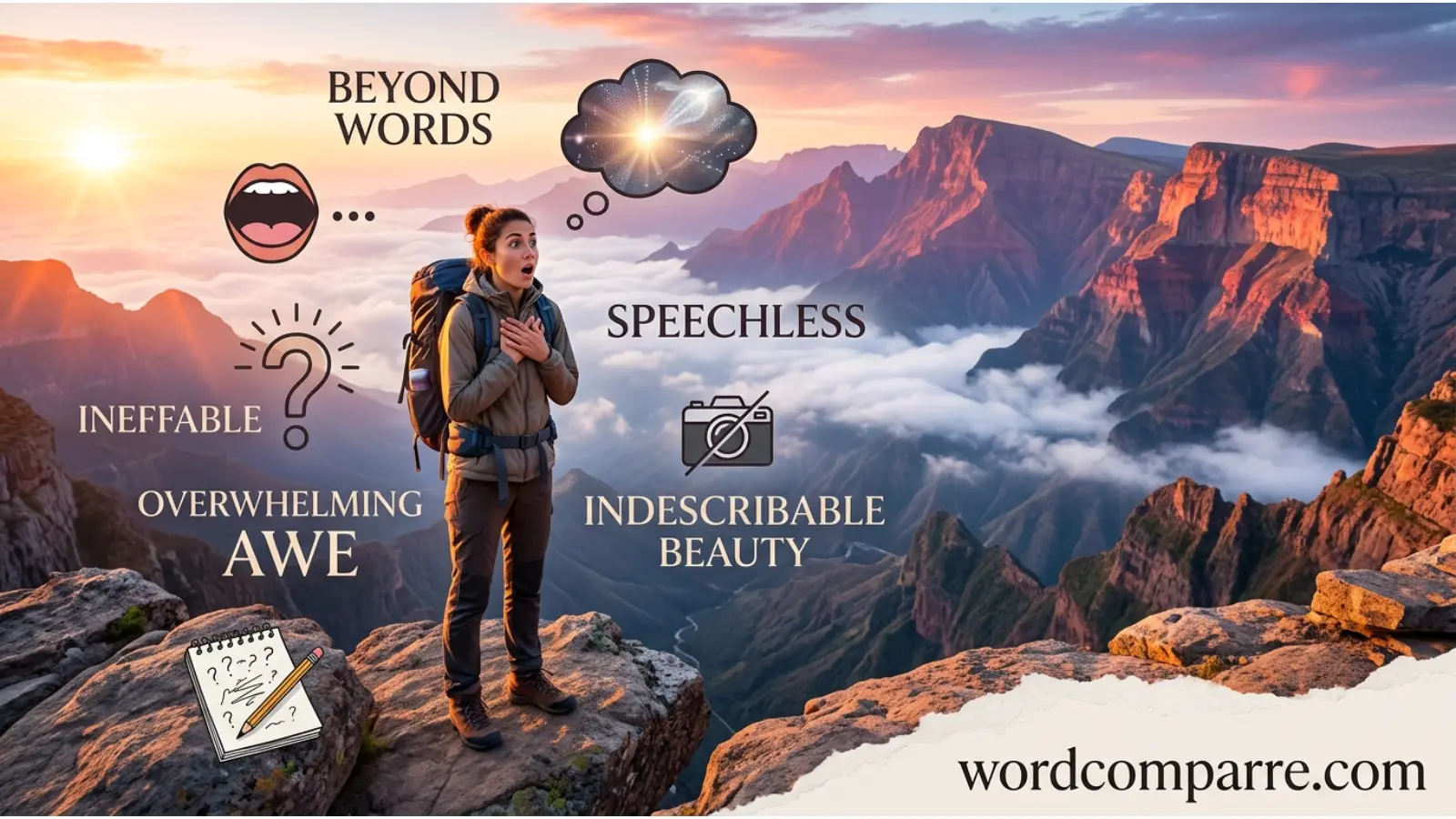
Indescribable or undescribable is a common question for English learners and writers who want to choose the most accurate word. At first glance, both words seem logical because they share the same root, describe. However, they are not treated equally in modern English. One is widely accepted in dictionaries and used by professional writers, while the other is extremely rare and often considered nonstandard.
This guide explains the meaning of both words, why people confuse them, what major dictionaries recommend, and which spelling you should use in everyday, academic, and professional writing.
Quick Answer
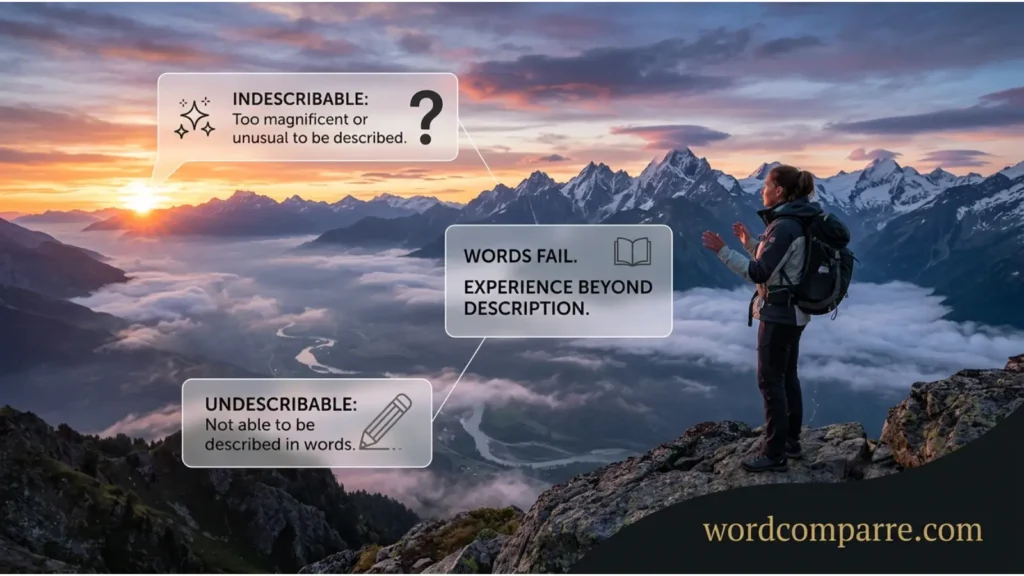
Indescribable is the standard, correct, and widely accepted English word. It means something so extraordinary, intense, or unusual that it cannot be described adequately with words.
Undescribable exists but is extremely uncommon. Most dictionaries either do not list it or label it as a rare or nonstandard variant. In almost every situation, indescribable is the better choice.
What Type of Comparison Is This?
This keyword belongs to a Spelling Comparison.
Both words are built from the verb describe, but only one has become the accepted standard in modern English. This article explains why indescribable became the preferred form.
What Does Indescribable Mean?
Indescribable is an adjective that refers to something impossible or very difficult to express in words.
People often use it to describe:
- Powerful emotions
- Incredible beauty
- Extreme pain
- Amazing experiences
- Extraordinary events
Examples
- The sunset was indescribable.
- She felt an indescribable sense of joy.
- The damage after the storm was indescribable.
In each example, words are not enough to fully explain the experience.
What Does Undescribable Mean?
Undescribable would literally mean “not describable.” Although its meaning is understandable, it is rarely used in modern English.
Most native speakers naturally choose indescribable instead because it has been the accepted form for centuries.
You may occasionally find undescribable in historical writings, regional usage, or older publications, but it is not considered the standard spelling today.
Indescribable vs Undescribable
| Feature | Indescribable | Undescribable |
|---|---|---|
| Standard English | ✔ Yes | Rare |
| Found in major dictionaries | ✔ Yes | Limited or omitted |
| Used by professional writers | ✔ Frequently | Very rarely |
| Suitable for academic writing | ✔ Yes | No |
| Suitable for business writing | ✔ Yes | No |
| Common in everyday English | ✔ Yes | No |
Where Did Indescribable Come From?
The word indescribable comes from the prefix in-, meaning “not,” combined with describable.
English has many adjectives formed this way, including:
- Invisible
- Incomplete
- Inaccurate
- Inexpressible
Over time, indescribable became the established form because it followed common English word-building patterns and gained widespread use in literature and formal writing.
Why Do People Get Confused?
The confusion usually happens because English uses several negative prefixes.
For example:
- inactive
- incapable
- incorrect
- unhappy
- unfair
- unknown
Since un- is a very common negative prefix, many people naturally assume undescribable should also be correct.
Although it makes logical sense, English usage developed differently, and indescribable became the accepted word.
What Do Dictionaries Recommend?
Major English dictionaries consistently recognize indescribable as the standard spelling.
It is the preferred choice in:
- Academic writing
- Newspapers
- Books
- Professional communication
- Business documents
Undescribable receives little or no recognition in most modern dictionaries because it is rarely used.
Real-Life Examples
Talking about emotions
- The happiness she felt was indescribable.
Describing nature
- We witnessed an indescribable view from the mountain.
Writing professionally
- The customer experienced indescribable disappointment after the incident.
Storytelling
- The silence created an indescribable feeling of suspense.
Common Mistakes
Using undescribable in formal writing
❌ The experience was undescribable.
✔ The experience was indescribable.
Assuming both spellings are equally common
Many writers believe both versions are interchangeable. In reality, indescribable is overwhelmingly preferred in modern English.
Depending on spell check alone
Some spelling tools may not immediately flag undescribable, but that does not make it the recommended choice.
Easy Memory Trick
Remember this sentence:
Incredible experiences are indescribable.
Both incredible and indescribable begin with in-, making them easy to associate.
Professional Writing Recommendation
If you are writing for school, work, publishing, journalism, marketing, or online content, always choose indescribable.
It is:
- Dictionary-approved
- Easily recognized by readers
- Preferred by editors
- Appropriate in every formal context
Reserve undescribable only when quoting historical material or reproducing original text exactly as written.
Frequently Asked Questions
Is undescribable a real word?
Yes, it has appeared in English, but it is extremely rare and is not the standard choice in modern writing.
Which spelling should I use?
Use indescribable in nearly every situation.
Why isn’t undescribable common?
English historically adopted indescribable as the accepted form, and it became the version supported by dictionaries, publishers, and educators.
Is indescribable grammatically correct?
Yes. It is the standard adjective used by native English speakers and major English dictionaries.
Can I use undescribable in creative writing?
You can if it serves a specific stylistic or historical purpose, but readers may view it as unusual or incorrect.
Conclusion
Although indescribable and undescribable appear to have similar meanings, they are not equally accepted in modern English. Indescribable is the standard spelling recognized by dictionaries, educators, publishers, and professional writers. It clearly communicates that something cannot be adequately expressed in words.
Undescribable is a rare alternative that occasionally appears in older or nonstandard usage, but it is not recommended for modern writing. If your goal is clear, polished, and professional English, indescribable is the spelling you should confidently use every time.

Alex Wordsmith is a comparison research writer and content specialist at WordComparre.com. He focuses on analyzing word meanings, spelling variations, grammar distinctions, and language usage to help readers make informed writing choices. Through clear explanations and practical examples, Alex simplifies complex language topics for students, writers, and professionals. His goal is to make English learning easier, more accurate, and accessible for everyone.