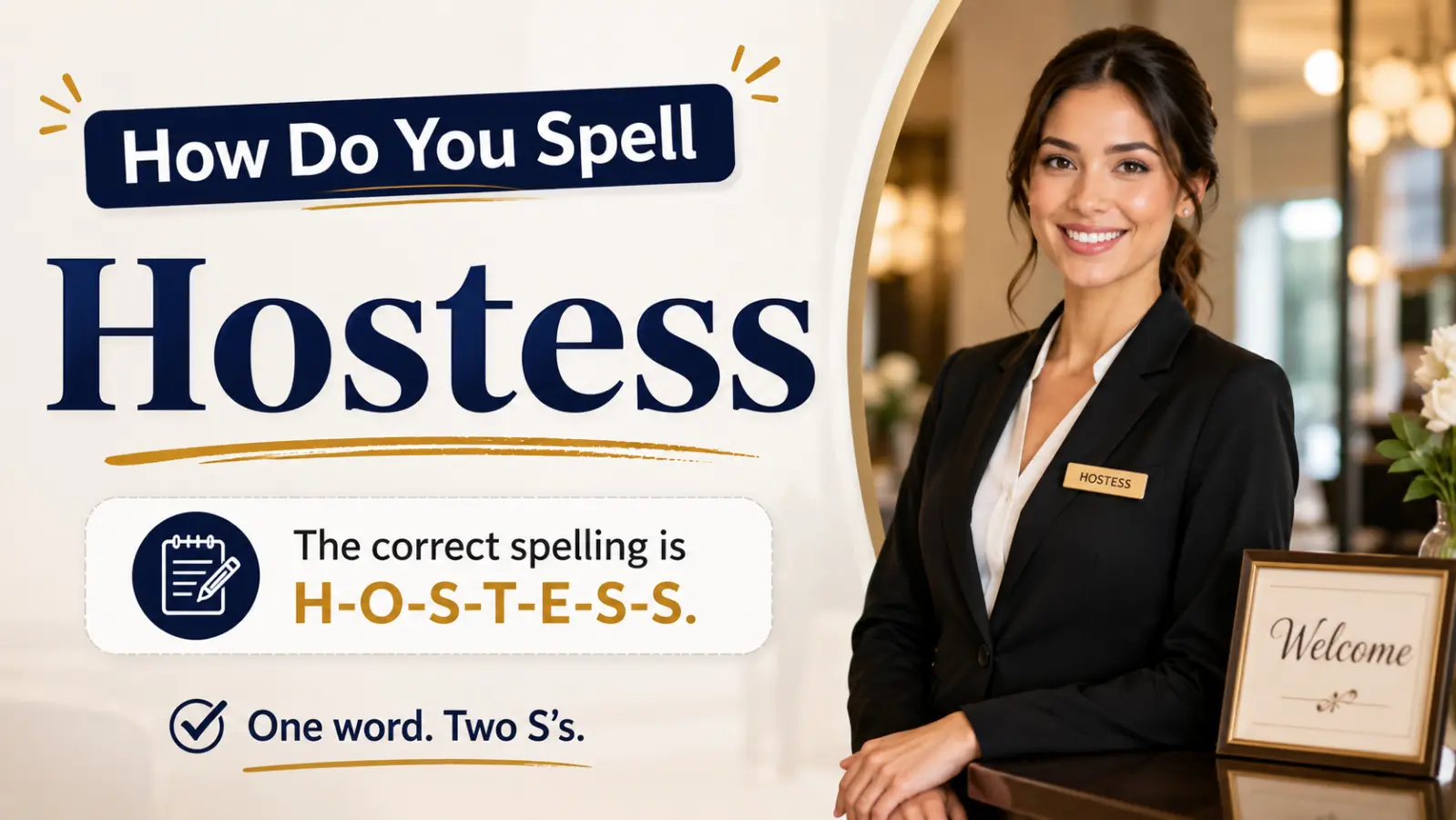
If you are asking, “How do you spell hostess?”, the correct spelling is hostess. It is a standard English word used for a woman who hosts guests, events, or customers.
The word is easy to confuse because its pronunciation does not clearly show the final spelling. Some people may leave out one of the letters or write hostes. However, hostess is the accepted modern spelling.
The word can describe a woman who welcomes and looks after guests. It can also refer to a woman who works in a restaurant, hotel, or other setting where she greets customers.
Quick Answer
How do you spell hostess?
The correct spelling is hostess.
- ✅ Hostess — correct
- ❌ Hostes — incorrect modern spelling
- Pronunciation: HOS-tis
- Plural: hostesses
Example:
The hostess welcomed everyone at the door.
What Does “Hostess” Mean?
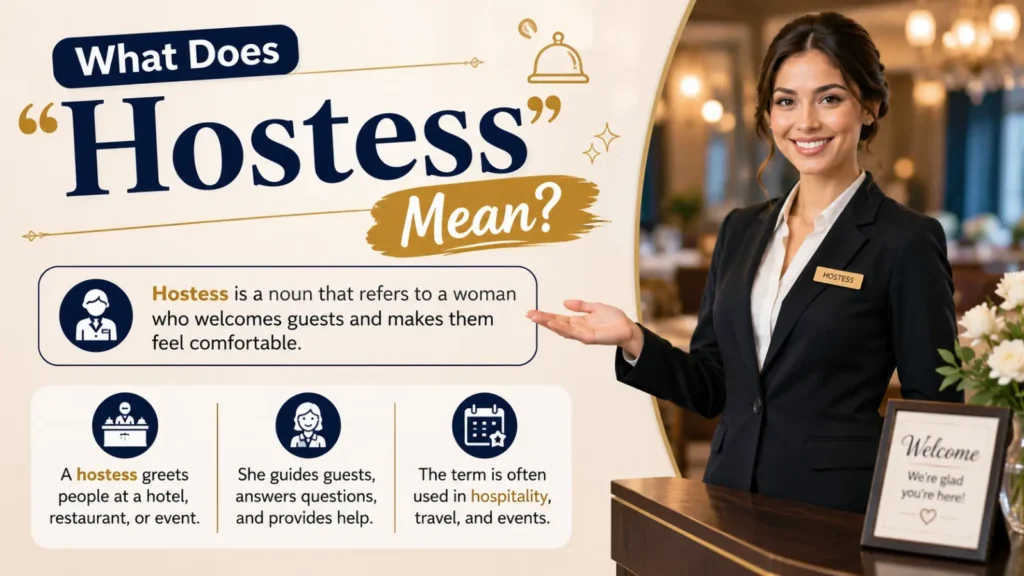
Hostess is a noun traditionally used for a woman who hosts or welcomes people.
For example, a hostess may:
- Welcome guests to a home
- Organize a social event
- Greet customers at a restaurant
- Help guests find their seats
- Look after visitors at an event
In a restaurant, the hostess is often the person who greets customers when they arrive and manages seating.
The word can also be used more broadly for a woman who provides hospitality.
What Does “Hostes” Mean?
Hostes is not the standard modern English spelling of this word.
If you mean a woman who hosts guests or welcomes customers, you should write hostess, with ss at the end.
Therefore:
✅ The hostess showed us to our table.
Not:
❌ The hostes showed us to our table.
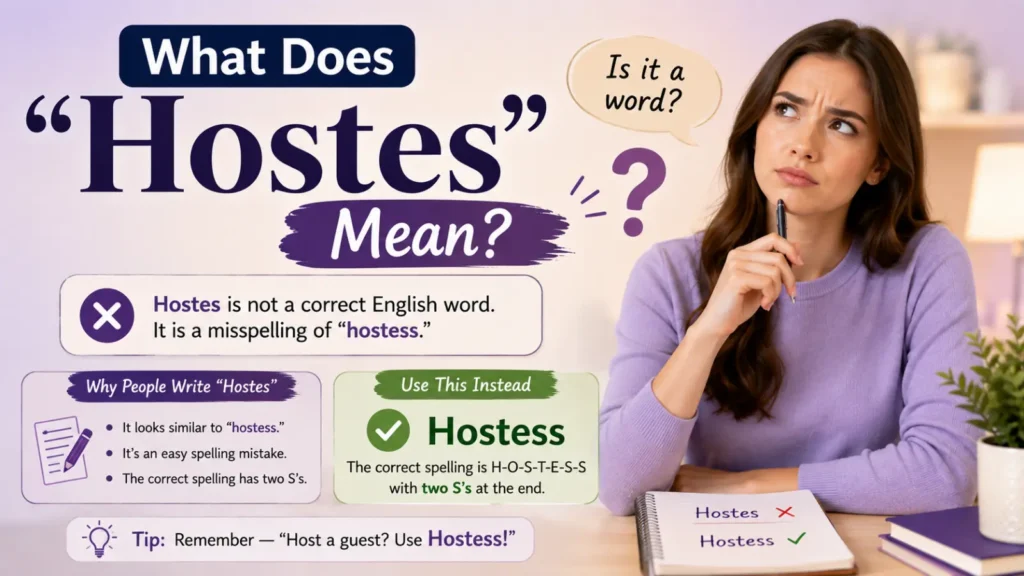
Hostes may appear as a typo or as a word in another language, but it is not the standard English spelling of hostess.
Hostess vs. Hostes
| Feature | Hostess | Hostes |
| Standard English spelling | ✅ Yes | ❌ No |
| Modern English word | ✅ Yes | ❌ No |
| Refers to a female host | ✅ Yes | ❌ No |
| Used in restaurants | ✅ Yes | ❌ No |
| Correct spelling for professional writing | ✅ Yes | ❌ No |
| Final letters | -ess | -es |
The important spelling point is the ending: hostess contains ss.
Where Does “Hostess” Come From?
Hostess comes from host combined with the suffix -ess.
The suffix -ess was historically used to form feminine nouns from words describing people or roles.
For example:
- host → hostess
- actor → actress
- waiter → waitress
- prince → princess
The word host itself comes from older French and Latin forms connected with the idea of receiving or entertaining guests.
English has used hostess for centuries to describe a woman who hosts or provides hospitality.
Why Is “Hostess” Easy to Misspell?
The main problem is the ending.
When people say hostess, the two s letters are not strongly noticeable in pronunciation. As a result, some writers may spell the word as hostes.
Another reason is that English has many words ending in -es, so writers may automatically choose that pattern.
However, the correct spelling is easy to remember:
host + ess = hostess
The double s is part of the standard spelling.
Dictionary Recommendation
Major English dictionaries recognize hostess as the standard spelling.
Dictionary definitions describe a hostess as a woman who receives or entertains guests. The word is also commonly used for a woman who greets and seats customers in a restaurant.
Modern dictionaries therefore support hostess, not hostes, when referring to this English word.
For current professional and everyday English, use hostess.
Real-Life Examples
Here are some natural examples.
At a Restaurant
The hostess asked how many people were in our party.
At a Party
Sarah was the perfect hostess and made everyone feel welcome.
At an Event
The hostess greeted the guests as they arrived.
In a Hotel
The hotel hostess helped us find the conference room.
In General Writing
She is known as a gracious hostess.
Plural Form
The plural of hostess is hostesses.
Several hostesses were working during the busy evening.
Notice that the plural adds -es to the existing word.
Common Spelling Mistakes
These are some common incorrect forms:
| Incorrect | Correct |
| Hostes | Hostess |
| Hostiss | Hostess |
| HostesS | Hostess |
| Hostesss | Hostess |
The most important thing to remember is that hostess ends with -ess.
Hostess vs. Host: Is There a Difference?
Yes, although modern English often uses host more broadly.
Traditionally:
- Host = a man who hosts
- Hostess = a woman who hosts
Today, host can refer to a person of any gender in many situations. Because of this, hostess can sometimes sound more traditional or role-specific.
For example, an event may simply have a host, regardless of gender.
However, hostess remains a correct English word and is still used in contexts such as restaurants and hospitality.
A Simple Memory Trick
Use this formula:
HOST + ESS = HOSTESS
Think of hostess as the word host plus -ess.
The ending has two s letters:
hoste + ss
So if you are unsure, remember:
A hostess is a host + ess.
This makes the correct spelling much easier to recall.
Professional Writing Recommendation
Use hostess when you specifically mean a woman who hosts, welcomes, or provides hospitality.
However, consider host when the person’s gender is unknown or irrelevant. Modern professional writing often prefers gender-neutral terms when they communicate the role clearly.
For example:
The host welcomed all attendees.
This works for any gender.
When you specifically need the traditional feminine term, hostess is the correct spelling.
Avoid hostes in professional writing because it is not the standard English spelling.
FAQ
How do you spell hostess correctly?
The correct spelling is hostess, with ss at the end.
Is it hostess or hostes?
Hostess is correct. Hostes is not the standard modern English spelling.
What is the plural of hostess?
The plural is hostesses.
Example:
The restaurant hired two new hostesses.
Is hostess a correct English word?
Yes. Hostess is a standard English noun traditionally referring to a woman who hosts or welcomes guests.
How do you remember the spelling of hostess?
Remember host + ess = hostess. The ending -ess contains two s letters.
Is hostess still used today?
Yes. The word is still used, especially in hospitality and restaurant settings. In some situations, host is preferred as a gender-neutral alternative.
What is the difference between host and hostess?
Traditionally, host refers to a male host and hostess to a female host. In modern English, host can describe a person of any gender.
Is “hostes” a word?
It is not the standard English spelling for a woman who hosts. If that is the meaning you want, use hostess.
Conclusion
If you are wondering “How do you spell hostess?”, the answer is hostess.
Hostess is the correct modern English spelling for a woman who hosts guests, welcomes customers, or provides hospitality. Hostes is not the standard spelling.
The easiest way to remember it is:
host + ess = hostess
For professional writing, use hostess when the feminine term is appropriate. Otherwise, host can often serve as a clear, gender-neutral alternative.

Alex Wordsmith is a comparison research writer and content specialist at WordComparre.com. He focuses on analyzing word meanings, spelling variations, grammar distinctions, and language usage to help readers make informed writing choices. Through clear explanations and practical examples, Alex simplifies complex language topics for students, writers, and professionals. His goal is to make English learning easier, more accurate, and accessible for everyone.