Many people search for relaid or relayed because the two words look almost identical but have completely different meanings. They are both correct English words, yet they belong to different verbs and are used in different situations. Choosing the wrong one can change the meaning of your sentence and make your writing confusing.
This guide explains when to use relaid and when relayed is the right choice. You’ll learn their meanings, origins, dictionary recommendations, practical examples, common mistakes, and an easy trick to remember the difference.
Quick Answer
Both relaid and relayed are correct.
- Relaid is the past tense and past participle of relay when it means to lay something again, such as bricks, flooring, tiles, or pipes.
- Relayed is the past tense and past participle of relay when it means to pass information, messages, signals, or broadcasts from one place to another.
The correct choice depends entirely on the meaning you want to express.
What Do Relaid and Relayed Mean?
Relaid
Relaid means something was laid again after being removed, repaired, or repositioned.
Examples:
- The workers relaid the damaged pavement.
- The plumber relaid the underground pipe.
- The old brick path was carefully relaid after repairs.
Relayed
Relayed means information, news, signals, instructions, or broadcasts were passed from one person or place to another.
Examples:
- She relayed the manager’s message to the team.
- The satellite relayed the signal back to Earth.
- The reporter relayed updates throughout the event.
Relaid vs Relayed Comparison
| Feature | Relaid | Relayed |
|---|---|---|
| Correct spelling | Yes | Yes |
| Base meaning | Laid again | Passed along |
| Verb origin | Relay (lay again) | Relay (transmit) |
| Common use | Construction and repairs | Communication and broadcasting |
| Used with | Bricks, tiles, flooring, pipes, roads | Messages, signals, news, instructions |
| Everyday frequency | Less common | Much more common |
Where Do These Words Come From?
Although they look similar, the meanings developed in different ways.
Relaid comes from the idea of laying something again. Builders, engineers, and contractors commonly use it when materials are removed and then placed back into position.
Relayed comes from the verb meaning to pass something onward. Historically, a relay involved replacing tired horses or runners during long journeys. Today, the idea has expanded to include passing messages, phone calls, television signals, radio broadcasts, and digital information.
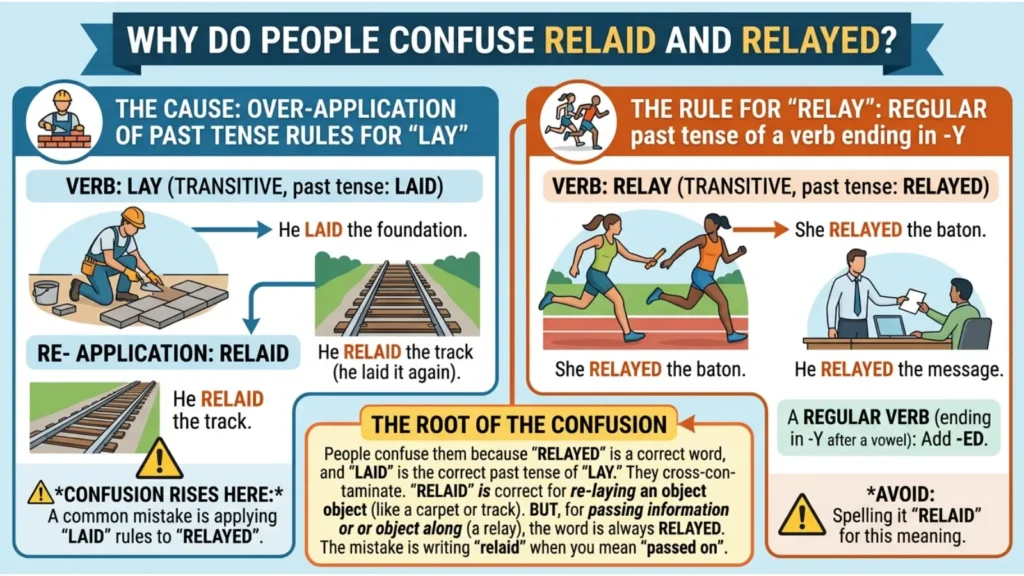
Why Do People Confuse Relaid and Relayed?
There are several reasons.
- Both come from the verb relay.
- They sound almost identical in everyday speech.
- Their spellings differ by only one letter.
- Most people encounter relayed far more often than relaid, making it easy to choose the familiar spelling automatically.
- Spell-checkers may not catch the mistake because both are legitimate English words.
What Do Dictionaries Recommend?
Major English dictionaries recognize both spellings because they represent different meanings.
Dictionary guidance is consistent.
- Use relaid when something has been laid again.
- Use relayed when something has been transmitted, communicated, or passed along.
Neither spelling replaces the other.
Real-Life Examples
Correct Use of Relaid
- The road was relaid after the utility work finished.
- Workers relaid the carpet before reopening the office.
- The garden path was carefully relaid using the original stones.
- The railway tracks were relaid during maintenance.
Correct Use of Relayed
- The assistant relayed the customer’s concerns.
- Emergency operators relayed important updates.
- The television station relayed the ceremony live.
- He relayed the instructions to everyone on the project.
Common Mistakes
Incorrect: The technician relaid the information to the client.
Correct: The technician relayed the information to the client.
Incorrect: The workers relayed the broken paving stones.
Correct: The workers relaid the paving stones.
Incorrect: She relaid the news immediately.
Correct: She relayed the news immediately.
Easy Memory Trick
Think about what is being moved.
- If you are laying something down again, choose relaid.
- If you are passing something along, choose relayed.
A simple reminder is:
Laid = placed again.
Relayed = repeated or transmitted.
Professional Writing Recommendation
Use relaid only when discussing physical objects that have been laid again, especially in construction, engineering, landscaping, or maintenance.
Use relayed whenever you are writing about communication, customer service, journalism, broadcasting, technology, business, education, healthcare, or everyday conversations.
Because relayed is much more common, double-check your sentence before using it to make sure you are referring to communication rather than physical placement.
Frequently Asked Questions
Is relaid a real English word?
Yes. It is the correct past tense of relay when the meaning is to lay something again.
Is relayed always the correct spelling?
No. It is correct only when referring to passing information, messages, signals, or broadcasts.
Which spelling is more common?
Relayed is significantly more common because communication happens more frequently in everyday writing than construction-related situations.
Can spell-check detect the mistake?
Not always. Since both are valid dictionary words, spell-check may accept either spelling even if it is incorrect for the sentence.
How can I remember the difference?
Ask yourself whether something was placed again or passed along. Physical placement requires relaid, while communication requires relayed.
Conclusion
The choice between relaid and relayed is not about one spelling being right and the other being wrong. Both are standard English words with different meanings.
Choose relaid when something has been physically laid again, such as bricks, tiles, roads, or pipes. Choose relayed when information, news, instructions, signals, or messages have been passed from one person or place to another.
Understanding this distinction will help you write with greater accuracy, whether you’re preparing professional documents, academic work, or everyday messages.

Alex Wordsmith is a comparison research writer and content specialist at WordComparre.com. He focuses on analyzing word meanings, spelling variations, grammar distinctions, and language usage to help readers make informed writing choices. Through clear explanations and practical examples, Alex simplifies complex language topics for students, writers, and professionals. His goal is to make English learning easier, more accurate, and accessible for everyone.