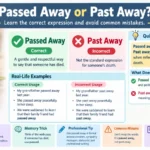
RSVP’d or RSVPed is a common question because the abbreviation RSVP does not follow the usual rules for forming English verbs. Once people turn the invitation term into a verb, they often wonder whether to add an apostrophe before d or simply attach ed. Both spellings appear online, in emails, and on social media, which makes the confusion even greater.
The good news is that both forms are understandable. However, one spelling is generally preferred in modern English and professional writing. Knowing the difference helps you write invitations, emails, event messages, and business communication with confidence.
Quick Answer
RSVPed is the preferred and more widely accepted spelling in modern English.
RSVP’d is also seen, especially in informal writing, but many editors and style guides recommend avoiding the apostrophe when adding a regular past tense ending to an abbreviation that has become a verb.
What Do RSVP’d and RSVPed Mean?
Both words have exactly the same meaning.
They describe the action of responding to an invitation.
Examples:
- She RSVPed yesterday.
- He RSVP’d as soon as he received the invitation.
The meaning does not change. Only the spelling differs.
RSVP’d vs. RSVPed Comparison
| Feature | RSVPed | RSVP’d |
|---|---|---|
| Meaning | Responded to an invitation | Responded to an invitation |
| Correct English | Yes | Yes |
| Modern preference | Yes | Less preferred |
| Professional writing | Recommended | Usually avoided |
| Informal writing | Common | Common |
| Easy to read | Yes | Yes |
Where Does RSVP Come From?
RSVP comes from the French phrase “Répondez s’il vous plaît,” which means “Please respond.”
It first appeared on formal invitations and later became widely recognized in English-speaking countries. Over time, English speakers began using RSVP as a verb.
For example:
- Please RSVP by Friday.
- Everyone RSVPed before the deadline.
This change is a natural example of how abbreviations become regular English verbs.
Why Do People Get Confused?
Several reasons create confusion.
First, RSVP is an abbreviation rather than a regular English word.
Second, some writers believe an apostrophe makes abbreviations easier to read when adding d, producing RSVP’d.
Others simply apply normal English verb rules and write RSVPed, just as they would with many other verbs ending in ed.
Since both versions appear online, many readers assume they are equally preferred.
What Do Dictionaries and Style Experts Recommend?
Most modern dictionaries recognize RSVP as both a noun and a verb.
When forming the past tense, professional editors generally favor RSVPed because English usually adds ed directly to verbs without inserting an apostrophe.
Many newspapers, publishers, and business writers also prefer RSVPed because it follows standard English word formation and creates a cleaner appearance.

Real Life Examples Of rsvp’d
Professional email:
- Everyone RSVPed before the registration deadline.
Wedding invitation follow-up:
- Nearly all guests RSVPed on time.
Casual text message:
- I RSVP’d last night.
Office communication:
- Only half the team RSVPed for the meeting.
Social media:
- We already RSVPed for the event.
Common Mistakes
Using different spellings in the same document.
Writing RSVP’ed, which is rarely recommended.
Thinking RSVP’d is the only correct form.
Assuming RSVPed is incorrect because the abbreviation ends with a capital letter.
Forgetting that RSVP can function as a verb in modern English.
A Simple Memory Trick
Think about regular English verbs.
When a word becomes a verb, English usually adds ed without an apostrophe.
Walk → Walked
Visit → Visited
RSVP → RSVPed
Remember this simple pattern whenever you write.
Professional Writing Recommendation
If you’re writing for work, school, websites, blogs, academic papers, or business emails, choose RSVPed.
It follows modern English writing conventions, looks cleaner, and matches the style preferred by many editors.
You may still see RSVP’d in informal messages, personal emails, or social media, but consistency is important. Pick one spelling and use it throughout your document.
Frequently Asked Questions
Is RSVPed correct?
Yes. RSVPed is correct and is generally the preferred spelling in modern English.
Is RSVP’d wrong?
No. RSVP’d is not wrong. It is simply less common in professional and edited writing.
Which spelling should I use in business emails?
Use RSVPed because it follows standard English style.
Why do some people add an apostrophe?
Some writers add an apostrophe to make abbreviations easier to read when adding d, although many editors prefer writing RSVPed instead.
Can RSVP be used as a verb?
Yes. In modern English, RSVP is commonly used as a verb meaning “to respond to an invitation.”
Conclusion
Both RSVP’d and RSVPed mean the same thing and are understood by English speakers. The difference is one of style rather than meaning. In most professional, academic, and published writing, RSVPed is the better choice because it follows standard English verb formation without an apostrophe. RSVP’d remains acceptable in informal contexts, but if you want a polished and widely accepted spelling, RSVPed is the safest option.

Alex Wordsmith is a comparison research writer and content specialist at WordComparre.com. He focuses on analyzing word meanings, spelling variations, grammar distinctions, and language usage to help readers make informed writing choices. Through clear explanations and practical examples, Alex simplifies complex language topics for students, writers, and professionals. His goal is to make English learning easier, more accurate, and accessible for everyone.