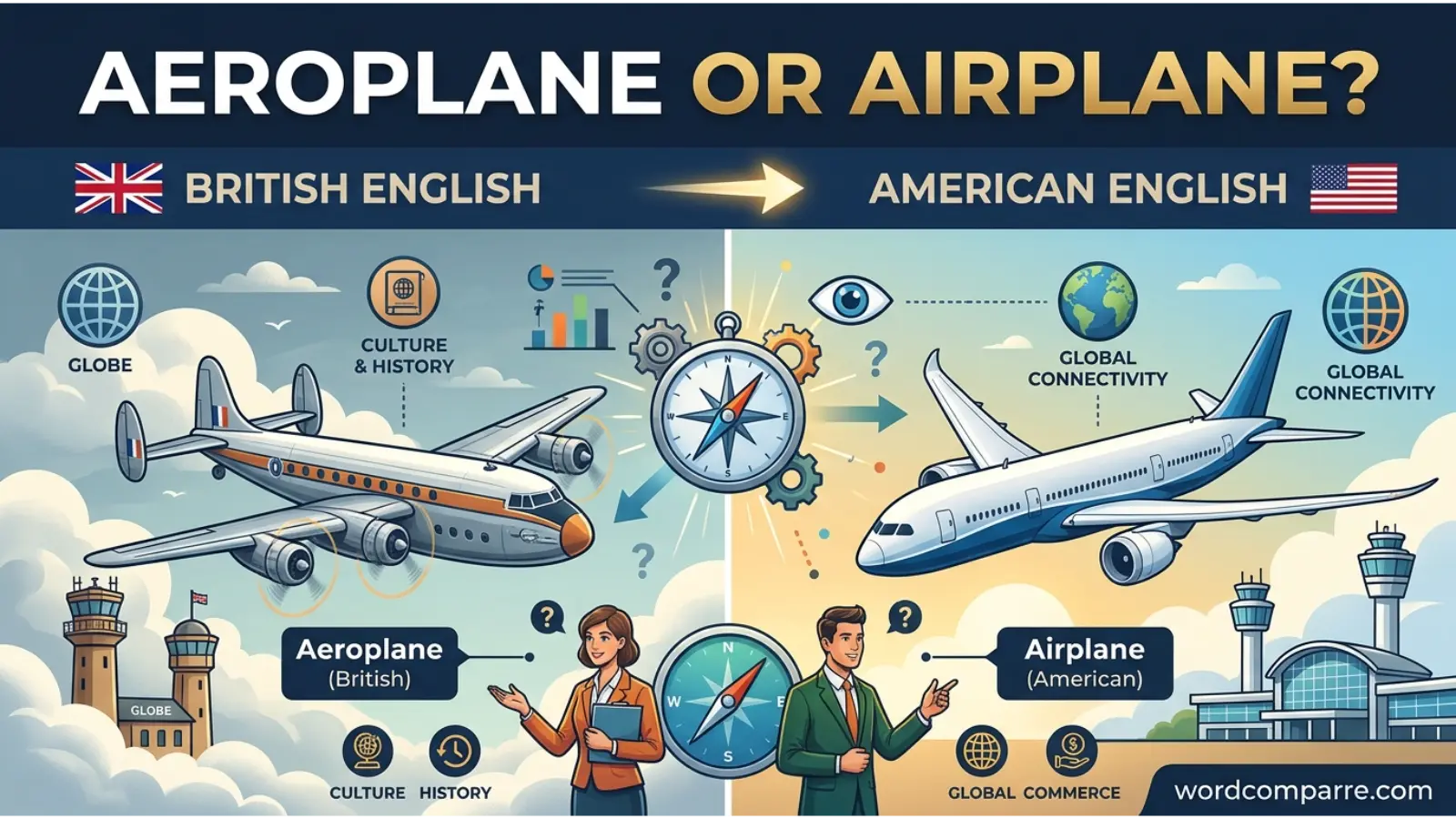
Choosing between aeroplane and airplane can be confusing because both spellings are correct, yet their popularity differs across English-speaking regions. If you are writing an article, preparing an academic assignment, publishing business content, or communicating with an international audience, understanding this difference can help you select the most appropriate word.
The main distinction is regional rather than grammatical. Aeroplane is traditionally preferred in British English, whereas airplane is the standard choice in American English. Both words describe a powered aircraft with wings that flies through the air. Neither spelling is universally wrong, so the best option depends on your intended readers and the spelling conventions you follow.
In this guide, you will learn when to use each spelling, what major dictionaries recommend, how professional style guides approach regional spelling, and how these words developed historically. You will also find practical examples, academic and business writing advice, and answers to frequently asked questions.
Aeroplane vs. Airplane: Quick Comparison
| Feature | Aeroplane | Airplane |
|---|---|---|
| English variety | Traditionally British English | American English |
| Preferred in US writing | Less common | Yes |
| Preferred in UK writing | Traditional choice | Also understood and increasingly familiar |
| Meaning | A powered, fixed-wing aircraft | A powered, fixed-wing aircraft |
| Part of speech | Noun | Noun |
| Plural form | Aeroplanes | Airplanes |
| Common shortened form | Plane | Plane |
Oxford Learner’s Dictionaries identifies aeroplane with British English and notes that airplane is especially common in North American English. Cambridge Dictionary also lists aeroplane as the British form and airplane as the American form. These references support the regional distinction rather than a difference in meaning.
What Does Aeroplane Mean?
An aeroplane is a powered flying vehicle with wings and one or more engines. It is the traditional British English spelling of the word.
The spelling is particularly suitable for writing intended for British readers or publications that follow British English conventions. It can also appear in other varieties of English influenced by British spelling traditions.
Examples of Aeroplane in Sentences
- The aeroplane landed safely at Heathrow Airport.
- My brother travelled to London by aeroplane.
- We watched an aeroplane fly above the clouds.
- The museum displays a historic aeroplane from the early twentieth century.
- The passengers boarded the aeroplane shortly before departure.
Each sentence uses aeroplane correctly. The spelling does not change the meaning of the sentence; it reflects a regional language preference.
What Does Airplane Mean?
An airplane is the same type of powered, fixed-wing flying vehicle. This spelling is standard in American English and is especially common in North American writing.
Use airplane when writing for an American audience, following a US publication’s editorial rules, or preparing content that consistently uses American spelling.
Examples of Airplane in Sentences
- The airplane arrived at Chicago O’Hare International Airport.
- She booked an airplane ticket for her business trip.
- The children watched an airplane cross the sky.
- The airline introduced a new airplane with improved passenger seating.
- Engineers tested the airplane before its first flight.
These sentences are grammatically correct. In American English, airplane is generally the natural choice.
Which Spelling Should You Use?
The best spelling depends on your audience, publication requirements, and chosen English variety.
Use aeroplane when:
- You are writing for a British English audience.
- Your publication traditionally uses British spelling.
- Your organisation’s editorial guidelines specify aeroplane.
- You are maintaining the spelling conventions of an existing British English document.
Use airplane when:
- You are writing for readers in the United States.
- Your publication follows American English conventions.
- You are preparing US-focused marketing materials or educational content.
- Your organisation’s style guide specifies American spelling.
For general communication, both words are understandable. However, consistency matters more than switching between the two forms without a reason.
British vs. American English: Regional Differences
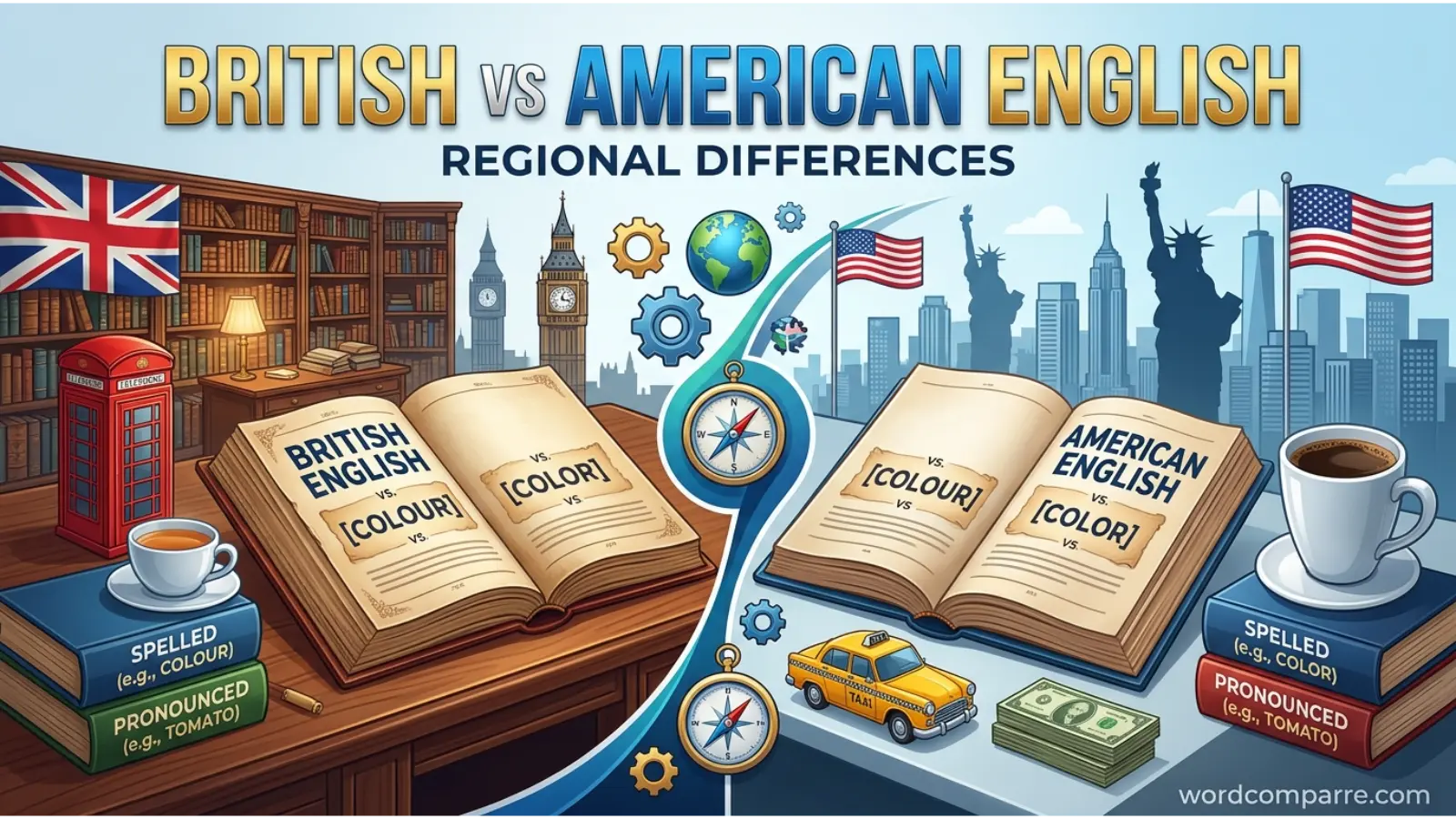
British and American English share the same grammatical foundation, but they differ in spelling, vocabulary, punctuation preferences, and certain expressions. The aeroplane/airplane distinction is one example of regional spelling variation.
| British English | American English |
|---|---|
| Aeroplane | Airplane |
| Colour | Color |
| Centre | Center |
| Theatre | Theater |
| Labour | Labor |
| Neighbour | Neighbor |
| Travelling | Traveling |
These differences illustrate why writers should identify their target audience before producing a long article or professional document.
British spelling is not automatically more correct than American spelling, and American spelling is not automatically more correct than British spelling. Both are established forms of English. The appropriate choice depends on the intended variety.
What Do Major Dictionaries Recommend?
Dictionaries help writers distinguish accepted spelling variants from genuine spelling mistakes. They also identify regional preferences, pronunciation, grammatical function, and word meaning.
Oxford Learner’s Dictionaries
Oxford Learner’s Dictionaries labels aeroplane as British English and notes airplane as the alternative commonly used in North American English. Its entry for airplane likewise identifies the word as particularly associated with North American English.
This guidance supports using aeroplane for traditional British English and airplane for American English.
Cambridge Dictionary
Cambridge Dictionary includes aeroplane and airplane in its guidance on British and American spelling differences. Its examples place aeroplane in the British column and airplane in the American column.
Merriam-Webster
Merriam-Webster is a major reference for American spelling, usage, and definitions. It is particularly useful when preparing content for US readers or following American editorial standards.
The Associated Press also identifies Merriam-Webster as its primary reference for spelling and usage questions.
Practical recommendation: Use Oxford or Cambridge references when checking British English, and Merriam-Webster when checking American English. Follow your organisation’s preferred dictionary if it has one.
Official Style Guides and Publishing Standards
Professional writers do not need to invent their own spelling rules for every article. Established style guides provide consistent editorial standards.
British and International Publishing
Publications that use British English may prefer aeroplane, depending on their editorial policy. However, British spelling conventions are not identical across every publisher or institution.
The International Organization for Standardization (ISO), for example, follows Oxford English spelling in its house style and advises consistent spelling throughout a document. Its conventions illustrate the importance of selecting a recognised standard and applying it consistently.
American Publishing
American publications commonly use airplane. The Associated Press recommends Merriam-Webster as its primary spelling and usage reference, making it a useful resource for journalists, editors, and content creators.
Other US publishers may follow their own editorial manuals, so their stated rules should take priority.
Academic Writing
Academic writers should follow the spelling requirements of their university, journal, department, or publisher.
For example, a paper submitted to an American journal would normally use airplane, while a British university assignment may use aeroplane if that is the institution’s preferred form.
Neither spelling makes an academic argument more accurate. What matters is following the required style and maintaining consistency.
Business Writing
Business communication should reflect the expectations of its audience.
- A US company would generally use airplane in its American English reports and website content.
- A British company may use aeroplane in material written according to traditional British conventions.
- A multinational organisation should establish a house style for each regional market.
- A technical report should follow the terminology and spelling conventions required by its industry or client.
These practices improve readability and help organisations present a consistent professional image.

International Communication: Which Word Is Better?
Both spellings can be understood by English speakers around the world. Nevertheless, airplane is a practical choice when a writer wants to follow American English, while aeroplane is suitable for traditional British English.
For an international website, the best choice depends on the intended audience and the site’s language policy.
If your website has separate US and UK editions, you can use airplane on the US edition and aeroplane on the UK edition. If the website uses one consistent variety of English, choose one spelling and maintain it throughout the content.
The shorter word plane is also widely understood in both varieties and is often more natural in everyday conversation.
For example:
- British English: We travelled by aeroplane.
- American English: We travelled by airplane.
- General conversational English: We travelled by plane.
All three sentences communicate the same basic idea.
The History of Aeroplane and Airplane
The word aeroplane emerged in the late nineteenth century. Oxford Learner’s Dictionaries traces it to the French word aéroplane, formed from aéro- meaning air and the Greek-derived element -planos, meaning wandering.
The spelling airplane developed as an alternative English form. Over time, it became the standard choice in American English, while aeroplane remained associated with British English.
This development is an example of how English spelling can evolve differently across regions. A word may retain one form in one country while another form becomes more common elsewhere.
The two spellings now refer to the same general type of aircraft. Their difference is primarily historical and regional, not technical.
Current Usage and Modern Trends
Modern English usage is influenced by international travel, online publishing, global media, and communication between countries. As a result, readers often encounter both aeroplane and airplane, even when one spelling is more familiar in their region.
American English continues to favour airplane, while aeroplane remains an established British English form. The shorter term plane is common in everyday speech and writing in both varieties.
It is important not to confuse greater international exposure with the disappearance of regional spelling preferences. A British publication may still choose aeroplane, and an American publication may still require airplane.
For current editorial decisions, consult a recent dictionary and the publication’s style guide rather than assuming that one spelling has replaced the other everywhere.
Common Mistakes to Avoid
Writers sometimes treat regional spelling differences as if they were grammar errors. This can lead to unnecessary corrections.
Mistake 1: Calling Aeroplane Incorrect
Incorrect claim: Aeroplane is always a misspelling.
Correction: Aeroplane is an accepted spelling, especially in British English.
Mistake 2: Calling Airplane Incorrect in British English
Incorrect claim: British writers must never use airplane.
Correction: British English traditionally favours aeroplane, but airplane is also understood and appears in British usage.
Mistake 3: Mixing Regional Spellings Without a Reason
Using aeroplane in one paragraph and airplane in the next may make an article appear inconsistent.
Correction: Select the appropriate variety of English and apply it consistently, unless a quotation, proper name, or other specific reason requires a different form.
Mistake 4: Assuming the Words Have Different Meanings
The extra letters in aeroplane do not indicate a different type of aircraft.
Correction: Both words describe the same general category of flying vehicle.
Frequently Asked Questions
Is Aeroplane or Airplane Correct?
Both are correct. Aeroplane is traditionally preferred in British English, while airplane is the standard spelling in American English.
Is Aeroplane British or American English?
Aeroplane is associated primarily with British English. It is an accepted spelling and is not a grammatical error.
Is Airplane British or American English?
Airplane is the standard American English spelling. It is also understood and used in British English, although aeroplane is the traditional British form.
Do Aeroplane and Airplane Mean the Same Thing?
Yes. Both words refer to a powered, fixed-wing aircraft. The main difference is spelling and regional preference, not meaning.
Should I Use Aeroplane or Airplane in an Academic Essay?
Follow the spelling conventions required by your university, instructor, journal, or publisher. Use airplane for American English and aeroplane for traditional British English.
Which Word Should I Use on an International Website?
Choose the form that matches your primary audience and editorial policy. If you target American readers, use airplane. If you target British readers and follow British English, use aeroplane. A consistent international style is preferable to switching randomly between forms.
Is Plane an Acceptable Alternative?
Yes. Plane is a common, shorter term used in both British and American English. It is often suitable for everyday conversation and general writing.
What Is the Plural of Aeroplane and Airplane?
The plural forms are aeroplanes and airplanes, respectively. Both follow the regular English rule of adding -s to form the plural.
Conclusion
The difference between aeroplane and airplane comes down to regional spelling preferences rather than meaning or grammatical correctness. Aeroplane is traditionally associated with British English, while airplane is standard in American English. Both spellings are accepted and refer to the same type of aircraft.
When choosing between them, consider your readers, consult a reliable dictionary, and follow the relevant publishing or organisational style guide. For a British English article, aeroplane is a suitable choice; for American English content, airplane is generally preferred. Most importantly, maintain consistency throughout your writing so that readers can focus on your message rather than spelling variations.