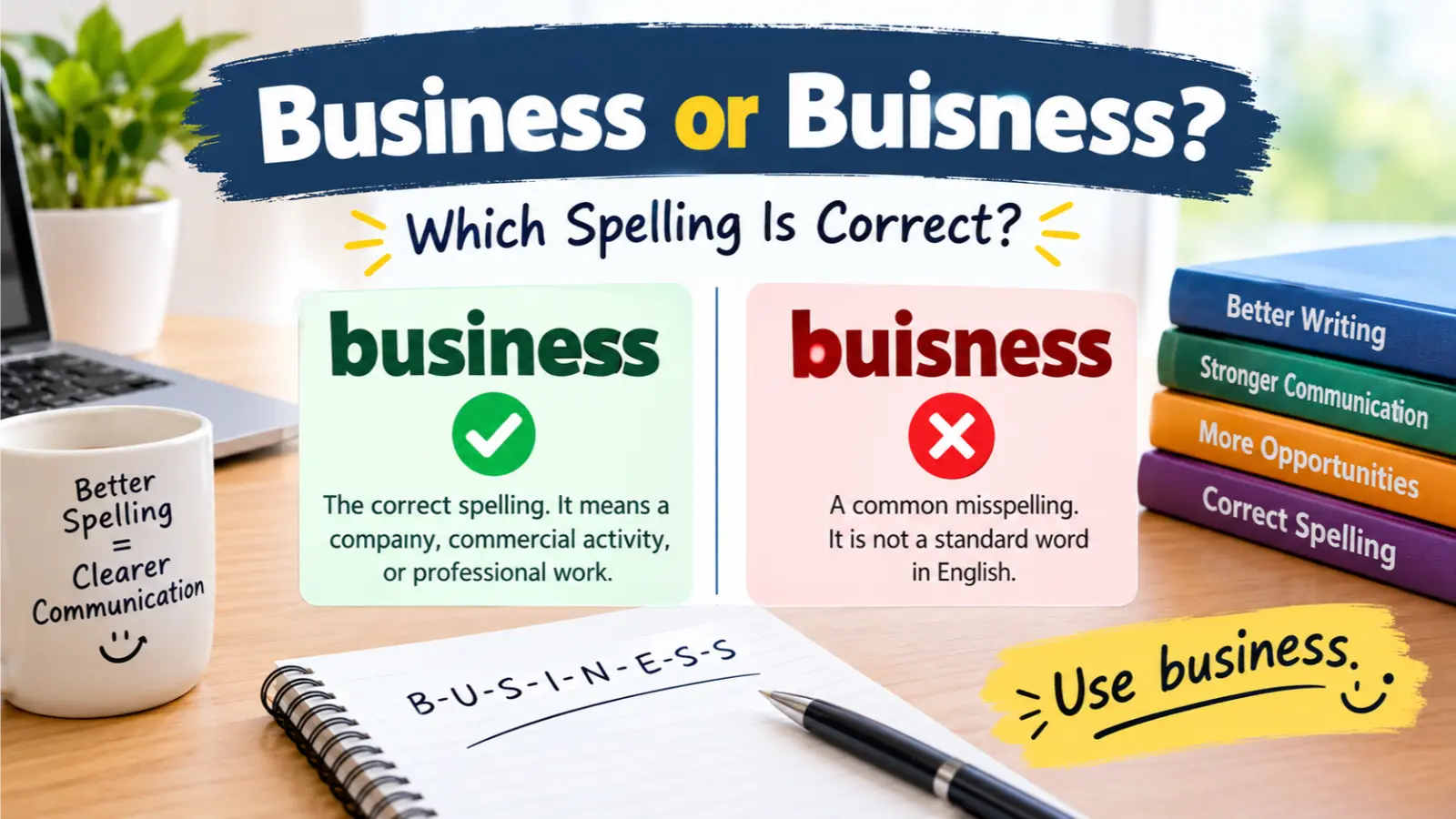
Are you unsure whether to write business or buisness? These two forms look similar, but only one is correct in standard English. The correct spelling is business, which refers to a company, commercial activity, or the buying and selling of goods and services. Although many people accidentally write buisness, it is not an accepted alternative spelling.
Understanding the difference between business or buisness can help you improve your spelling and communicate more professionally. Whether you are writing a school assignment, preparing a business proposal, sending an email, or publishing an online article, choosing the correct spelling makes your content clearer and more trustworthy.
Quick Answer: Business or Buisness?
Business is the correct spelling. Buisness is a misspelling and should be avoided in formal, academic, and professional writing.
Examples:
- Correct: She owns a successful business.
- Incorrect: She owns a successful buisness.
- Correct: Our business provides excellent customer service.
- Incorrect: Our buisness provides excellent customer service.
Remember that the correct spelling contains the letters B-U-S-I-N-E-S-S.

What Does Business Mean?
The word business is a noun with several meanings. Its exact meaning depends on how it is used in a sentence.
Business as a Company
A business can be an organization that sells products or provides services to customers.
Example: My family runs a small clothing business.
Business as Commercial Activity
The word can describe buying, selling, trading, or providing services to earn money.
Example: International business connects companies across different countries.
Business as Work or Responsibility
Business can also refer to a task, responsibility, or matter that requires attention.
Example: I have some important business to finish before leaving the office.
Business as a Professional Activity
In everyday communication, business can describe someone’s work-related affairs or professional activities.
Example: She travels frequently for business.
Business vs. Buisness: Key Differences
| Feature | Business | Buisness |
|---|---|---|
| Spelling | Correct | Incorrect |
| Word type | Noun | Misspelling |
| Standard dictionary entry | Yes | No standard entry as an alternative spelling |
| Meaning | Company, trade, work, or commercial activity | No established standard meaning |
| Formal writing | Recommended | Avoid |
| Academic writing | Correct | Incorrect |
| Professional communication | Appropriate | Spelling error |
The main difference is simple: business is the established English word, whereas buisness is an incorrect arrangement of the letters.
Origin and History of the Word Business
The word business developed from Middle English forms related to being busy, occupied, or engaged in an activity. It is historically connected with the word busy.
Over time, its meaning expanded beyond general work and activity to include trade, commercial organizations, and professional affairs. Today, it is widely used in finance, management, economics, marketing, and everyday conversation.
The modern spelling has become firmly established in standard English. Although its pronunciation may seem unusual to learners, the accepted spelling remains business.

Why Do People Confuse Business and Buisness?
Several factors explain why writers sometimes misspell this common word.
1. Pronunciation Does Not Match Every Letter Clearly
Business is commonly pronounced approximately as “BIZ-niss.” The pronunciation does not make the spelling immediately obvious, particularly for English learners.
As a result, some people remember the sound but arrange the letters incorrectly.
2. The Letter Order Is Easy to Forget
The middle of the word can cause confusion. Writers may accidentally place the letters in the wrong order and produce buisness.
The correct sequence is:
B-U-S-I-N-E-S-S
Pay attention to the s before the i.
3. Typing Errors Happen Frequently
People often type quickly when writing emails, reports, social media posts, or website articles. A small typing mistake can turn business into buisness.
Proofreading and spell-checking can help prevent this error.
4. Repeated Mistakes Can Become Habits
When someone repeatedly types an incorrect spelling, it may begin to look familiar. However, familiarity does not make a spelling correct.
Learning the correct letter sequence and using it consistently can help establish the right habit.

Dictionary Recommendations for Business or Buisness
Standard English dictionaries, including Merriam-Webster and Cambridge Dictionary, recognize business as the correct spelling.
The word is used in American English, British English, and other varieties of standard English. There is no standard regional spelling distinction that makes buisness correct in one country and incorrect in another.
For reliable writing, follow these recommendations:
- Use business in professional documents.
- Write business in school and university assignments.
- Use the correct form in website articles and SEO content.
- Check spelling before sending important emails.
- Consult a reputable dictionary when you are uncertain about a word.
These practices help maintain accuracy across different types of communication.
Real-Life Examples of Business in Sentences
The following examples demonstrate how to use business naturally in different contexts.
Everyday Examples
- My uncle owns a successful business.
- She wants to start her own business.
- Their business is growing every year.
- We discussed business during lunch.
- He has some personal business to attend to.
Professional Examples
- Our business offers digital marketing services.
- The company plans to expand its business internationally.
- Please contact the business department for assistance.
- Good communication is essential for business success.
- The manager reviewed the business report yesterday.
Academic Examples
- Small businesses contribute to economic development.
- The course introduces students to business management.
- Technology has changed modern business practices.
- The research examines business growth in developing economies.
- Effective planning can improve business performance.
Online and Digital Business Examples
- She runs an online business from home.
- Digital marketing helps businesses reach new customers.
- The website provides information about the business.
- Many businesses use social media to promote their products.
- E-commerce has created new opportunities for business owners.
In every example, business is the correct form. Replacing it with buisness would introduce a spelling error.
Common Mistakes to Avoid
Even experienced writers can make spelling errors when typing quickly. The following mistakes are worth checking.
Using Buisness in Professional Emails
Incorrect spelling can make a message appear careless. Always check the word before sending a proposal, invoice, or client email.
Using Buisness in Website Content
Website articles should use correct spelling to maintain quality and readability. Review titles, headings, paragraphs, image descriptions, and metadata.
Assuming Both Spellings Are Acceptable
Some words have different accepted spellings in British and American English. Business and buisness do not follow that pattern. Only business is correct.
Forgetting the Correct Letter Sequence
Remember that the word begins with bus, not bui. Practising the spelling can reduce repeated errors.
Confusing Business and Businesses
Business is the singular form, while businesses is the plural form.
Examples:
- Singular: The business is profitable.
- Plural: The businesses are profitable.
Both forms are correct when used in the appropriate grammatical context.
Memory Tricks to Spell Business Correctly
Use these simple techniques to remember the correct spelling.
Remember the First Three Letters
The word begins with BUS, followed by INESS.
Think of the complete word as:
BUS + INESS = BUSINESS
This is a memory aid rather than the word’s actual historical construction, but it can help you recall the letters.
Learn the Full Letter Sequence
Repeat the spelling aloud or write it several times:
B-U-S-I-N-E-S-S
Practising the sequence can make it easier to remember during writing.
Connect It With a Familiar Phrase
Use the phrase “Busy people build businesses” to associate the word with work and commercial activity.
Check Before Publishing
If you frequently make the same mistake, add business to a spelling practice list and review it before writing important documents.
Business or Buisness in Professional Writing
In professional communication, spelling accuracy contributes to a polished and credible presentation. A misspelled word may distract readers from your main message, particularly in business proposals, reports, marketing materials, and website content.
Always use business when writing about a company, commercial activity, or professional matter.
For website owners, it is also useful to proofread SEO titles and meta descriptions. Search optimization should support helpful, accurate writing rather than replace basic editing. Use the correct spelling naturally wherever the topic requires it.
Before publishing an article, follow this quick checklist:
- Confirm that business is spelled correctly throughout the article.
- Check the H1 title and all subheadings.
- Review the meta description and introduction.
- Correct spelling errors in image alt text.
- Read the final article once before publishing.
These small steps can improve the overall quality of your content.
Frequently Asked Questions
1. Is business or buisness correct?
Business is correct. Buisness is a misspelling and should not be used in standard English.
2. Why do people spell business incorrectly?
People often misspell the word because its pronunciation does not clearly reveal its spelling. Typing too quickly and forgetting the letter order can also cause mistakes.
3. Is buisness an accepted British spelling?
No. Buisness is not a standard British English spelling. The correct form is business in both British and American English.
4. What is the plural of business?
The plural form is businesses.
Example: Several new businesses opened in the city this year.
5. How can I remember the spelling of business?
Remember the sequence B-U-S-I-N-E-S-S. You can also use the memory aid “BUS + INESS” to recall the correct letter order.
6. Is business a noun or a verb?
Business is a noun. The related verb busy is not used to mean operating a company. For commercial activity, use expressions such as “conduct business” or “run a business.”
7. Does business have the same spelling in the United States and the United Kingdom?
Yes. Both American and British English use business. There is no standard spelling difference between these varieties.
8. Can a spelling mistake affect my website content?
Spelling mistakes can reduce readability and make content appear less polished. Correct spelling helps readers understand your content and supports a professional user experience.
Conclusion
When comparing business or buisness, the correct choice is always business. It is the standard English spelling for a company, commercial activity, professional work, or a matter requiring attention. The form buisness is a spelling mistake, not an alternative used in British or American English.
Remember the sequence B-U-S-I-N-E-S-S, proofread your writing, and use the correct form in emails, assignments, reports, and website articles. With regular practice, you can avoid this common mistake and write with greater confidence.