Understanding the difference between shelf or shelve is important for anyone who wants to improve their English spelling, grammar, and writing skills. Although these words look and sound similar, they have different meanings and grammatical functions. Using the wrong word can make a sentence confusing or incorrect. Fortunately, learning a simple rule can help you choose the correct word in everyday conversations, school assignments, emails, and professional documents.
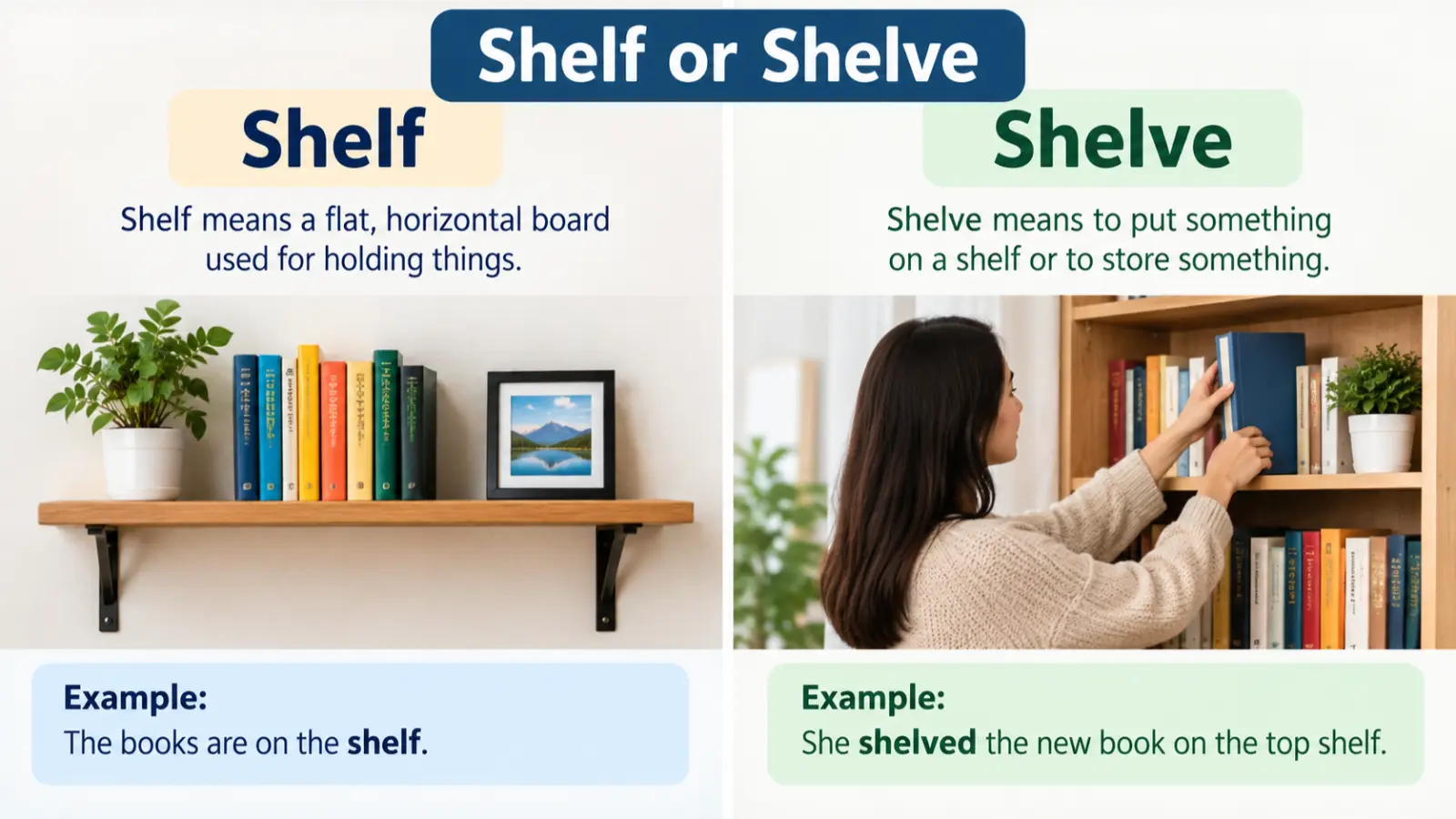
A shelf is a flat surface used to store or display items, such as books, dishes, or decorations. On the other hand, shelve is a verb that means to place something on a shelf or postpone a plan, project, or decision. This guide explains the difference between shelf and shelve, including their meanings, grammar rules, plural forms, common mistakes, and practical examples. By the end, you will know when to use each word correctly.
What Does Shelf Mean?
The word shelf is a noun that describes a flat, horizontal surface used for storing or displaying objects. Shelves can be attached to walls or supported by furniture and storage units.
People commonly use shelves in homes, offices, libraries, classrooms, and shops.
Examples:
- I placed my favorite books on the shelf.
- The kitchen shelf holds several cups and plates.
- She bought a wooden shelf for her bedroom.
- The top shelf is too high for me to reach.
- Please clean the shelf before putting the decorations on it.
In each sentence, shelf refers to a physical object rather than an action.
What Does Shelve Mean?
The word shelve is a verb with two common meanings. First, it means to place something on a shelf. Second, it means to postpone or set aside a plan, proposal, project, or decision.
The meaning depends on the context in which the word appears.
Examples:
- Please shelve these books after reading them.
- The company decided to shelve its expansion plans.
- Workers shelve new products every morning.
- The committee chose to shelve the proposal until next month.
- We may need to shelve this idea because of budget restrictions.
In these examples, shelve describes an action. When it refers to a project or proposal, it usually means delaying or setting it aside rather than necessarily cancelling it permanently.
Shelf vs. Shelve: What Is the Difference?
The main difference between shelf and shelve is their grammatical function. Shelf is a noun, while shelve is a verb.
| Feature | Shelf | Shelve |
|---|---|---|
| Part of speech | Noun | Verb |
| Main meaning | A surface for storing items | To place something on a shelf or postpone it |
| Example | The shelf is clean. | Please shelve the books. |
| Related forms | Shelves | Shelved, shelving |
| Common context | Furniture and storage | Organizing items and postponing plans |
Remember: Use shelf when naming the object. Use shelve when describing the action.
Grammar Rules for Shelf and Shelve
When Should You Use Shelf?
Use shelf when you need a singular noun to identify a storage surface.
Correct examples:
- This shelf is made of wood.
- There is a photograph on the shelf.
- He repaired the broken shelf.
- I need a shelf for my office.
Because shelf is a singular countable noun, it commonly appears with words such as a, the, this, or that.
When Should You Use Shelve?
Use shelve when describing an action. The verb can appear in different forms depending on the sentence structure and tense.
Examples of different verb forms:
- Present: I shelve the books every evening.
- Third-person singular: She shelves the books every morning.
- Past tense: He shelved the documents yesterday.
- Present participle: They are shelving the new books.
- Infinitive: We need to shelve these items.
Notice that the spelling changes when the verb is used in different grammatical forms.
Is the Plural of Shelf Shelves or Shelfs?
The correct plural form of shelf is shelves, not shelfs.
Many English nouns ending in f or fe change to ves in the plural, although some follow different patterns.
Examples:
- One shelf, two shelves.
- One leaf, several leaves.
- One knife, three knives.
- One wolf, two wolves.
Example sentence: The library has hundreds of shelves filled with books.
The word shelves can also function as a verb. For example, in the sentence “She shelves books at the library,” it describes an action performed by one person.
Therefore, use the context to determine whether shelves is a plural noun or a verb.
Common Mistakes When Using Shelf and Shelve
Writers sometimes confuse these words because their spellings are similar. The following examples show how to correct common errors.
| Incorrect Sentence | Correct Sentence | Explanation |
|---|---|---|
| Put the books on the shelve. | Put the books on the shelf. | Shelf is the noun needed here. |
| Please shelf the documents. | Please shelve the documents. | Shelve is the verb needed here. |
| Two shelfs are broken. | Two shelves are broken. | Shelves is the correct plural. |
| They shelfed the proposal. | They shelved the proposal. | Shelved is the correct past tense. |
| She is shelfing the books. | She is shelving the books. | Shelving is the correct verb form. |
To avoid these mistakes, identify whether your sentence names an object or describes an action before choosing the word.
Professional Usage of Shelf and Shelve
Both words are useful in professional English, but they appear in different situations.
Using Shelf in Professional Writing
Use shelf when discussing physical storage, retail displays, libraries, warehouses, or product placement.
Examples:
- The new products are displayed on the top shelf.
- Please check the storage shelf before ordering additional supplies.
- The documents are arranged on a separate shelf.
- The retailer placed the latest collection on the front shelf.
Using Shelve in Professional Writing
Use shelve when discussing plans, proposals, business decisions, and projects that are postponed or set aside.
Examples:
- Management decided to shelve the proposal until the next quarter.
- The company may shelve the project because of financial limitations.
- The board agreed to shelve the decision pending further review.
- The team temporarily shelved its marketing campaign.
In professional communication, shelve a proposal usually means postponing it or setting it aside. It does not automatically mean that the proposal has been permanently cancelled.
Formal vs. Informal Usage
Both shelf and shelve are appropriate in formal and informal English. Their correct use depends on the intended meaning rather than the level of formality.
Formal examples:
- The report has been placed on the designated shelf.
- The committee decided to shelve the proposal pending further investigation.
Informal examples:
- Put your books on that shelf.
- Let’s shelve that idea for now.
The expression shelve that idea is common in everyday conversations and workplace discussions. Meanwhile, shelf is frequently used when describing furniture, storage, or the location of objects.
Shelf or Shelve: Comparison Examples
The following sentences demonstrate how these words work in different situations.
- The shelf needs cleaning before we put the books on it.
- Please shelve the books after you finish reading.
- The store displayed its new products on a shelf near the entrance.
- The company decided to shelve its marketing campaign.
- I need another shelf to organize my office supplies.
- The manager chose to shelve the proposal until next year.
- The wooden shelf broke under the weight of the boxes.
- Library workers shelve hundreds of books every day.
- She placed the vase on the highest shelf.
- The team agreed to shelve the plan temporarily.
These examples show that shelf identifies a storage surface, while shelve describes an action involving storage or postponement.
Easy Memory Tricks to Remember Shelf and Shelve
Remembering the difference becomes easier when you connect each word with its purpose.
- Shelf means a surface: Think of a wooden shelf holding books or decorations.
- Shelve means an action: Think of someone putting books away or postponing a project.
- Shelf becomes shelves: Remember the irregular plural spelling.
- Shelve becomes shelved: Add d to form the simple past tense.
- Shelving describes an ongoing action: For example, “He is shelving the books.”
A helpful test is to replace the word with “a storage surface.” If the sentence still makes sense, shelf may be correct. If you mean “put away” or “postpone,” use shelve in the appropriate grammatical form.
Real-Life Conversations Using Shelf and Shelve
Conversation 1: At Home
Ali: Where should I put these books?
Sara: Put them on the bottom shelf.
Ali: Should I shelve the magazines, too?
Sara: Yes, please organize them neatly.
Conversation 2: At Work
Manager: What happened to the new project?
Employee: We decided to shelve it until next month.
Manager: Does that mean we cancelled it?
Employee: No, we are only postponing it for now.
Conversation 3: At the Library
Librarian: Have you finished organizing the books?
Assistant: Almost. I still need to shelve these last few books.
Librarian: Please put them on the correct shelves.
Assistant: Sure. I will finish before closing time.
Frequently Asked Questions
1. Is shelf or shelve correct?
Both words are correct, but they have different meanings. Shelf is a noun for a storage surface, while shelve is a verb meaning to place something on a shelf or postpone something.
2. What is the plural of shelf?
The plural of shelf is shelves. The spelling shelfs is generally incorrect when referring to more than one storage shelf.
3. Is shelve a noun or a verb?
Shelve is a verb. It describes placing something on a shelf or postponing a plan, project, or decision.
4. What is the past tense of shelve?
The past tense of shelve is shelved. For example, “The company shelved the proposal last week.”
5. Can shelve mean postpone?
Yes. Shelve commonly means postponing or setting aside a plan, proposal, project, or decision. For example, “The manager decided to shelve the project until next year.”
Conclusion
Understanding shelf or shelve is simple once you learn their grammatical differences. Shelf is a noun that refers to a flat surface used for storing or displaying objects. Shelve is a verb that means placing something on a shelf or postponing a plan, project, or decision.
Remember that the plural of shelf is shelves, while the past tense of shelve is shelved. By paying attention to the meaning and structure of each sentence, you can use these words correctly in everyday conversations, academic assignments, and professional writing. Practice the examples in this guide to strengthen your English grammar and avoid common mistakes.