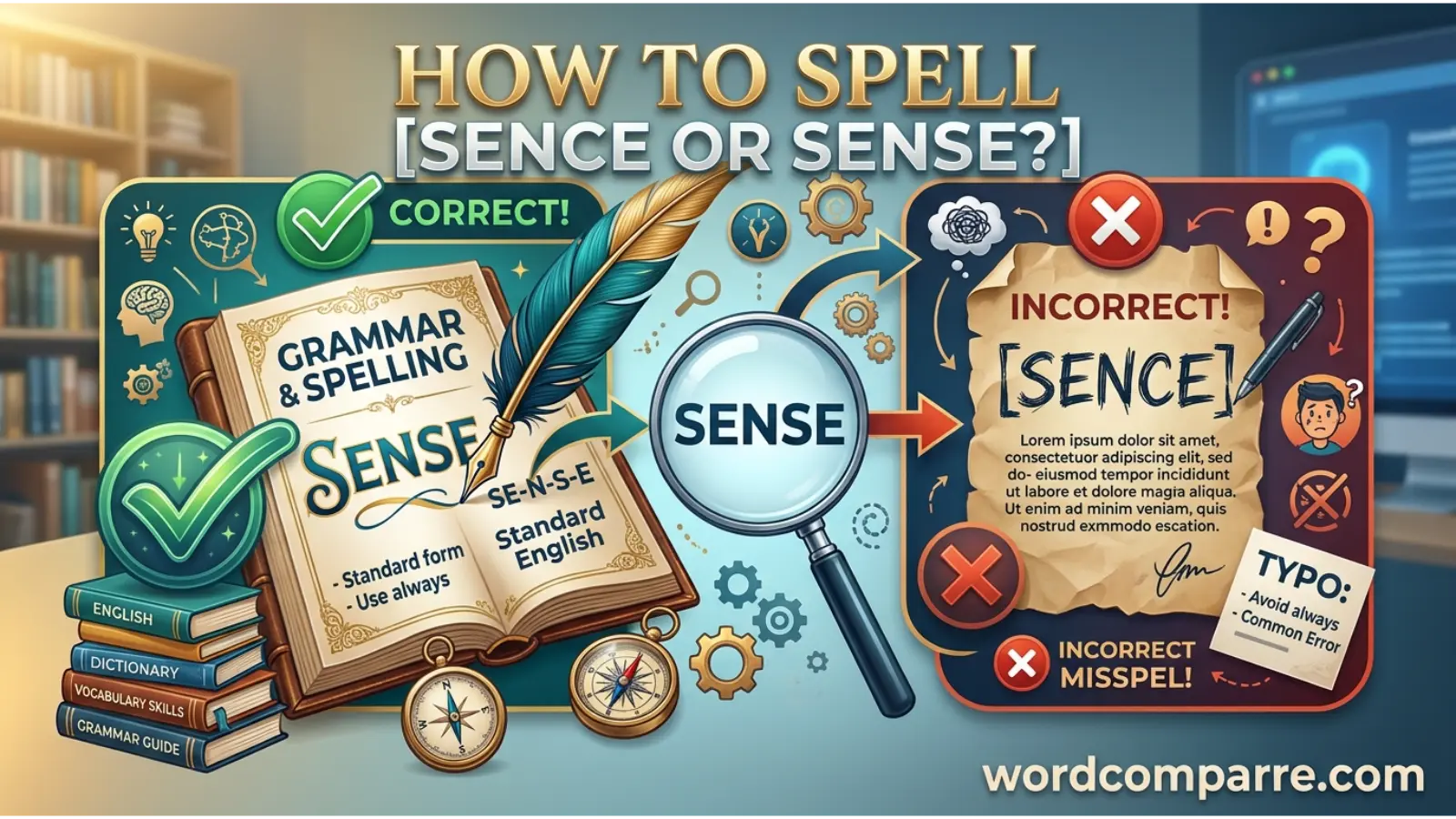
Have you ever wondered how to spell sence when writing a message, completing a school assignment, or creating an article? You are not alone. Many English learners and native speakers occasionally confuse words that sound similar but have different spelling patterns. If you are trying to decide whether to write sense or sence, the correct choice in standard modern English is sense. The spelling sence is generally considered incorrect when you mean understanding, awareness, perception, or good judgment.
The confusion often happens because English spelling does not always follow pronunciation in an obvious way. When people hear the word sense, they may remember its sound but accidentally replace the letter s with c. However, learning the correct spelling is straightforward once you connect sense with familiar words such as sensible, sensory, and sensation. In this guide, you will discover the correct spelling, understand its meaning, explore its historical background, and learn practical ways to avoid this common mistake. You will also find clear examples and helpful answers to frequently asked questions.
Remember: Sense is the standard spelling. Sence should not replace it in ordinary English writing.
Quick Answer: How Do You Spell Sence?
The correct spelling is sense, written S-E-N-S-E.
- Sense: The correct modern English spelling.
- Sence: A common misspelling of sense in everyday writing.
For example:
Incorrect: That explanation does not make spell sence.
Correct: That explanation does not make spell sense.
According to standard English usage, sense is the appropriate choice in schoolwork, professional emails, websites, reports, and everyday communication.
What Does Sense Mean?
The word sense has several meanings depending on how it is used in a sentence. It can function as both a noun and a verb.
Sense as a noun
As a noun, sense can refer to understanding, practical judgment, perception, or a particular meaning.
Examples:
- She has excellent common sense.
- I lost my sense of direction.
- The story gives me a sense of hope.
- The sentence has a different sense in this context.
Sense as a verb
As a verb, sense means to notice, detect, perceive, or become aware of something.
Examples:
- I can sense that something is wrong.
- The dog sensed danger nearby.
- She could sense his disappointment.
- Modern equipment can sense changes in temperature.
The intended meaning may change, but the spelling remains sense.
Sense vs. Sence: Comparison Table
| Feature | Sense | Sence |
|---|---|---|
| Standard spelling | Correct | Incorrect for the intended meaning |
| Pronunciation | /sens/ | Usually intended to sound like sense |
| Meaning | Understanding, awareness, perception, or judgment | No standard modern meaning as a replacement for sense |
| Part of speech | Noun and verb | Common spelling error |
| Formal writing | Recommended | Avoid |
| Example | Use your common sense. | Use your common sence. |
The important distinction is that these forms are not interchangeable in ordinary modern English. Although sence appears in some historical contexts as an older spelling, sense is the accepted spelling for contemporary writing.
Origin and History of the Word Sense
The English word sense comes through Old French from Latin sensus, meaning feeling, perception, or understanding. Its historical roots are connected with the ability to perceive something through the senses or understand its significance.
Over time, sense developed several related meanings. It came to describe the five traditional sensory faculties, practical judgment, awareness, and the meaning conveyed by words or expressions.
The spelling sence has appeared historically as an older variant, but that does not make it a suitable alternative in present-day standard English. For modern articles, educational materials, and professional communication, use sense.
Why Do People Confuse Sense and Sence?
Several factors can contribute to this spelling mistake.
Similar pronunciation
Both forms may be read aloud in the same way when sence is intended as a misspelling of sense. Hearing the word alone does not necessarily reveal which letters should be used.
Confusion about English spelling
English includes words such as fence, hence, and tense. Their spelling patterns may lead some writers to assume that sense follows a different pattern.
Typing too quickly
When writing on a phone or computer, people sometimes type the wrong letter without noticing. A quick proofreading check can catch this error.
Limited familiarity with related words
Readers who regularly encounter sensible, sensory, and sensation may find it easier to remember the spelling of sense. Learning related vocabulary can reinforce the correct pattern.
Dictionary Recommendations: Which Spelling Should You Use?
For standard modern English, use sense.
English dictionaries recognize sense as a noun and verb with meanings related to perception, understanding, awareness, and judgment. Common expressions include common sense, sense of humor, sense of smell, and make sense.
The form spell sence is generally treated as a misspelling when it is used with these meanings. Although historical records may contain older variants, writers should not use sence as an alternative in contemporary English articles.
For reliable spelling checks, consult established references such as Merriam-Webster, Oxford Learner’s Dictionaries, or Cambridge Dictionary. These resources can help confirm a word’s spelling, pronunciation, definition, and grammatical use.
Sense in Real-Life Sentences
The following examples demonstrate how to spell and use sense correctly in different situations.
Everyday conversations
- That makes perfect sense to me.
- I can sense that you are worried.
- Use your common sense before making a decision.
- I have a good sense of direction.
School and education
- The teacher explained the meaning of the word sense.
- Your answer makes sense, but it needs more detail.
- Students should understand the sense of each sentence.
- Reading regularly can improve your sense of language.
Professional writing
- The proposal makes sense from a financial perspective.
- We need a clear sense of the project’s priorities.
- The report helps us sense emerging changes in demand.
- Please check that every sentence makes sense before publication.
Personal experiences
- She had a sense of excitement before the trip.
- I sensed that he wanted to leave early.
- He developed a strong sense of responsibility.
- The experience gave her a new sense of purpose.
Each example uses the correct spelling, whether sense functions as a noun or a verb.
Common Mistakes to Avoid
Understanding the most frequent errors can help you write more accurately.
Mistake 1: Writing common sence
Incorrect: Everyone needs common sence.
Correct: Everyone needs common sense.
Mistake 2: Writing make sence
Incorrect: Your explanation makes sence.
Correct: Your explanation makes sense.
Mistake 3: Writing sence as a verb
Incorrect: I can sence something unusual.
Correct: I can sense something unusual.
Mistake 4: Using sence in formal documents
Incorrect: The results do not make sence.
Correct: The results do not make sense.
Mistake 5: Assuming the two spellings are equally acceptable
In ordinary contemporary English, sence is not a standard alternative to sense. Avoid using it in articles, assignments, business documents, and website content.
An Easy Memory Trick for Sense
A simple memory trick can help you remember the correct spelling without memorizing complicated rules.
Remember S-E-N-S-E.
Connect sense with the related words sensible, sensory, and sensation. Each word reinforces the familiar sens spelling pattern.
You can also remember this sentence:
Common sense always has an S after SEN.
Whenever you hesitate between sense and sence, think of sensible. This connection can make the correct spelling easier to recall.
For additional practice, write these expressions a few times:
- Common sense.
- Sense of humor.
- Sense of direction.
- Make sense.
- Sense of responsibility.
Regular exposure to these phrases will help you recognize the correct form more quickly.
Professional Writing Recommendation
If you are writing an article, school assignment, business email, or website page, always use sense when you mean understanding, perception, awareness, or judgment.
Before publishing, review sentences containing common expressions such as make sense, common sense, and sense of purpose. These phrases are particularly easy to mistype when writing quickly.
You can also use a spelling checker to identify possible errors. However, automated tools should support proofreading rather than replace it, because context still matters.
For WordPress publishers, correcting spelling mistakes improves readability and helps maintain a professional impression. Use the correct spelling naturally throughout your content rather than repeating it unnecessarily for search engines.
Frequently Asked Questions
1. How do you spell sence correctly?
The correct spelling is sense, spelled S-E-N-S-E. Sence is generally a misspelling when you mean understanding, awareness, perception, or judgment.
2. Is sence a real English word?
Sence appears in historical records as an older spelling and may occur in specialized or dialectal contexts. However, it is not the standard modern spelling of sense. Use sense in ordinary contemporary English.
3. Why do people spell sense as sence?
People may confuse the letters because both forms can represent the same intended pronunciation. Familiarity with related words such as sensible and sensory can help prevent this mistake.
4. What is the difference between sense and sence?
Sense is the standard spelling of the word meaning perception, understanding, awareness, or judgment. Sence is generally an incorrect spelling when used with these meanings in modern English.
5. Is sense a noun or a verb?
Sense can be both. As a noun, it refers to perception, understanding, or judgment. As a verb, it means to notice, detect, or become aware of something.
6. How can I remember the spelling of sense?
Remember S-E-N-S-E and connect the word with sensible, sensory, and sensation. Practicing expressions such as common sense and make sense can also reinforce the correct spelling.
Conclusion
If you are searching for how to spell sence, the answer is simple: sense is the correct spelling for standard modern English. It can describe perception, understanding, awareness, practical judgment, or the ability to detect something. The spelling sence should generally be avoided when expressing these meanings.
To remember the difference, connect sense with sensible and sensory, and check your writing before publishing. Whether you are preparing a school assignment, writing a professional email, or creating WordPress content, using the correct spelling will make your message clearer and more polished.