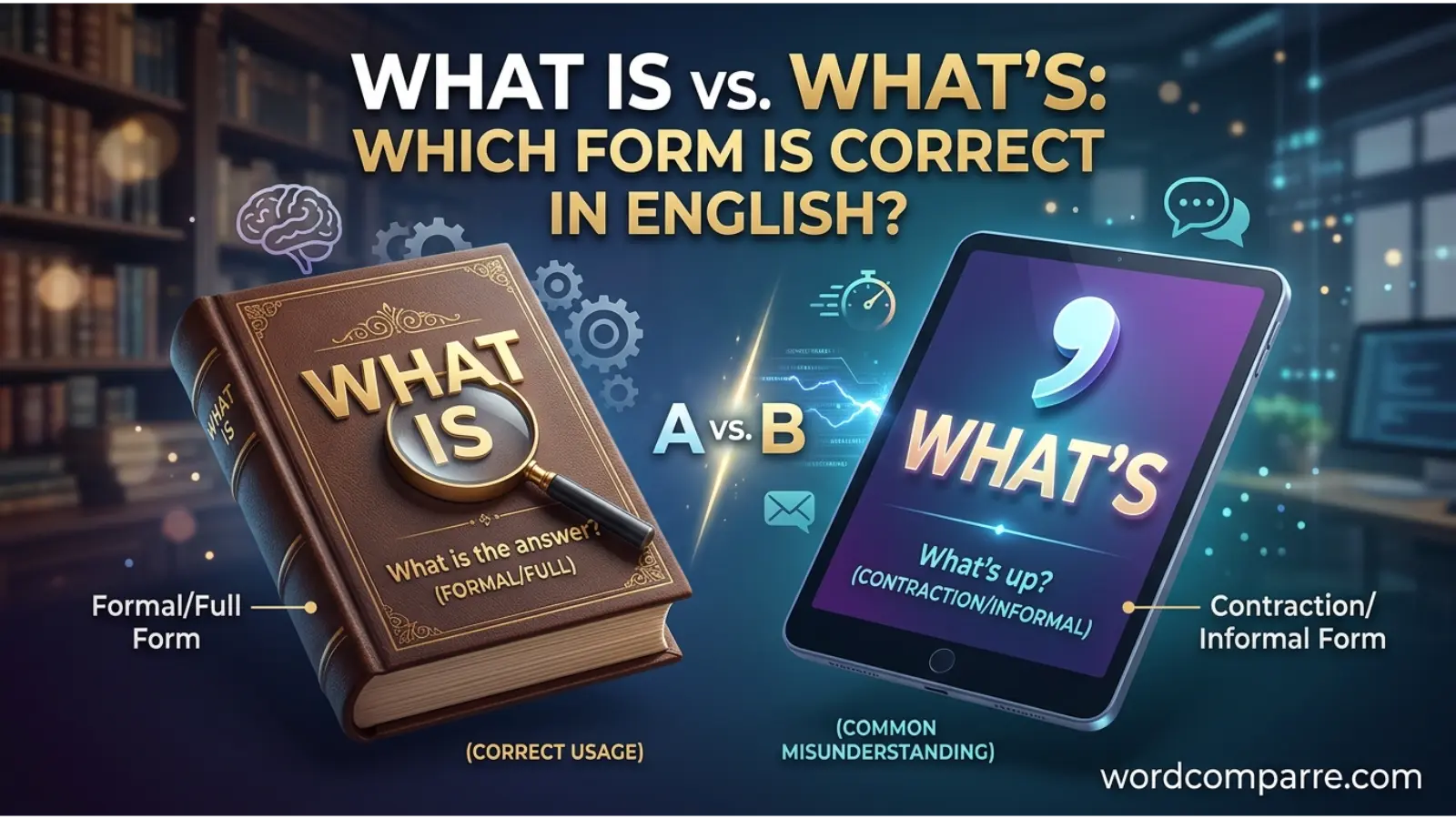
Understanding What Is vs. What’s is an important step toward improving your English grammar, writing, and everyday communication. Both expressions are correct, and they often have the same meaning. The main difference is that “what is” is the complete form, while “what’s” is a contraction that combines the words “what” and “is.” Learning the difference between these expressions will help you write accurate sentences, understand spoken English, and communicate confidently in different situations.
The choice between What Is vs. What’s often depends on the tone, purpose, and context of your sentence. English speakers frequently use “what’s” in casual conversations, text messages, and informal writing because it sounds natural and saves space. In contrast, “what is” may be preferred in academic assignments, formal documents, and educational content. However, both forms are acceptable in many situations. Another important detail is that “what’s” can also mean “what has,” depending on the words that follow it. This guide explains the meanings, grammar rules, sentence structures, common mistakes, and practical examples you need to use both forms correctly.
What Is vs. What’s: Understanding the Main Difference
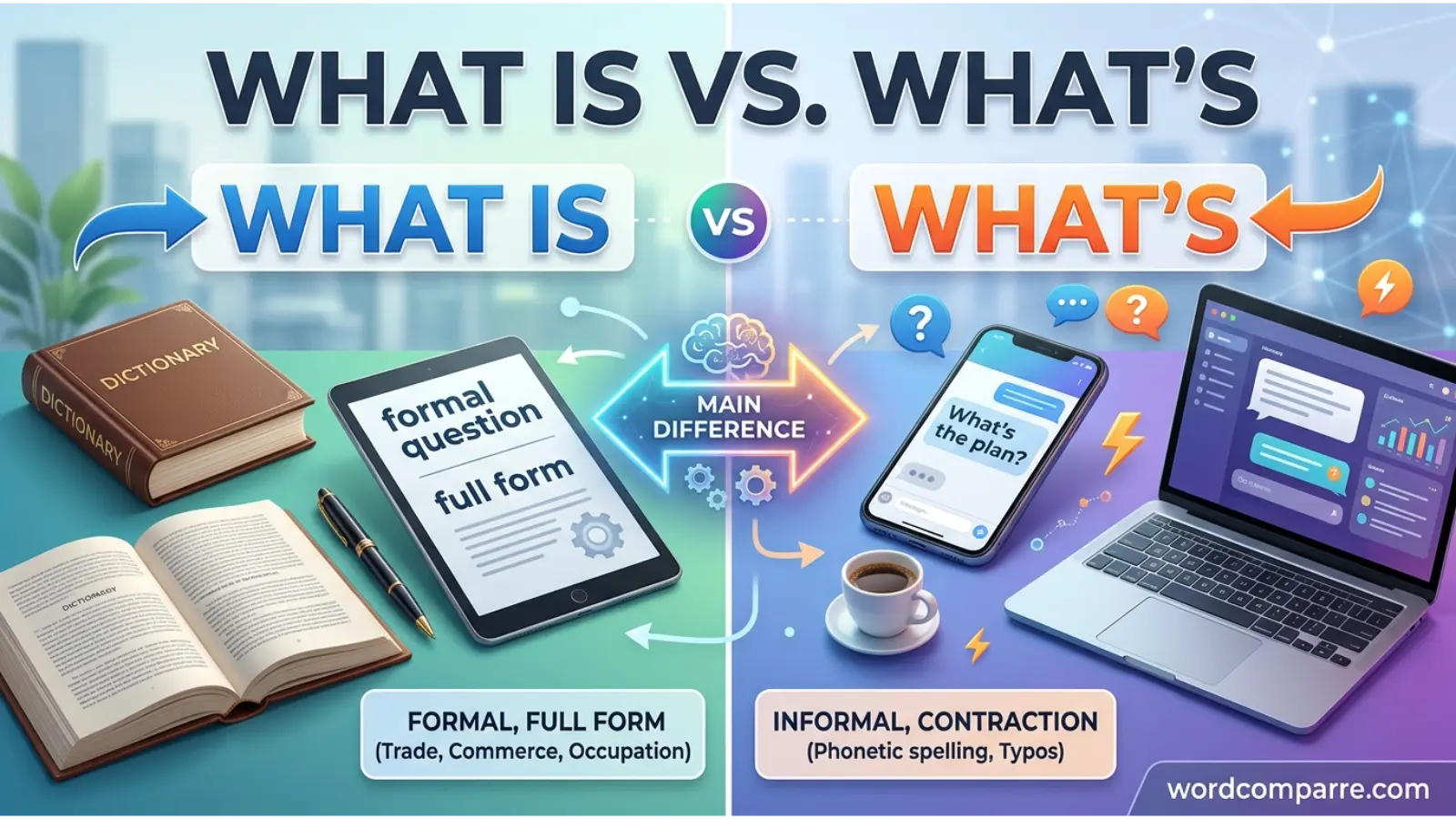
The main difference between What Is vs. What’s is the grammatical form of each expression. “What is” contains two separate words, whereas “what’s” is a contraction that combines them into one written word.
The word “what” is commonly used to ask questions or request information. The word “is” is a form of the verb “to be.” Together, they help ask about people, objects, situations, definitions, and conditions.
“What’s” is the shortened form of “what is” in sentences where that expansion makes grammatical sense. The apostrophe indicates that letters have been omitted.
Consider these examples:
- What is your name?
- What’s your name?
- What is the problem?
- What’s the problem?
- What is your favorite subject?
- What’s your favorite subject?
Each pair communicates essentially the same question. The contracted form is shorter, but the full form is equally correct.
Neither expression is universally better than the other. Your decision should depend on the audience, the context, and the tone you want to create.
What Does What Is Mean?
“What is” is used to ask questions or introduce information about a person, object, situation, or idea. It commonly appears when someone wants to identify something, understand a definition, or learn about a particular condition.
For example:
- What is your favorite subject?
- What is the capital of England?
- What is the meaning of this word?
- What is happening outside?
- What is your biggest concern?
- What is the purpose of this meeting?
In these examples, “what is” introduces a question that requests specific information.
The expression can also appear in statements and indirect questions. For example, “I understand what is causing the problem” is a statement rather than a direct question. Similarly, “Please explain what is required” asks someone to provide information.
The complete form can be useful when you want your writing to sound explicit and carefully structured. Teachers, researchers, editors, and professional writers may choose it when explaining concepts or presenting information.
However, “what is” is not restricted to formal writing. It is also perfectly natural in everyday conversations.
What Does What’s Mean?
“What’s” is a standard English contraction that usually means “what is.” It combines the word “what” with the verb “is,” using an apostrophe to mark the omitted letters.
Here are some common examples:
- What’s your name?
- What’s the weather like?
- What’s your favorite book?
- What’s happening today?
- What’s the answer?
- What’s the matter?
- What’s your plan for tomorrow?
These sentences are shorter alternatives to “What is your name?”, “What is the weather like?”, and similar questions.
People frequently use “what’s” because contractions make spoken English sound relaxed and conversational. They are also common in personal messages, friendly emails, dialogue, and informal online content.
However, “what’s” does not always mean “what is.” In some sentences, it represents “what has.”
For example:
- What’s happened here? means “What has happened here?”
- What’s changed since yesterday? means “What has changed since yesterday?”
- What’s she done? means “What has she done?”
The surrounding words determine the correct meaning. Understanding this distinction is essential when learning What Is vs. What’s.
Grammar Rules for What Is vs. What’s
Knowing a few simple grammar rules can help you choose the appropriate expression in different sentences.
Rule 1: Use What Is in Direct Questions
“What is” commonly introduces direct questions about a person, object, situation, or idea.
Examples:
- What is your address?
- What is the correct answer?
- What is the purpose of this meeting?
- What is your favorite type of music?
These questions request information about a subject or situation.
Rule 2: Use What’s as a Contraction of What Is
When the sentence allows “what is,” you can often replace it with “what’s” without changing the basic meaning.
Examples:
- What is your plan? → What’s your plan?
- What is the problem? → What’s the problem?
- What is your opinion? → What’s your opinion?
- What is going on? → What’s going on?
Both versions are grammatically correct. The contracted version generally creates a more conversational tone.
Rule 3: Recognize When What’s Means What Has
“What’s” can represent “what has” when the sentence requires the auxiliary verb “has.”
Examples:
- What’s happened to the computer?
- What’s changed since last week?
- What’s she done?
- What’s he been working on?
The expanded versions are “What has happened to the computer?”, “What has changed since last week?”, “What has she done?”, and “What has he been working on?”
This rule shows why you must consider the complete sentence rather than interpreting a contraction in isolation.
Rule 4: Maintain Correct Word Order in Indirect Questions
Direct questions and indirect questions sometimes follow different word orders.
Direct question: What is the problem?
Indirect question: Can you tell me what the problem is?
Another example:
Direct question: What is happening?
Indirect question: I wonder what is happening.
You can also write, “I wonder what’s happening.” The contraction does not change the normal word order of the indirect question.
Rule 5: Use the Apostrophe Correctly
The standard spelling is “what’s,” with an apostrophe between “what” and “s.”
Incorrect: Whats your name?
Correct: What’s your name?
The apostrophe is an essential part of the contraction. Without it, “whats” is not the standard spelling when you intend to write this expression.
What Is vs. What’s: Sentence Structure and Examples
Understanding What Is vs. What’s becomes easier when you see both forms used in different sentence patterns.
Asking About a Person or Object
- What is that?
- What’s that?
- What is your job?
- What’s your job?
Both forms ask for information. The contracted form is especially common in everyday conversation.
Asking for a Definition
- What is democracy?
- What’s democracy?
- What is the meaning of this phrase?
- What’s the meaning of this phrase?
The full form may sound more deliberate in an educational explanation, while the contraction can sound more conversational.
Asking About a Situation
- What is happening here?
- What’s happening here?
- What is causing the noise?
- What’s causing the noise?
Both forms are natural and grammatically acceptable.
Using an Indirect Question
- I know what is wrong.
- I know what’s wrong.
- Please explain what is required.
- Please explain what’s required.
These examples demonstrate that both forms can appear within a larger statement.
Asking About Recent Changes
- What has changed recently?
- What’s changed recently?
- What has happened to the package?
- What’s happened to the package?
In these examples, “what’s” means “what has,” not “what is.”
What Is vs. What’s: Comparison Table
| Feature | What Is | What’s |
|---|---|---|
| Grammatical form | Complete form | Contraction |
| Number of written words | Two | One |
| Common meaning | What is | What is or what has |
| Formal writing | Often preferred | Depends on the style |
| Casual conversation | Correct | Very common |
| Text messages | Correct | Common |
| Academic writing | Generally suitable | Follow the relevant style guide |
| Apostrophe required | No | Yes |
| Meaning depends on context | Yes | Yes, especially when distinguishing is from has |
The most important difference is not correctness but usage. Both forms are correct when they fit the grammatical structure and meaning of the sentence.
Common Mistakes to Avoid
Although both expressions are easy to understand, several mistakes can cause confusion.
Mistake 1: Forgetting the Apostrophe
Incorrect: Whats the answer?
Correct: What’s the answer?
Always include the apostrophe when writing the contraction.
Mistake 2: Assuming What’s Always Means What Is
Incorrect interpretation: “What’s happened?” means “What is happened?”
Correct interpretation: “What’s happened?” means “What has happened?”
The second expansion is correct because “has happened” is the appropriate grammatical construction.
Mistake 3: Believing What Is Is Always More Correct
Some English learners believe that contractions are grammatically wrong. This is not true. “What’s your name?” is standard English and is widely used in everyday communication.
The full form may be preferable in certain formal contexts, but the contraction is not inherently incorrect.
Mistake 4: Using Incorrect Word Order in Indirect Questions
Incorrect: Can you explain what is the problem?
Correct: Can you explain what the problem is?
In a standard indirect question, the subject generally comes before the verb. Direct questions follow a different structure: “What is the problem?”
Mistake 5: Confusing Whats With What’s
“Whats” without an apostrophe is generally a spelling mistake when you intend to use the contraction.
Remember that the apostrophe is part of the standard spelling of “what’s.”
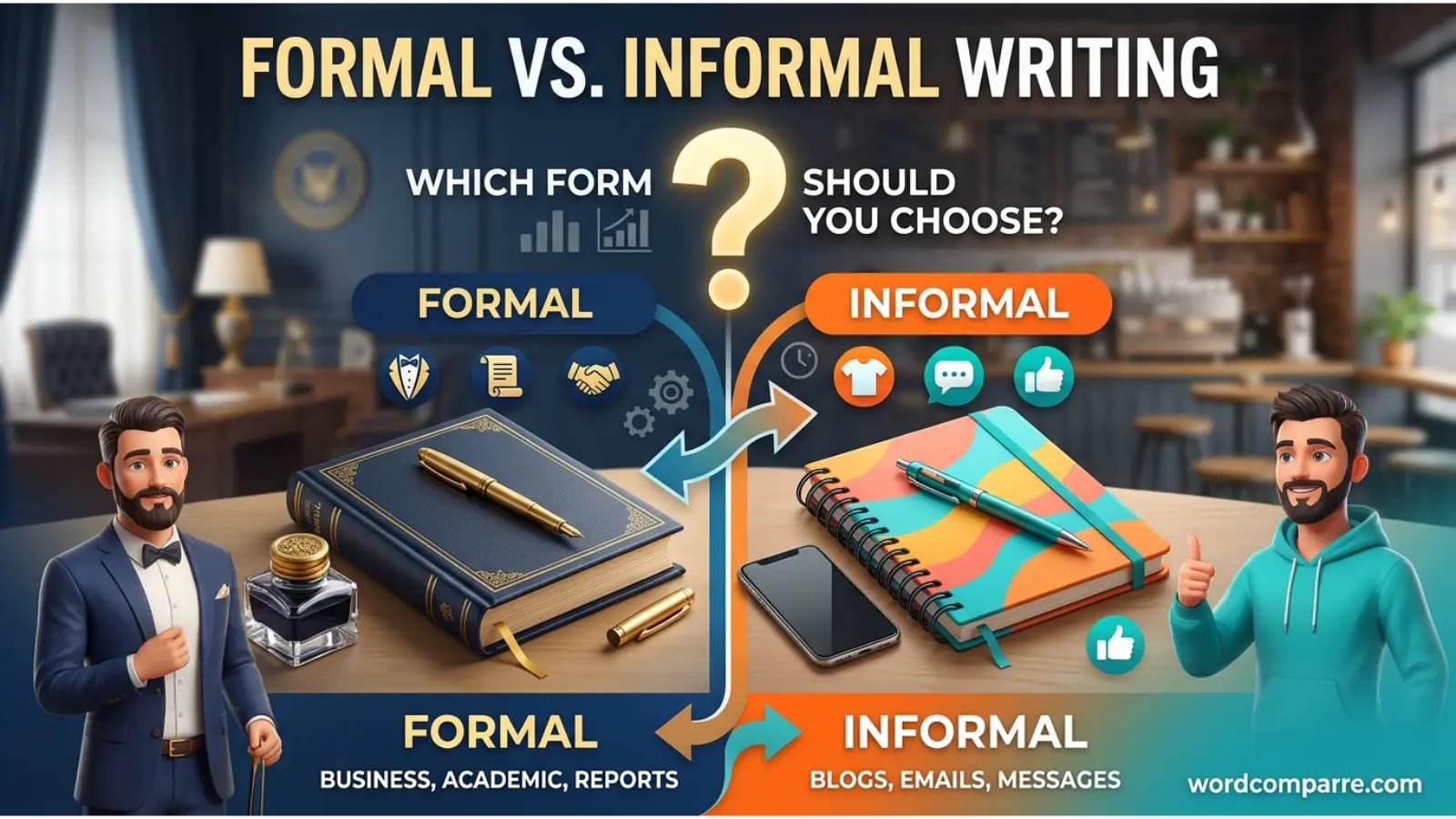
Formal vs. Informal Writing: Which Form Should You Choose?
The choice between “what is” and “what’s” often depends on the tone and purpose of your writing.
Formal Writing
The complete form is often a good choice in academic papers, formal reports, professional documents, and instructional materials.
Examples:
- What is the primary objective of this research?
- What is the relationship between these variables?
- What is the recommended procedure?
Using the full form can make your writing sound more explicit and formal. Nevertheless, contractions are acceptable in many modern professional and academic contexts, depending on the relevant style guide.
Informal Writing
“What’s” is especially common in everyday conversations, social media posts, personal messages, and casual emails.
Examples:
- What’s up?
- What’s for dinner?
- What’s your plan for tomorrow?
- What’s going on?
These expressions sound natural and are easy to understand.
Professional Emails
Both forms can work in professional emails. Your choice should reflect the recipient and the tone of your message.
More formal: “Could you please clarify what is required for the application?”
Conversational: “Could you clarify what’s required for the application?”
The first option sounds more formal, while the second is shorter and more conversational. Neither is automatically wrong.
Professional Usage: Choosing the Right Expression
Professional communication requires clarity, consistency, and an appropriate tone. Therefore, choosing between “what is” and “what’s” should involve more than simply counting words.
In a technical report, a complete expression may fit the document’s formal style. In a friendly business email, a contraction may make the message sound approachable without reducing professionalism.
For example:
Formal report: “What is the primary cause of the delay?”
Friendly workplace message: “What’s causing the delay?”
Both sentences request information, but the tone differs slightly.
Writers should also follow their organization’s editorial guidelines. Some organizations prefer avoiding contractions in formal documents, while others permit them when they improve readability.
The best approach is to remain consistent throughout the document and prioritize clarity over unnecessary formality.
Memory Tricks to Remember the Difference
Use these simple tricks to remember when to write “what is” and “what’s.”
Trick 1: Remember the Apostrophe
“What’s” contains an apostrophe because it is a contraction. If you write the shortened form, do not forget this punctuation mark.
Trick 2: Expand the Contraction
Whenever you are unsure about “what’s,” replace it with “what is” or “what has.” Choose the expansion that makes the sentence grammatically correct.
For example:
“What’s the problem?” becomes “What is the problem?”
“What’s happened?” becomes “What has happened?”
Trick 3: Think About Your Audience
If you are writing a formal report, consider using “what is.” If you are writing a casual message, “what’s” may sound more natural.
Trick 4: Focus on Meaning, Not Length
A shorter expression is not necessarily less correct. Both forms are useful, and each can communicate the same basic idea in the appropriate context.
Real-Life Conversations Using What Is and What’s
These short conversations demonstrate how both expressions can be used naturally.
Conversation 1: Meeting Someone
Alex: What’s your name?
Sam: My name is Sam.
Alex: What is your favorite subject?
Sam: My favorite subject is English.
Both expressions are correct. The first question sounds conversational, while the second uses the complete form.
Conversation 2: At Work
Manager: What is the main issue with this project?
Employee: The delivery schedule has changed.
Manager: What’s causing the delay?
Employee: We are waiting for final approval.
The conversation uses both forms naturally in a workplace setting.
Conversation 3: Talking About a Problem
Mia: What’s wrong with the computer?
Leo: I think the battery is dead.
Mia: What is the next step?
Leo: We should check the charger first.
Both expressions fit naturally into the conversation.
Conversation 4: Asking About Recent Changes
Ava: What’s changed since our last meeting?
Noah: The budget has increased.
Ava: What is the new total?
Noah: It is five thousand dollars.
In the first question, “what’s” means “what has.” In the second, “what is” introduces a question about the current total.
More Examples of What Is vs. What’s in Everyday English
The following examples provide additional practice.
- What is your favorite book? / What’s your favorite book?
- What is the time? / What’s the time?
- What is your phone number? / What’s your phone number?
- What is the purpose of this meeting? / What’s the purpose of this meeting?
- What is happening outside? / What’s happening outside?
- What is your biggest achievement? / What’s your biggest achievement?
- What is the next step? / What’s the next step?
- What has changed recently? / What’s changed recently?
- What has happened to the package? / What’s happened to the package?
- What is the best way to learn English? / What’s the best way to learn English?
In the first seven pairs, “what’s” means “what is.” In the final three pairs, “what’s” means “what has.”
These examples show why context matters when interpreting contractions.
Frequently Asked Questions About What Is vs. What’s
1. Is What Is or What’s Correct?
Both expressions are correct. “What is” is the complete form, while “what’s” is its contraction in many sentences. Choose the form that suits your sentence and intended tone.
2. Does What’s Always Mean What Is?
No. “What’s” can mean either “what is” or “what has.” For example, “What’s your name?” means “What is your name?” However, “What’s happened?” means “What has happened?”
3. Is What’s Too Informal for Professional Writing?
Not necessarily. Many professional writers use contractions when they fit the document’s tone. However, some academic institutions, organizations, and style guides prefer complete forms in formal documents.
4. Can I Use What’s in an Academic Essay?
Yes, when the relevant style guide permits contractions. If your teacher, university, or publisher requires formal wording, using “what is” may be the safer choice.
5. Why Does What’s Need an Apostrophe?
The apostrophe indicates omitted letters in the contraction. It is part of the standard spelling of “what’s,” so writing “whats” is generally incorrect when you intend the contraction.
6. Which Form Sounds More Natural in Conversation?
“What’s” is very common in everyday conversation because it is short and natural. However, “what is” is also used frequently, particularly when the speaker wants to emphasize a question or speak more deliberately.
7. Can What Is and What’s Be Used in the Same Paragraph?
Yes. You can use both forms in the same paragraph when they suit the context. In formal writing, maintaining a consistent tone is important.
8. What Is the Difference Between Whats and What’s?
“What’s” is the standard contraction of “what is” or “what has.” “Whats” without an apostrophe is generally incorrect when you intend to write the contraction.
9. Is What’s a Real English Word?
Yes. “What’s” is a standard English contraction used in speech and writing. It is a shortened grammatical form rather than a separate full form of “what is.”
10. How Can I Remember When to Use What Is and What’s?
Remember that “what is” is the complete form and “what’s” is the contraction. When uncertain, expand “what’s” into “what is” or “what has” and check which version makes sense in the sentence.
Conclusion:
Understanding What Is vs. What’s becomes simple once you recognize their grammatical roles. “What is” is the complete form, while “what’s” is a contraction that can mean either “what is” or “what has,” depending on the context. Both expressions are correct when used appropriately, and neither should automatically be considered better in every situation.
Use “what is” when you want a complete form that suits formal or carefully structured writing. Choose “what’s” when a shorter, conversational expression fits your message. Always include the apostrophe in “what’s,” check the meaning of the contraction, and maintain the correct word order in direct and indirect questions. By practicing these rules and reviewing the examples in this guide, you can avoid common mistakes and communicate more naturally and confidently in English.