Have you ever wondered whether to write prey or pray? These two words sound exactly alike, but they have completely different meanings. Choosing the correct word depends on what you want to express in your sentence.
In this guide, you will learn the difference between prey and pray through simple definitions, grammar rules, practical examples, common mistakes, and easy memory tricks. You can also use our copy button to quickly copy your favorite examples and sentences for learning or writing.

What Is the Difference Between Prey and Pray?
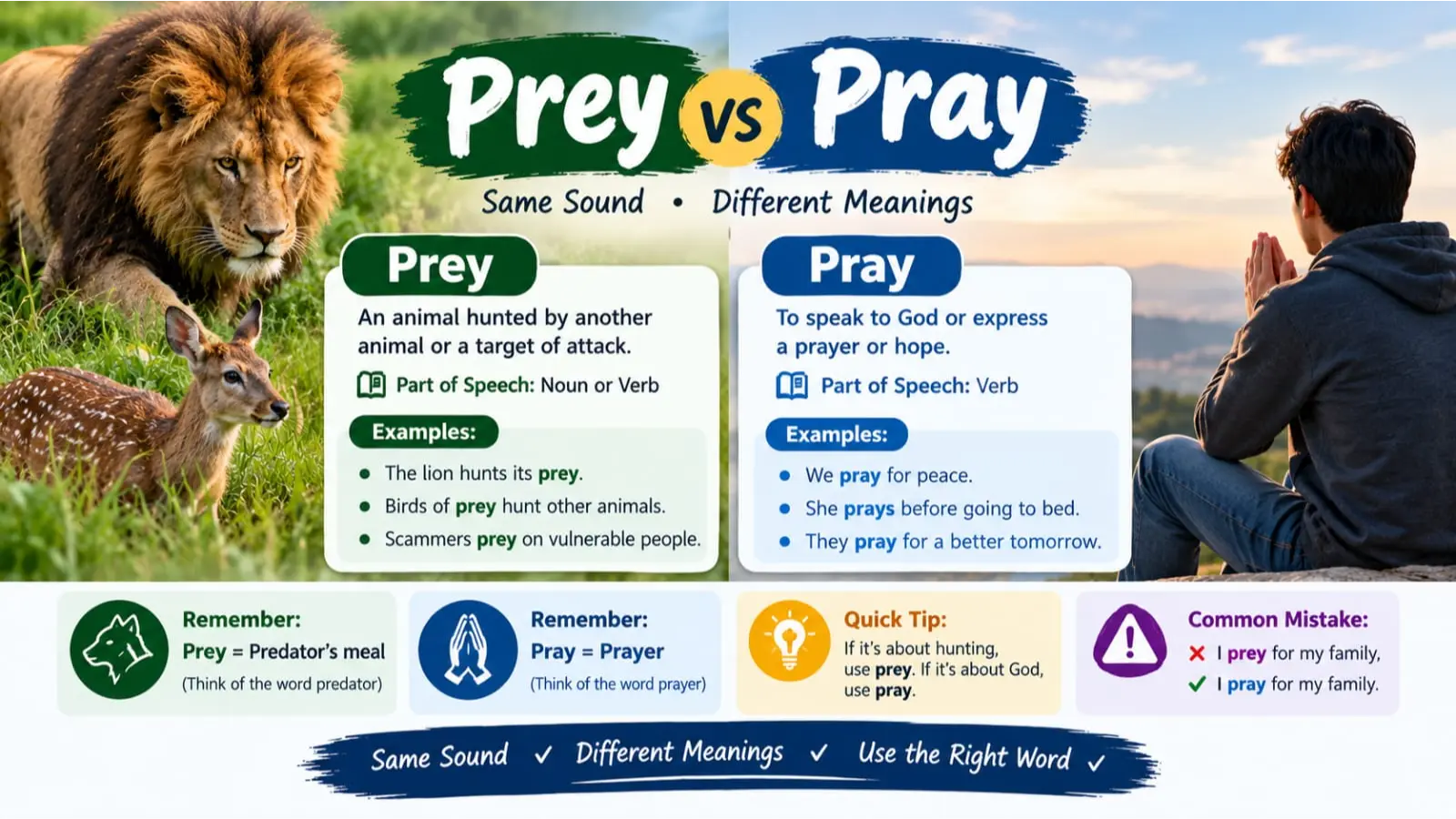
The main difference between prey and pray is their meaning and grammatical use. Prey usually refers to an animal hunted by another animal, while pray means to speak to God or express a religious hope.
Although both words have the same pronunciation, they cannot be used interchangeably.
| Word | Meaning | Part of Speech | Example |
|---|---|---|---|
| Prey | An animal hunted by another animal or a target of attack | Noun or verb | The lion hunts its prey. |
| Pray | To speak to God or express a prayer | Verb | We pray for peace. |
Remember: Use prey when discussing hunting or being targeted. Use pray when discussing prayer or religious devotion.
What Does Prey Mean?
The word prey refers to an animal that another animal hunts and eats. It can also describe a person or group targeted for harm, exploitation, or deception.
Prey can function as both a noun and a verb.
Prey as a Noun
As a noun, prey describes an animal being hunted or a person who becomes a target.
Examples:
- The rabbit became prey for the hungry fox.
- Eagles search for prey from high above.
- Small fish often serve as prey for larger fish.
- The predator caught its prey near the river.
- Scammers sometimes target vulnerable people as prey.
Prey as a Verb
As a verb, prey commonly appears with the preposition on. The phrase prey on means to hunt, exploit, or take advantage of someone or something.
Examples:
- Wolves prey on smaller animals.
- Certain offenders exploit older people
- Owls prey on mice during the night.
- Fraudsters prey on people’s fears.
- Certain insects prey on other insects.
What Does Pray Mean?
The word pray means to speak to God, offer a prayer, or express a religious request. It can also communicate a sincere hope for a particular outcome.
Pray is a verb, so it describes an action.
Examples:
- We pray for our family’s safety.
- She likes to pray before going to bed.
- They pray together every morning.
- I pray that everything goes well.
- People gathered at the place of worship to pray.
How to Use Pray in Everyday English
You can use pray when discussing religious practices, personal hopes, or requests for a positive outcome.
Examples:
- I pray for your success.
- Let us pray for peace around the world.
- He prayed for strength during a difficult time.
- We are praying that she recovers soon.
- She stopped to pray before the journey.
In everyday conversation, hope is often more natural when no religious meaning is intended. However, pray can also express a sincere wish for something to happen.
Grammar Rules for Prey vs. Pray
Understanding the grammar of these words makes it easier to choose the correct spelling.
Rules for Using Prey
Prey can be used as a noun or a verb.
As a noun:
- The snake caught its prey.
- Birds of prey hunt other animals.
As a verb:
- The hawk preys on small birds.
- Criminals prey on vulnerable people.
The verb prey changes to preys with a third-person singular subject and preying in the continuous form.
Rules for Using Pray
Pray is a verb that changes according to tense and subject.
- Present: I pray every day.
- Third-person singular: She prays every morning.
- Past: They prayed for good news.
- Present continuous: He is praying quietly.
- Future: We will pray for everyone.
Both verbs follow regular spelling patterns when forming their past tense and continuous forms.
Prey vs. Pray: Sentence Structure
Sentence structure can help you identify which word fits your intended meaning.
Common Structures With Prey
Subject + hunts + its prey
Example: The lion hunts its prey.
Subject + preys on + object
Example: The owl preys on small rodents.
The second structure is especially useful when describing hunting or exploitation.
Common Structures With Pray
Subject + pray + for + noun
Example: We pray for our children.
Subject + pray + that + clause
Example: I pray that you succeed.
Subject + pray + to + God
Example: She prays to God every night.
These patterns help you use the words naturally in written and spoken English.
Prey vs. Pray: Comparison Examples
The easiest way to understand these homophones is to compare them in similar sentences.
- The eagle searched for its prey. The family stopped to pray.
- The fox caught its prey. The villagers gathered to pray for rain.
- Small fish become prey for sharks. The sailors pray for safe passage.
- The owl hunts its prey at night. The child likes to pray before sleeping.
- The hunter watched his prey carefully. The community came together to pray for peace.
- Many predators depend on prey for food. Many people pray during difficult times.
- The snake approached its prey slowly. She will pray for her friend’s recovery.
- The lion searched for prey across the grassland. The family will pray for a better future.
- Predators chase their prey over long distances. The congregation will pray during the service.
- The animal escaped before becoming prey. I pray that you find happiness.
These examples show that context, rather than pronunciation, determines the correct spelling.
Common Mistakes When Using Prey and Pray
Because these words sound identical, writers sometimes confuse them. Here are common errors and their corrections.
| Incorrect Sentence | Correct Sentence | Explanation |
|---|---|---|
| I prey for my family. | I pray for my family. | Prayer requires pray. |
| The lion caught its pray. | The lion caught its prey. | The hunted animal is prey. |
| She wants to prey before dinner. | She wants to pray before dinner. | Speaking to God is pray. |
| The eagle hunts its pray. | The eagle hunts its prey. | An animal being hunted is prey. |
| They prey for peace. | They pray for peace. | Asking for peace through prayer uses pray. |
How to Avoid These Errors
Before choosing a word, ask yourself what the sentence means.
- If it describes hunting, a target, or exploitation, use prey.
- If it describes prayer, speaking to God, or a religious request, use pray.
- If you are unsure, replace the word with a simple synonym and check whether the sentence still makes sense.
Professional Usage of Prey and Pray
Both words are appropriate in professional writing, but they belong to different contexts.
Prey in Professional Writing
Prey commonly appears in scientific, wildlife, ecological, legal, and social discussions.
Examples:
- Researchers observed the predator pursuing its prey.
- The study examined changes in prey populations.
- Investigators warned that scammers prey on vulnerable consumers.
- The report explored how predators select their prey.
Pray in Professional Writing
Pray is suitable for religious writing, personal messages, speeches, and discussions involving faith.
Examples:
- The community gathered to pray for those affected by the disaster.
- The family asked friends to pray for their recovery.
- Members of the congregation pray together each week.
In formal business or academic writing, use pray only when its religious or intended meaning fits the subject. In scientific writing, prey is the appropriate word when discussing predator-prey relationships.
Formal vs. Informal Usage
Neither word is inherently informal. Both are standard English words used in appropriate contexts.
Prey
- Formal: The researchers studied the relationship between predators and prey.
- Informal: That little mouse became the cat’s prey.
- Figurative: Scammers prey on people who are desperate for money.
Pray
- Formal: The congregation gathered to pray for the affected families.
- Informal: I’ll pray for you.
- Personal: I pray that everything works out.
The correct choice depends on meaning, not on whether the situation is formal or informal.
Easy Memory Tricks for Prey vs. Pray
These simple tricks can help you remember the difference.
1. Remember the Animal Connection
Prey = Predator’s meal.
Both prey and predator contain the letters pre. This connection can remind you that prey is associated with hunting.
Example: The tiger searched for its prey.
2. Remember the Prayer Connection
Pray = Prayer.
Both words contain the letters pray. If the sentence is about religious devotion or asking God for help, choose pray.
Example: We pray for our loved ones.
3. Replace the Word
Try replacing the word with a related expression.
- If animal being hunted makes sense, use prey.
- If say a prayer makes sense, use pray.
4. Ask a Simple Question
Ask yourself: Is someone hunting, or is someone praying?
If an animal is hunting, the word is usually prey. If someone is speaking to God, the word is pray.
Real-Life Conversations Using Prey and Pray
Short conversations help you see how these words work naturally.
Conversation 1: At the Zoo
Ali: What is that lion looking for?
Sara: It is probably searching for its prey.
Ali: So prey means the animal it hunts?
Sara: Exactly!
Conversation 2: Before an Exam
Ahmed: I am nervous about my exam tomorrow.
Hamza: Just do your best. I’ll pray for your success.
Ahmed: Thank you. I hope everything goes well.
Conversation 3: Learning About Wildlife
Teacher: What do we call an animal hunted by another animal?
Student: Prey!
Teacher: Correct. And what do we call speaking to God?
Student: Pray!
Frequently Asked Questions
1. What Is the Main Difference Between Prey and Pray?
Prey refers to an animal being hunted or someone being targeted. Pray means to speak to God or offer a prayer. They sound the same but have different meanings.
2. Is Prey or Pray Correct?
Both words are correct English spellings. Use prey for hunting or exploitation and pray for prayer or religious requests.
3. Are Prey and Pray Homophones?
Yes. Prey and pray are homophones because they share the same pronunciation but have different meanings and spellings.
4. What Is the Past Tense of Prey and Pray?
The past tense of the verb prey is preyed. The past tense of pray is prayed.
Examples:
- The wolves preyed on the livestock.
- She prayed for her family.
5. Can Prey Be Used as a Verb?
Yes. Prey can be a noun or a verb. As a verb, it commonly appears in the phrase prey on, meaning to hunt or exploit someone or something.
Example: Some criminals prey on unsuspecting people.
6. Is Pray a Noun or a Verb?
Pray is a verb. Its related noun is prayer.
Example: They pray every day. They also say a prayer for their family.
7. What Does “Fall Prey To” Mean?
It means to become a victim of something harmful, such as a scam, illness, or manipulation.
Example: He fell prey to an online scam.
8. Should I Write “Pray for Peace” or “Prey for Peace”?
Write pray for peace because it expresses a wish or request for peace through prayer.
9. What Is the Difference Between “Preyed” and “Prayed”?
Preyed is the past tense of prey, while prayed is the past tense of pray.
Examples:
- The wolves preyed on deer.
- She prayed for her family.
10. How Can I Remember the Difference Between Prey and Pray?
Remember that pray is related to prayer, while prey is related to predators and animals being hunted.
Conclusion
Understanding prey vs. pray is simple once you remember their different meanings. Both words are pronounced the same, but they are used in different situations.
Use prey when talking about animals being hunted, victims, or people being exploited. Use pray when talking about religious devotion, speaking to God, or sincerely hoping for something.
For an easy memory trick, connect pray with prayer and prey with predators. These simple associations can help you choose the correct word whenever you write.