Bareable or bearable is a common spelling question because both words look almost identical, yet only one is recognized as standard English in most situations. If you’ve seen bareable online or typed it yourself, you’re not alone. Many English learners and native speakers accidentally replace bear with bare because they sound the same.
This guide explains which spelling is correct, why the confusion happens, what major dictionaries recommend, and when each word should be used. You’ll also find practical examples, common mistakes, and an easy memory trick to help you remember the correct spelling every time.
Quick Answer
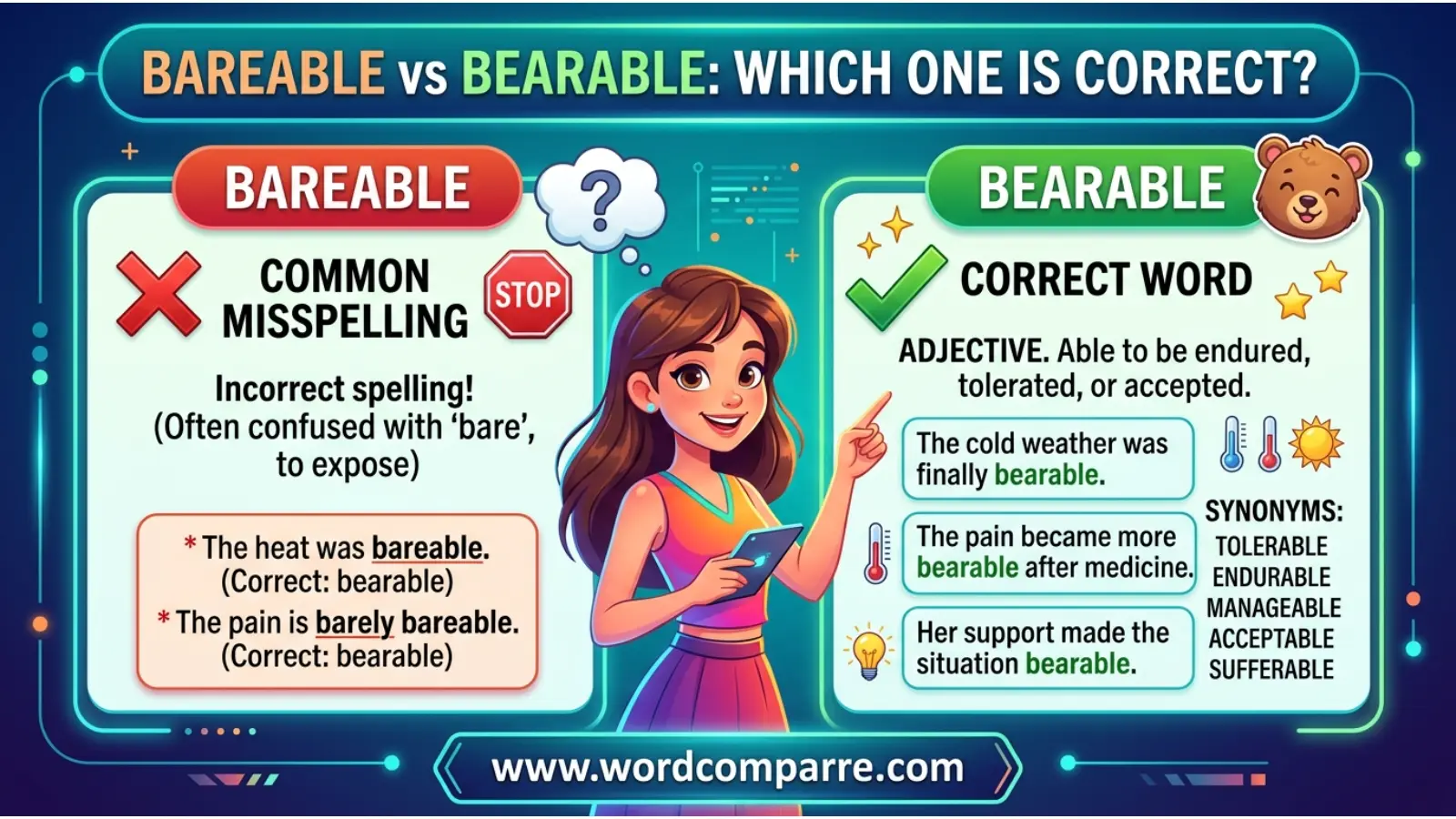
The correct spelling is bearable.
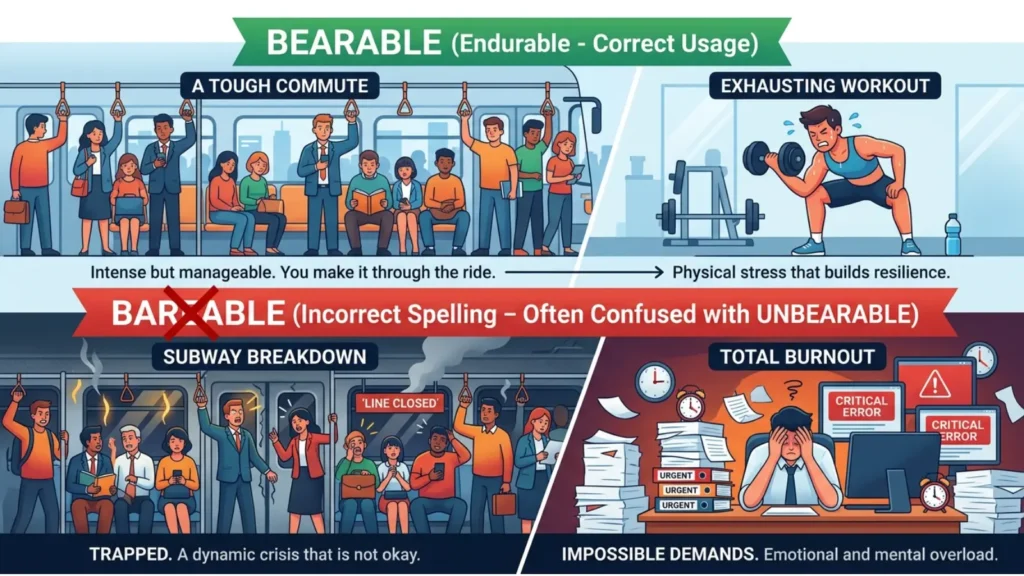
Bearable means something is tolerable, manageable, or not too difficult to endure.
Bareable is generally considered a misspelling and is not accepted as a standard English word in major dictionaries.
Meaning of Both Spellings
Bearable
Bearable is an adjective that describes something you can endure or tolerate without too much difficulty.
Examples:
- The summer heat became bearable after sunset.
- The pain was uncomfortable but still bearable.
- Waiting another hour was bearable.
Common meanings include:
- Tolerable
- Endurable
- Manageable
- Not unbearable
Bareable
Bareable does not appear as a standard English word in major dictionaries. It is almost always a spelling mistake for bearable.
Some writers accidentally use bareable because they confuse it with the word bare, which means uncovered or exposed.
Example of the mistake:
❌ The workload is finally bareable.
Correct version:
✅ The workload is finally bearable.
Comparison Table
| Feature | Bearable | Bareable |
|---|---|---|
| Standard English word | Yes | No |
| Found in major dictionaries | Yes | No |
| Correct spelling | Yes | No |
| Meaning | Able to be tolerated or endured | Usually a misspelling |
| Recommended in professional writing | Yes | No |
| Suitable for school and business writing | Yes | No |
Origin
The word bearable comes from the verb bear, meaning to carry, endure, tolerate, or withstand. The suffix -able means “capable of.”
Together, bearable literally means capable of being endured.
The word bare has a completely different meaning. It refers to something uncovered, exposed, or without covering. Because bare and bear sound exactly alike, people sometimes spell bearable incorrectly as bareable.
Why the Confusion Exists
There are several reasons why people confuse these spellings.
Bear and bare are homophones. They have the same pronunciation but different meanings and spellings.
Spell checkers may not always catch typing mistakes if the sentence is incomplete.
Many people learn words by hearing them rather than seeing them written.
Fast typing on phones and computers increases spelling errors.
Online posts and social media sometimes spread incorrect spellings, making them appear more common than they actually are.
Dictionary Recommendations
Major English dictionaries recognize bearable as the correct spelling.
It is listed with meanings related to enduring or tolerating something.
Bareable is not included as a standard English word in respected dictionaries and style guides.
For academic writing, business communication, journalism, and professional documents, always use bearable.
Real Life Examples
Correct examples:
- The weather became bearable after the rain.
- Her headache was painful but bearable.
- The traffic delay was bearable because we left early.
- Living expenses are still bearable in this town.
- The criticism was harsh but bearable.
Incorrect examples:
❌ The weather is bareable today.
✅ The weather is bearable today.
❌ This pain is barely bareable.
✅ This pain is barely bearable.
❌ The noise became more bareable.
✅ The noise became more bearable.
Common Mistakes
Many writers accidentally replace bear with bare because they sound alike.
Another mistake is assuming every word ending in -able can be built from a similar-looking root word. In this case, the correct root is bear, not bare.
Some people also believe bareable is an alternative British spelling, but it is not. Both British English and American English use bearable.
Memory Trick
Think of the word bear as meaning to endure.
If you can bear something, it is bearable.
Remember this simple sentence:
If you can bear it, it is bearable.
This association makes the correct spelling much easier to remember.
Professional Writing Recommendation
Always choose bearable in every type of professional writing.
Use it in:
- Academic assignments
- Business emails
- Reports
- Books
- Articles
- Job applications
- Website content
Avoid bareable, as readers, editors, and spell-checking tools will generally treat it as a spelling mistake.
Frequently Asked Questions
Is bareable a real English word?
No. Bareable is generally considered a misspelling of bearable and is not recognized in standard English dictionaries.
Which spelling is correct, bareable or bearable?
Bearable is the correct spelling.
Does bearable mean painful?
Not exactly. It means something is difficult or uncomfortable but still possible to tolerate.
Is bareable accepted in British English?
No. British English also uses bearable.
Why do people spell bearable as bareable?
Because bear and bare are pronounced the same, making them easy to confuse when writing.
Can I use bareable in formal writing?
No. Use bearable in all formal, academic, and professional writing.
Conclusion
When comparing bareable or bearable, the answer is straightforward. Bearable is the correct spelling recognized by English dictionaries and style guides. It describes something that can be tolerated or endured. Bareable is simply a common spelling mistake caused by the similar pronunciation of bear and bare. Choosing bearable will ensure your writing is accurate, professional, and understood by readers everywhere.

Alex Wordsmith is a comparison research writer and content specialist at WordComparre.com. He focuses on analyzing word meanings, spelling variations, grammar distinctions, and language usage to help readers make informed writing choices. Through clear explanations and practical examples, Alex simplifies complex language topics for students, writers, and professionals. His goal is to make English learning easier, more accurate, and accessible for everyone.