
Choosing between supercede or supersede can be confusing because both spellings look reasonable and sound exactly the same. However, their acceptance in modern English dictionaries and professional writing is not identical. Understanding their spelling history can help you avoid mistakes in everyday communication, academic assignments, and business documents.
The word generally means to replace something older, outdated, or no longer useful with something newer or more effective. Although many writers mistakenly use supercede, supersede remains the dominant spelling in standard English. This guide explains their meanings, origins, dictionary recommendations, and practical examples so you can confidently choose the appropriate form.
Quick Answer: Supercede or Supersede?
Supersede is the preferred spelling in standard modern English. It means to replace something or someone, particularly when a newer option takes the place of an older one.
Supercede is a less common spelling variant that is traditionally treated as a misspelling. However, some dictionaries, including the American Heritage Dictionary, recognize it as an established variant.
For professional, academic, and general writing, choose supersede.
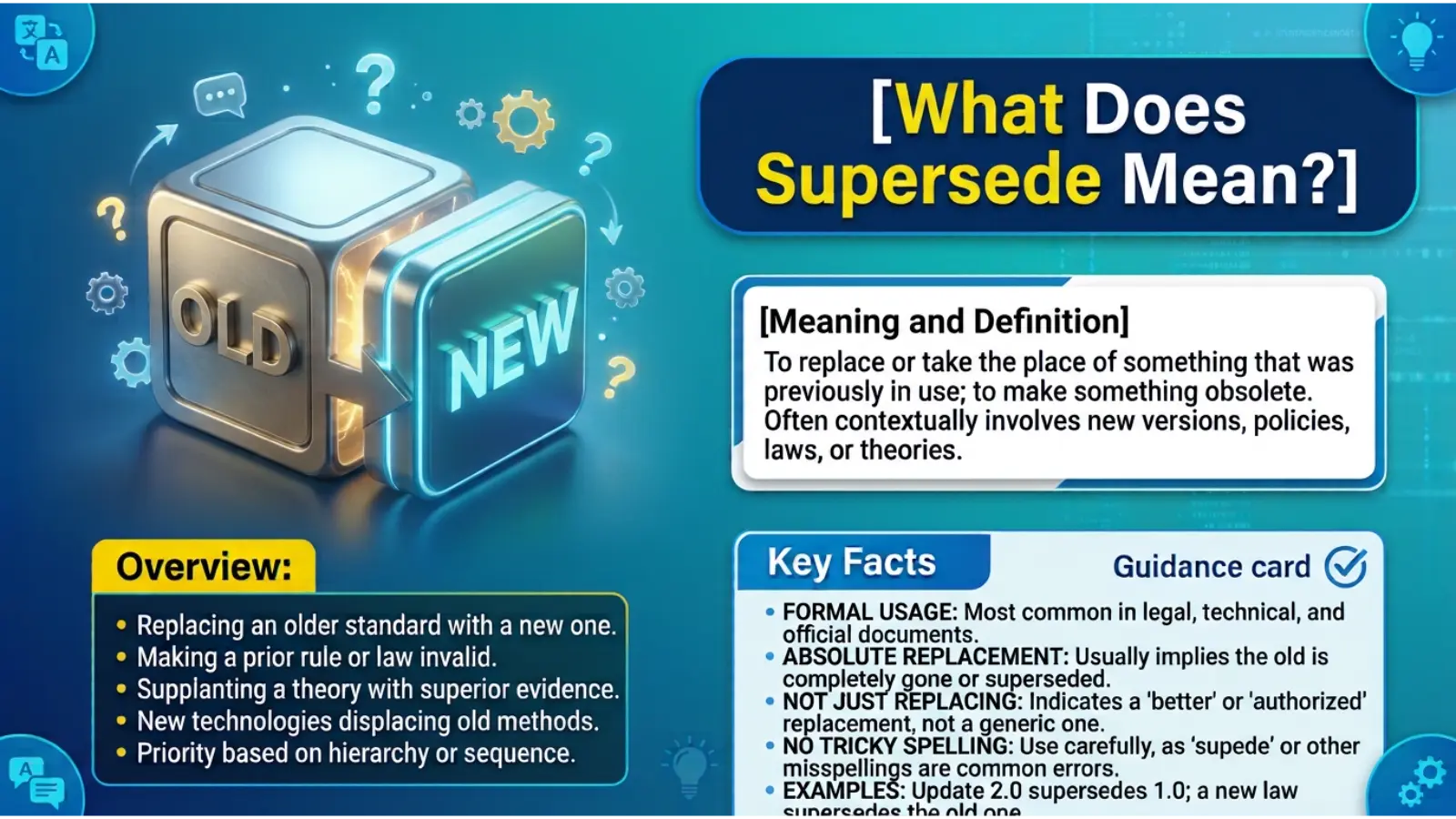
What Does Supersede Mean?
Supersede is a verb that means to replace something that is outdated, unnecessary, less effective, or no longer suitable. It can describe changes involving technology, laws, policies, products, systems, and people in professional positions.
For example, modern smartphones have superseded many traditional devices because they combine several functions in one product.
The word can also describe a new rule replacing an older regulation or a new employee taking over an existing position.
Examples:
- New technology may supersede older equipment.
- The updated agreement will supersede the previous contract.
- Digital records have superseded many traditional paper documents.
- A new manager will supersede the previous department head.
What Does Supercede Mean?
Supercede is a spelling variant of supersede. It is frequently used because people associate its spelling with other English words ending in -cede, such as precede, concede, and intercede.
Although some dictionaries recognize supercede as a variant, it is not the preferred spelling in most modern English writing.
For example:
- Incorrect for most standard writing: The new policy will supercede the old rules.
- Preferred: The new policy will supersede the old rules.
When writing for professional audiences, using supersede helps maintain consistency with major dictionary recommendations and established editorial practices.
Supercede vs. Supersede: Comparison Table
| Feature | Supersede | Supercede |
|---|---|---|
| Spelling status | Preferred standard spelling | Less common variant |
| Part of speech | Verb | Verb |
| Meaning | To replace something | Same intended meaning |
| Pronunciation | /ˌsuː.pɚˈsiːd/ | Same pronunciation |
| Dictionary recognition | Widely recognized | Recognized by some dictionaries |
| Modern usage | Dominant | Less common |
| Professional writing | Recommended | Generally avoid |
| Example | Technology supersedes older systems. | Technology supercedes older systems. |
The main difference is spelling preference rather than pronunciation or intended meaning. Both forms are associated with the same verb, but supersede is the safer choice for standard English.
Origin and History of Supersede
Understanding the history of supersede makes its unusual spelling easier to remember.
The word comes from the Latin verb supersedēre, which combines two elements:
- Super: Meaning above or over.
- Sedere: Meaning to sit.
The original expression carried the idea of sitting above something or refraining from an action. Over time, its meaning developed to include setting something aside, making it unnecessary, or replacing it.
The word entered English through French during the late Middle Ages. Its modern meaning of replacing something became established in the seventeenth century.
The spelling with an s remained dominant, even though the alternative spelling with a c appeared historically.
This Latin background explains why supersede has an unusual ending compared with many familiar English verbs.
Why Do People Confuse Supercede and Supersede?
There are several reasons writers frequently mix up these spellings.
Influence of Other English Words
Many English verbs contain the ending -cede. Examples include:
- Precede.
- Concede.
- Recede.
- Accede.
- Intercede.
Because supersede has a similar sound and structure, writers naturally assume it should follow the same spelling pattern.
However, supersede comes from a different Latin root, which explains its unusual spelling.
Identical Pronunciation
Both spellings are pronounced the same way. Therefore, listening to someone use the word does not help distinguish the correct written form.
Writers must remember the spelling rather than rely on pronunciation.
Historical Spelling Variations
Supercede has appeared in English for centuries. Its historical presence has helped the variant survive, even though supersede remains the dominant spelling in modern usage.
Typing and Autocorrect Habits
Some writers automatically type supercede because they associate the word with other familiar -cede verbs. Autocorrect may also fail to identify every spelling preference, depending on the dictionary installed in a device.
What Do Dictionaries Recommend?
Major English dictionaries provide useful guidance about these spellings.
Oxford English Dictionary and Oxford Learner’s Dictionary
Oxford identifies supersede as the standard headword and explains its meaning as taking the place of something considered old-fashioned or no longer the best available.
Its spelling guidance supports using supersede in standard English.
Cambridge Dictionary
Cambridge lists supersede as a verb meaning to replace something, especially something older or more old-fashioned.
It also provides examples involving technology, laws, and other replacements.
American Heritage Dictionary
The American Heritage Dictionary recognizes both supersede and supercede. It discusses the history and established usage of the alternative c spelling.
This is an important distinction: although supersede is the dominant spelling, supercede is not absent from every recognized dictionary.
Overall dictionary recommendation: Use supersede as your default spelling, particularly in academic, professional, and international English.
Real-Life Examples of Supersede
Seeing the preferred spelling in different situations makes its meaning easier to understand.
Technology and Innovation
- Modern laptops have superseded many older desktop systems.
- Digital cameras have superseded several traditional photography devices.
- New software updates supersede previous versions.
- Online communication has superseded some traditional methods of sending information.
Business and Workplace
- The new company policy will supersede the previous guidelines.
- A qualified replacement may supersede the current department manager.
- The updated contract supersedes the agreement signed last year.
- New procedures have superseded outdated workplace practices.
Education and Research
- Recent research has superseded several older scientific theories.
- The new textbook supersedes the previous edition.
- Updated information has superseded the original findings.
- Modern teaching methods have superseded some traditional classroom practices.
Law and Government
- The new legislation will supersede the existing regulation.
- A revised agreement supersedes the earlier contract.
- The updated rules supersede the previous requirements.
- Federal regulations may supersede conflicting state regulations when applicable.
Common Mistakes When Using Supersede
Writers sometimes make spelling and grammatical mistakes when using this verb. Here are some common examples and their corrections.
Mistake: Using Supercede in Formal Writing
Incorrect: The new software will supercede the old application.
Correct: The new software will supersede the old application.
Mistake: Adding an Unnecessary Letter
Incorrect: The new system will supersceed the existing process.
Correct: The new system will supersede the existing process.
Mistake: Using the Wrong Verb Form
Incorrect: The new policy has superseding the old policy.
Correct: The new policy has superseded the old policy.
Mistake: Confusing Supersede With Succeed
Supersede means to replace something, whereas succeed can mean to achieve a goal or take someone’s place.
Examples:
- The new manager will supersede the previous manager.
- She hopes to succeed in her career.
These verbs have different meanings and should not be used interchangeably.
Correct Verb Forms of Supersede
Supersede follows regular verb conjugation patterns.
| Verb Form | Correct Spelling |
|---|---|
| Base form | Supersede |
| Third-person singular | Supersedes |
| Past tense | Superseded |
| Past participle | Superseded |
| Present participle | Superseding |
Example sentences:
- This technology supersedes the older model.
- The new agreement superseded the previous contract.
- The outdated rules have been superseded.
- The company is superseding its old procedures.
Remember that the correct spelling remains consistent throughout these forms.
Memory Trick: How to Remember Supersede
A simple memory trick can help you remember the correct spelling.
Think of supersede as the unusual English word that ends in -sede.
Unlike familiar words such as precede, concede, and intercede, supersede uses an s rather than a c in its final syllable.
You can also remember this sentence:
“The newer system supersedes the older system.”
Notice the s in supersedes. Repeating this sentence can help you remember the spelling whenever you need it.
Another helpful tip is to save the word in your personal spelling list and review it when writing professional documents.
Which Spelling Should You Use in Professional Writing?
For most professional situations, supersede is the recommended spelling.
Whether you are preparing a business report, academic assignment, legal document, website article, email, or company policy, choosing the dominant spelling makes your writing consistent with widely followed editorial conventions.
Here are some practical recommendations:
- Academic writing: Use supersede to follow standard dictionary spelling.
- Business communication: Choose supersede in reports, proposals, and contracts.
- Website content: Use supersede consistently for correct spelling and reader clarity.
- Legal documents: Follow the terminology and spelling conventions of the relevant legal authority.
- Everyday communication: Use supersede to avoid unnecessary spelling confusion.
Although supercede appears in some dictionary records, supersede is the more widely preferred form. Therefore, writers should use supersede unless they have a specific reason to follow a publication’s accepted variant.
Frequently Asked Questions
Is Supercede or Supersede Correct?
Supersede is the preferred spelling in standard modern English. Supercede is a less common variant recognized by some dictionaries, but most writers should choose supersede.
Is Supercede Ever an Acceptable Spelling?
Yes. The American Heritage Dictionary recognizes supercede as an established spelling variant. However, it is less widely preferred than supersede in modern editorial practice.
Why Is Supersede Spelled With an S Instead of a C?
Supersede comes from the Latin word supersedēre, which contains the root sedere, meaning to sit. Its spelling reflects this historical origin rather than the -cede ending found in words such as precede and concede.
What Does Supersede Mean in Simple English?
Supersede means to replace something old, outdated, or less useful with something newer or better.
Is Superseded the Correct Past Tense?
Yes. Superseded is the correct past tense and past participle of supersede.
Example: The new regulations superseded the previous rules.
What Is the Difference Between Supersede and Succeed?
Supersede means to replace something or someone. Succeed generally means to achieve a goal or take the position of someone who came before.
Example: The new director will supersede the previous director, and the company hopes she will succeed.
How Do You Pronounce Supersede?
Supersede is pronounced /ˌsuː.pɚˈsiːd/ in American English. The final syllable sounds like the word seed.
Does Supercede Have a Different Meaning From Supersede?
No. When used as the spelling variant, supercede has the same intended meaning as supersede. The difference is primarily spelling preference and dictionary acceptance.
Conclusion
The choice between supercede or supersede becomes easier when you understand their history and modern usage. Supersede is the dominant and preferred spelling in standard English, while supercede remains a less common variant recognized by some dictionaries.
Although both forms have a historical presence, using supersede is the most reliable option for academic, professional, and everyday writing. Remember its unusual -sede ending, and you will be less likely to make this common spelling mistake.