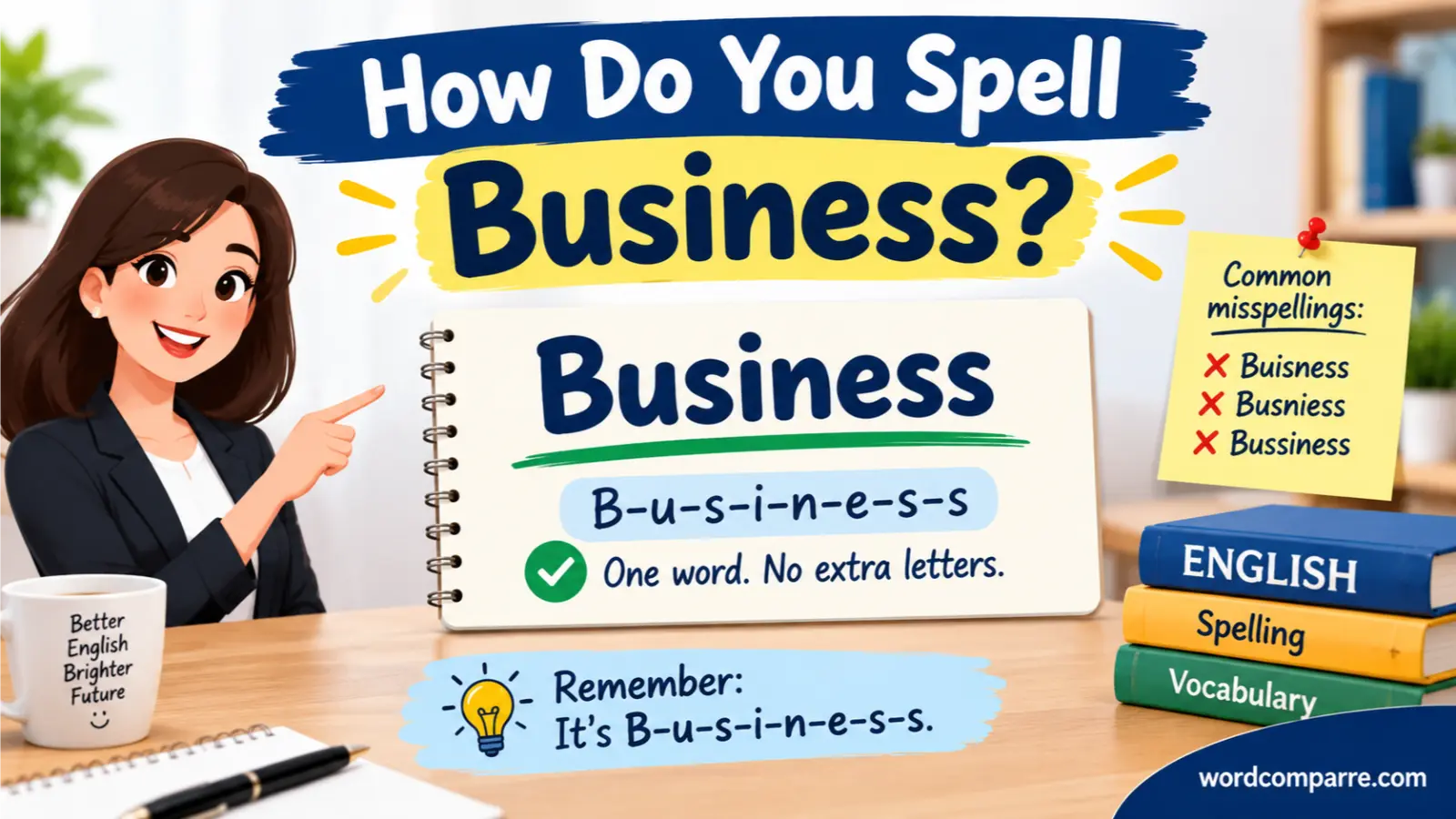
Have you ever wondered, “How do you spell business?” The correct spelling is business. This word is commonly used when discussing companies, trade, professional activities, or the work of providing goods and services. However, many people accidentally write it as “buisness” because the pronunciation can make the correct letter order difficult to remember.
Learning the correct spelling helps you write more clearly in emails, school assignments, business documents, website content, and everyday conversations. This guide explains the meaning of business, why spelling mistakes occur, and how to remember the correct form.
Quick Answer: How Do You Spell Business?
The correct spelling is business.
- Correct: Business
- Incorrect: Buisness
- Incorrect: Busines
- Incorrect: Buisines
Example: She wants to start her own business next year.
Remember that business contains the letters B-U-S-I-N-E-S-S. The correct form has one letter “s” after “bu” and two letters “s” at the end.
What Does Business Mean?
The word business has several related meanings. Its exact meaning depends on how it is used in a sentence.
Business as a Company or Organization
Business can refer to an organization that sells products or provides services.
Examples:
- My family owns a small business.
- The business opened a new office downtown.
- She manages a successful online business.
Business as Commercial Activity
Business can also describe activities involving buying, selling, or providing services.
Examples:
- He studied business at university.
- International business connects companies across countries.
- Good customer service can help a business grow.
Business as Work or Responsibility
In some contexts, business refers to a person’s work, responsibility, or concern.
Examples:
- She is busy with business matters.
- It is my business to make sure the project runs smoothly.
- Please focus on your own business.
The phrase “mind your own business” is an informal expression that means someone should avoid interfering in another person’s private affairs.
Business vs. Buisness: Which Spelling Is Correct?
The spelling business is correct in standard English. “Buisness” is a common spelling error and should not be used in formal or informal writing.
| Feature | Business | Buisness |
|---|---|---|
| Spelling status | Correct | Incorrect |
| Standard dictionary form | Yes | No |
| Suitable for professional writing | Yes | No |
| Meaning | Commercial activity, company, or work | No standard meaning |
| Example | She runs a business. | She runs a buisness. |
Always use business when writing about companies, commercial activities, or professional responsibilities.
Why Is Business Difficult to Spell?
The word business can be confusing because its pronunciation does not clearly reveal the order of every letter.
Pronunciation Does Not Match Every Letter
Business is commonly pronounced BIZ-nis or BIZ-nəs, depending on the accent. The first syllable sounds like “biz,” which may lead writers to rearrange the letters when spelling the word.
The Vowel Order Causes Confusion
Some writers mistakenly place “i” before “u,” producing “buisness.” However, the correct beginning is bus, followed by iness.
The Ending Contains Double S
Another common mistake is writing “busines” with only one final “s.” The standard spelling ends with ss, making the complete word business.
Origin and History of the Word Business
The word business developed from the older English word bisig, meaning busy or occupied. Over time, the related word busyness described the state of being busy, while business developed broader meanings involving occupations, duties, trade, and commercial activity.
This history helps explain why business and busyness look similar but have different meanings.
- Business refers to commercial activity, an organization, or a matter requiring attention.
- Busyness refers to the state of being busy or occupied.
For example, “Her business is growing” refers to her company or commercial activity. “The busyness of the office made it difficult to concentrate” describes a busy environment.
Dictionary Recommendations for Business
Standard English dictionaries recognize business as the correct spelling for the noun referring to commercial activity, a company, or a matter of concern.
When checking a spelling question, consult a reputable dictionary such as:
- Merriam-Webster, for American English definitions and usage.
- Cambridge Dictionary, for meanings, pronunciation, and example sentences.
- Oxford English Dictionary, for historical development and detailed word usage.
These references can help confirm a word’s standard spelling, pronunciation, and meaning. For everyday writing, use business rather than the misspelling buisness.
Correct Spelling of Business in Real-Life Examples
Seeing the word in different contexts can help you recognize and remember its correct spelling.
Business in Everyday Sentences
- My father runs a small business.
- Their business is located near the city center.
- Starting a business requires careful planning.
- She wants to expand her business internationally.
Enterprise in Professional Writing
- Our business provides digital marketing services.
- The company is reviewing its business strategy.
- Please send the business proposal before Friday.
- The meeting will discuss future business opportunities.
Business in Academic Writing
- Business management teaches students how organizations operate.
- Technology has changed the way people conduct business.
- The research examines the relationship between business growth and customer satisfaction.
Enterprise in Email Communication
- Thank you for your business.
- I am writing to discuss a business opportunity.
- Please find the business report attached.
- We appreciate your continued business and support.
These examples demonstrate that the spelling remains the same across everyday, professional, and academic contexts.
Common Business Spelling Mistakes
Writers often make predictable mistakes when spelling business. Recognizing these errors can improve accuracy.
Writing Buisness Instead of Business
Incorrect: She owns a buisness.
Correct: She owns a business.
The letters “u” and “i” are frequently reversed. Remember that the correct spelling begins with “bus.”
Leaving Out the Final S
Incorrect: He started a busines.
Correct: He started a business.
The word ends with two “s” letters. Check the ending before submitting your work.
Confusing Business With Busyness
Incorrect: The busyness sells products online.
Correct: The business sells products online.
Business refers to the company, while busyness describes the state of being busy.
Misspelling Business in Website Content
Incorrect spelling can make a website, product description, or company profile look unprofessional. Use a spellchecker and proofread important content before publishing it.
Easy Memory Trick to Spell Business Correctly
A simple memory trick can help you remember the correct spelling.
Break the word into two parts: BUS + INESS.
Think of it as:
BUS + I + NESS = BUSINESS
This is a memory aid rather than a formal linguistic breakdown. Its purpose is to remind you that “u” comes before “i” and that the word ends in “ness,” with a double “s” at the end.
You can also repeat this short sentence:
“My business is busy.”
Writing the word several times and using it in a sentence can help reinforce the correct letter order.
Business vs. Busyness: Understanding the Difference
Although business and busyness look similar, they are different words.
| Word | Meaning | Example |
|---|---|---|
| Business | A company, commercial activity, or matter | Her business serves local customers. |
| Busyness | The state of being busy | The busyness of the season increased stress. |
Use business when discussing a company, trade, professional activity, or responsibility. Use busyness when describing how occupied someone or something is.
For example:
- Correct: His business is doing well.
- Correct: Her busyness prevented her from attending the event.
Both words are correctly spelled, but they are not interchangeable.
Professional Writing Recommendations
Correct spelling is particularly important in professional communication because it supports clarity and credibility.
Check Business Documents
Review proposals, contracts, invoices, reports, and presentations before sharing them. A spelling checker can identify many mistakes, but manual proofreading is still useful.
Use the Correct Word in Emails
When writing to clients, colleagues, or customers, make sure business is spelled correctly. Simple errors can distract readers from your message.
Proofread Website Content
If you publish articles, service pages, or company descriptions, check spelling before making the content public. Consistent spelling contributes to a polished website.
Learn Frequently Confused Words
Practise words that are often misspelled, spell business, separate, necessary, receive, and definitely. Learning their correct forms can improve your overall writing accuracy.
Frequently Asked Questions
How do you spell business correctly?
The correct spelling is business. It contains eight letters: B, U, S, I, N, E, S, and S.
Is it spelled business or buisness?
Business is correct. Buisness is a common misspelling caused by reversing the “u” and “i.”
Why do people misspell business?
The pronunciation of business does not make the vowel order obvious. As a result, some writers place “i” before “u” or forget the double “s” at the end.
Is business a noun or a verb?
Business is a noun. The verb form is busy in the sense of occupying someone, while do business is a common phrase describing commercial activity.
What is the plural of business?
The plural is businesses.
Example: Several small businesses operate in the neighborhood.
What is the difference between business and busyness?
Business refers to a company, commercial activity, or responsibility. Busyness describes the state of being busy.
How can I remember the spelling of business?
Remember that the word starts with “bus” and ends with “ness.” Practising the spelling and writing example sentences can also help.
Conclusion
The correct spelling is business, not “buisness” or “busines.” The word refers to a company, commercial activity, work, or a matter of concern. Although its pronunciation can make the letter order confusing, remembering the correct sequence and practising it in sentences can help prevent mistakes.
Whether you are writing an email, preparing a school assignment, creating website content, or discussing a company, using business correctly makes your writing clearer and more professional. When in doubt, check a reputable dictionary and proofread your work before publishing it.