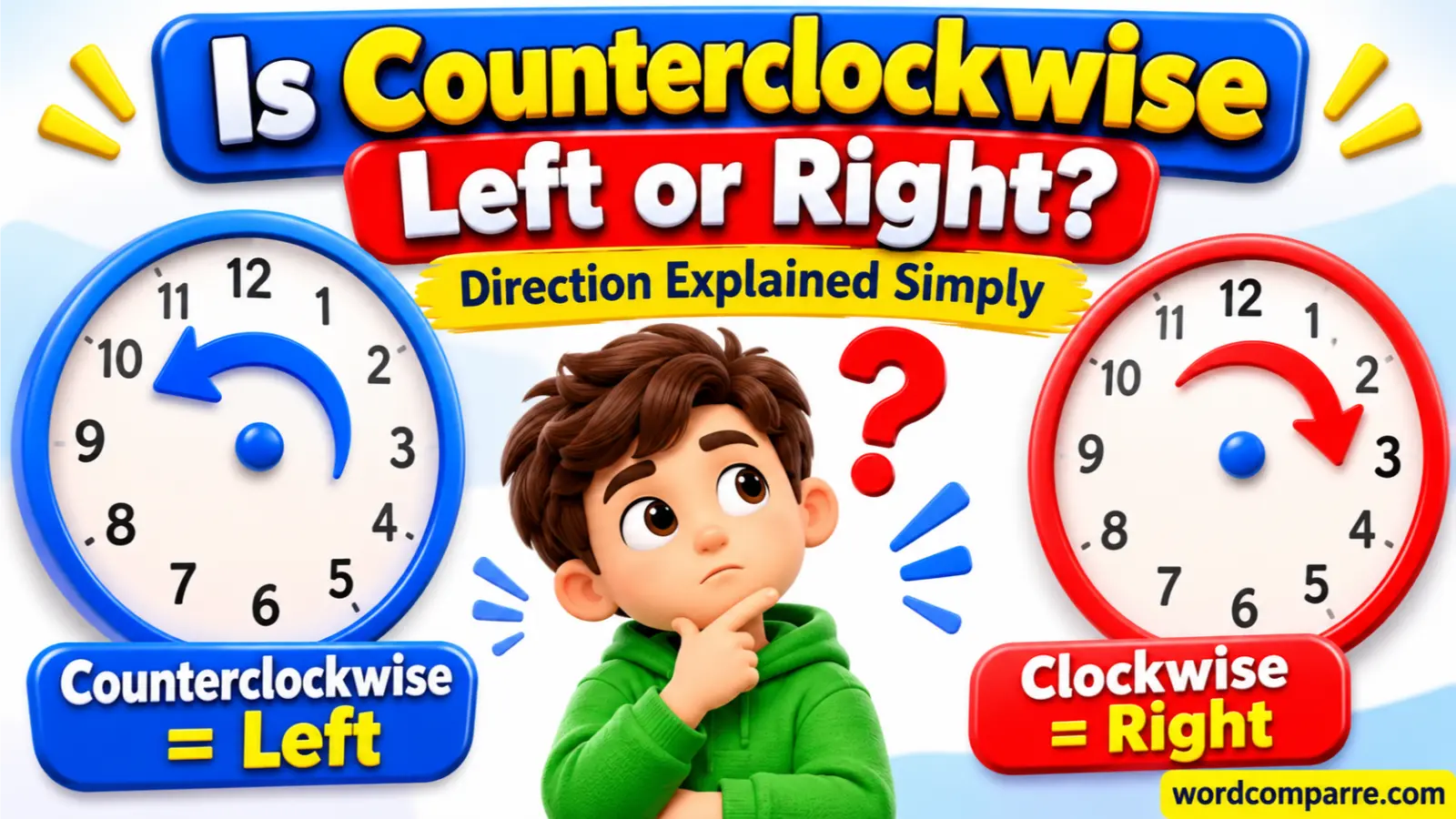
Have you ever wondered, is counterclockwise left or right when turning a wheel, opening a jar, or following directions? Counterclockwise means moving in the opposite direction of a clock’s hands. In simple terms, it usually describes a leftward movement around a central point. However, the exact appearance of this movement can depend on your viewing position and the object’s orientation.
Understanding clockwise and counterclockwise directions makes everyday activities easier. For example, you may encounter these terms when using tools, solving math problems, following maps, or operating machines. This guide explains what counterclockwise means, whether it indicates left or right, and how to recognize the difference through simple examples.
What Does Counterclockwise Mean?
Counterclockwise describes movement that follows the opposite direction of a traditional clock’s hands.
Imagine looking directly at an ordinary clock. Its hands move from 12 to 1, then 2, 3, and continue around the face. This movement is clockwise.
When something moves from 12 toward 11, then 10 and 9, it follows a counterclockwise direction.
In other words:
- Clockwise: Moves in the same direction as clock hands.
- Counterclockwise: Moves in the opposite direction of clock hands.
People commonly use counterclockwise to describe turning, rotating, spinning, or moving around a central point.

Is Counterclockwise Left or Right?
Counterclockwise generally means turning left when you look directly at the object or circular surface from the front.
For example, imagine a clock hanging on a wall. If you move your finger from the 12 position toward 11, you move counterclockwise. Your finger travels toward the left side of the clock.
However, counterclockwise does not always mean turning left from every viewing position. Your perspective matters, especially when you look at a rotating object from different sides.
Here is a simple way to remember:
- Counterclockwise = Opposite to clock hands.
- Clockwise = Same direction as clock hands.
- Counterclockwise appears leftward when viewed directly from the front of a clock.
Therefore, counterclockwise usually represents a leftward circular direction, but the viewing angle can change how the rotation appears.
Counterclockwise vs. Clockwise: What Is the Difference?
Counterclockwise and clockwise describe two opposite directions of rotation. Both terms help people understand how objects move around a fixed center.
| Feature | Counterclockwise | Clockwise |
|---|---|---|
| Direction | Opposite to clock hands | Same as clock hands |
| Movement on a clock | From 12 toward 11 | From 12 toward 1 |
| Common association | Leftward circular movement | Rightward circular movement |
| Rotation | Reverse clock direction | Normal clock direction |
| Common example | Unscrewing many jar lids | Tightening many jar lids |
For example, when you turn a traditional screw-top jar lid to the left, you usually move it counterclockwise. When you turn it to the right, you generally move it clockwise.
However, always follow the markings or instructions on a particular product because some mechanisms use different designs.

How to Identify Counterclockwise Movement
You do not need special equipment to identify counterclockwise movement. A simple clock face can help you understand it.
Follow these steps:
- Imagine a clock with 12 at the top.
- Place your finger at the 12 position.
- Move your finger toward 11.
- Continue toward 10, 9, and 8.
- Notice that your finger travels in the opposite direction of clock hands.
This is counterclockwise movement.
By comparison, moving your finger from 12 toward 1, 2, and 3 demonstrates clockwise movement.
Once you understand this simple pattern, you can recognize both directions in everyday situations.

Does Counterclockwise Always Mean Turning Left?
No. Counterclockwise does not always look like a left turn because your viewing position can change the apparent direction of rotation.
Imagine a spinning wheel. When you observe it from one side, it may appear to rotate counterclockwise. However, when you move to the opposite side and look at the same wheel, its rotation appears clockwise.
The physical rotation remains unchanged. Only your viewing perspective changes.
This distinction matters in science, engineering, mechanics, and mathematics. Therefore, counterclockwise describes rotation relative to a particular viewing direction rather than an absolute left or right direction.
Everyday Examples of Counterclockwise Movement
Counterclockwise movement appears in many common activities. Here are some easy examples that make the concept clearer.
1. Opening a Jar
Many traditional jar lids open when you turn them to the left. This movement follows a counterclockwise direction.
2. Using a Screwdriver
Many standard screws loosen when you turn them counterclockwise. This action helps separate or remove connected parts.
3. Drawing a Circle
When you draw a circle starting at the top and move toward the left, you create a counterclockwise path.
4. Following a Clock Diagram
Moving from 12 toward 11, 10, and 9 demonstrates counterclockwise movement.
5. Playing Certain Board Games
Some board games ask players to move around the board in a counterclockwise direction. Players follow the opposite path of clock hands.
These examples show how counterclockwise describes circular movement in everyday situations.
Common Mistakes When Understanding Counterclockwise
People sometimes confuse counterclockwise with clockwise because both words describe circular movement.
Here are a few common mistakes to avoid:
Mistake 1: Thinking counterclockwise always means left.
Counterclockwise usually appears leftward when you view a clock from the front. However, your viewing position can change its appearance.
Mistake 2: Confusing clockwise with counterclockwise.
Clockwise follows the movement of clock hands, while counterclockwise follows the opposite direction.
Mistake 3: Assuming every screw opens counterclockwise.
Many standard screws follow the left-to-loosen rule, but some products use reverse-threaded mechanisms.
Mistake 4: Ignoring the starting position.
To identify rotational direction correctly, look at the movement around the center rather than focusing on a single position.
Understanding these differences helps you follow instructions more accurately.
How to Remember Counterclockwise and Clockwise Easily
A simple memory trick can help you remember both directions without confusion.
- Clockwise: Follow the clock hands.
- Counterclockwise: Move against the clock hands.
You can also remember the letter C in counterclockwise as a reminder that it means the contrary or opposite direction of a clock’s normal movement.
Another useful trick is to imagine the numbers on a clock. Moving from 12 toward 1 means clockwise, while moving from 12 toward 11 means counterclockwise.
Practice this movement a few times, and you will quickly recognize the difference.
How People Use Counterclockwise in Everyday Conversations
People use counterclockwise in everyday conversations when they explain how to turn, rotate, or move something.
Here are some practical examples:
Conversation 1: Opening a Jar
Person A: How can I open this jar?
Person B: Turn the lid counterclockwise.
Conversation 2: Following Instructions
Person A: Which direction should I rotate this wheel?
Person B: Move it counterclockwise, toward the left side.
Conversation 3: Understanding a Diagram
Person A: Should I follow the numbers clockwise?
Person B: No, follow them counterclockwise, starting from 12 and moving toward 11.
These conversations show how people use the word naturally when explaining directions.
Frequently Asked Questions
1. Is counterclockwise left or right?
Counterclockwise generally represents a leftward circular direction when you look directly at a clock from the front. However, the apparent direction can change depending on your viewing position.
2. Does counterclockwise mean turning left?
Yes, in many everyday situations, counterclockwise means turning left around a central point. For example, turning a traditional jar lid left usually means moving it counterclockwise.
3. Is clockwise the same as turning right?
Clockwise generally corresponds to rightward circular movement when viewed from the front of a clock. It follows the same direction as clock hands.
4. What is the opposite of counterclockwise?
Clockwise is the opposite of counterclockwise. Clockwise follows the direction of clock hands, while counterclockwise moves against them.
5. How do I know if something is rotating counterclockwise?
Imagine a clock face and watch the direction of movement. If an object moves from the 12 position toward 11, 10, and 9, it rotates counterclockwise.
6. Is counterclockwise the same as anticlockwise?
Yes. Counterclockwise and anticlockwise have the same meaning. American English commonly uses counterclockwise, while British English commonly uses anticlockwise.
7. Why does counterclockwise sometimes look clockwise?
The viewing angle explains this difference. When you observe a rotating object from its opposite side, its apparent direction reverses even though its physical rotation remains unchanged.
Conclusion
So, is counterclockwise left or right? The simple answer is that counterclockwise generally means moving leftward around a central point when viewed directly from the front. It describes movement opposite to the direction of traditional clock hands.
However, your viewing position can affect how the rotation appears. Remember that clockwise follows the hands of a clock, while counterclockwise moves in the opposite direction. Once you understand this basic difference, identifying either direction becomes much easier in everyday activities, instructions, and practical situations.