Many English learners wonder, is or a conjunction, and how does it work in a sentence? The word “or” appears frequently in everyday conversations, questions, instructions, and written communication. However, understanding its grammatical function can help you use it more confidently.
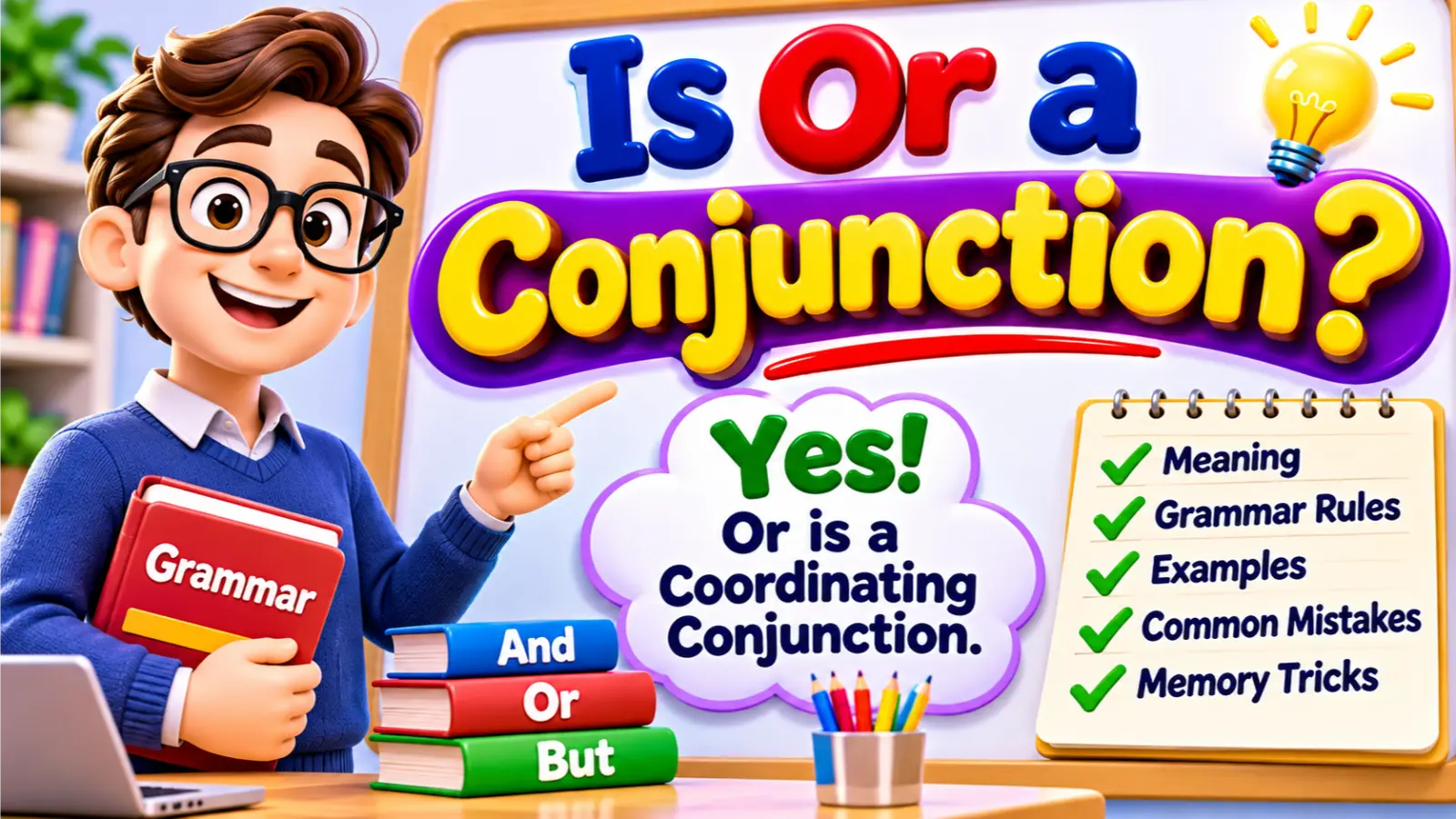
The simple answer is yes. “Or” is a coordinating conjunction that connects words, phrases, and independent clauses. It generally presents a choice, an alternative, or another possibility. For example, in the sentence “Would you like tea or coffee?” the word “or” connects two choices.
This guide explains why or is a conjunction, how it works in different sentence structures, and which grammar rules you should follow. You will also discover common mistakes, practical examples, and easy memory tricks.
Quick Answer: Is Or a Conjunction?
Yes, or is a coordinating conjunction in English grammar. It connects two or more words, phrases, or independent clauses that have a similar grammatical function.
Writers commonly use “or” to express alternatives, choices, and possibilities.
Examples:
- Would you like tea or coffee?
- You can walk or take the bus.
- We can watch a movie, or we can play a game.
In these examples, “or” connects different options and helps readers understand the relationship between them.
What Is a Conjunction?
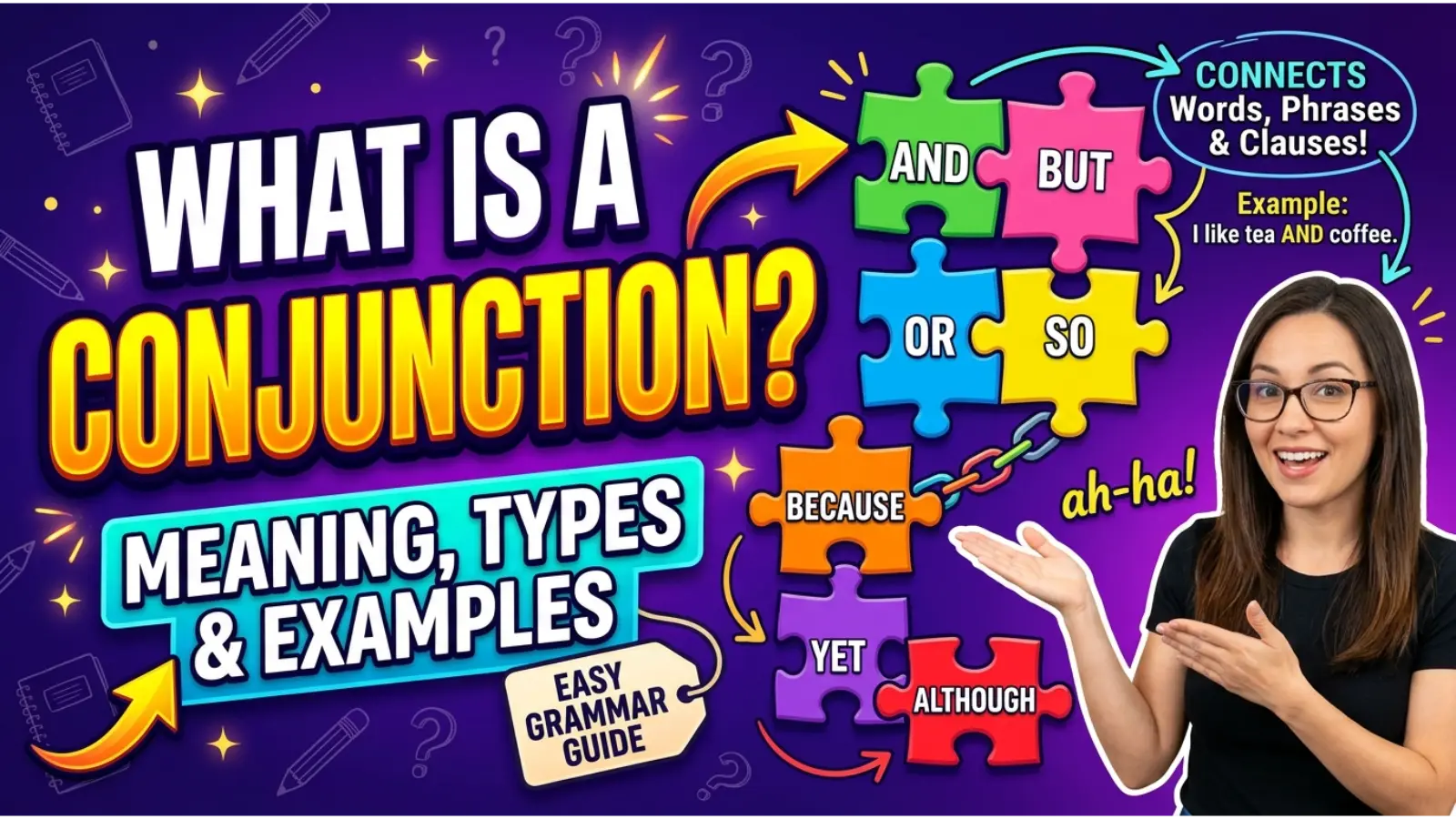
A conjunction is a word that connects different parts of a sentence. It can join individual words, phrases, or clauses to make sentences clearer and more meaningful.
English grammar recognizes three main types of conjunctions:
- Coordinating conjunctions: Connect grammatical elements with equal importance.
- Subordinating conjunctions: Introduce dependent clauses and connect them to independent clauses.
- Correlative conjunctions: Work in pairs to connect related sentence elements.
Some common coordinating conjunctions include:
- For
- And
- Nor
- But
- Or
- Yet
- So
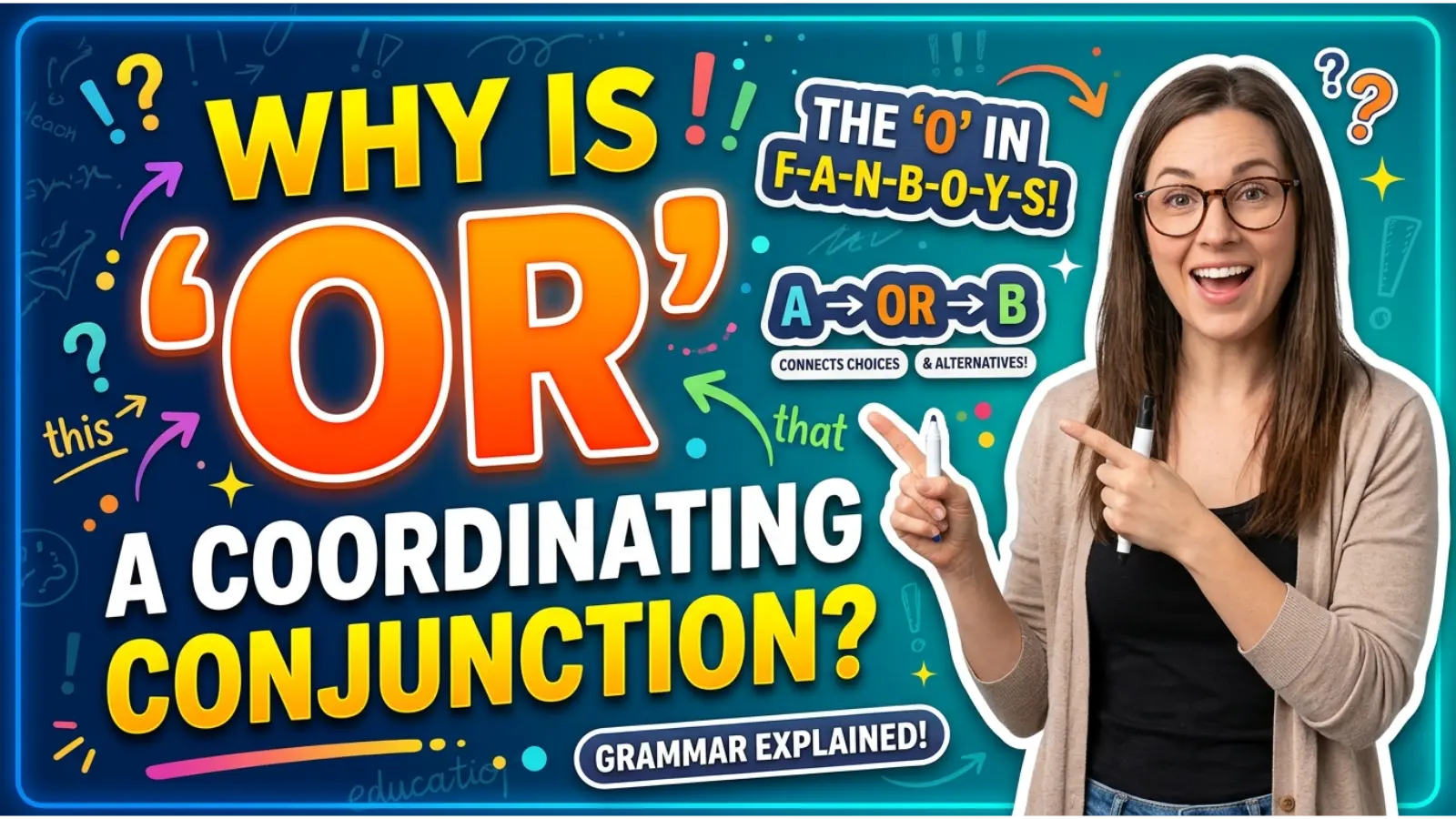
You can remember these seven words using the acronym FANBOYS.
The word “or” belongs to the coordinating conjunction category because it connects elements that have equal grammatical importance.
Why Is Or a Coordinating Conjunction?
The word “or” is a coordinating conjunction because it connects alternatives without making one connected element grammatically dependent on the other.
For example:
She wants tea or coffee.
In this sentence, “or” connects two nouns: tea and coffee. Both nouns function as possible objects of the verb “wants.”
Consider another example:
You can study now, or you can study tomorrow.
Here, “or” connects two independent clauses. Each clause expresses a complete thought.
Therefore, the word “or” performs the coordinating function by presenting different possibilities.
How Is Or Used in a Sentence?
The word “or” can connect different grammatical elements. Understanding these uses will help you construct correct sentences.
1. Connecting Words
Writers use “or” to connect individual words that offer alternatives.
Examples:
- Do you prefer apples or oranges?
- Is your favorite color blue or green?
- Should we order pizza or burgers?
- Would you like water or juice?
In these sentences, “or” connects nouns that represent different choices.
2. Connecting Phrases
The word “or” can also connect phrases that perform the same grammatical function.
Examples:
- We can meet in the morning or after lunch.
- She wants to travel by train or by airplane.
- You can complete the assignment at home or in the library.
Each example presents two alternative phrases.
3. Connecting Independent Clauses
An independent clause contains a subject and a verb and expresses a complete thought. The conjunction “or” can connect two independent clauses.
Examples:
- You can call me, or you can send an email.
- We can leave early, or we can wait until evening.
- Study regularly, or you may struggle with the examination.
When “or” connects two independent clauses, writers generally place a comma before it.
Grammar Rules for Using Or
Although “or” is a simple word, a few grammar rules can help you use it correctly.
Rule 1: Use Or to Present Alternatives
Use “or” when you want to offer different choices or possibilities.
Correct examples:
- Would you like coffee or tea?
- You can read a book or watch television.
- Should we travel today or tomorrow?
The conjunction helps readers understand that more than one option exists.
Rule 2: Use a Comma Between Independent Clauses
When “or” joins two independent clauses, place a comma before the conjunction.
Correct: I can cook dinner, or we can order food.
Incorrect: I can cook dinner or, we can order food.
However, you generally do not need a comma when “or” connects individual words or short phrases.
Example: I want tea or coffee.
Rule 3: Maintain Parallel Structure
When connecting alternatives, keep the grammatical structure balanced.
Correct: She enjoys reading books or watching movies.
Incorrect: She enjoys reading books or to watch movies.
The correct example connects two -ing forms, creating parallel structure.
Rule 4: Use Or in Questions
Writers frequently use “or” to present alternatives in questions.
Examples:
- Are you coming or staying home?
- Do you want rice or pasta?
- Is the meeting on Monday or Tuesday?
These questions allow the listener to choose between different possibilities.
Rule 5: Use Or in Either…Or Constructions
The expression “either…or” is a correlative conjunction. It emphasizes a choice between two alternatives.
Examples:
- Either Sarah or John will lead the meeting.
- You can either stay here or come with us.
- Either we leave now, or we miss the bus.
Remember that “either” and “or” work together as a pair.
Sentence Structure: Where Does Or Fit?
Understanding sentence structure makes it easier to recognize how “or” connects different grammatical elements.
| Sentence Structure | Example |
|---|---|
| Noun + or + noun | Would you like tea or coffee? |
| Verb + or + verb | You can walk or run. |
| Phrase + or + phrase | We can meet in the morning or after lunch. |
| Independent clause + or + independent clause | I can drive, or you can take the bus. |
| Either + alternative + or + alternative | Either Tom or Alex will help. |
As these examples demonstrate, “or” can connect different parts of a sentence while maintaining their grammatical relationship.
Or vs. Other Coordinating Conjunctions
The word “or” belongs to the FANBOYS group. However, it serves a different purpose from the other coordinating conjunctions.
| Conjunction | Main Purpose | Example |
|---|---|---|
| For | Gives a reason | I stayed home, for I felt tired. |
| And | Adds information | She bought apples and oranges. |
| Nor | Adds a negative alternative | He doesn’t drink coffee, nor does he drink tea. |
| But | Shows contrast | I wanted to go, but I was busy. |
| Or | Presents alternatives | Would you like tea or coffee? |
| Yet | Shows contrast | It was raining, yet we continued. |
| So | Shows a result | I was tired, so I went to bed. |
Although all seven words are coordinating conjunctions, each one expresses a different relationship between connected elements.
Common Mistakes When Using Or
English learners sometimes make mistakes when connecting alternatives. Here are several problems you should avoid.
Mistake 1: Using an Incorrect Comma
Do not place a comma between two words simply because “or” connects them.
Incorrect: Would you like tea, or coffee?
Correct: Would you like tea or coffee?
In ordinary sentences, a comma is unnecessary when “or” connects two short nouns.
Mistake 2: Forgetting the Comma Between Independent Clauses
When “or” connects two independent clauses, use a comma before the conjunction in standard writing.
Incorrect: You can study now or you can study later.
Correct: You can study now, or you can study later.
Mistake 3: Mixing Different Grammatical Structures
Maintain parallel structure when connecting alternatives.
Incorrect: He likes swimming or to ride a bicycle.
Correct: He likes swimming or riding a bicycle.
Both connected elements should follow the same grammatical pattern.
Mistake 4: Confusing Or With And
These conjunctions have different meanings.
- And: Adds information or combines items.
- Or: Presents alternatives or possibilities.
Example with And: I want tea and coffee.
Example with Or: I want tea or coffee.
The first sentence suggests both items, while the second presents a choice.
Mistake 5: Using Either and Or Incorrectly
When using the correlative construction “either…or,” make sure both alternatives appear in the sentence.
Incorrect: Either you can stay here you can leave.
Correct: Either you can stay here, or you can leave.
Subject-Verb Agreement With Or
Subject-verb agreement can become slightly tricky when “or” connects two subjects.
In a compound subject joined by “or,” the verb generally agrees with the subject closest to it. Grammar books often call this the proximity rule.
Examples:
- Either the teacher or the students are responsible.
- Either the students or the teacher is responsible.
- Neither my brother nor my sister is available.
Notice how the verb changes depending on the subject closest to it.
When the subjects differ greatly in number, rewriting the sentence can make it sound more natural.
Example:
Instead of writing “Either the manager or the employees are responsible,” you could write “The manager is responsible, or the employees are responsible.”
This approach can improve clarity in formal writing.
Formal vs. Informal Usage of Or
The conjunction “or” is appropriate in both formal and informal English. Its grammatical function remains the same in different writing styles.
Formal Writing
In professional documents, academic papers, and business communication, use “or” to present clear alternatives.
Examples:
- Applicants may submit their documents online or by post.
- The committee will approve the proposal or request further changes.
- Students must complete the assignment individually or in groups.
Informal Writing
In everyday conversations and casual messages, “or” helps people offer simple choices.
Examples:
- Do you want pizza or burgers?
- Should we watch a movie or play a game?
- Are you coming with us or staying home?
The main difference is the tone and context of the sentence, not the grammatical rules.
Real-Life Conversations Using Or
These short conversations demonstrate how people naturally use “or” in everyday communication.
Conversation 1: Choosing a Drink
Ali: Would you like tea or coffee?
Sara: I would prefer coffee, please.
Ali: Would you like sugar or milk?
Sara: Just a little milk.
Conversation 2: Making Weekend Plans
John: Should we visit the park or go shopping?
Mike: Let’s visit the park.
John: Should we go in the morning or afternoon?
Mike: The afternoon sounds better.
Conversation 3: Discussing Homework
Teacher: Will you complete the assignment today or tomorrow?
Student: I will finish it today.
Teacher: Will you work alone or with a partner?
Student: I prefer working alone.
These conversations show that “or” makes choices and questions easier to understand.
Memory Tricks: How to Remember the Function of Or
Remembering the purpose of “or” is simple when you connect it with everyday choices.
Trick 1: Think of Two Choices
Whenever you see “or,” think about choosing between alternatives.
Example: Tea or coffee?
Trick 2: Remember FANBOYS
The word “or” is one of the seven coordinating conjunctions represented by FANBOYS:
- F = For
- A = And
- N = Nor
- B = But
- O = Or
- Y = Yet
- S = So
Trick 3: Connect Or With Alternatives
Remember this simple idea:
OR = One choice or another possibility.
This reminder will help you recognize its function in questions, statements, and everyday conversations.
Frequently Asked Questions (FAQs)
1. Is Or a conjunction in English grammar?
Yes. “Or” is a coordinating conjunction that connects words, phrases, and independent clauses. It usually presents alternatives or different possibilities.
2. What type of conjunction is Or?
“Or” is a coordinating conjunction. It belongs to the FANBOYS group, which includes seven common coordinating conjunctions.
3. Is Or a coordinating or subordinating conjunction?
“Or” is a coordinating conjunction, not a subordinating conjunction. It connects grammatical elements of equal importance rather than introducing a dependent clause.
4. What does Or mean in a sentence?
The word “or” generally introduces an alternative, choice, or possibility. For example, “Would you like tea or coffee?” presents two possible options.
5. Can Or connect two complete sentences?
Yes. “Or” can connect two independent clauses. When it joins two independent clauses, writers generally place a comma before the conjunction.
Example: You can call me, or you can send a message.
6. Is Or one of the FANBOYS conjunctions?
Yes. “Or” represents the letter O in FANBOYS. This acronym helps students remember the seven coordinating conjunctions.
7. Can Or be used at the beginning of a sentence?
Yes. Writers sometimes begin a sentence with “or” to introduce an alternative or connect an idea with the previous sentence.
Example: We could take a taxi. Or we could walk to the station.
This construction is acceptable when the context makes the relationship clear.
8. Is Either…Or a conjunction?
Yes. “Either…or” is a correlative conjunction. These two words work together to connect alternatives and emphasize a choice.
9. Does Or always indicate an exclusive choice?
No. Depending on the context, “or” can express an exclusive choice or present alternatives that may overlap. For example, “Bring a pen or pencil” may allow either item, while “Choose one option or the other” clearly limits the choice.
10. What is the difference between And and Or?
“And” adds or combines information, while “or” presents alternatives or possibilities.
Example: “Tea and coffee” refers to both drinks, while “tea or coffee” presents a choice.
Conclusion
So, is or a conjunction? Yes, “or” is a coordinating conjunction that connects words, phrases, and independent clauses. Its main purpose is to present alternatives, choices, and possibilities.
You can use it in questions, statements, professional documents, and everyday conversations. Remember to follow basic punctuation rules, maintain parallel structure, and use correct subject-verb agreement when connecting subjects.
The easiest way to remember its function is to associate “or” with choices. Once you understand this simple rule, you can recognize and use this important conjunction confidently in your writing.