Knicked or nicked is a comparison that confuses many English learners and writers because the two words look almost identical and can sound the same in conversation. If you have seen both spellings online, you may wonder whether they have the same meaning or if one is simply a misspelling.
The answer depends on the context. Nicked is the standard and widely accepted spelling in modern English for most meanings, while knicked is much less common and usually appears only as the past tense of the rare verb knick. Understanding the difference helps you choose the right word in professional, academic, and everyday writing.
Quick Answer
For almost every situation, nicked is the correct spelling.
Use nicked when referring to:
- A small cut or scratch
- Stealing something (informal British English)
- Arresting someone (British slang)
- Damaging something slightly
Use knicked only if you are intentionally using the uncommon verb knick, which means to make a small notch or cut. Most modern dictionaries and style guides favor nick instead.
Are These a Spelling Comparison?
Yes.
This keyword belongs to a Spelling Comparison. Both words exist, but they are not equally common. Nicked is the preferred spelling in modern English, while knicked is a rare alternative connected to the uncommon verb knick.
Meaning of Both Spellings
Nicked
Nicked is the past tense of nick. It has several accepted meanings.
It can mean:
- To make a small cut in something
- To slightly damage an object
- To steal something (mainly British English)
- To arrest someone (British informal English)
Examples:
- I accidentally nicked my finger while cooking.
- Someone nicked my bicycle.
- The police nicked the suspect yesterday.
- The knife nicked the wooden table.
Knicked
Knicked is the past tense of the rare verb knick, meaning to make a small notch or cut.
Although it is a legitimate word, it appears very rarely in modern English because nick has replaced it in almost every context.
Example:
- The carpenter carefully knicked the edge before carving.
Most readers would naturally expect nicked instead.
Knicked vs Nicked Comparison
| Feature | Knicked | Nicked |
|---|---|---|
| Is it a real word? | Yes, but rare | Yes |
| Common in modern English | Very uncommon | Extremely common |
| Found in dictionaries | Yes | Yes |
| Preferred in everyday writing | No | Yes |
| Used for small cuts | Rarely | Yes |
| Used for stealing | No | Yes |
| Used for arresting someone | No | Yes |
| Recommended spelling | Rarely | Yes |
Where Did These Words Come From?
The word nick has existed in English for centuries and originally referred to making a small notch or cut. Over time, its meaning expanded to include slight damage, stealing, and even police slang in Britain.
The spelling knick developed as a historical variant. As English spelling became more standardized, nick became the accepted form, leaving knick with very limited modern use.
Why Do People Confuse Knicked and Nicked?
Several reasons create confusion.
- Both words are pronounced almost the same.
- The silent k resembles words like knife, knee, and knock.
- Some people assume adding a silent k makes the spelling more correct.
- Older texts occasionally contain knick, making readers think it is the standard spelling.
In today’s English, however, nicked is overwhelmingly more common.
What Do Dictionaries Recommend?
Major English dictionaries recognize nick as the standard verb.
They define nicked as:
- Making a small cut
- Slightly damaging something
- Stealing something in British English
- Arresting someone in British slang
Some dictionaries also include knick, but usually as an uncommon or historical variant.
If you are writing for school, work, publishing, or online audiences, nicked is the recommended spelling.
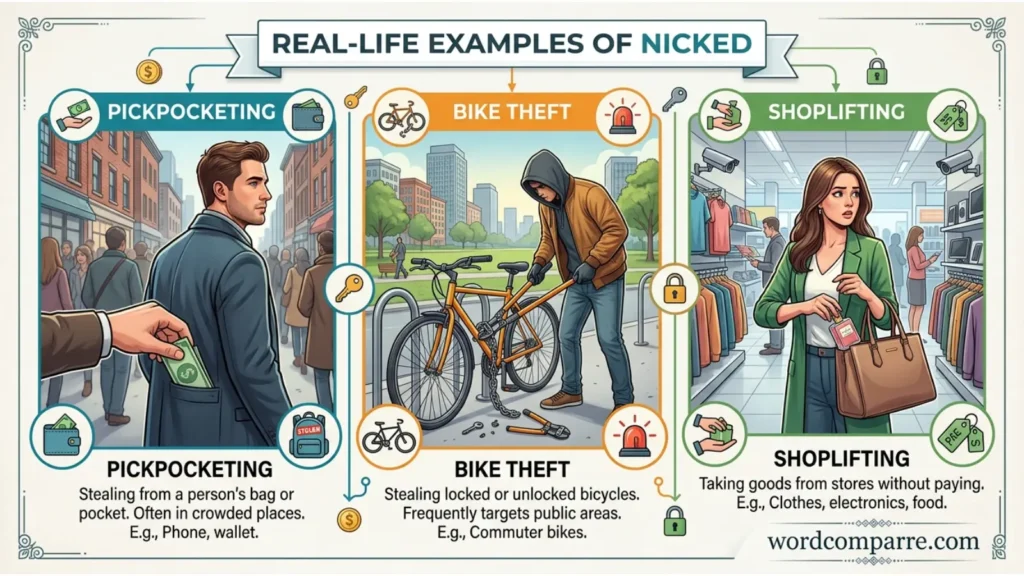
Real Life Examples Of Nicked
Correct:
- I nicked my thumb while opening the package.
- Someone nicked my wallet at the station.
- The blade nicked the paint.
- Police nicked two suspects after the robbery.
Rare but correct:
- The artist knicked the wood before carving.
Common Mistakes
Many writers accidentally replace nicked with knicked because they think the silent k belongs there.
Incorrect:
- I knicked my finger.
Correct:
- I nicked my finger.
Incorrect:
- Someone knicked my phone.
Correct:
- Someone nicked my phone.
Unless you are intentionally referring to the rare verb knick, choose nicked.
Easy Memory Trick
Think of nick as the normal everyday word.
Nicked begins with N, just like Normal.
Knicked begins with a silent K, which reminds you that it is a less common spelling.
If you are unsure, nicked is almost always the right choice.
Professional Writing Recommendation
For modern English writing, always use nicked unless you have a specific historical, literary, or dictionary reason to use knicked.
Editors, publishers, teachers, and professional writers overwhelmingly prefer nicked because it is the recognized standard spelling and is immediately understood by readers.
Frequently Asked Questions
Is knicked a real word?
Yes. It is a real but uncommon word that comes from the rare verb knick.
Which spelling is more common?
Nicked is vastly more common in both British and American English.
Can knicked mean stolen?
No. The informal British meaning “stolen” uses nicked, not knicked.
Is nicked correct in American English?
Yes. Americans commonly use nicked to describe a small cut or slight damage. The slang meanings related to stealing or arresting are mainly British.
Should I ever use knicked?
Only if you are intentionally referring to the rare verb knick or quoting older texts. For nearly all modern writing, nicked is the better choice.
Conclusion
Although knicked and nicked are both legitimate English words, they are not equally useful. Nicked is the standard spelling recognized across modern English and covers meanings such as making a small cut, causing slight damage, stealing something in British English, and arresting someone in British slang. Knicked survives only as the past tense of the uncommon verb knick and is rarely needed outside specialized or historical contexts.
If your goal is clear, professional, and natural writing, choose nicked with confidence in almost every situation. It is the spelling readers expect, dictionaries prioritize, and editors recommend.

Alex Wordsmith is a comparison research writer and content specialist at WordComparre.com. He focuses on analyzing word meanings, spelling variations, grammar distinctions, and language usage to help readers make informed writing choices. Through clear explanations and practical examples, Alex simplifies complex language topics for students, writers, and professionals. His goal is to make English learning easier, more accurate, and accessible for everyone.