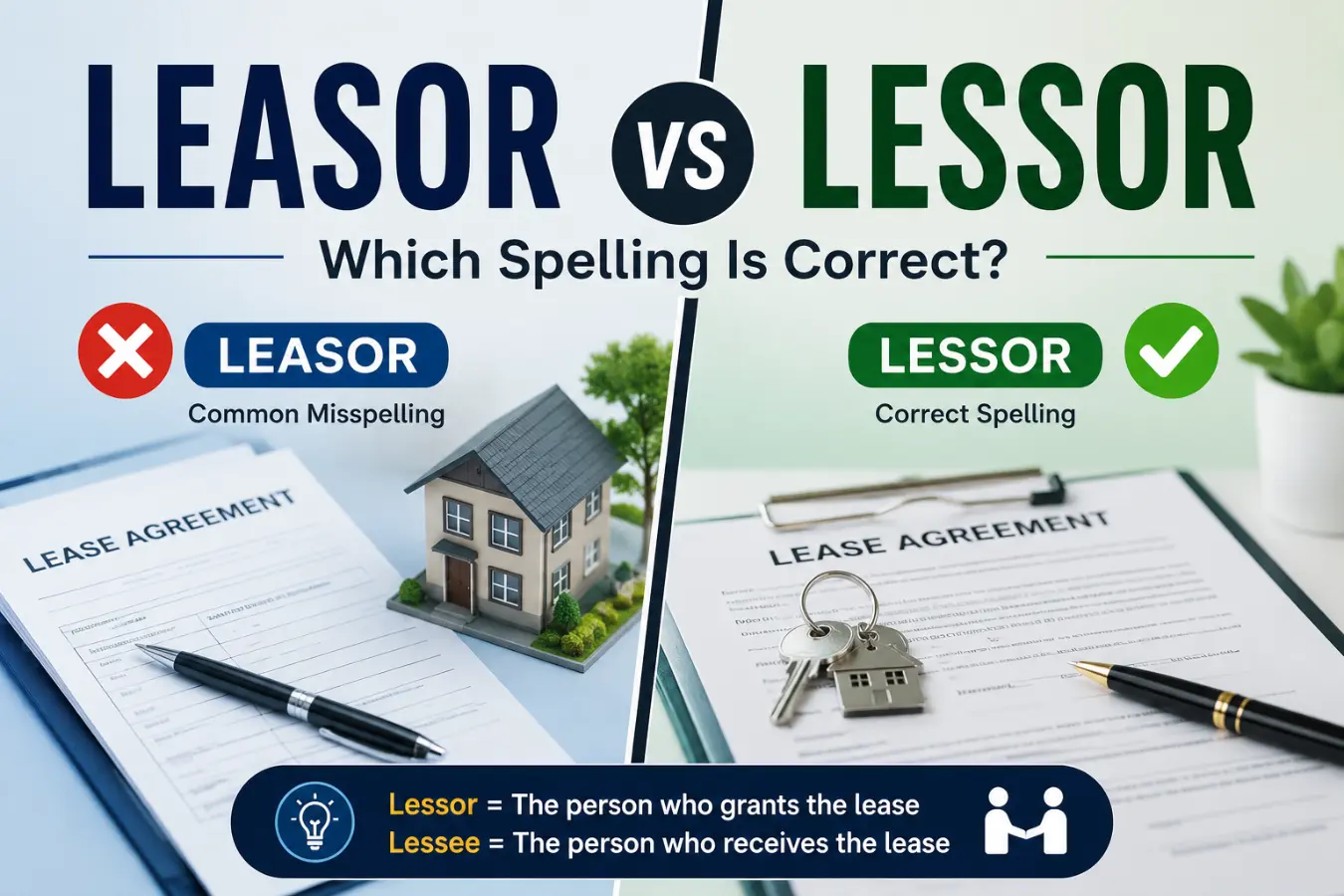
If you are unsure whether to write leasor or lessor, the correct choice in standard English is lessor. A lessor is a person or organization that grants a lease, such as a property owner who rents a house, a company that leases equipment, or an aircraft owner that leases planes.
Leasor is generally a misspelling when it is intended to mean the party that grants a lease. However, Leasor can occur as a surname, so the capitalized name should not automatically be treated as a spelling error.
The confusion is understandable because the word lease contains ea. This can make leasor look like the natural form. English terminology does not always preserve the spelling of the word from which a related term developed, though. In this case, the established legal and dictionary form is lessor.
Quick Answer: Leasor or Lessor?
Lessor is the correct spelling when you mean a person or organization that grants a lease.
- Lessor = the person or organization granting the lease. ✅
- Leasor = generally a misspelling when used with this meaning. ❌
- Lessee = the person or organization receiving or holding the property under the lease. ✅
For example:
The lessor agreed to renew the tenant’s lease.
Not:
The leasor agreed to renew the tenant’s lease.
Merriam-Webster defines lessor as one that transfers property through a contract, while its legal definition describes a person who conveys possession of real or personal property under a lease.
What Type of Word Comparison Is This?
Leasor vs lessor is primarily a spelling comparison.
Unlike comparisons in which both forms are accepted, this one has a clear standard form for the intended meaning:
lessor is the established English word for the party that grants a lease.
There is no meaningful British-versus-American spelling difference here. Both varieties of English use lessor.
Meaning of Lessor
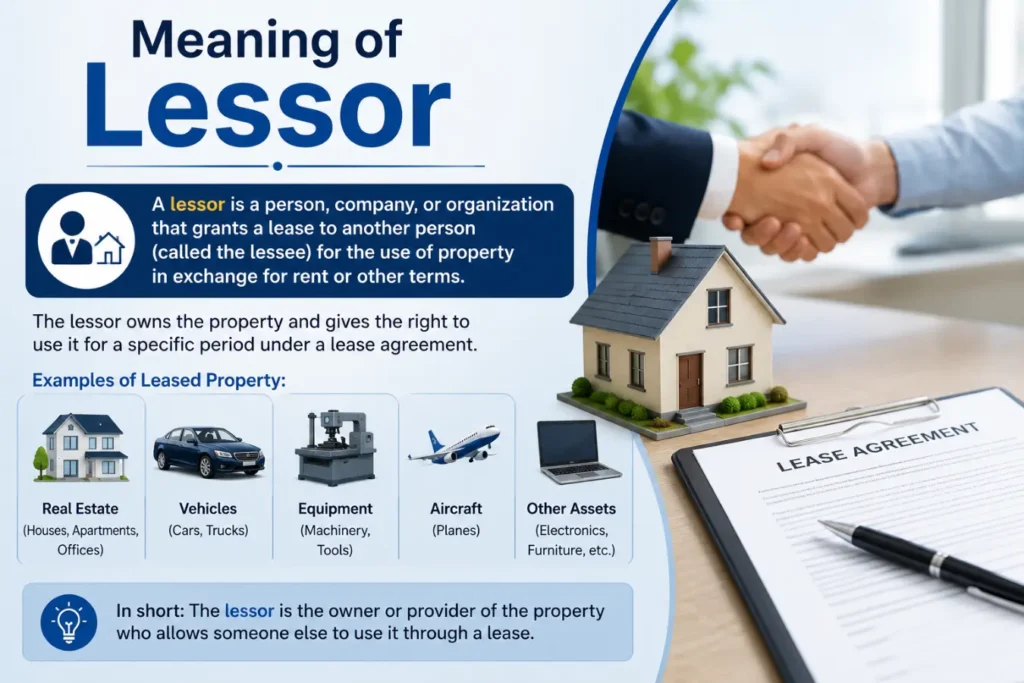
A lessor is the person, business, or organization that grants someone else the right to use property under a lease.
The property can be:
- A house or apartment
- Commercial real estate
- A car
- Machinery or equipment
- An aircraft
- Other leased assets
For example:
The lessor owns the building and rents several offices to local businesses.
The lessor does not necessarily have to be an individual. A company, government body, financial institution, or other legal entity can also be a lessor.
What Does Leasor Mean?
When leasor is written to mean “a person who grants a lease,” it is generally treated as a misspelling rather than the preferred standard term.
Major dictionary references identify lessor as the established noun. Merriam-Webster, Dictionary.com, and Collins-based dictionary material use lessor for the person who grants a lease.
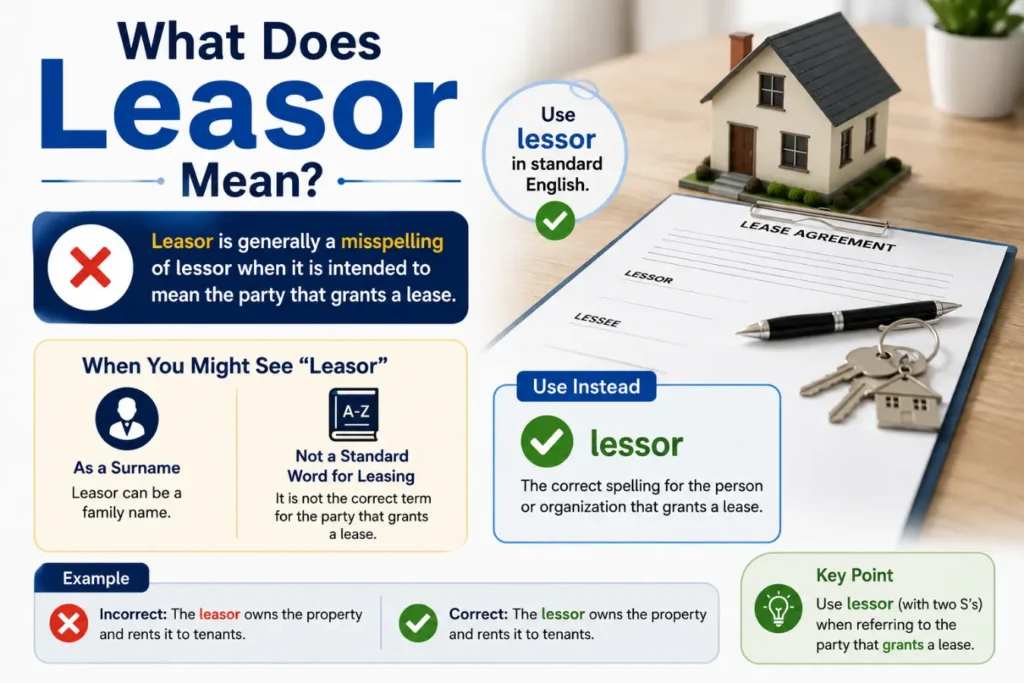
There is one important exception: Leasor can be a surname. Wiktionary, for example, records Leasor as a family name.
So, if you see a person’s name written Leasor, it should not automatically be “corrected” to Lessor. As a common noun meaning the party granting a lease, however, lessor is the appropriate spelling.
Lessor vs Leasor: Side-by-Side Comparison
| Word | Correct for a leasing party? | Meaning | Recommended use |
| Lessor | Yes | Person or organization that grants a lease | Standard English, legal, business, and professional writing |
| Leasor | No, when used with this meaning | Usually a misspelling of lessor | Avoid in standard writing |
| Leasor | Yes, in a different context | Can be a surname | Use only when it is someone’s actual name |
The distinction is especially important in contracts because lessor and lessee identify opposite sides of a lease.
Lessor and Lessee: Don’t Mix Them Up
A related source of confusion is lessee.
The two standard terms are:
Lessor → grants the lease
Lessee → holds the property under the lease
Merriam-Webster defines lessee as someone who holds real or personal property under a lease.
Consider this example:
The lessor owns the apartment, while the lessee rents and occupies it.
A simple way to remember the relationship is:
Lessor = gives the lease
Lessee = gets the lease
Why Does the Confusion Exist?
The main reason is the spelling of lease.
People naturally see:
lease → leasor
and assume that adding an ending should produce leasor. That pattern seems logical, but the established noun is lessor.
The historical development of the word also helps explain the difference. Merriam-Webster traces lessor to Middle English lessour, from Anglo-French, and records its first known use in the 14th century. Dictionary.com likewise gives a Middle English/Anglo-French origin.
In other words, lessor is not simply a modern spelling created by taking “lease” and adding “-or.” It has its own established history.
Origin of Lessor
The noun lessor dates back to Middle English and developed through Anglo-French terminology associated with leasing.
Merriam-Webster gives lessour as an earlier form and traces the word through Anglo-French to lesser, meaning to lease. Its first known use is listed as the 14th century.
Dictionary.com similarly dates lessor to approximately 1350–1400 and identifies a Middle English form derived from Anglo-French.
This history explains why the modern spelling is lessor, even though the related everyday word is lease.
What Do Dictionaries Recommend?
The dictionary evidence strongly supports lessor.
Merriam-Webster: Lessor defines lessor as the party that transfers property through a contract.
Dictionary.com: Lessor defines lessor as a person or group that grants a lease.
A terminology record from the Government of Canada’s TERMIUM Plus is even more explicit in the context of property law: it lists lessor as correct and leasor as a form to avoid.
Therefore, writers should use lessor in contracts, legal documents, business correspondence, academic writing, and other formal contexts.
British English vs American English
There is no standard British-versus-American spelling difference for this word.
Both British English and American English use:
lessor
For example:
- British English: The lessor must provide notice before terminating the agreement.
- American English: The lessor must provide notice before terminating the agreement.
Changing the spelling to leasor is not a British English alternative.
Real-Life Examples of Lessor
Real Estate
The lessor agreed to repair the roof before the new tenant moved in.
Here, the lessor is the property owner or party granting the lease.
Vehicle Leasing
The lessor remained responsible for the terms specified in the vehicle lease.
The term can refer to the company or organization providing the leased vehicle.
Equipment
The lessor delivered the machinery after the agreement was signed.
A business can act as a lessor when it leases equipment to another company.
Aircraft
The airline returned the aircraft to its lessor at the end of the lease.
The word is common in aviation and financial reporting as well as real estate. Current dictionary examples include references to aircraft lessors and leasing companies.
Legal Agreement
The lessor and lessee signed the agreement after reviewing its terms.
This sentence correctly identifies the two parties involved in the lease.
Common Mistakes
Mistake 1: Writing Leasor Because of Lease
Incorrect:
The leasor owns the commercial property.
Correct:
The lessor owns the commercial property.
The spelling of lease does not mean that the person granting a lease should be called a leasor.
Mistake 2: Confusing Lessor With Lessee
Incorrect:
The lessor pays monthly rent to the property owner.
Correct:
The lessee pays monthly rent to the property owner.
The lessor grants the lease; the lessee holds the property under the lease.
Mistake 3: Using Leasor in a Contract
Because contracts require precise terminology, writing leasor where lessor is intended can make the document look poorly edited.
Use:
Lessor: ABC Properties Ltd.
rather than:
Leasor: ABC Properties Ltd.
Mistake 4: “Correcting” the Surname Leasor
Not every occurrence of Leasor is a spelling mistake. If Leasor is someone’s surname, retain the person’s actual spelling.
For example:
James Leasor was listed as the author.
Here, Leasor is a name, not an alternative spelling of lessor.
Memory Trick: Think “Less” + “Or”
A simple memory aid is:
Lessor has two S’s.
Think:
less + or = lessor
You can also connect the two leasing roles:
Lessor → lease giver
Lessee → lease holder
If you remember that lessor contains two S’s, you are less likely to write the tempting but incorrect leasor.
Professional Writing Recommendation
For professional English, the recommendation is straightforward:
Always use “lessor” when referring to the person or organization that grants a lease.
This is particularly important in:
- Lease agreements
- Property documents
- Legal correspondence
- Business contracts
- Financial reports
- Real estate articles
- Academic writing
- Government documents
- Professional emails
If you encounter leasor in ordinary text and it is clearly intended to mean the party granting a lease, edit it to lessor.
The only reason to retain Leasor is when it is being used as a proper name, such as a person’s surname.
Frequently Asked Questions
Is “leasor” or “lessor” correct?
Lessor is correct when you mean a person or organization that grants a lease. Leasor is generally a misspelling in this context.
Is leasor a real word?
As a common noun meaning “a person who grants a lease,” leasor is not the standard English form. The established term is lessor. Leasor can also appear as a surname, which is a separate use.
What is the difference between a lessor and a lessee?
The lessor grants the lease, while the lessee holds or uses the property under that lease.
Is “lessor” used in British English?
Yes. Lessor is used in both British and American English. It is not a US-only spelling.
Why is it spelled lessor instead of leasor?
Lessor has a historical origin in Middle English and Anglo-French. Its spelling was established independently of the modern spelling pattern people may expect from lease.
Can “Leasor” be correct?
Yes, if Leasor is a proper name or surname. It is not the standard spelling for the leasing party.
What is the plural of lessor?
The plural is lessors.
Example:
Several lessors submitted proposals for the project.
What is the opposite of lessor?
In a lease relationship, the corresponding party is the lessee. A lessor grants the lease, while a lessee holds the leased property.
Conclusion
When choosing between leasor vs lessor, use lessor when you mean the person, company, or organization that grants a lease.
The confusion comes largely from the spelling of lease, which makes leasor look reasonable at first glance. However, historical usage and modern dictionaries establish lessor as the standard term. It is the form to use in legal, business, academic, and professional writing.
Remember the simple rule:
Lessor = the party that grants the lease.
Lessee = the party that holds the lease.
And if you see Leasor with a capital letter, check the context—it may be a surname rather than a spelling mistake.

Alex Wordsmith is a comparison research writer and content specialist at WordComparre.com. He focuses on analyzing word meanings, spelling variations, grammar distinctions, and language usage to help readers make informed writing choices. Through clear explanations and practical examples, Alex simplifies complex language topics for students, writers, and professionals. His goal is to make English learning easier, more accurate, and accessible for everyone.