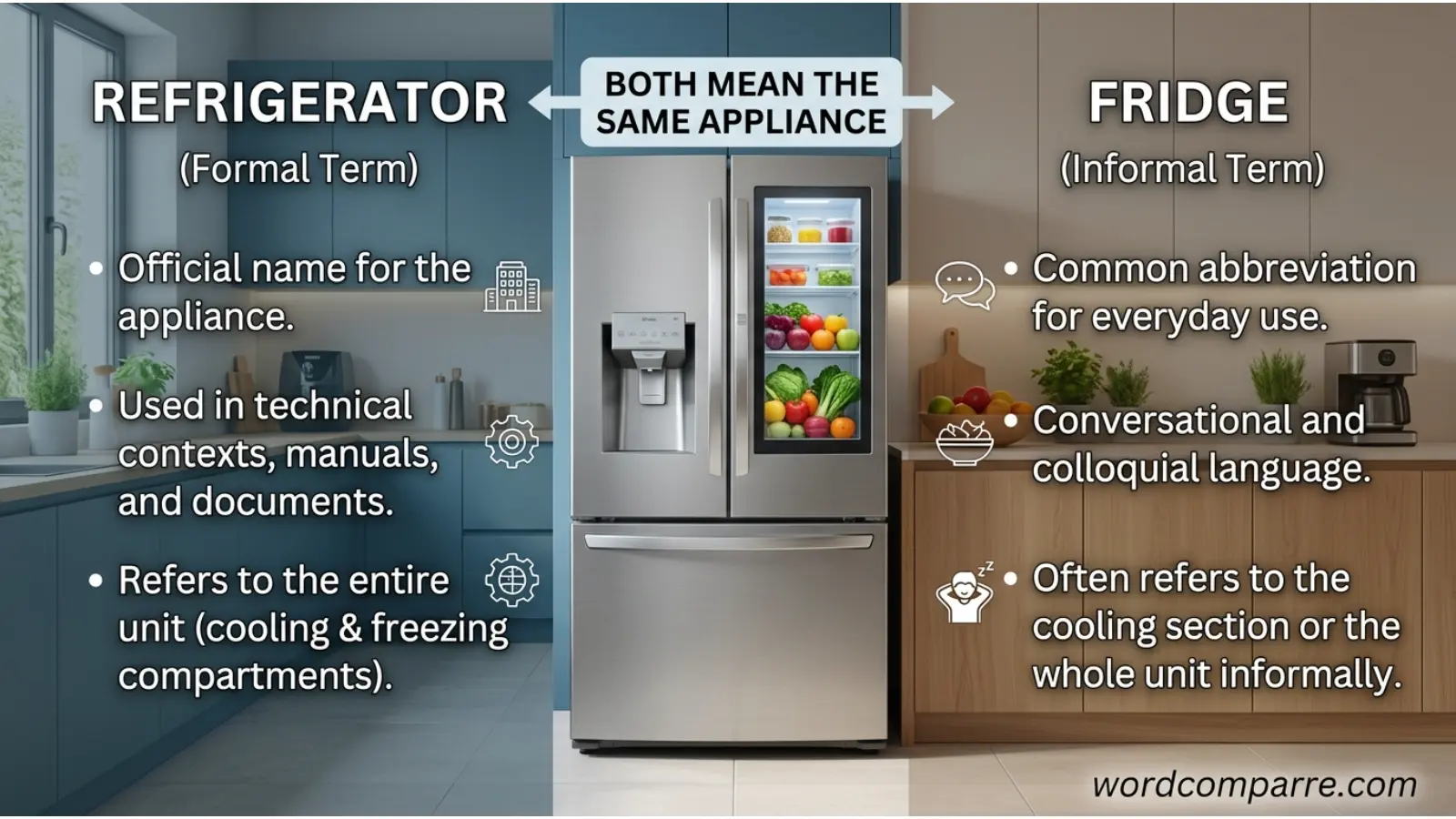
Fridge vs refrigerator is a common comparison because both words refer to the same kitchen appliance, yet people often wonder if one is more correct or professional than the other. The confusion usually comes from the fact that one word is a shortened form of the other, and different situations call for different levels of formality.
The good news is that both fridge and refrigerator are correct English words. The best choice depends on your audience, writing style, and context. In this guide, you’ll learn what each word means, why both exist, which dictionaries recommend them, and when you should use one instead of the other.
Quick Answer
Both fridge and refrigerator are correct.
- Refrigerator is the full, formal word.
- Fridge is the standard shortened form used in everyday English.
- Both are accepted by major English dictionaries.
- In casual conversation, fridge is more common.
- In technical, legal, academic, or product documentation, refrigerator is usually the better choice.
Meaning of Both Words
Refrigerator
A refrigerator is an electrical appliance that keeps food and drinks cold to slow spoilage. It is the original and complete English word.
Example:
Please clean the refrigerator before moving into the new apartment.
Fridge
A fridge is simply the shortened version of refrigerator. It has exactly the same meaning and is widely accepted in both spoken and written English.
Example:
There’s fresh juice in the fridge.
Fridge vs Refrigerator Comparison
| Feature | Fridge | Refrigerator |
|---|---|---|
| Correct English | Yes | Yes |
| Meaning | Cold food storage appliance | Cold food storage appliance |
| Formality | Informal to neutral | Formal and technical |
| Everyday speech | Very common | Less common |
| Professional documents | Sometimes | Preferred |
| Dictionaries | Accepted | Accepted |
| Best for conversations | Yes | Yes, but less natural |
| Best for manuals and official writing | Usually not | Yes |
Origin of the Words
The word refrigerator comes from the Latin word refrigerare, meaning “to make cool.”
The shorter word fridge appeared in the early twentieth century after refrigerators became common household appliances. Interestingly, the spelling is fridge rather than frig because the added d helps preserve the soft j sound found in refrigerator.
Although fridge began as an abbreviation, it is now recognized as a complete English word in its own right.
Why the Confusion Exists
Many people assume that shortened words are informal slang or incorrect spellings. That is not true in this case.
Several factors cause confusion.
- Both words describe exactly the same appliance.
- One is much shorter and more common in conversation.
- Some people think abbreviations are not suitable for writing.
- Learners of English often expect the shortened form to be frig, not fridge.
- Different writing situations require different levels of formality.
What Do Dictionaries Recommend?
Major English dictionaries recognize both fridge and refrigerator as correct.
Their general guidance is simple.
- Use refrigerator when writing formally or technically.
- Use fridge in everyday conversation, blogs, emails, and informal writing.
- Neither word is considered incorrect.
This means your choice should depend on your audience rather than grammar.
When Should You Use Fridge?
Choose fridge when your writing sounds conversational or friendly.
Examples include:
- Put the milk back in the fridge.
- We bought a new fridge last weekend.
- Check the fridge before ordering groceries.
This version feels natural in everyday communication.
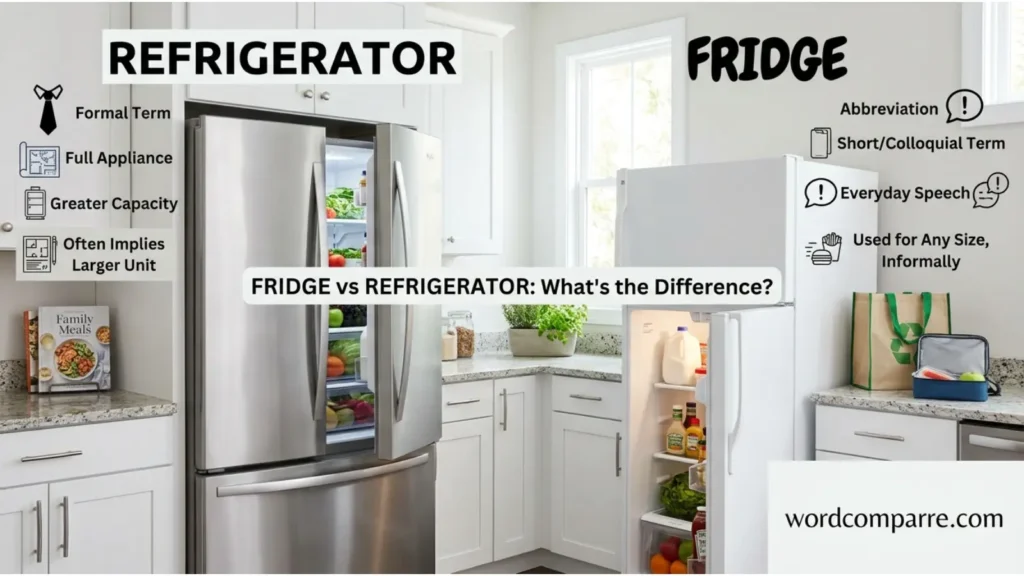
When Should You Use Refrigerator?
Choose refrigerator when precision and professionalism matter.
Examples include:
- The refrigerator should be installed on a level surface.
- Store medicine in the refrigerator if instructed.
- The refrigerator includes an energy-saving cooling system.
The full word is especially common in manuals, contracts, research papers, and product descriptions.
Real Life Examples
Everyday conversation:
“Can you grab the butter from the fridge?”
Home appliance advertisement:
“This refrigerator features advanced cooling technology.”
Property listing:
“The apartment includes a refrigerator.”
Family text message:
“There’s pizza in the fridge if you’re hungry.”
Medical instructions:
“Keep the medicine in the refrigerator after opening.”
Common Mistakes
Using refrigerator in very casual conversations can sound unnecessarily formal.
Assuming fridge is incorrect simply because it is shorter is also a mistake. It is a standard English word.
Writing frig instead of fridge is another common error. Although the pronunciation may seem similar, frig is not the accepted short form of refrigerator.
Switching randomly between the two words in the same article without a reason can make your writing feel inconsistent.
Easy Memory Trick
Think of refrigerator as the complete, official name.
Think of fridge as its everyday nickname.
If you’re chatting with friends, use fridge.
If you’re writing something professional, use refrigerator.
Professional Writing Recommendation
For business writing, academic work, technical documents, product manuals, and legal content, refrigerator is usually the safest choice because it sounds more formal and precise.
For blogs, social media, lifestyle articles, recipes, emails, and everyday communication, fridge is perfectly correct and often sounds more natural.
If your audience is the general public, consistency is more important than choosing one over the other. Pick the word that best matches your tone and use it throughout the article.
Frequently Asked Questions
Is fridge a real English word?
Yes. Fridge is a standard English word recognized by major dictionaries.
Is refrigerator more correct than fridge?
No. Both are correct. Refrigerator is simply more formal.
Why isn’t the short form spelled “frig”?
The spelling fridge preserves the same soft j sound found in refrigerator, making pronunciation consistent.
Which word is more common in everyday speech?
Fridge is much more common in everyday conversations.
Which word should I use in professional writing?
Use refrigerator for technical, academic, legal, or official documents. Use fridge when writing in a friendly or conversational style.
Do British and American English use different words?
Both British English and American English use fridge and refrigerator. The choice is based more on formality than regional preference.
Conclusion
The comparison between fridge vs refrigerator is not about right versus wrong. Both words are correct, accepted by dictionaries, and understood by English speakers around the world. Fridge is the natural choice for everyday conversation and informal writing, while refrigerator is better suited to formal, technical, and professional contexts. Understanding the difference helps you choose the word that best matches your audience, making your writing clearer, more consistent, and more effective.

Alex Wordsmith is a comparison research writer and content specialist at WordComparre.com. He focuses on analyzing word meanings, spelling variations, grammar distinctions, and language usage to help readers make informed writing choices. Through clear explanations and practical examples, Alex simplifies complex language topics for students, writers, and professionals. His goal is to make English learning easier, more accurate, and accessible for everyone.