If you have ever written about coding, software development, or computer science, you may have wondered whether the correct spelling is programming or programing. The difference is only one letter, but both forms appear in English dictionaries, which makes the choice less obvious than it first seems.
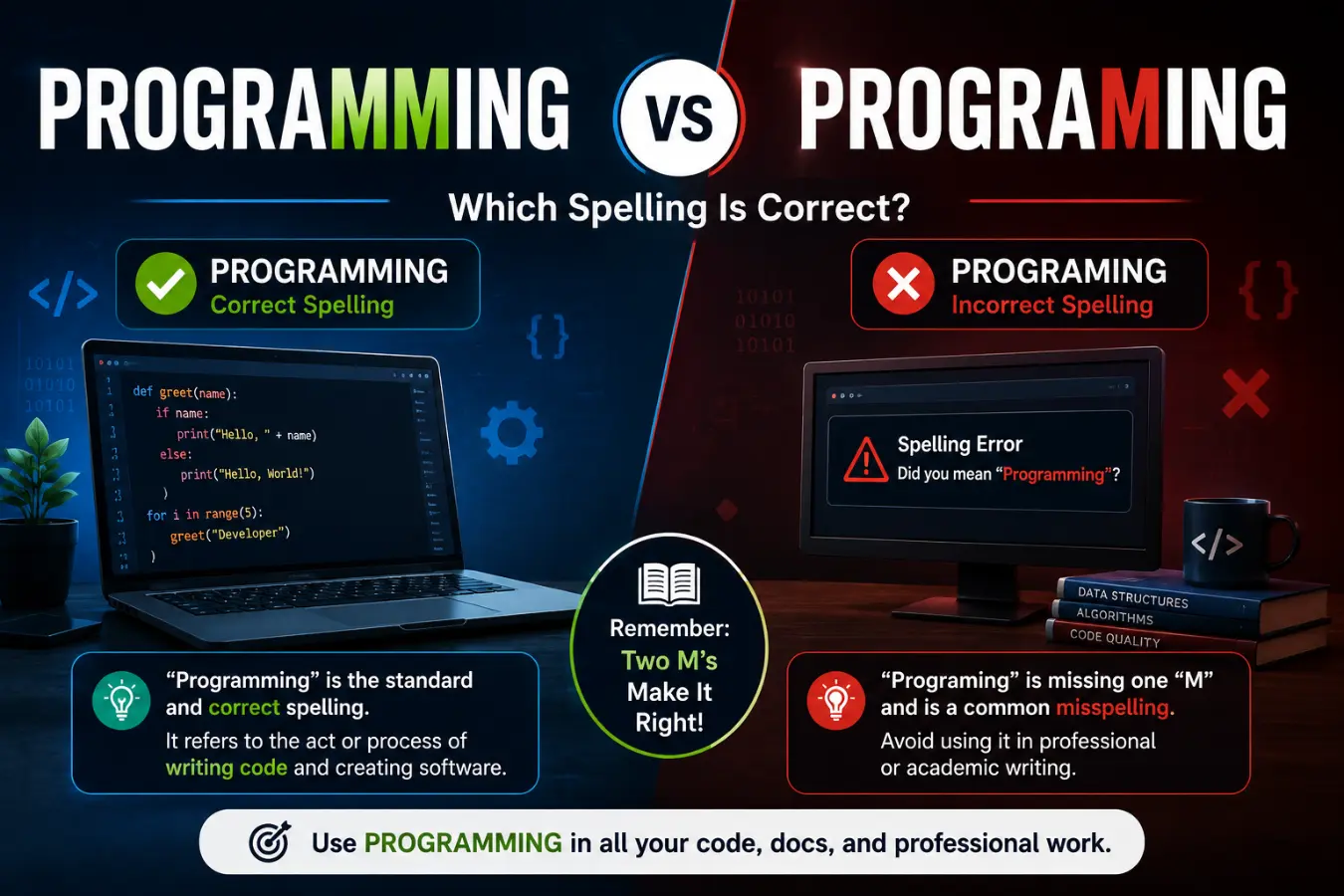
The good news is that programming is the standard spelling you should normally use. However, programing is not simply a random misspelling. Major dictionaries recognize it as a legitimate variant, particularly in North American English.
This distinction matters when writing articles, resumes, academic papers, software documentation, or other professional content. Understanding why the two forms exist can help you choose the spelling that best fits your audience and style guide.
Quick Answer: Programming or Programing?
Programming is the preferred and most widely used spelling.
Programing is also a recognized variant, especially in North American English, but it is much less common in everyday professional writing.
For most situations, write:
She is learning programming at university.
Rather than:
She is learning programing at university.
Oxford lists programming as the standard -ing form of program, while also noting programing as a North American variant. Merriam-Webster similarly gives programming as the main form and programing as a variant.
What Does “Programming” Mean?
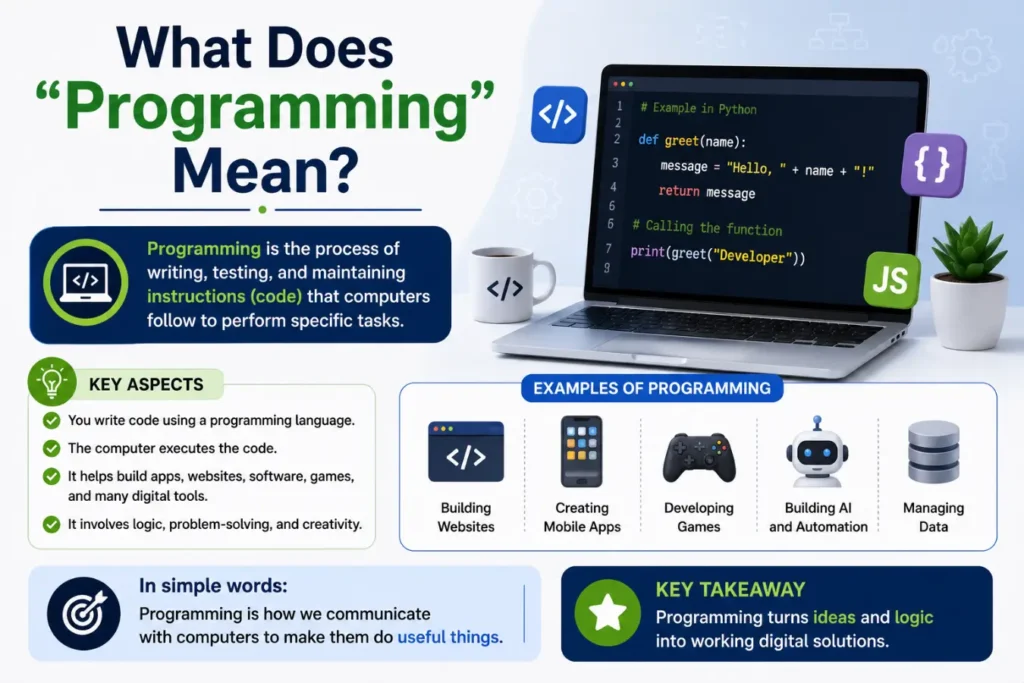
Programming is the process of writing, testing, and developing instructions that computers can execute. It can refer to activities involving programming languages such as Python, JavaScript, Java, C++, and many others.
Oxford defines programming as the process of writing and testing computer programs.
Examples
- Programming is an important skill for software developers.
- She is studying programming at college.
- He enjoys programming in Python.
- The course introduces students to computer programming.
The word can also have a broader meaning outside computing. For example, programming can refer to planning or scheduling television and radio content.
What Does “Programing” Mean?
Programing has the same basic meaning as programming. It is an alternative spelling of the present participle or gerund of program.
The important point is that programing is not a different activity. It does not describe a different type of coding, software, or computer language.
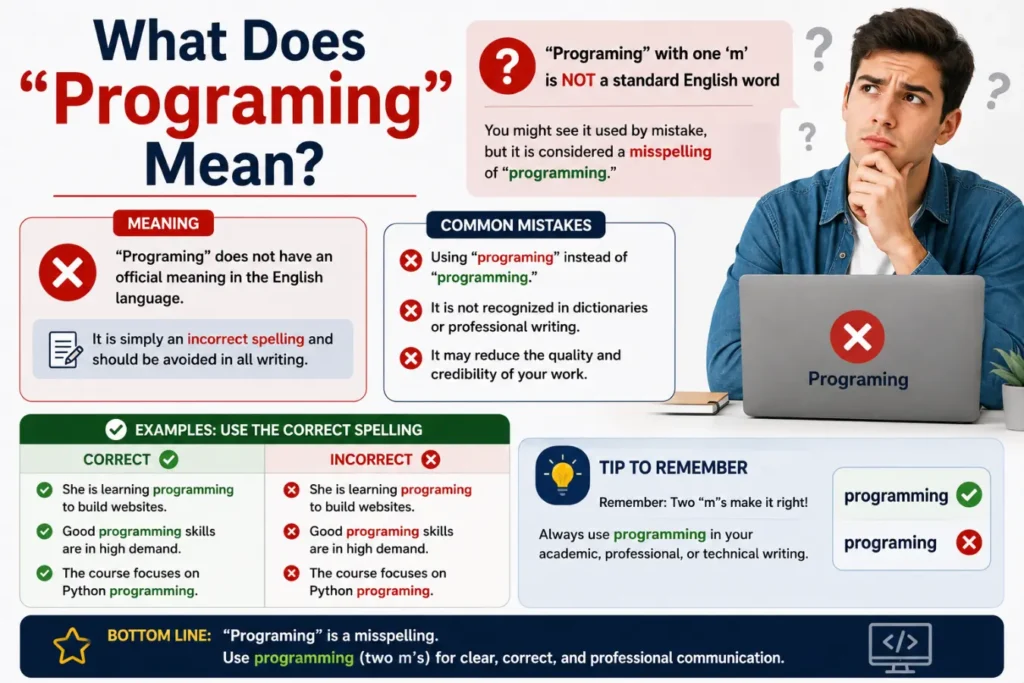
For example:
- Programming is becoming increasingly important in education.
- Programing is an accepted variant of the same word.
Merriam-Webster explicitly lists programing as a variant of programming, while Oxford identifies it as a North American English alternative.
Programming vs Programing: Comparison Table
| Feature | Programming | Programing |
| Spelling | Standard/preferred form | Recognized variant |
| Meaning | Writing or developing programs | Same meaning |
| Double “m” | Yes | No |
| Dictionary status | Main entry/form | Variant |
| Common in professional writing | Very common | Less common |
| North American English | Common | Also recognized |
| British English | Standard | Not normally preferred |
| Recommended for general use | Yes | Usually avoid unless required by a style or source |
Why Does the Confusion Exist?
The confusion comes from the way English handles words ending in a consonant when adding -ing.
With many words, English spelling rules can involve doubling the final consonant:
- run → running
- sit → sitting
- plan → planning
- stop → stopping
Because program ends in m, many writers naturally expect the same pattern:
program + ing → programming
That produces the standard spelling with two ms.
However, programing has also developed as an accepted variant. This is partly connected with differences in spelling conventions and the tendency of American English to simplify certain spellings.
The result is unusual: unlike many ordinary spelling mistakes, programing can appear in reputable dictionaries.
Is “Programing” Wrong?
Not necessarily.
Calling programing completely wrong would be too strong because major dictionaries recognize it as a variant. Merriam-Webster lists programing alongside programming, and Oxford specifically labels programing as a North American English alternative.
However, recognition does not mean the two spellings are equally common or equally advisable.
For general readers, programming is the safer choice because it is the familiar spelling and the form most readers expect to see.
So the practical distinction is:
Programing = accepted variant
Programming = preferred standard form
Dictionary Recommendations
Dictionary evidence is particularly useful here because the issue is not simply a matter of personal preference.
Merriam-Webster
Merriam-Webster lists programming and identifies programing as a variant. Its entry for program also gives both programmed/programed and programming/programing.
Oxford Learner’s Dictionaries
Oxford gives programming as the normal -ing form of program. It also states that programing is used in North American English.
Oxford’s definition of programming specifically includes computer programming as the process of writing and testing computer programs.
Dictionary.com
Dictionary.com also recognizes programing as an alternative form of programming.
Taken together, these sources show that programming is the safest default, while programing has legitimate dictionary status.
British vs American English
This is partly a British-versus-American spelling question, but it is not as simple as saying:
British = programming
American = programing
That would be inaccurate.
Both varieties commonly use programming. The important difference is that programing is recognized as an additional North American variant. Oxford specifically labels it as such.
There is another related spelling difference worth knowing:
- British English often uses programme as a noun.
- American English normally uses program as a noun.
- The verb program is used in both varieties.
- The standard -ing form is programming.
For example:
British English:
The television programme includes educational content.
American English:
The television program includes educational content.
But when discussing computer coding, programming is the normal spelling in both varieties.
The Origin of “Programming”
The word comes from program, which ultimately traces back through Latin to Greek programma, referring to something written or publicly announced.
The modern word programming developed from program + -ing.
Merriam-Webster records the first known use of programming in 1896.
The computer-related sense developed later as the word program became associated with sets of instructions given to machines. Today, programming is strongly associated with software development and computer science.
Real-Life Examples
Here are examples showing how programming is normally used today.
Computer Science
Programming requires logical thinking and attention to detail.
Software Development
She works as a software engineer and spends most of her day programming.
Education
The school introduced programming classes for students.
Programming Languages
Python is a popular language for beginners who are learning programming.
Professional Writing
Experience with computer programming is required for this position.
Using the Variant
Some North American sources use programing instead of programming.
The last example is useful when discussing spelling itself. In ordinary writing, however, programming remains the better default.
Common Mistakes
Mistake 1: Assuming “Programing” Is Always Incorrect
This is the most common oversimplification.
Programing is recognized by major dictionaries as a variant, so it is not accurate to describe it as an entirely invalid word.
Mistake 2: Treating the Two Spellings as Different Meanings
They do not have different meanings.
Both forms refer to the same activity or process.
Mistake 3: Assuming American English Always Uses “Programing”
American English does recognize programing, but programming is also widely used and is the safer choice for most readers.
Mistake 4: Mixing Forms in the Same Document
If you choose programming, use it consistently throughout your article, report, website, or academic paper.
Avoid switching randomly between:
programming
programing
programming
programing
Consistency makes professional writing easier to read and edit.
Mistake 5: Confusing “Program” and “Programme”
The noun programme is common in British English, particularly for television, radio, events, and organized activities.
For computer-related writing, however, programming is the standard form.
A Simple Memory Trick
Use this easy rule:
Program → programming
Think of the final m as being doubled when you add -ing:
progra + m + m + ing = programming
If you are writing an ordinary article, school assignment, resume, technical document, or website, programming is the spelling to remember.
A second trick is even simpler:
Two m’s = the spelling most readers expect.
Which Spelling Should You Use in Professional Writing?
For professional writing, programming is the best choice.
Use programming in:
- Resumes and CVs
- Academic assignments
- Research papers
- Blog posts
- Software documentation
- Job descriptions
- Business websites
- Educational materials
- Technical articles
- General web content
There is usually no advantage to choosing programing unless you are following a specific North American style, reproducing an original source, or working within a system that deliberately uses that spelling.
For SEO content, programming is also the natural default because readers are more likely to recognize and expect it.
If your organization has a house style guide, follow that guide consistently. A publication may have its own preferred spelling even when dictionaries recognize multiple variants.
Which One Should You Choose?
If you are still unsure, use this decision:
Writing for a general audience?
→ Use programming.
Writing academic or professional content?
→ Use programming.
Writing about computer science or software development?
→ Use programming.
Following a source that specifically uses “programing”?
→ Preserve the source’s spelling when appropriate.
Following a North American style that permits “programing”?
→ Either may be acceptable, but check the relevant style guide.
In almost every ordinary situation, programming is the clearest and safest choice.
FAQ
Is programming or programing correct?
Programming is the preferred spelling, but programing is also recognized as a legitimate variant by major dictionaries. Oxford identifies programing as a North American English alternative.
Is “programing” a misspelling?
Not always. Although it is less common, programing is a recognized spelling variant. Merriam-Webster lists it as a variant of programming.
Why does programming have two m’s?
Programming is formed from program + -ing, with the final consonant doubled in the standard spelling.
Is programming British or American spelling?
Programming is used in both British and American English. Programing is additionally recognized as a North American variant.
Do British people spell it “programming”?
Yes. Programming is the normal spelling in British English when referring to computer programming.
Is “programming” always related to computers?
No. It can also refer to the planning or scheduling of television and radio content. In modern usage, however, computer programming is one of its most familiar meanings.
Which spelling is better for a resume?
Use programming. It is the more familiar and widely preferred form, making it the safest choice for professional documents.
Which spelling should I use in an SEO article?
Use programming as the primary spelling. If discussing the spelling difference itself, you can mention programing as the recognized variant.
Conclusion
Programming is the spelling you should normally use. It is the standard and widely familiar form in modern English, especially in professional, academic, technical, and computer-related writing.
Programing is not simply an invented spelling or an unavoidable typo. Major dictionaries recognize it as a legitimate variant, with Oxford specifically identifying it as a North American English form.
The two spellings have the same meaning, so the choice is mainly about convention, audience, and consistency. When you need one dependable spelling, choose programming.
In short: Programming is the preferred spelling; programing is an accepted variant.

Alex Wordsmith is a comparison research writer and content specialist at WordComparre.com. He focuses on analyzing word meanings, spelling variations, grammar distinctions, and language usage to help readers make informed writing choices. Through clear explanations and practical examples, Alex simplifies complex language topics for students, writers, and professionals. His goal is to make English learning easier, more accurate, and accessible for everyone.