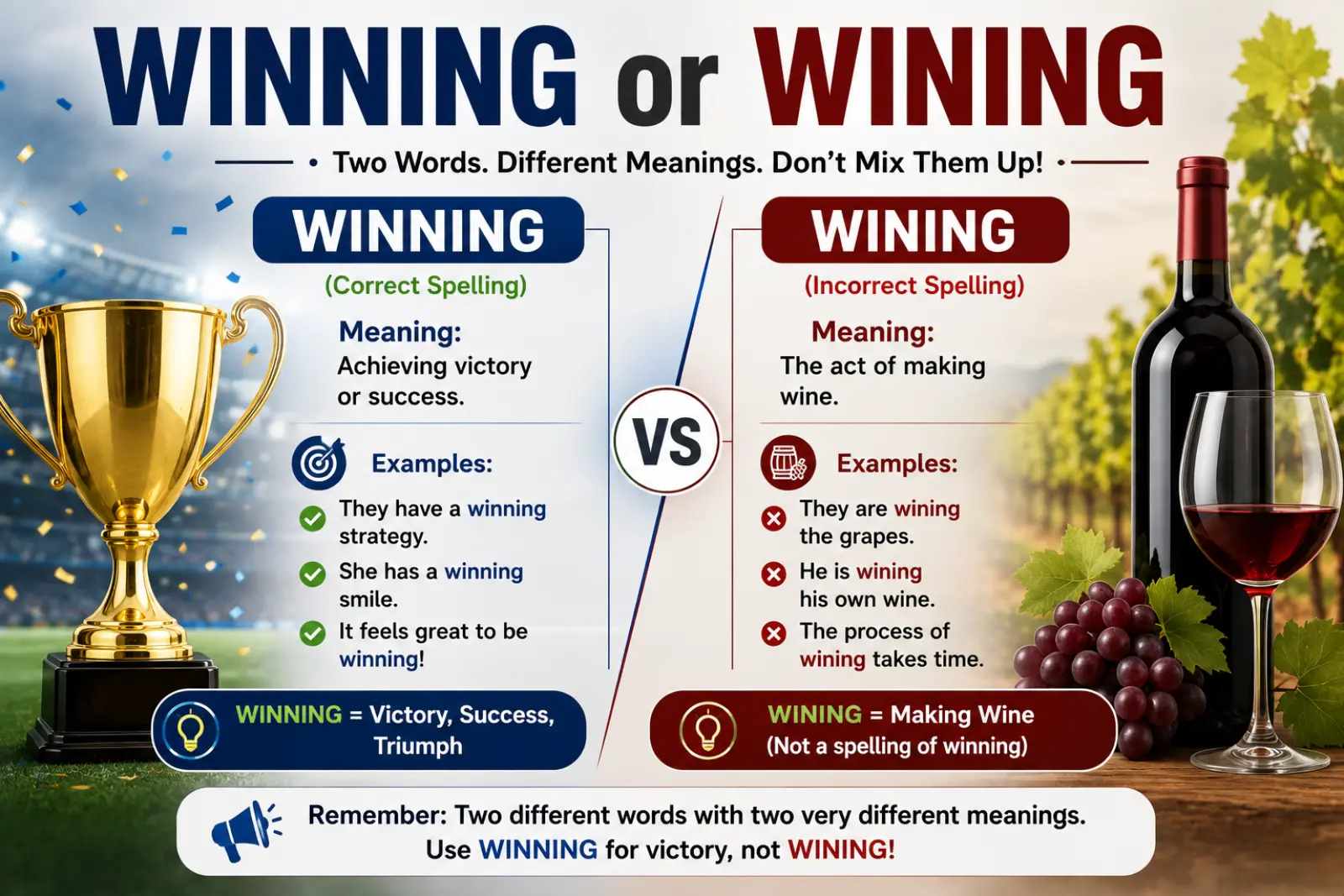
If you are unsure whether to write winning or wining, you are not alone. The two words look almost identical, but they come from different verbs and have completely different meanings.
In most everyday situations involving success, competition, victory, or achieving a goal, the correct spelling is winning. It is the present participle of win and can also function as an adjective or noun.
Wining is also a real English word, but it is much less common. It is the present participle of wine, meaning to drink wine or provide someone with wine. Therefore, choosing between the two depends on what you mean.
Quick Answer: Winning or Wining?
Winning is correct when you mean succeeding, being victorious, or achieving a win.
- She is winning the race.
- They have a winning strategy.
- Our team is winning again.
Wining is correct only when it relates to the verb wine, meaning to drink wine or give someone wine.
- They spent the evening wining and dining.
- The guests were wining at the restaurant.
So, if you are talking about a competition, success, a victory, or a successful person or idea, use winning.
Winning vs. Wining at a Glance
| Word | Correct? | Meaning | Base Word | Common Use |
| winning | Yes | Succeeding, being victorious, or successful | win | Very common |
| wining | Yes, but uncommon | Drinking or providing wine | wine | Specialized use |
The important point is that neither spelling is universally wrong. They represent different verbs.
What Does “Winning” Mean?
Winning is the present participle of win. It describes the action of succeeding or being victorious.
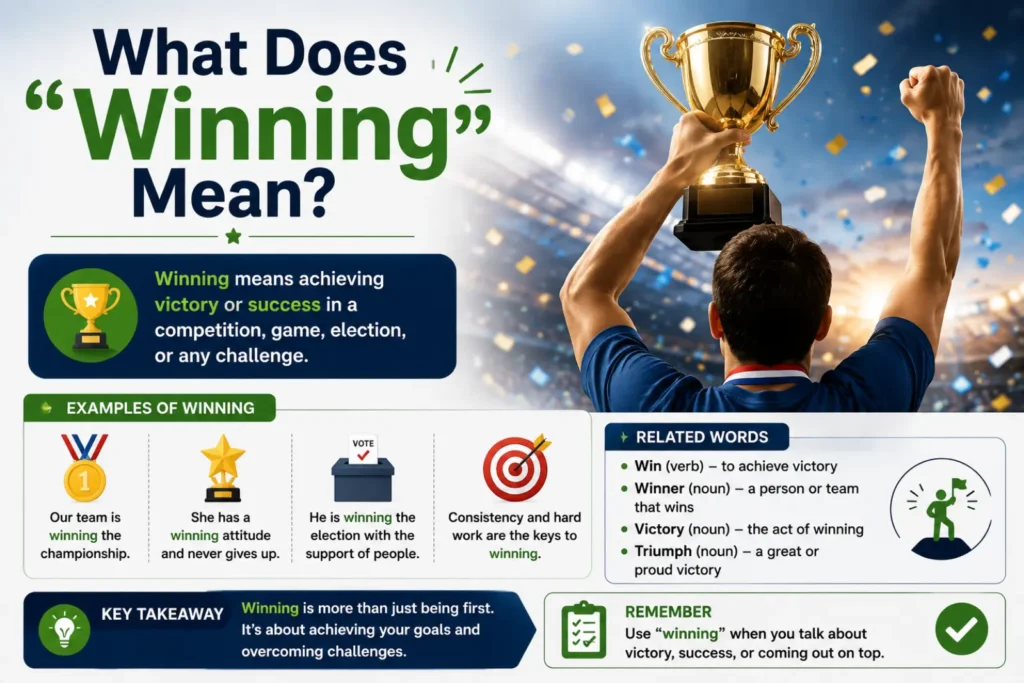
For example:
- The team is winning the match.
- She is winning the competition.
- He keeps winning important awards.
The word can also be used as an adjective. In this sense, it describes something successful or likely to attract approval.
- They developed a winning strategy.
- She has a winning personality.
- That was the winning design.
Merriam-Webster lists winning as both a noun and an adjective. As a noun, it can refer to the act of winning or something won. As an adjective, it can describe something successful or pleasing.
Cambridge likewise defines winning as something that has won and uses it for qualities such as a friendly or charming personality.
Examples of “Winning”
- The player is winning the game.
- We celebrated after winning the championship.
- Her winning attitude impressed the judges.
- This could be a winning business strategy.
- The company has a winning formula.
What Does “Wining” Mean?
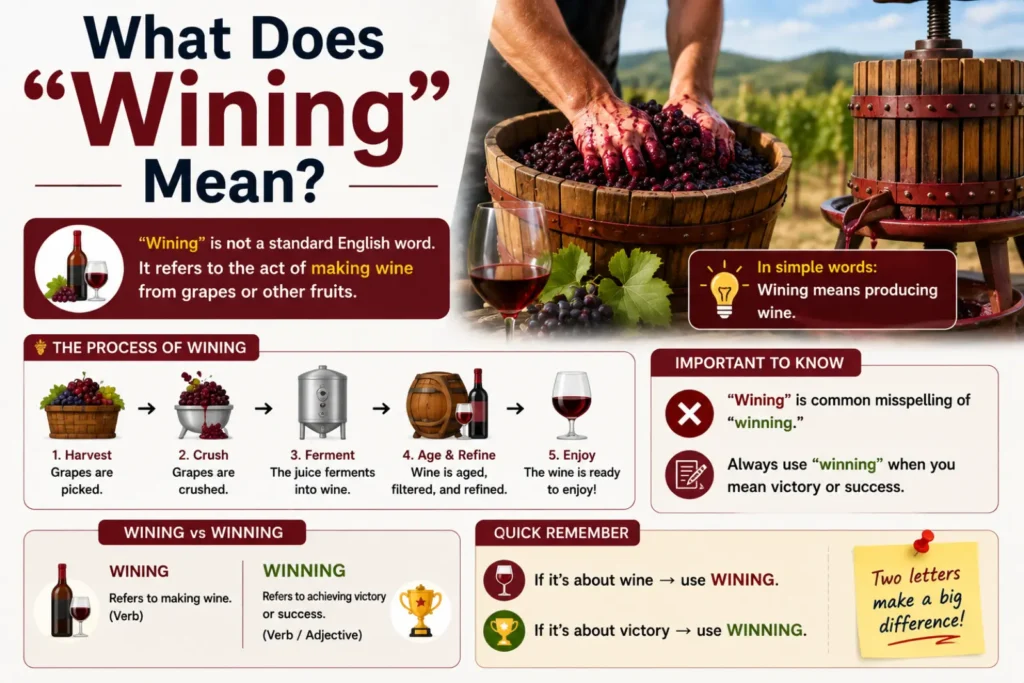
Wining is a genuine English word, but its meaning has nothing to do with winning a competition.
It is the present participle of wine. The verb wine means to drink wine or to provide someone with wine. Merriam-Webster lists wining as the form used with the verb wine.
For example:
- They were wining and dining with their clients.
- The group spent the evening wining at a vineyard.
- Guests were wining while enjoying the meal.
This usage is relatively uncommon in ordinary writing. You are much more likely to encounter the phrase “wine and dine” than the standalone word wining.
Why Do People Confuse “Winning” and “Wining”?
The confusion comes from the spelling rules used when adding -ing to short verbs.
The base verb win becomes:
win + ing → winning
The final consonant is doubled.
By contrast, wine becomes:
wine + ing → wining
The final silent e is removed before -ing is added.
This creates two visually similar words:
- win → winning
- wine → wining
The extra n in winning is therefore important. Without it, the word changes from a form of win to a form of wine.
The Spelling Rule Behind “Winning”
The spelling of winning follows a common English pattern for certain short verbs ending in a consonant.
When win takes -ing, the final consonant is doubled:
win → winning
The same pattern appears in words such as:
- run → running
- sit → sitting
- stop → stopping
- plan → planning
The doubling helps preserve the pronunciation and follows standard English spelling conventions.
The Spelling Rule Behind “Wining”
The word wine ends in a silent e. When -ing is added, that final e is normally dropped:
wine → wining
Compare:
- make → making
- write → writing
- hope → hoping
- use → using
- wine → wining
This explains why wining has only one n.
Dictionary Recommendations
Major dictionaries recognize both forms, but they give them separate entries and meanings.
Merriam-Webster defines winning in connection with victory, success, and pleasing qualities. Its entry records the word’s first known use as an adjective in the 15th century and as a noun in the 14th century.
Cambridge identifies winning as an adjective meaning that someone or something has won. It also gives examples involving winning teams, winning goals, winning combinations, and winning personalities.
For wining, Merriam-Webster identifies it as the present participle of wine. The underlying verb wine means to drink wine or give wine to someone.
Cambridge’s entry for win specifically lists winning as the present participle, confirming the standard spelling used for the verb win.
Dictionary Verdict
If your sentence is about victory or success, dictionaries support:
winning
If your sentence is about wine, the correct form can be:
wining
Real-Life Examples of “Winning”
Here are examples where winning is the correct choice:
Competition
The athlete is winning the race.
Sports
Our team is winning by two points.
Success
She is winning several major awards this year.
Business
The company has developed a winning strategy.
Personality
His winning personality makes him easy to like.
Achievement
They celebrated after winning the contract.
In each example, the meaning comes from win, not wine.
Real-Life Examples of “Wining”
Although uncommon, wining can be correct when it comes from wine.
Drinking wine
They were wining and dining during their vacation.
Providing wine
The restaurant specializes in wining its guests during private events.
Wine-related activities
The visitors spent the afternoon wining at a local vineyard.
In modern everyday English, however, writers often choose clearer alternatives such as drinking wine, serving wine, or enjoying wine.
Common Mistakes
Mistake 1: “I am wining the game.”
If you mean that you are succeeding in the game, this is incorrect.
Correct:
I am winning the game.
Mistake 2: “She is wining the competition.”
A competition involves winning, not wining.
Correct:
She is winning the competition.
Mistake 3: “They are winning and dining.”
If the intended meaning is a meal involving wine, the conventional phrase is:
They are wining and dining.
Here, wining refers to wine.
Mistake 4: Thinking “wining” is always a misspelling
It is not. Wining is a legitimate word because it is the -ing form of wine.
The problem occurs when someone uses it when they actually mean the verb win.
Winning or Wining in Common Phrases
Certain phrases make the correct spelling easier to identify.
| Phrase | Correct Form |
| winning a game | winning |
| winning a race | winning |
| winning an award | winning |
| winning a competition | winning |
| winning strategy | winning |
| winning personality | winning |
| wine and dine | wining and dining |
| wining and dining | wining |
A useful test is to replace the word with its base verb.
If the base verb is win, use winning.
If the base verb is wine, use wining.
A Simple Grammar Test
Ask yourself:
“Am I talking about winning something?”
If yes, use winning.
They are winning the match.
The base verb is:
They win the match.
Now ask:
“Am I talking about drinking or providing wine?”
If yes, wining may be correct.
They are wining with their guests.
The base verb is:
They wine with their guests.
This simple test works because it connects the spelling directly to the original verb.
Memory Trick: Win Needs Two Ns
Here is an easy way to remember the difference:
WIN + ING = WINNING
Think:
Win the game → Winning the game
The word win gets an extra n before -ing.
For wine, remember the silent e disappears:
Wine + ing → Wining
So:
Victory = winning
Wine = wining
A second memory trick is to look at the meaning rather than the spelling. If someone is trying to beat an opponent, they are winning. If someone is enjoying wine, they may be wining.
British vs. American English
There is no major British-versus-American spelling difference between winning and wining.
Both varieties of English use:
- winning for the -ing form of win
- wining for the -ing form of wine
The distinction is grammatical rather than regional.
Therefore, you should not choose one spelling based on whether your audience uses British or American English.
Professional Writing Recommendation
For professional, academic, business, and general online writing, use winning whenever you mean success or victory.
For example:
The team is winning the competition.
We need a winning marketing strategy.
She has a winning approach to customer service.
Use wining only when its specific wine-related meaning is genuinely intended. Because the word is uncommon, a phrase such as drinking wine, serving wine, or enjoying wine may be clearer for a general audience.
This is especially useful when writing for readers who may interpret wining as a spelling error.
Why “Winning” Is Much More Common
The verb win is widely used in everyday English. People win games, races, prizes, elections, arguments, awards, and competitions. Its -ing form therefore appears frequently.
Cambridge’s entry for win gives winning as its present participle and provides examples involving competitions and arguments.
The verb wine, in contrast, has a much narrower meaning. Merriam-Webster records the verb as meaning to drink wine or provide wine, which naturally limits how often wining appears.
This difference in frequency is one reason readers are much more likely to recognize winning immediately.
Word Origins
Winning comes from the verb win, a very old English word. Merriam-Webster records winning as having a first known use in the 14th century as a noun and in the 15th century as an adjective.
Wining comes from the verb wine. The noun wine has a much older history: Merriam-Webster traces it through Middle English win and Old English wīn, ultimately connecting it with Latin vinum. The verb wine in the sense of drinking or providing wine has a recorded first use in 1829.
Although the two words look similar, their histories come from different base words.
FAQ
Is “winning” or “wining” correct?
Both are correct words, but they have different meanings. Winning is used for success or victory. Wining is the present participle of wine and relates to drinking or providing wine.
Is “wining” a real word?
Yes. Wining is a legitimate English word. It is the present participle of wine. However, it is much less common than winning.
Why does winning have two Ns?
The verb win forms its present participle as winning. The final consonant is doubled before -ing.
Why is it “wining” and not “wineing”?
The final silent e in wine is dropped before -ing:
wine → wining
Is “wining” the same as “winning”?
No. Winning relates to win, while wining relates to wine. They have different meanings and grammatical roots.
Is “winning” always correct?
No. It is correct when you mean success, victory, or a quality associated with success or appeal. If you mean drinking or providing wine, wining can be correct.
Which spelling should I use in an essay?
Use winning when discussing success, competition, achievements, or victory. Use wining only when you specifically mean the wine-related verb.
Is “winning” used in both British and American English?
Yes. Winning is standard in both British and American English. There is no regional spelling difference here.
What is the easiest way to remember winning?
Remember:
win → winning
If someone wins a competition, they are winning it.
Conclusion
The choice between winning and wining depends on the verb behind the word.
Winning is the standard choice when you mean succeeding, being victorious, or achieving something. It is the form you will use in sentences about games, competitions, awards, business success, and winning personalities.
Wining is also a valid spelling, but it comes from wine. It means drinking or providing wine and is considerably less common in everyday English.
The easiest rule is simple:
Win → winning
Wine → wining
When in doubt, identify the base verb first. If the sentence is about victory, choose winning. If it is genuinely about wine, wining may be the right word.

Alex Wordsmith is a comparison research writer and content specialist at WordComparre.com. He focuses on analyzing word meanings, spelling variations, grammar distinctions, and language usage to help readers make informed writing choices. Through clear explanations and practical examples, Alex simplifies complex language topics for students, writers, and professionals. His goal is to make English learning easier, more accurate, and accessible for everyone.